
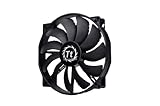
- Top Pick: Thermaltake 200mm Pure 20 Series Black 200x30mm Thick Quiet High Airflow Case Fan with Anti-Vibration Mounting System Cooling CL-F015-PL20BL-A
- Best Value: Thermaltake CT200 ARGB PWM Fan Single Pack, PWM Controlled 500~900 rpm, 5V Motherboard Sync, 16.8 Million Color 9 Addressable LEDs, Airflow 131.6 CFM, Hydraulic Bearing, 200mm, Black, CL-F179-PL20SW-A
- Premium Choice: Noctua NF-A20 PWM chromax.Black.swap, High-Performance Quiet Fan 200mm
The best 200mm case fans move a lot of air at speeds a 120mm fan cannot match, which is why they still appear in large airflow cases. The catch is that the format is niche, mounting patterns vary, and replacement options are far thinner than they look online. Check the screw spacing first, since the format is less standard than it looks.
As an Amazon Associate we earn from qualifying purchases at no extra cost to you. Product prices and availability are accurate as of the date shown and are subject to change.


As an Amazon Associate we earn from qualifying purchases at no extra cost to you. Product prices and availability are accurate as of the date shown and are subject to change.
By Ryan Cole
How to Choose the Best 200mm Case Fans
Large fans follow different rules from the 120mm standard. Four things decide whether one actually fits and helps, and the first has nothing to do with performance figures printed on the box. Getting the best 200mm case fans right starts with the case manual.
Mounting pattern and frame depth
Most 200mm fans use a 154mm screw spacing, but some cases and older fans use different patterns, so a fan that looks identical may not line up. Check the case manual for the exact mount before you order anything. Photographs will not tell you the spacing.
Depth also varies between roughly 20mm and 30mm, and a thicker frame can foul a drive cage, a radiator bracket or the front panel wiring. Measure the space behind the mount rather than assuming the case allows a standard frame. Front panel wiring often eats the gap.
Airflow at low speed
The point of this format is volume without noise. A 200mm fan spinning near 800 RPM can push airflow comparable to a 120mm fan running at twice the speed, which is why large intakes tend to sound calmer under load. Blade area does the work here.
Static pressure is the trade-off, and figures near 1 mmH2O are typical rather than the 2 mmH2O you see on 120mm pressure fans. That is fine behind an open mesh panel but weak against a dense filter or a radiator. Match the fan to the position it sits in.
Connector type and speed control
Many 200mm fans still ship with 3-pin connectors, which means the motherboard controls them by voltage rather than by a PWM signal. That works, but the usable speed range is narrower and some boards will not slow them far. Check the minimum speed as well as the maximum.
If you want a proper fan curve, look for a 4-pin PWM model and check the minimum speed in the specification. Lighting adds a second cable, usually a 5V 3-pin ARGB header, which needs a spare connector on the board. Count your spare headers before ordering.
Availability and replacement
This is a low-volume format, so models disappear and return under new part numbers with little warning. If your case shipped with a 200mm fan that has failed, an exact replacement is often no longer sold anywhere. Part numbers change without any announcement.
Before committing to a case that depends on them, check what is currently listed in the size. Some builders fit an adapter bracket to run two 120mm fans instead, which is less tidy but far easier to source later. An adapter bracket is a reasonable fallback.
Top Picks: Best 200mm Case Fans in 2026
These five cover quiet operation, lighting and budget replacement. Check your case mounting pattern against each listing first, because fit rules out more of these options than performance ever does. Any of these can be the best 200mm case fans for a given chassis.
| Fan | Speed | Connector | Best for |
|---|---|---|---|
| Noctua NF-A20 PWM | Up to 800 RPM | 4-pin PWM | Quiet, controllable airflow |
| Cooler Master MegaFlow 200 | Around 700 RPM | 3-pin | Budget replacement |
| Phanteks PH-F200SP | Around 600-900 RPM | 3-pin | Large front intakes |
| Thermaltake Pure 20 ARGB | Around 800 RPM | PWM plus ARGB | Lighting builds |
| Antec Big Boy 200 | Around 600-800 RPM | 3-pin | High-volume intake |
Noctua NF-A20 PWM
Noctua quotes roughly 110 CFM at 800 RPM with a rated noise figure near 18 dBA, and the 4-pin PWM connector means you can actually curve it down at idle. It is the only fan here that behaves like a modern 120mm unit. It is the only genuinely modern option in the size.
It is expensive for a case fan, costing several times what the budget options do, and the beige and brown colour scheme remains divisive. The 30mm frame depth also needs checking against tight front panels. Check the depth against your front panel.
Cooler Master MegaFlow 200
The MegaFlow has been the default cheap 200mm fan for years, running near 700 RPM on a 3-pin connector with a rated noise figure around 19 dBA. It is the sensible choice when a case fan has simply died. It is the safe replacement when one fails.
Voltage control limits how far you can slow it, and the sleeve bearing is less durable than the fluid dynamic types used on premium fans. Static pressure is low, so keep it away from filters and radiators. Keep it in an open intake position.
Phanteks PH-F200SP
Phanteks designed this one for large front intakes, and it ships as the stock fan in several of the company’s own cases. Airflow is solid at low speed, and the frame uses a common mounting pattern that suits most chassis. It suits large front intakes best.
It is a 3-pin fan, so speed control comes from the motherboard voltage rather than a PWM signal. Availability outside Phanteks cases has been inconsistent, so check current stock before planning a build around it. Stock outside Phanteks cases comes and goes.
Thermaltake Pure 20 ARGB
If the fan is visible behind a glass panel, this is the practical lighting option in the size. It combines a PWM connector for speed with a separate 5V 3-pin ARGB cable for motherboard-controlled lighting effects. Plan a spare header for the lighting cable.
Two cables per fan adds clutter behind the tray, and the lighting is the main reason to pay the premium rather than the airflow. Build quality is a step below Noctua, and the bearing is rated for a shorter service life. Buy it for looks rather than for airflow.
Antec Big Boy 200
The Big Boy is an old design that survives because it moves a lot of air for very little money. It runs at low speed on a 3-pin connector and suits an open front intake where pressure is not the priority. It moves serious volume for the money.
It is louder than its rating suggests once mounted against a panel, and the bearing can develop a hum after a couple of years. Treat it as a functional replacement rather than a quiet upgrade for a showcase build. Expect a hum rather than silence.
What the 2026 Market Means for Case Fans
Fans are one of the few components still priced sensibly this year, but the large formats are the most exposed to supply gaps. Two factors are worth knowing before you order. Both matter when you are hunting the best 200mm case fans as spares.
Large formats are the first to disappear
Cooler and fan pricing has moved up roughly 6% to 8% since promotional pricing policies ended at the start of February 2026, and manufacturers have concentrated on the higher-volume mid-range. Niche sizes get cut first. Niche sizes are always the first casualty.
The practical response is to buy a spare when you find the model your case uses. Prices quoted here reflect August 2026 and should be checked against the live listing, since stock in this size moves unpredictably. Buy a spare while the model still exists.
Late November discounts still apply here
The usual advice to wait for Black Friday does not hold for memory, storage or prebuilt systems this year, because that stock reflects high contract pricing agreed earlier in 2026. Cooling parts are a different case. That advice held in previous years but not this one.
Fans, coolers, cases and thermal compound are outside that constraint, so real reductions around 27 November remain likely. If your system runs fine today, waiting a few weeks costs nothing but the odd degree. Set a price alert and revisit it later.
Airflow is the cheap half of any upgrade
With graphics card pricing up sharply and no new CPU or GPU generation arriving before CES in January 2027, there is little point holding cash for a platform jump that remains more than a year away from retail. Maintenance is the sensible spend this year.
Be realistic about the gain, though. Better intake airflow lowers component temperatures and lets other fans run slower, but it will not add frames to a system that is not already thermally limited under load. Measure before and after to be certain.
Frequently Asked Questions
The questions readers ask most often about the best 200mm case fans, covering conversions, filters, direction and whether the size is worth chasing at all. They come up most from readers replacing a failed stock fan.
Can I fit 120mm fans instead?
Many cases include mounting holes for both, and adapter brackets exist where they do not. Two 120mm fans usually give more static pressure, at the cost of slightly more noise and a busier look behind the front panel. Two smaller fans are easier to replace later.
Do 200mm fans work behind dust filters?
They work, but their low static pressure means a dense filter costs a noticeable share of the airflow. Cleaning the filter regularly matters more with this format than it does with high-pressure 120mm fans. Clean the filter more often with this format.
Should they be intake or exhaust?
Intake is the usual position, since the size suits pulling large volumes of cool air across the whole board. Using one as a top exhaust works too, though most cases only provide the mount at the front or the side. Check which mounts your case actually provides.
Are they quieter than smaller fans?
Generally yes at the same airflow, because the blades move more air per rotation and turn slower. The pitch of the noise is lower too, which most people find less intrusive than the whine of a fast 120mm fan. Lower pitch is the real advantage here.
See More:
- best CPU cooler for Ryzen 5 5600X
- best small form factor CPU cooler
- best SFF CPU cooler
- best CPU cooler for i9-14900K
- What is the best AIO CPU cooler
Final Thoughts
The best 200mm case fans are worth fitting when your case is designed around them and the mounting pattern matches. Confirm the screw spacing and frame depth first, then choose a PWM model if you want real control over noise. Buy a spare at the same time.



Write Your Review
No reviews yet. Be the first to share your experience!