
Best CPU coolers for gaming split into two camps in 2026: tall dual-tower air designs and 240-360mm AIOs, and the gap between them is narrower than the marketing suggests. This guide sorts six coolers by package power, case clearance and noise, so you can match hardware instead of guessing at spec-sheet numbers.
As an Amazon Associate we earn from qualifying purchases at no extra cost to you. Product prices and availability are accurate as of the date shown and are subject to change.



As an Amazon Associate we earn from qualifying purchases at no extra cost to you. Product prices and availability are accurate as of the date shown and are subject to change.
By Ryan Cole
How to Choose the Best CPU Coolers for Gaming
Gaming load is bursty rather than flat, so a cooler that survives a synthetic stress test can still let clocks sag during a long session. Four criteria separate the best CPU coolers for gaming from the ones that merely look impressive.
Start With Your CPU’s Real Package Power
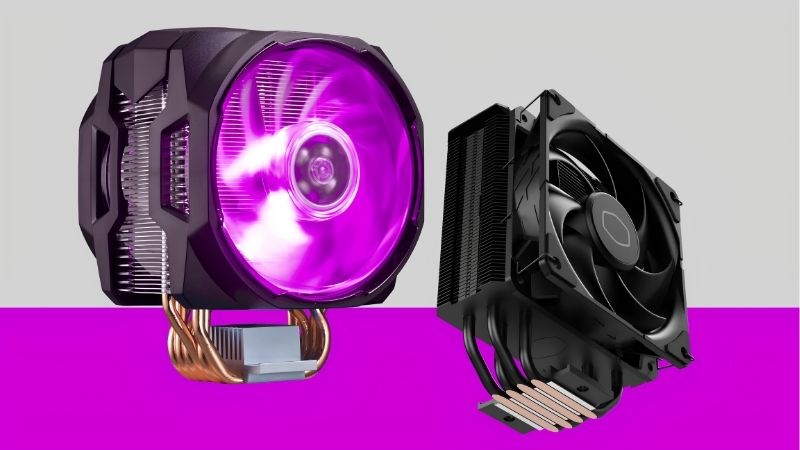
A Ryzen 7 9800X3D draws far less package power than a Core Ultra 9 285K, yet it concentrates that heat under a small die area. Wattage ratings only tell half the story, so weigh both total draw and hotspot behaviour.
Mid-range chips like the Ryzen 5 9600X or Core i5-14600K stay comfortable on a good 120mm dual tower. Flagship K-series and X-series parts under sustained all-core load are where 280mm and 360mm radiators start earning their price.
Check the manufacturer’s TDP rating as a rough sorting tool, not a guarantee. Every vendor measures it differently, so treat a 250W claim as a class indicator rather than a number you can compare across brands.
Measure Height and RAM Clearance First
Most mid-towers accept 165-170mm of cooler height, but compact mesh-front designs often stop near 155mm. Measure from the motherboard tray to the side panel, then subtract a few millimetres for cable bulk behind the board.
Tall RAM heat spreaders cause the other common collision. Coolers with offset or raised front fans clear most kits, while symmetrical dual towers may force you to lift the front fan and give up a little airflow.
For AIOs, add radiator thickness to fan thickness and compare that against the clearance figure in your case manual. A 38mm radiator with 25mm fans needs 63mm, which several popular mid-towers cannot take in the roof.
Judge Noise at Gaming Load, Not Peak RPM
Published dBA figures come from fans at maximum speed, which almost never happens while gaming. What matters is the RPM a cooler settles at after twenty minutes, and how smoothly the fan curve ramps between states.
More surface area lets a cooler hit the same temperature at lower fan speed. That is the practical reason a 140mm tower or a 360mm radiator often sounds calmer than a smaller unit chasing the same thermal target.
Check Mounting Hardware and Socket Support
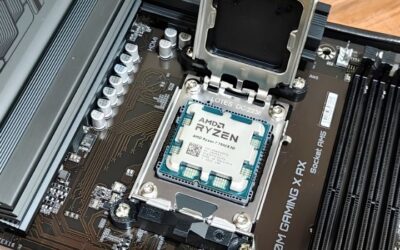
AM5 and LGA1851 brackets ship with most current stock, but older inventory sometimes lacks them. Verify what is in the box rather than trusting the headline compatibility list, and note whether a contact frame is included.
Mounting pressure matters as much as the fin stack. A backplate with even, screw-limited tension gives repeatable results, while push-pin systems are the usual cause of one stubbornly hot core in an otherwise healthy build.
Top Picks: Best CPU Coolers for Gaming
The best CPU coolers for gaming below cover the realistic range, from a sub-$40 tower to a thick 360mm radiator. Specifications below come from manufacturer documentation; pricing moves week to week, so treat tiers as guidance rather than fixed figures.
| Cooler | Type | Height / Radiator | Fans | Best For |
|---|---|---|---|---|
| Thermalright Peerless Assassin 120 SE | Dual-tower air | 155mm | 2 x 120mm | Budget builds |
| Deepcool AK620 Digital | Dual-tower air | 162mm | 2 x 120mm | Tuning and telemetry |
| Noctua NH-D15 G2 | Dual-tower air | 168mm | 2 x 140mm | Premium silent air |
| be quiet! Dark Rock Pro 5 | Dual-tower air | 162.8mm | 135mm + 120mm | Quiet dark-themed builds |
| Arctic Liquid Freezer III 360 | AIO | 360mm / 38mm thick | 3 x 120mm | High-draw Intel chips |
| Corsair Nautilus 360 RS | AIO | 360mm / 27mm thick | 3 x 120mm | Simple liquid cooling |
Thermalright Peerless Assassin 120 SE
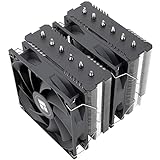
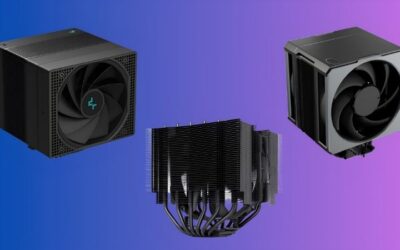
The Peerless Assassin 120 SE is still the default budget answer: six 6mm heatpipes, a 155mm dual-tower stack and two TL-C12C fans rated near 1,550 RPM. It handles a 65-105W gaming CPU without complaint.
The trade-off is hardware polish. The mounting kit is fiddlier than premium brands, the fan clips take patience, and the plain silver finish looks dated beside newer designs. At this price, most builders forgive all three.
Deepcool AK620 Digital
AK620 Digital adds a package-power and temperature readout on the cap, which is genuinely useful when tuning PBO or a Curve Optimizer profile. Deepcool rates the dual tower at 260W across a 162mm stack.
That height rules out several compact cases, and the display needs a USB header you may already have committed. Raw cooling tracks the cheaper non-digital AK620 closely, so buy this version for the telemetry.
Noctua NH-D15 G2
The NH-D15 G2 is the reference point for premium air: eight heatpipes, a 168mm stack and two NF-A14x25 G2 fans, with LBC and HBC variants offset for different socket hotspots. Noctua covers it for six years.
It costs several times what a budget tower does and stands tall enough to shade the first DIMM slot on some layouts. Pick the variant matched to your socket, or you give away part of what you paid for.
be quiet! Dark Rock Pro 5
Dark Rock Pro 5 suits people who want quiet without liquid: seven heatpipes, a 270W rating and Silent Wings fans, with a removable front fan for RAM clearance. The black-coated fin stack fits dark builds cleanly.
At 162.8mm it is another tall unit, and the assembly is heavy enough that you want the board mounted and fully seated first. It costs more than the Deepcool while cooling in roughly the same class.
Arctic Liquid Freezer III 360
For high-draw Intel parts, Liquid Freezer III 360 brings a 38mm-thick radiator, P12 Pro fans and a small VRM fan on the pump block. It offers the most cooling capacity per dollar in the current AIO market.
That thick radiator does not fit every roof mount, and the VRM fan adds a faint whir at idle in a quiet room. Arctic’s six-year warranty offsets the usual worry about pump lifespan over a long build cycle.
Corsair Nautilus 360 RS
Nautilus 360 RS covers the mainstream 360mm slot with RS120 fans and a simpler block than display-equipped models. It makes sense if you want liquid cooling without committing to a software ecosystem.
There is no screen and no VRM fan, and the tubing is stiff for tight front mounts. Against Arctic’s thicker radiator it trades a little thermal headroom for easier fitment in cases with limited roof clearance.
What 2026 Pricing Means for Cooling Upgrades
Component pricing has moved unevenly this year, and cooling is one of the few categories where a buyer still has leverage. Three points are worth knowing before you check out.
Cooler Prices Crept Up, but Real Deals Remain
Coolers and power supplies rose roughly 6-8% through 2026 as vendors shifted attention toward mid and high-end SKUs, and promotional pricing policies tightened from February. The entry-level shelf is thinner than it was.
Late November is still a mixed picture. Memory, SSDs and prebuilt systems are built from expensive 2026 contract DRAM, but coolers, fans, cases and paste are discounted normally, so timing a cooler purchase around that window remains sensible.
There Is No New Silicon to Wait For
RTX 50 Super, Zen 6 and Intel Nova Lake all slipped to CES in January 2027. If your machine is loud or thermally limited today, waiting buys you nothing except several more months of trimmed boost clocks.
This is where the best CPU coolers for gaming quietly earn their place. A better tower or radiator recovers clock headroom the chip was already giving up, for a fraction of what a GPU upgrade now costs.
When You Should Hold Off
If you are moving to AM5, buy now with confidence: AMD has committed to new CPUs on that socket through 2029, so today’s bracket stays current. Intel’s next platform moves to a different socket entirely.
Hold off only if your case cannot physically take the cooler you want, or if a sale is days away. Cooler supply is stable, so ignore any scarcity messaging attached to this category.
Frequently Asked Questions
A few questions come up in almost every thread about the best CPU coolers for gaming, and some answers have changed since the previous socket generation.
Is air cooling still enough for a modern gaming CPU?
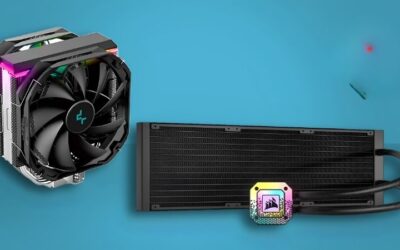
For most gaming chips, yes. A quality dual-tower handles the 65-142W range comfortably, and gaming rarely produces the sustained all-core load that pushes a CPU past what good air can absorb. Liquid mainly helps flagship parts and heavy render work.
Does a Ryzen 7 9800X3D need a 360mm AIO?
No. X3D parts have a lower power ceiling than flagship Intel chips, so a strong 120mm dual tower keeps them in range. A larger radiator lowers fan speed and noise, but it is a comfort upgrade rather than a requirement.
How often should thermal paste be replaced?
Every three to five years is a reasonable interval for most compounds, or whenever you remove the cooler. Replace it sooner if idle temperatures creep several degrees above where the build started under identical conditions.
Are more heatpipes always better?
Not on their own. Heatpipe count matters less than base contact quality, fin surface area and fan static pressure. A six-pipe tower with a flat, well-lapped base often outperforms an eight-pipe design with uneven contact.
See More:
Final Thoughts
The best CPU coolers for gaming are the ones that fit your case, clear your memory and settle at a fan speed you can ignore. Start with your CPU’s real power draw, confirm clearance with a tape measure, then pick the largest cooler that fits your budget and your noise tolerance. Any of these six will outlast the platform they are mounted on.

Write Your Review
No reviews yet. Be the first to share your experience!