
- Top Pick: GIGABYTE B850M Eagle WIFI6E AMD AM5 mATX Motherboard, Support AMD Ryzen 9000/8000/7000 Series, DDR5, 8+2+2 Power Phase, 2X M.2, PCIe 5.0, USB-C, WIFI6E, 2.5GbE LAN, EZ-Latch, 3-Year Warranty
- Best Value: GIGABYTE B850M AORUS Elite WIFI6E ICE AMD AM5 mATX Motherboard, Support AMD Ryzen 9000/8000/7000 Series, DDR5, 12+2+2 Power Phase, 2X M.2, PCIe 5.0, USB-C, WIFI6E, 2.5GbE, EZ-Latch, 5-Year Warranty
- Premium Choice: ASUS ROG Strix B850-G Gaming WiFi AMD AM5 B850 mATX Motherboard, Advanced AI PC Ready, 14+2+1 Power Stages, DDR5 Slots, 4X M.2 Slots, PCIe® 5.0 Ready, WiFi 7, 2.5G LAN, USB 20Gbps Type-C®, AI Advisor
The best micro ATX motherboard AM5 lets you build a compact Ryzen system without giving up PCIe 5.0 storage, dual-channel DDR5 headroom, or a VRM that can handle a Ryzen 7 or 9 chip. Micro-ATX AM5 boards have matured fast since 2023, and several now match their full-ATX siblings feature-for-feature.
As an Amazon Associate we earn from qualifying purchases at no extra cost to you. Product prices and availability are accurate as of the date shown and are subject to change.


As an Amazon Associate we earn from qualifying purchases at no extra cost to you. Product prices and availability are accurate as of the date shown and are subject to change.
By Ryan Cole
How to Choose the Right Micro ATX Motherboard AM5
Micro-ATX AM5 boards trade PCIe expansion slots and DIMM count for a smaller footprint, but the good ones don’t cut corners on the parts that actually affect performance. Here’s what to check before buying.
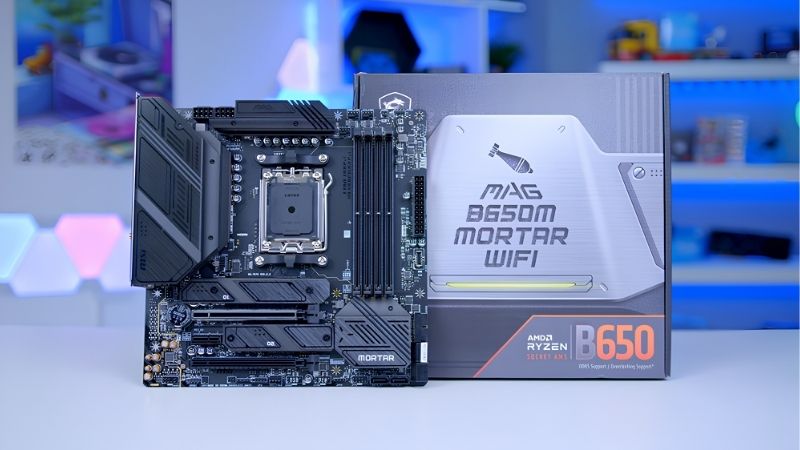
VRM quality still matters at small sizes
Don’t assume every mATX board is VRM-limited. The Gigabyte B650M Aorus Pro AX runs 12 70A power stages, enough to handle a Ryzen 9 without throttling, while budget mATX boards often drop to 8-12 phases in the 55-60A range that’s better suited to Ryzen 5 chips.
Check the phase count and amperage rating specifically, not just “VRM” in the marketing copy, since the gap between a budget and premium mATX board’s power delivery can be substantial.
This is the single biggest differentiator between entries on any best micro ATX motherboard AM5 shortlist, more so than aesthetics or bundled software, so don’t skip past it while comparing spec sheets.
M.2 slot count and PCIe generation
Most mATX AM5 boards fit two to three M.2 slots versus three to five on full ATX. Confirm whether the primary slot runs PCIe 5.0 or is capped at Gen4, since that’s the single biggest storage-speed differentiator between otherwise similar boards in this class.
Also check whether the secondary M.2 slot shares bandwidth with a SATA port or PCIe slot, a common mATX space-saving tradeoff that can silently disable ports depending on your configuration.
Read the board manual’s block diagram before assuming you can run a full-speed primary M.2 drive alongside every SATA port and the secondary PCIe slot simultaneously; on compact boards, that combination is often not possible.
Case and cooler clearance
Micro-ATX boards fit both mATX and full-ATX cases, but if you’re specifically building small-form-factor, check the board’s DIMM slot placement and VRM heatsink height against your cooler. Tall air coolers can occasionally clear DIMM slots by only a few millimeters on tightly packed mATX designs.
Rear I/O placement also varies more on mATX boards than ATX, so double-check port layout against your case’s I/O shield cutout before ordering, especially with older SFF cases.
Case fit is one of the few areas where the best micro ATX motherboard AM5 for your specific build might not be the highest-spec option on paper, since a board that’s technically superior but physically doesn’t clear your cooler or radiator mount isn’t actually the right pick.
Top Picks: Best Micro ATX Motherboard AM5
These five boards represent the strongest micro-ATX options across budget, mid-range, and VRM-focused categories, all built on the AM5 socket for Ryzen 7000/9000 compatibility.
| Motherboard | Chipset | VRM | M.2 Slots | Networking |
|---|---|---|---|---|
| Gigabyte B650M Aorus Pro AX | B650 | 12x70A | PCIe 5.0 M.2 | WiFi 6E |
| ASRock B650M Pro RS WiFi | B650 | 8+2+1 Dr.MOS | 3 (1x Gen5) | WiFi 6E, 2.5GbE |
| ASUS TUF Gaming B650M-Plus WiFi | B650 | 12+2 (60A) | 2 (1x Gen5) | 2.5GbE, USB4 header |
| Gigabyte B650M Aorus Elite AX | B650 | 12x60A | 2 slots | WiFi 6E, 2.5GbE |
| MSI PRO B650M-A WiFi | B650 | Mid-range | 2+ slots | WiFi 6E |
Gigabyte B650M Aorus Pro AX
This is the best micro ATX motherboard AM5 for builders who want ATX-class power delivery in a smaller footprint. Its 12x70A power stages handle even a Ryzen 9 without VRM throttling, and it’s one of the few mATX boards with a genuine PCIe 5.0 M.2 slot plus eleven USB 3.2 ports.
At around $210, it costs more than most mATX competitors, and its RGB and aesthetic options are more understated than Gigabyte’s ATX AORUS lineup. For raw capability per square inch, though, it’s the standout.
ASRock B650M Pro RS WiFi
The Pro RS WiFi balances price and features well: an 8+2+1 Dr.MOS VRM sized for Ryzen 5/7 chips, a PCIe 5.0 “Blazing M.2” primary slot plus two more Gen4 slots, 2.5G LAN, and WiFi 6E, all around the $150-180 mark depending on region. It’s frequently recommended as the best micro ATX motherboard AM5 pick for builders who want Gen5 storage without paying Aorus Pro AX pricing.
Some buyers report the bundled WiFi/Bluetooth drivers need a manual install rather than working out of the box, and the two rear expansion slots limit multi-card setups. Neither is a dealbreaker for a typical single-GPU compact build.
ASUS TUF Gaming B650M-Plus WiFi
ASUS brought its 12(60A)+2(60A)+2 power stage TUF VRM design down to mATX here, along with a PCIe 5.0 M.2 slot, 6-layer PCB, and enlarged heatsinks that Tom’s Hardware testing found kept a 7950X from throttling at stock settings.
It only carries two total M.2 slots rather than three, which is the main tradeoff of the mATX form factor here, and its Realtek ALC897 audio codec is dated compared to newer boards. For a solid mid-tier VRM in a compact size, it’s a strong pick regardless.
Gigabyte B650M Aorus Elite AX
This is the budget-value option in Gigabyte’s mATX lineup: a dozen 60A power stages for the VRM, WiFi 6E, 2.5GbE, and DDR5 support up to roughly 7000 MT/s (OC), all at one of the lowest price points in the AM5 mATX category.
Reviewers note it trims to just two PCIe expansion slots and occasional early-BIOS boot-time quirks that a firmware update typically resolves. If your build is CPU- and GPU-focused rather than expansion-heavy, it’s an easy way to save money.
MSI PRO B650M-A WiFi
TechSpot’s B650 roundup singled this board out as the better buy over cheaper mATX alternatives, citing an extra PCIe expansion slot, more USB 3.2 ports, and WiFi 6E for only a modest price bump over base-tier competitors. It’s a sensible pick when the absolute cheapest board on the shelf feels a little too bare-bones.
It sits in the mid-range VRM tier rather than the premium end, so it’s best suited to Ryzen 5/7 builds rather than a flagship Ryzen 9 9950X pairing. For most mATX gaming builds, that’s exactly the right tier, and the PRO series naming reflects MSI positioning it as a practical workhorse rather than a showpiece.
Market Context: Buying an AM5 mATX Board in 2026
A few real market factors shape whether now is a smart time to invest in the best micro ATX motherboard AM5, so here’s a level-headed read rather than a countdown-timer sales pitch. Compact builders in particular benefit from thinking about platform longevity, since a small case is usually a long-term commitment.
AM5 longevity makes compact builds a long-term bet
AMD confirmed at Computex 2026 that AM5 keeps taking new CPUs through at least the end of 2029. That matters more for small-form-factor builders than most, because reusing a compact case and its mATX board across two or three CPU upgrades is far easier than swapping the whole platform inside a cramped chassis.
So the board you buy today for a Ryzen 5 or 7 chip realistically hosts a much stronger CPU later without a rebuild. That upgrade runway is a genuine reason to buy a good mATX board now rather than treating it as disposable.
Entry-level boards are thinning out
Board makers have reported entry-level motherboard sales dropping notably, and the lineup is shifting toward mid-range and premium models. In practice, the rock-bottom mATX boards are losing features and some promotional pricing has quietly disappeared, which pushes the real value up to well-rounded mid-tier options like the ones on this list.
For a compact build, that’s not bad news; it just means the sweet-spot board is a feature-complete mid-range model rather than the cheapest thing available. Spending in that tier now buys durability and connectivity you’d otherwise miss.
No imminent launch to wait for
If you’re tempted to hold off, the next AMD desktop CPU generation isn’t expected until CES in early 2027 at the soonest, and mATX board refreshes tend to follow chip launches rather than lead them. There’s no near-term product that makes a current mATX purchase feel premature, so a build today stays relevant well into next year.
Frequently Asked Questions
Here’s what builders most often ask when narrowing down the best micro ATX motherboard AM5 for a small-form-factor Ryzen build.
Is micro-ATX AM5 as capable as full ATX?
For single-GPU builds, largely yes. Boards like the Gigabyte B650M Aorus Pro AX match or beat many ATX boards on VRM quality and PCIe 5.0 storage. The main tradeoff is fewer expansion slots and DIMM slots, not raw CPU power delivery.
Can a micro ATX AM5 board run a Ryzen 9 9950X?
Some can. The Gigabyte B650M Aorus Pro AX’s 12x70A VRM is rated for high-core-count Ryzen chips, but budget mATX boards with 8-12 phase, 55-60A VRMs are better matched to Ryzen 5/7-class CPUs instead.
Do micro ATX boards fit in a full ATX case?
Yes, every micro-ATX board’s mounting holes are a subset of the ATX standoff pattern, so they install in any ATX or micro-ATX case. The reverse isn’t true; a full-ATX board won’t fit in a micro-ATX-only case.
Do I lose PCIe 5.0 storage by going micro-ATX?
Not necessarily. Several boards on this list, including the ASRock B650M Pro RS WiFi and ASUS TUF Gaming B650M-Plus WiFi, include a Gen5-rated primary M.2 slot despite the smaller form factor.
See More:
- Best MSI motherboard
- Best motherboard processor combo for gaming
- Best B550 motherboard
- Best CPU for streaming
- What is the best AM4 CPU for gaming
Final Thoughts
The best micro ATX motherboard AM5 depends mostly on how much VRM headroom your CPU choice needs. The Gigabyte B650M Aorus Pro AX leads on raw capability, the ASRock B650M Pro RS WiFi is the best value, and the ASUS TUF Gaming B650M-Plus WiFi offers the most polished VRM cooling design in this compact category.


Write Your Review
No reviews yet. Be the first to share your experience!