
- Top Pick: ARCTIC MX-4 (4 g) – Premium Performance Thermal Paste for All Processors
- Best Value: ARCTIC MX-6 (4 g, incl. 6 MX Cleaner) – Ultimate Performance Thermal Paste for CPU, Consoles, Graphics Cards, laptops, Very high Thermal Conductivity, Long Durability, Non-Conductive
- Premium Choice: ARCTIC MX-4 (incl. Spatula, 4 g) – Premium Performance Thermal Paste
Best thermal paste for laptop repasting is a different question from desktop paste, because laptops cycle between cold and very hot dozens of times a day and most compounds are slowly destroyed by exactly that. This guide covers pump-out, bare die safety and which materials actually survive a laptop cooling system.
As an Amazon Associate we earn from qualifying purchases at no extra cost to you. Product prices and availability are accurate as of the date shown and are subject to change.


As an Amazon Associate we earn from qualifying purchases at no extra cost to you. Product prices and availability are accurate as of the date shown and are subject to change.
By Ryan Cole
How to Choose the Best Thermal Paste for Laptop Cooling
The best thermal paste for laptop use is rarely the one with the highest conductivity rating. Four factors decide whether a repaste holds up for years or degrades back to where it started within months.
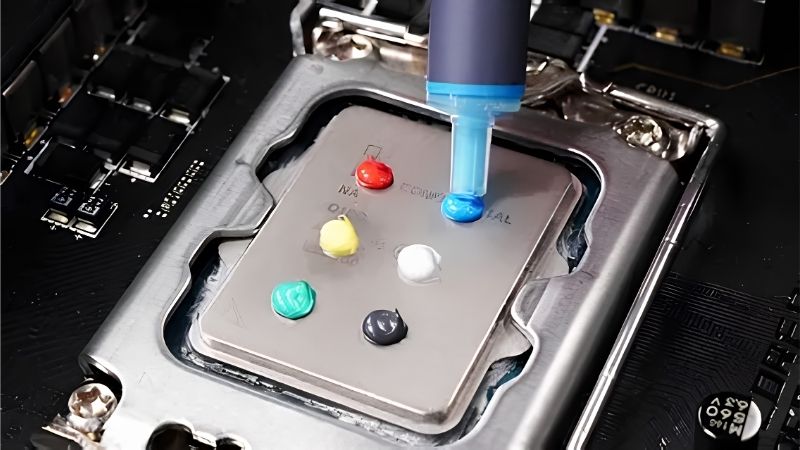
Pump-Out Is the Real Enemy
Pump-out happens when repeated heating and cooling gradually squeezes compound out from between the chip and the heatsink. Laptops are the worst case for it, cycling from idle to full load and back many times in a single session.
Thin heatsink assemblies with light, uneven mounting pressure make it worse. This is why a laptop repasted with a high-performing conventional compound can look excellent for two months and then quietly return to throttling.
Materials that resist or eliminate pump-out therefore matter more here than peak conductivity numbers. A compound rated at 8.5 W/mK that stays put beats a 14 W/mK paste that migrates within a year.
Bare Die Means Less Room for Error
Most laptop processors and graphics chips expose bare silicon with no heatspreader. The die is small, sharp-edged and surrounded by tiny surface-mount components, so excess compound has nowhere useful to go.
That rules out anything electrically conductive unless you are prepared to mask carefully. Liquid metal is used in some high-end laptops from the factory, but applying it yourself on a bare die next to exposed components is a genuine risk.
Viscosity and How Little You Actually Need
A laptop die is a fraction of the size of a desktop heatspreader, so the amount of compound needed is tiny. Over-application is the most common mistake and causes squeeze-out onto the board rather than better cooling.
Thinner compounds spread more evenly under low mounting pressure, which suits laptop heatsink screws. Very thick pastes designed for desktop use can leave gaps when the assembly cannot generate enough clamping force.
Tighten the heatsink screws gradually in the numbered order printed on the bracket rather than fully seating one at a time. Uneven pressure tilts the block off the die and costs more degrees than any difference between compounds.
Do Not Forget the Thermal Pads
Repasting the processor while leaving hardened, cracked pads on the memory and power stages solves half the problem. Those pads carry heat from components that will throttle the whole system if they overheat.
Pad thickness must match the original, since too thin leaves an air gap and too thick lifts the heatsink off the die entirely. Measure before ordering and buy a multi-thickness set if you are unsure.
Memory modules, voltage regulation stages and the graphics chip memory all rely on pads rather than paste. On a gaming laptop these are frequently the components that trigger throttling first, long before the processor itself reaches its limit.
Top Picks: Best Thermal Paste for Laptop Repasting
These six cover the realistic options, from a phase-change material that solves pump-out permanently to conventional compounds that are easier to apply. Ratings are manufacturer figures as of August 2026.
| Product | Type | Rated Conductivity | Electrically Conductive |
|---|---|---|---|
| Honeywell PTM7950 | Phase change sheet | 8.5 W/mK | No |
| Thermal Grizzly KryoSheet | Graphene pad | Not published | Yes |
| Arctic MX-6 | Paste | 8.5 W/mK | No |
| Noctua NT-H2 | Paste | Not published | No |
| Thermal Grizzly Kryonaut | Paste | 12.5 W/mK | No |
| Thermalright TF8 | Paste | 13.8 W/mK | No |
Honeywell PTM7950 – The Definitive Laptop Answer
For most machines this is the best thermal paste for laptop use, and it is not really a paste at all. PTM7950 is a phase-change sheet that softens at operating temperature and reflows into the gap rather than being pushed out. That eliminates pump-out entirely, which is exactly the failure mode laptops are designed to cause.
It needs several heat cycles before reaching full performance, so the first boot after applying it will look disappointing. It is sold in sheets that must be cut to size, and counterfeit listings are common, so buy from a reputable seller.
Thermal Grizzly KryoSheet – Reusable and Permanent
This graphene pad cannot dry out or pump out, and it survives repeated disassembly, making it excellent for a machine you open regularly for cleaning. There is no curing period and no mess.
It is electrically conductive, so any overhang past the die edge onto nearby components is a genuine hazard. It also relies on firm even pressure to perform, which some thin laptop heatsink designs struggle to provide.
Arctic MX-6 – Best Conventional Value
MX-6 is non-conductive, spreads readily under light pressure and costs very little per gram. For a straightforward repaste on a machine you will service again in a year or two, it does the job without complication.
Being a conventional compound, it is subject to pump-out on a hot laptop and will need reapplying sooner than the phase-change options. It is also noticeably thick when cold, so warm the tube in your hand first.
Noctua NT-H2 – Easiest to Apply Correctly
NT-H2 has forgiving viscosity that spreads evenly under the low clamping pressure a laptop heatsink provides, and the retail box includes cleaning wipes. For a first repaste, that removes two ways to get it wrong.
You pay a premium per gram and Noctua does not publish a conductivity figure, which frustrates direct comparison. It is also a conventional compound, so it shares the same pump-out limitation as everything else in that category.
Thermal Grizzly Kryonaut – Best Day-One Numbers
Kryonaut delivers excellent temperatures immediately and is non-conductive, so a small amount of squeeze-out is not fatal. On a gaming laptop where you want the lowest possible readings right now, it performs.
Its known weakness is drying out on hot chips, and laptops are the hottest environment it will encounter. Expect to redo the job within twelve to eighteen months on a machine that regularly hits ninety degrees.
Thermalright TF8 – High Rating at Low Cost
Rated at 13.8 W/mK, TF8 offers strong conductivity at a modest price and is non-conductive. It spreads reasonably well and is a sensible pick when you are repasting several machines and do not want to spend heavily.
Manufacturer ratings in this price bracket should be treated with some caution, and independent testing usually places it slightly behind the headline figure. Long-term stability on a hot laptop is also unproven relative to the established names.
Why a Laptop Repaste Is Worth Doing in 2026
The wider hardware market has made maintaining an existing machine far more attractive than replacing it, which is why finding the best thermal paste for laptop use is worth the effort right now.
Cheap Upgrades Still Deliver Real Results
With graphics hardware pricing up sharply and no new architectures arriving before CES in January 2027, holding a laptop for another year is the sensible plan for most people. A repaste is among the few changes that produces a measurable improvement.
A machine that was throttling within ten minutes of a gaming session can often sustain full clocks afterwards. That shows up as steadier frame rates and a quieter fan curve, not just a lower number in a monitoring tool.
Cooling Supplies Are Still Priced Normally
While memory and storage climbed steeply through 2026, thermal compounds, pads and cooling accessories have stayed close to normal pricing with genuine seasonal discounts. Increases in this category have been in the single digits.
That makes it one of the few areas where the November sales are worth waiting for if you are not in a hurry. Buying a larger tube or a multi-thickness pad set at a discount is straightforwardly good value.
Know When Not to Open the Machine
If the laptop is under warranty, check the terms before removing the base. Some manufacturers treat internal service as voiding coverage, and a repaste is rarely worth losing a warranty claim over a fault that may develop later.
If temperatures only became a problem recently, try clearing dust from the fan intakes and exhaust fins first. A blocked heatsink causes worse throttling than degraded compound and takes minutes rather than an afternoon to fix.
Frequently Asked Questions
The best thermal paste for laptop question is usually followed by these, from people opening a machine for the first time and unsure how far to go.
Is the best thermal paste for laptop use different from desktop paste?
Often yes. Laptops cycle temperature far more aggressively, which drives pump-out, and they clamp with less pressure onto a small bare die. Phase-change materials and graphene pads solve those specific problems in ways conventional compounds cannot.
How often should a laptop be repasted?
With a conventional compound, every eighteen months to two years on a machine that runs hot. With a phase-change material such as PTM7950, you can realistically leave it for the remaining life of the laptop.
How much paste should I use on a bare die?
Considerably less than on a desktop processor. A small dot roughly the size of a grain of rice, spread thinly to cover the die and no further, is enough. Excess squeezes onto the surrounding board rather than improving contact.
Should I use liquid metal on my laptop?
Only if you are experienced and prepared to mask the area thoroughly. Some manufacturers use it from the factory with proper containment, but a bare die surrounded by exposed components leaves very little margin for a spill.
See More:
- Best 4TB NVMe SSD
- Best thermal grizzly paste
- Best thermal paste for 7800X3D
- Best CPU case fans
- Best motherboard for gaming computer
Final Thoughts
The best thermal paste for laptop repasting is the one that survives thermal cycling rather than the one with the highest number on the packet. PTM7950 is the strongest choice for a machine you want to fix once, KryoSheet suits laptops you open often, and MX-6 or NT-H2 cover straightforward jobs at lower cost. With hardware prices elevated and nothing new until 2027, a careful repaste plus fresh pads is the cheapest real performance gain available.





Write Your Review
No reviews yet. Be the first to share your experience!