
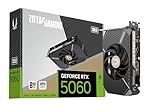
- Top Pick: ZOTAC Gaming GeForce RTX 5060 Solo DLSS 4 8GB GDDR7 128-bit 28 Gbps PCIE 5.0 Gaming Graphics Card, SFF-Ready Ultra Compact Card, ZT-B50600G-10A
- Best Value: ASUS Phoenix NVIDIA GeForce RTX 3050 Gaming Graphics Card – PCIe 4.0, 8GB GDDR6 Memory, HDMI 2.1, DisplayPort 1.4a, Axial-tech Fan, Protective Backplate, Dual Ball Fan Bearings, Auto-Extreme (Renewed)
- Premium Choice: ASRock Intel Arc A380 Challenger ITX 6GB OC, 2250MHz GPU, 6GB GDDR6 96-bit, PCIe 4.0, Single Fan, 0dB Silent, DP 2.0, HDMI 2.0b
Best single fan GPU shopping is a compromise negotiation: you are trading cooling surface area for physical length, and the question is how much performance survives that trade. These six cards cover slim office machines through compact gaming builds, with the thermal realities stated plainly.
As an Amazon Associate we earn from qualifying purchases at no extra cost to you. Product prices and availability are accurate as of the date shown and are subject to change.


As an Amazon Associate we earn from qualifying purchases at no extra cost to you. Product prices and availability are accurate as of the date shown and are subject to change.
By Ryan Cole, PC hardware writer at NVIDIA Review.
How to Choose the Best Single Fan GPU
Single-fan cards exist because a case demands them, not because the design is superior. Four factors determine whether the best single fan GPU for your build performs well or simply runs hot and loud.
Measure Length, Height and Slot Depth
Three dimensions matter and people usually check only one. Length determines whether the card clears the drive cage, height determines whether a low-profile bracket is needed, and slot depth determines how many expansion slots it blocks.
Low-profile is a separate category from short. A card can be 170 mm long and still full-height, which fits a compact mid-tower but not a slim office desktop, so read both figures before ordering anything.
Accept the Thermal Trade-Off Honestly
One fan across a smaller heatsink means either higher temperatures or higher fan speeds, and usually some of both. That is fine on a 75W card and increasingly demanding as board power climbs toward 115W and beyond.
Case airflow becomes the deciding factor. A single-fan card in a mesh-front case with two intakes behaves very differently from the same card in a sealed slim chassis, where it recirculates its own exhaust.
Match Board Power to the Power Supply
Cards up to 75W draw entirely from the PCIe slot, which suits prebuilt machines with no spare connector. Above that you need a 6-pin or 8-pin lead, and small-form-factor power supplies do not always provide one.
Check the power supply’s rating as well as its connectors. Many compact prebuilt machines ship with 250 to 300W units, which limits your options regardless of what the case can physically accommodate.
Expect More Noise Than a Triple-Fan Card
A single fan reaches higher RPM to move the same air, and smaller fans produce a higher-pitched sound that many people find more intrusive than the low hum of larger ones under identical loads.
Custom fan curves help considerably. Allowing the card to run a few degrees warmer in exchange for lower fan speeds usually produces a quieter machine with no meaningful performance cost in normal gaming use.
Idle behaviour differs too. Many modern cards stop their fans entirely below a temperature threshold, which makes desktop use silent, and that feature is worth checking if the machine sits close to where you work.
Top Picks: Best Single Fan GPU Options for Small Builds
The best single fan GPU for you depends on case size and power budget, so these six span low-profile office cards to compact gaming models. Specifications come from manufacturer documentation; dimensions vary between board partners, so check your exact SKU.
| Card | Memory | Board Power | Profile | Best For |
|---|---|---|---|---|
| Zotac GeForce RTX 4060 Solo | 8GB GDDR6 | 115W | Full height, dual slot | Compact 1080p gaming |
| Gigabyte RTX 4060 OC Low Profile | 8GB GDDR6 | 115W | Low profile | Slim cases |
| ASUS Phoenix GeForce RTX 3050 | 8GB GDDR6 | 130W | Full height | Budget gaming |
| ASRock Radeon RX 6600 Challenger ITX | 8GB GDDR6 | 132W | Full height | Value 1080p |
| Sapphire PULSE Radeon RX 6400 | 4GB GDDR6 | 53W | Low profile | Very low power |
| Sparkle Intel Arc A310 ELF | 4GB GDDR6 | Around 75W | Low profile | Media and AV1 |
Zotac GeForce RTX 4060 Solo
This is the most capable single-fan card most people can actually buy. The RTX 4060 delivers solid 1080p gaming with 8GB of GDDR6, DLSS support and a 115W board power that a single fan can manage in a ventilated case.
Zotac’s compact design fits cases that reject longer cards comfortably. The drawback is noise under sustained load, where the single fan spins noticeably harder than dual-fan versions of the same GPU running identical settings.
Gigabyte RTX 4060 OC Low Profile
A low-profile RTX 4060 is genuinely unusual, and this card makes real 1080p gaming possible in slim office chassis. It keeps the 8GB memory configuration and DLSS support in a half-height form factor.
For upgrading a small prebuilt it is close to unique. The compromises are predictable: it runs warmer than full-size versions, the fan is audible under load, and it still requires an 8-pin power connector that some slim machines lack.
ASUS Phoenix GeForce RTX 3050
The Phoenix line is ASUS’s compact single-fan design and pairs well with the 8GB RTX 3050. It handles 1080p gaming at medium settings and includes NVENC for streaming, in a shroud that fits most small cases.
It is a reasonable step up from slot-powered cards without needing much more space. The limitations are performance, which sits clearly below the RTX 4060, and a 130W draw that requires an external power connector.
ASRock Radeon RX 6600 Challenger ITX
For value 1080p gaming this remains a strong compact option. The RX 6600 offers 8GB of GDDR6 and performance comparable to the RTX 3050 tier, in a short ITX-length board designed for small enclosures.
AMD’s memory configuration is generous for the price bracket. The trade-offs are ray tracing performance that trails NVIDIA equivalents and a 132W board power that pushes a single fan harder than lower-power cards do.
Sapphire PULSE Radeon RX 6400
At 53W with no external power connector, this is the card for machines with the tightest constraints. Low-profile brackets are included, and it slots into slim office desktops with small power supplies without any modification.
It is a genuine upgrade over integrated graphics on older systems. Two real limitations apply though: it lacks hardware video encoding entirely, and its four-lane PCIe connection loses performance on PCIe 3.0 boards.
Sparkle Intel Arc A310 ELF
When media handling matters more than gaming, Arc A310 is the interesting choice. AV1 encoding support at around 75W is rare in this class and useful for transcoding or running a compact home media server.
Low-profile availability makes it easy to fit. The reservations are gaming performance well below the NVIDIA and AMD options here, and driver behaviour in older DirectX titles that has improved but remains less predictable.
Resizable BAR support also matters more on Arc than on competing cards. Enabling it in the BIOS makes a measurable difference, and older boards without the option will hold this card back noticeably in games.
Where Compact Cards Sit in the 2026 Market
Three market conditions affect this segment, and small cards are influenced somewhat differently from flagship models.
Graphics Pricing Rose Across Every Tier
NVIDIA cut partner supply by around 20 percent and graphics pricing climbed roughly 19 percent globally from late 2025, with some manufacturers raising prices by 15 to 30 percent. Compact cards followed the same curve.
One useful detail: Radeon RX 9000 series cards use GDDR6 rather than GDDR7, which insulated them somewhat from memory-driven cost increases. That has not reached the older compact models here, but it is worth knowing when comparing tiers.
No New Compact Cards Before CES 2027
The refreshed RTX 50 Super line has moved to CES in January 2027, constrained partly by GDDR7 supply where higher-capacity modules cost several times what the previous generation did. Compact variants typically arrive later still.
For small-form-factor builders that means the current lineup is what exists for the foreseeable future. There is no imminent launch that would make a purchase today feel premature within the next few months.
Weigh a Card Against a Case Change
Single-fan cards command a premium for their form factor while performing no better than larger versions of the same chip. If your case can be replaced, a standard dual-fan card is frequently cheaper and quieter.
That calculation only works when the constraint is the case rather than the desk. For genuinely small builds or slim office machines the compact card remains the only route, which is exactly when the premium is worth paying.
Resale is worth a thought too. Compact cards hold value reasonably well because demand for small-form-factor parts is steady, which softens the premium if you expect to upgrade again within a couple of years.
Frequently Asked Questions
These questions come up most often when people plan a small-form-factor graphics upgrade for an existing case.
Do single-fan cards run much hotter?
They run warmer and louder than dual or triple-fan versions of the same GPU, though within safe limits. The gap widens as board power increases, which is why 75W cards handle single-fan cooling far more gracefully than 130W ones.
Is the best single fan GPU always low profile?
No. Low profile means half-height and is a separate specification from length. Many single-fan cards are full-height but short, which suits compact mid-towers but will not fit a slim office desktop requiring half-height brackets.
Will a single-fan card fit any ITX case?
Not automatically. ITX cases vary enormously in graphics clearance, from around 170 mm to over 300 mm. Check the case manufacturer’s stated maximum length rather than assuming a compact card fits every small enclosure.
Should I undervolt a compact card?
It often helps. A modest undervolt reduces heat output and lets the fan run slower for the same performance, which addresses the two main weaknesses of single-fan designs without requiring any hardware changes.
See More:
- Best MSI motherboard
- Best motherboard processor combo for gaming
- Best B550 motherboard
- Best CPU for streaming
- What is the best AM4 CPU for gaming
Final Thoughts
The best single fan GPU depends on how tight your constraints really are. The Zotac RTX 4060 Solo leads for compact gaming, the low-profile RTX 4060 is close to unique for slim chassis, and the RX 6400 and Arc A310 cover very low-power machines where anything larger simply will not fit or run.


Write Your Review
No reviews yet. Be the first to share your experience!