
- Top Pick: PNY NVIDIA RTX 6000 ADA
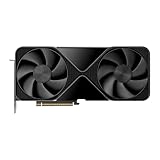
- Best Value: NV Frame RTX 6000 ADA GEN 48GB GDDR6 384BITS PNY VCNRTX6000ADA-PB Video Card
- Premium Choice: NVD RTX PRO 6000 Blackwell Professional Workstation Edition Graphics Card for AI, Design, Simulation, Engineering – 96GB DDR7 ECC Memory – 4th Gen RT/5th Gen Tensor Core GPU – OEM Packaging
RTX 6000 Ada price is the first thing every studio lead and solo creator checks before greenlighting a workstation build, and for good reason: this is one of the most expensive professional cards you can put in a desktop. If you render, simulate, or run local AI models for a living, the question is not whether the RTX 6000 Ada is powerful, but whether its price buys you enough real productivity to justify skipping cheaper options. This guide breaks down exactly what you pay for, how the value stacks up, and whether 2026 is a smart time to buy or wait.
As an Amazon Associate we earn from qualifying purchases at no extra cost to you.




Understanding the RTX 6000 Ada Price Tag
Before deciding if the number is fair, you need to know what sits behind it. The RTX 6000 Ada is built on the same AD102 silicon as the flagship consumer cards, but tuned for professional workloads with certified drivers, error-correcting memory, and a huge frame buffer. Those differences are precisely what push the price into professional territory.
What You Actually Get for the Money
The card packs 18,176 CUDA cores, 568 fourth-generation Tensor cores, and 142 third-generation RT cores, paired with 48 GB of GDDR6 memory with ECC. That memory capacity is the headline: it is double what most flagship gaming cards offer and enough to hold scenes, datasets, and models that would crash a smaller buffer.
That gap matters more every year. As textures move to 8K, scenes grow denser, and AI models balloon, the 24 GB ceiling on consumer flagships is hit sooner than most buyers expect, and the 6000 Ada is Nvidia’s answer for professionals who cannot afford to run out of memory mid-project.
Street prices in 2026 typically land between $6,800 and $7,500 depending on the reseller and stock. That is a serious outlay, so the rest of this article focuses on whether the workload you run turns that spend into returns rather than idle horsepower.
RTX 6000 Ada Price vs Its Performance
On raw compute the RTX 6000 Ada delivers roughly flagship-tier rasterization and ray tracing, but its real advantage is doing so within a 300 W power envelope in a workstation-friendly dual-slot design. For professionals, sustained performance without thermal throttling matters more than a benchmark spike that a gaming card cannot hold.
The analytical way to judge the price is cost per productive hour, not cost per frame. If the 48 GB buffer lets you finish a render or fit a model that would otherwise fail, the card pays for itself quickly. If your projects comfortably fit in 24 GB, you are paying a premium for headroom you never touch.
Think in terms of utilization, not prestige. A 6000 Ada that spends its life on tasks a 4090 could do is an expensive status symbol; the same card kept busy on memory-bound rendering and AI work is one of the best productivity investments a studio can make.
It is also worth weighing the ECC memory. For long simulations and scientific work, silent memory errors can corrupt hours of computation, and error correction is a feature the price includes that consumer cards simply do not offer at any tier.
Where the Price Sits Against Alternatives
Against the RTX 5000 Ada, which offers 32 GB, the 6000 Ada charges a large premium mainly for extra memory and cores. If your ceiling is 32 GB, the 5000 Ada is the value pick; if you regularly exceed it, the 6000 Ada is the only single-card answer that avoids splitting work across two GPUs.
Against the previous-generation RTX A6000, the Ada model brings better efficiency and a newer architecture at a similar or higher price, making it the smarter long-term buy for new purchases rather than betting on a used A6000 with unknown history.
Against a consumer RTX 4090, the comparison is about fitness for purpose, not just speed. The 4090 is cheaper and fast, but it lacks ECC, certified drivers, and the 48 GB buffer, so for professional and AI work the 6000 Ada justifies its price on capability the gaming card cannot match.
Is the RTX 6000 Ada Worth It for Your Work?
Value is entirely workload-dependent, so the honest answer changes based on what you actually do all day. Below are the three scenarios where buyers most often justify the RTX 6000 Ada price, along with the signs that a cheaper card would serve you just as well.
For 3D Rendering and Visualization Studios
For GPU rendering in tools like Blender, V-Ray, or Octane, the 48 GB buffer is transformative. Complex scenes with high-resolution textures and dense geometry that would exceed a 24 GB card render in a single pass, saving the time and hassle of out-of-core workarounds that slow everything down.
Studios that bill by the project rather than the hour feel this most: fewer failed renders and faster iteration cycles translate directly into more finished work per month, which is exactly where the price earns back its keep.
Multi-GPU scaling adds to the case. Because the card is built for side-by-side operation, a studio can start with one board and add a second later, nearly doubling render capacity without redesigning the workstation or fighting thermal limits.
For AI and Local Model Inference
Running large language models or diffusion models locally is where the RTX 6000 Ada has found a second life. The 48 GB frame buffer holds sizeable quantized models entirely in VRAM, delivering fast, private inference without cloud costs or sensitive data ever leaving your machine.
For developers prototyping AI features, that local capability is both a privacy and a speed advantage. The experimental upside is real too: as model optimization and quantization improve, a 48 GB card keeps handling newer, larger models long after smaller cards run out of room.
Power, Cooling, and Workstation Compatibility
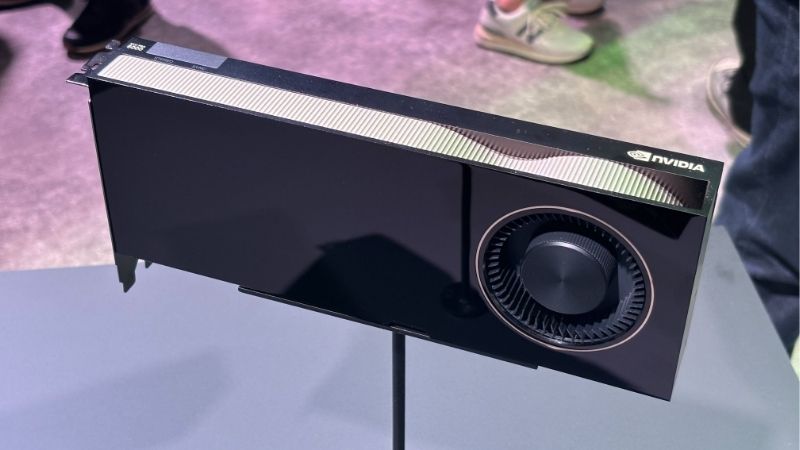
Practically, the 300 W draw and blower-style cooler are designed to fit standard workstation chassis and run reliably in multi-GPU configurations. Unlike a triple-slot gaming card, two RTX 6000 Ada boards can sit side by side without cooking each other, which is central to its value in serious builds.
Before buying, confirm your power supply headroom and case airflow. This is a professional card meant for a professional system, and pairing it with an underpowered consumer build wastes part of what the price delivers.
Noise and heat are practical wins too. In a shared studio, the blower design pushing hot air out the back keeps the room and neighbouring components cooler than an open-fan gaming card, which matters when the machine runs long renders overnight.
Buying the RTX 6000 Ada in 2026: Market Forces and Verdict
Timing a purchase this expensive means understanding the market around it, not just the card itself. Two forces in particular are shaping what you will pay in 2026, and both argue against waiting for a big discount that may never arrive.
Why Memory Prices Keep the RTX 6000 Ada Expensive
The single biggest reason professional cards stay pricey is memory. Component and memory prices climbed steeply through late 2025 before finally leveling off, but that plateau is a pause, not a price cut. A card carrying 48 GB of premium memory is directly exposed to those costs, so its price tracks the memory market closely.
New supply is on the horizon: OEMs can now source DDR5 from vendors such as CXMT, and Micron is building two plants in Idaho. The catch is timing, since those fabs will not reach volume production until 2027 to 2028. For a buyer today, that means the RTX 6000 Ada price is unlikely to fall meaningfully in the near term, so budgeting as if a discount is coming would be optimistic.
The practical takeaway is measured, not panicked. Prices have stopped spiking, but real relief is years away, so if you need the card for active work, waiting mostly costs you the productivity you could be capturing right now.
There is a second-order effect worth noting. Because laptop and component prices have kept trending upward, the whole professional-hardware market is priced for scarcity, and cards with large memory buffers feel that pressure most, which reinforces the case for buying to a real need rather than speculating on a cheaper tomorrow.
User Feedback: Praise and Complaints
Owners consistently praise the RTX 6000 Ada for its enormous memory, rock-solid stability under sustained loads, and quiet, efficient operation compared to consumer flagships. The certified drivers earn repeated mention from users of CAD and simulation software who value reliability over peak numbers.
The most common complaints are predictable: the price itself, and that for pure gaming or light work it is overkill. A few users also note that memory bandwidth, while ample, is not the card’s strong suit versus HBM-based data-center parts, so extremely bandwidth-hungry tasks may prefer a different tool.
Reading across reviews, a clear pattern emerges: buyers who purchased the card for its memory and reliability report high satisfaction, while the disappointed minority almost always bought it for tasks a cheaper card would have handled. Matching the card to the workload separates a great purchase from an expensive regret.
RTX 6000 Ada Pros and Cons
Distilling the ownership picture into a clear ledger helps you decide fast.
Pros: 48 GB ECC memory that fits large scenes and AI models; flagship-class compute in a 300 W, workstation-friendly design; certified professional drivers and strong reliability; excellent for local AI inference and heavy rendering.
Cons: high purchase price that only pays off with demanding workloads; overkill for gaming or light creative tasks; memory bandwidth trails data-center HBM cards; prices held up by a memory market that will not ease until 2027 to 2028.
See More:
Final Verdict: Is the RTX 6000 Ada Price Justified?
For professionals who routinely exceed 24 GB of VRAM, run local AI models, or need certified stability for client work, the RTX 6000 Ada price is justified because it removes real bottlenecks and delivers more finished work over the card’s life. For anyone whose projects fit comfortably in less memory, a cheaper card such as the RTX 5000 Ada will serve you better for the money.
Also factor in resale and longevity. Professional cards with large memory hold their value comparatively well and stay relevant across more software generations, so a higher upfront RTX 6000 Ada price can translate into a lower effective cost once you account for how long the card stays useful.
If this card fits your workflow, the market signals point toward buying when you need it rather than waiting on a price drop that is years out. Check the latest RTX 6000 Ada price, stock, and configurations through the link below and lock in the productivity while your project needs it.
Top-Rated Picks


| Product | Brand | Rating | Reviews | Price |
|---|---|---|---|---|
| ARCTIC MX-4 (4 g) – Premium Performance Thermal Paste… | ARCTIC | ★ 4.8 | 104k | $4.99 |
| ARCTIC MX-4 (incl. Spatula, 4 g) – Premium Performanc… | ARCTIC | ★ 4.8 | 71.9k | $5.49 |
| Crucial 8GB DDR4 RAM 3200MHz (PC4-25600), Downclockab… | Crucial | ★ 4.8 | 62.8k | $74.99 |
| AMD Ryzen 5 5600X 6-core, 12-thread unlocked desktop … | — | ★ 4.8 | 30.2k | $177.60 |
| NVIDIA Shield Remote; Voice Search, Motion-Activated,… | — | ★ 4.7 | 10.6k | $25.99 |
Frequently Asked Questions
Why does the RTX 6000 Ada cost so much more than an RTX 4090?
The professional card carries 48GB of ECC GDDR6, double the 4090’s memory, plus certified ISV drivers for CAD, DCC and simulation applications, a blower cooler that permits multi-card workstations, and a 300W power envelope. You are paying for validated drivers, error-corrected memory and warranty terms rather than for extra gaming performance, which is actually slightly lower.
Will it fit and run in a normal desktop tower?
Yes. It is a dual-slot, 267mm card with a rear-exhaust blower and a single 16-pin power connector, so it fits most mid-tower cases far more easily than a triple-slot 4090. A quality 850W power supply is ample for a single card, and its 300W ceiling means less thermal stress on cramped builds.
Is 48GB of VRAM worth it for AI work?
For fine-tuning models in the 7-13 billion parameter range, rendering huge scenes, or running long-context inference locally, 48GB removes constant out-of-memory frustration and avoids offloading to system RAM. If your models comfortably fit in 24GB, the extra capacity is idle silicon and a 4090 or 5090 gives better value per hour of compute.
Can I link two cards for 96GB of pooled memory?
No. The Ada generation dropped NVLink entirely, so two RTX 6000 Ada cards communicate only over PCIe and cannot present a single 96GB pool. Frameworks can still shard a model across both with tensor or pipeline parallelism, but the PCIe link is far slower than the NVLink bridges available on older Ampere professional cards.
Are there cheaper alternatives with similar memory?
The RTX 5000 Ada offers 32GB at a significantly lower price, and used A6000 cards provide 48GB with NVLink support for less money, albeit on the older Ampere architecture without FP8 acceleration. Weigh whether ECC memory and ISV certification genuinely matter to your workflow before paying the professional premium.

Write Your Review
No reviews yet. Be the first to share your experience!