
Nvidia L4 is the card that proves the best inference GPU is not always the biggest one. Sipping just 72 watts in a single-slot, low-profile design, it is engineered for one job: serving AI at high volume and low cost. For engineers who measure success in cost per thousand requests rather than peak FLOPS, the L4 is a quietly brilliant tool. This review covers exactly what the L4 excels at, where its limits are, and whether its efficiency-first design fits the workloads you actually run.
As an Amazon Associate we earn from qualifying purchases at no extra cost to you.




What Makes the Nvidia L4 Different
The L4 is built on Nvidia’s Ada Lovelace architecture but tuned for efficiency rather than raw power. It is not trying to be a training card or a flagship accelerator; it is designed to pack inference capacity into dense, power-constrained servers. Understanding that focus is the key to knowing whether it fits your deployment.
Efficiency-First Ada Design
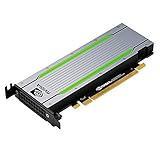
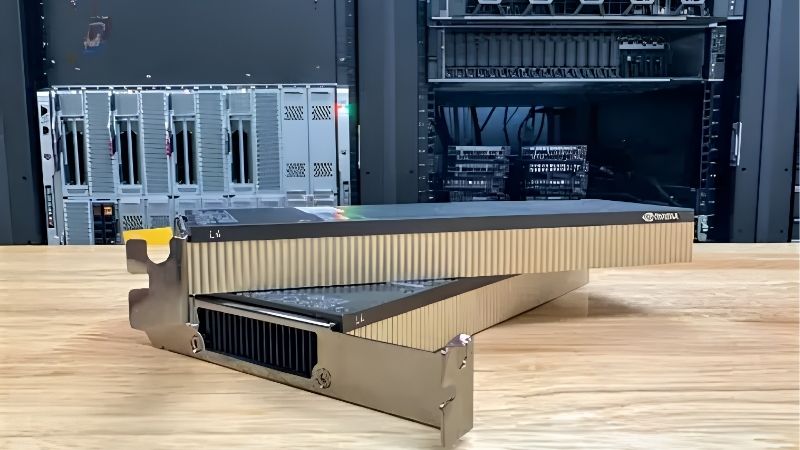
The L4 draws around 72 watts and needs no external power connector, which lets data centers pack many cards into a single server without special cooling or power upgrades. That efficiency is the entire point of the card and its biggest practical advantage.
Despite the low power, it carries Ada Tensor cores with FP8 support, so it accelerates modern inference workloads far more efficiently than its wattage suggests. The analytical result is class-leading performance per watt for lightweight serving.
The experimental angle is longevity: as inference frameworks keep optimizing for FP8, the L4 keeps improving on the same silicon, stretching its value across more software generations without a hardware change.
For a fleet operator, that slow depreciation in usefulness is a real financial point: hardware that keeps getting faster through software updates earns its cost back over a longer window than a card that peaks on day one.
24 GB of Memory and Media Acceleration
The L4 pairs 24 GB of GDDR6 with dedicated media engines, including AV1 encode and decode. That memory holds small and quantized models comfortably, while the media engines make the L4 excellent for AI video pipelines and transcoding at scale.
That media capability is increasingly relevant as AI video and streaming explode, giving the L4 a strong second use case beyond pure model serving.
For high-volume video and streaming workloads, that combination is a genuine differentiator. A single L4 can run inference and handle video encoding together, consolidating jobs that would otherwise need separate hardware.
The practical limit is capacity: 24 GB is ample for small models but not for large ones, so the L4 is a scale-out card for many light services rather than a home for a single giant model.
Framed correctly, that is a design choice rather than a shortcoming: the L4 is built to multiply across many small services, not to host one large one, and judged on that intent it does its job extremely well.
Where the L4 Fits vs L40S and T4
Against the older T4 it replaces, the L4 delivers a large generational leap in inference performance and efficiency, plus modern FP8 and AV1 support, making it the clear upgrade for T4-based fleets.
Against the L40S, the L4 is the smaller, cheaper, lower-power option for lightweight serving, while the L40S handles larger models and heavier throughput. Choosing between them is simply a question of how big your models are and how much throughput each server must deliver.
A simple rule helps: if a quantized model fits in 24 GB and you need to serve it broadly and cheaply, the L4 is the answer; if the model is larger or throughput per card must be high, step up to the L40S.
Getting that sizing right up front is what separates a deployment that celebrates the L4’s cost savings from one that fights its limits, so spend the time to profile your model before you order at scale.
Nvidia L4 Performance in Real Deployments
The L4’s value only becomes clear when matched to the right workloads. Across the deployments it targets, operator feedback paints a consistent picture of where it shines and where a different card would serve you better.
High-Volume, Small-Model Inference
For serving many small or quantized models at high request volume, the L4 delivers the lowest cost per request of nearly any card. Its efficiency means more services per server and a smaller energy bill, which dominates long-run inference cost.
This is the L4’s core use case, and it is where satisfied operators concentrate. Recommendation engines, chat endpoints for smaller models, and computer-vision inference all fit the card’s profile neatly.
Because so many production AI features run on small or distilled models, this covers a surprisingly large share of real-world inference, which is why the L4 shows up in so many cost-optimized deployments.
As distillation and quantization keep shrinking capable models, the share of production workloads the L4 can handle only grows, which makes it an increasingly safe long-term bet for scale-out inference and a strong argument for standardizing on it.
The recurring complaint is predictable and fair: users who tried to run large models on it hit the 24 GB ceiling. That is not a flaw but a mismatch, and it underscores the importance of sizing the card to the model.
Treat that as the single most important buying check: confirm your model and its cache fit in 24 GB, and the L4 will reward you; ignore it, and no amount of efficiency will save the deployment.
AI Video and Streaming Workloads
The dedicated AV1 media engines make the L4 a standout for video AI: transcoding, content analysis, and generative video pipelines all benefit from doing media and inference on one efficient card.
For streaming platforms and video-heavy applications, that consolidation is a practical cost saver. The L4 turns what used to require separate transcoding and inference hardware into a single, dense, low-power deployment.
For platforms processing large volumes of user-generated video, that consolidation compounds into meaningful savings on both hardware count and the power bill, which is where the L4’s design pays off most visibly.
The combined media-plus-inference pipeline also simplifies operations, since one card and one driver stack cover a workflow that used to span separate transcoding and AI hardware.
Edge, Cloud Density, and Compatibility
Because it is single-slot, low-profile, and needs no power connector, the L4 fits almost anywhere, from dense cloud servers to compact edge systems. That flexibility is central to its appeal for distributed inference.
Edge sites with limited power and cooling are a natural home, letting you push inference closer to users for lower latency without the electrical upgrades a bigger card would demand.
Before buying, confirm your server has an appropriate slot and airflow, since the passive design relies on chassis cooling. Get that right and the L4 slots into mainstream infrastructure with minimal fuss, which keeps deployment cost and risk low.
That drop-in simplicity also speeds rollout: with no power-connector routing or cooling redesign, standing up a fleet of L4s is closer to a software change than a data-center project.
Buying the L4 in 2026: Value, Market, and Pros and Cons
The L4 is a value and efficiency play, and it makes the most sense at scale where its low power multiplies into real savings. Two market realities in 2026 also shape the buying decision, and both favor acting when the card fits rather than waiting.
Why Efficiency Wins at Scale
The core argument is operating cost. When you deploy dozens or hundreds of cards, the L4’s low power draw compounds into large savings on electricity and cooling, often outweighing the raw performance of a hungrier card.
For a cost-per-request-minded engineer, that math is decisive. The cheapest inference is rarely the fastest chip; it is the most efficient card that comfortably meets the workload, and for lightweight serving that is frequently the L4.
Over a multi-year deployment, energy and cooling often outweigh the purchase price entirely, so the card that wins on watts frequently wins on total cost, and for lightweight serving that card is the L4.
Memory Prices and Buying Timing
The main external factor is the memory market. Component and memory prices climbed steeply through late 2025 before leveling off, and that plateau is a pause rather than a price cut, so even a modest 24 GB card feels the pressure of elevated memory costs.
New supply is coming, with OEMs able to source DDR5 from vendors such as CXMT and Micron building two Idaho plants, but those fabs will not reach volume until 2027 to 2028. The measured conclusion is that L4 pricing is unlikely to drop much soon, so if efficiency at scale is your goal, buying now beats waiting on relief that remains years away.
The general upward drift in component prices only strengthens the case: with the market priced for scarcity, today’s L4 quote is likely near the floor until new memory capacity arrives later in the decade.
For a fleet buyer, that means timing the purchase around a hoped-for price drop is the weaker plan; deploying efficient cards now and starting to bank the power savings is the stronger one, given how far off real memory relief remains.
Nvidia L4 Pros and Cons
The ownership picture distilled for a fast decision.
Pros: outstanding performance per watt at around 72 W; no power connector needed; FP8 for efficient inference; AV1 media engines for video workloads; fits dense and edge servers easily.
Cons: 24 GB limits it to small and mid-sized models; not a training or large-model card; GDDR6 bandwidth is modest; pricing held up by an elevated memory market into 2027.
See More:
Final Verdict: Is the Nvidia L4 Worth It?
For high-volume, small-model inference, AI video pipelines, and dense or edge deployments where power is the real cost, the Nvidia L4 is one of the most cost-effective GPUs Nvidia makes, delivering the lowest cost per request for the workloads it targets. If you need to serve large models or do serious training, a bigger card such as the L40S or a data-center accelerator is the right tool instead.
For the very common reality of serving many lightweight models at scale, though, the L4 is not a compromise but the correct tool, and treating it that way is how teams cut their inference bill without cutting capability.
Sized to the job, it delivers exactly what a cost-focused inference team wants: predictable, efficient serving that keeps the monthly bill low even as request volume climbs.
If the L4 matches your workload, a firm memory market means waiting is unlikely to pay off. Check the latest Nvidia L4 pricing, availability, and server compatibility through the link below and lock in the efficiency while supply lasts.
Top-Rated Picks


Best Seller
PNY NVIDIA Tesla T4 Datacenter Card 16GB GDDR6 PCI Express 3.0 x16, Single Slot, Passive Cooling
Save $133.22

| Product | Brand | Rating | Reviews | Price |
|---|---|---|---|---|
| ARCTIC MX-4 (4 g) – Premium Performance Thermal Paste… | ARCTIC | ★ 4.8 | 104k | $4.99 |
| ARCTIC MX-4 (incl. Spatula, 4 g) – Premium Performanc… | ARCTIC | ★ 4.8 | 71.9k | $5.49 |
| Crucial 8GB DDR4 RAM 3200MHz (PC4-25600), Downclockab… | Crucial | ★ 4.8 | 62.8k | $74.99 |
| AMD Ryzen 5 5600X 6-core, 12-thread unlocked desktop … | — | ★ 4.8 | 30.2k | $177.60 |
| NVIDIA Shield Remote; Voice Search, Motion-Activated,… | — | ★ 4.7 | 10.6k | $25.99 |
Frequently Asked Questions
What are the L4 specifications?
The L4 is an Ada Lovelace data center card with 24GB of GDDR6, roughly 72W power draw, and a single-slot low-profile passive design. It includes fourth-generation tensor cores with FP8 support plus dedicated encode and decode engines with AV1 support for high-density video work.
Why is the L4 so popular for inference?
It offers a rare combination of 24GB capacity, modern tensor throughput and a 72W envelope in a single low-profile slot. That means many cards per server with modest power and cooling demands, which drives down cost per inference request compared with larger, hotter accelerators.
Can I use an L4 in a desktop PC?
Not comfortably. The passive cooler requires strong directed server airflow, and there are no display outputs, so you need separate graphics for video. Enthusiasts do adapt them with 3D-printed shrouds and fans, but it is an unsupported configuration prone to thermal throttling.
How does AV1 encoding help?
AV1 delivers better quality at lower bitrates than H.264 and HEVC, cutting bandwidth and storage costs for streaming platforms. The L4 hardware AV1 encoder handles many concurrent streams within its 72W budget, which is a substantial upgrade over the older T4 that lacks AV1 entirely.
Is the L4 better than the L40S for my workload?
The L40S is far more powerful with 48GB and a 350W budget, suited to training and heavy rendering. The L4 wins on density, efficiency and cost for inference and transcoding. Choose the L4 when you need many modest accelerators, and the L40S when you need fewer strong ones.



Write Your Review
No reviews yet. Be the first to share your experience!