
- Top Pick: ASRock Radeon RX 7700 XT Challenger 12GB OC Graphics Card, AMD RDNA 3 Architecture, 12GB GDDR6, 2584 MHz Boost Clock, 3X DisplayPort 2.1, 1x HDMI 2.1, Dual Fan Cooling
- Best Value: ASRock Radeon RX 7600 Challenger Pro 8GB OC, AMD RDNA 3, 8GB GDDR6, PCIe 4.0, Triple Fans, 0dB Silent, 2695MHz Boost, Triple Fan Graphics Card
- Premium Choice: XFX Speedster SWFT210 Radeon RX 7600 Graphics Card with 8GB GDDR6 HDMI 3xDP, AMD RDNA 3 RX-76PSWFTFY
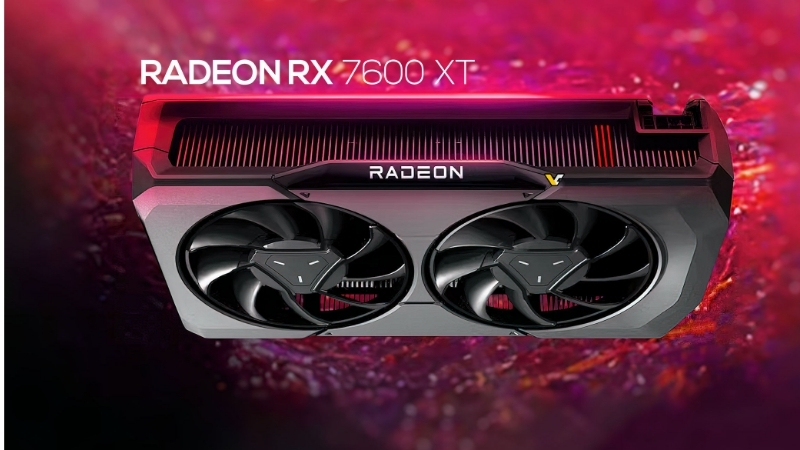
RX 7600 XT exists to answer one specific question: what if a budget 1080p card came with 16GB of VRAM? That generous frame buffer is the headline, and it is exactly what draws in buyers who want a cheap card that will not run out of memory in a couple of years. If you game at 1080p, dabble in light 1440p, or run texture-heavy titles and mods on a budget, the real question is whether that extra VRAM is worth paying for over the standard RX 7600. This review breaks down the performance, the practical build details, and the value of that 16GB buffer.
RX 7600 XT Performance: 16GB VRAM at a Budget Price
The RX 7600 XT uses the same RDNA 3 Navi 33 GPU as the standard 7600, but pairs it with 16GB of GDDR6 on a 128-bit bus and a slightly higher 190W board power. The key thing to understand is that this is primarily a VRAM upgrade rather than a big leap in raw speed, so its appeal rests on memory headroom and longevity. Below, the performance is broken down the way a budget buyer focused on value and longevity evaluates it.
As an Amazon Associate we earn from qualifying purchases at no extra cost to you.







1080p and Light 1440p Frame Rates
At 1080p the RX 7600 XT is a strong performer, clearing 60 FPS in the vast majority of modern titles at high settings and pushing well past 100 FPS in lighter and competitive games. Its raw speed is close to the standard 7600, so the 1080p experience is similar, with the difference showing up mainly in the most VRAM-hungry titles.
The 16GB buffer is where it pulls ahead. In texture-heavy games, with high-resolution texture packs, and in light 1440p gaming, the extra VRAM keeps the card running smoothly where an 8GB card would start to stutter or pop in textures. That makes the XT a more comfortable choice for 1440p than its sibling, even though the core GPU is the same.
The practical takeaway is that this card buys you headroom rather than raw speed. You get a solid 1080p experience today plus the memory capacity to handle 1440p and future games more gracefully, which is the whole reason to choose the XT over the standard model.
Ray Tracing, FSR and AV1 Encoding
Ray tracing is available but, as with the standard 7600, it is best treated as a light bonus rather than a primary feature. The interesting wrinkle is that the 16GB buffer actually helps in ray-traced titles, since ray tracing increases VRAM demand, so the XT can hold up better than an 8GB card in those scenarios, even if the raw ray-tracing horsepower is still entry-level.
For upscaling it uses FSR, including FSR 3 with Frame Generation, which is broadly supported and a useful way to lift frame rates in heavier games. As an RDNA 3 card it does not support the newer RDNA 4-exclusive FSR 4, but the existing FSR support is effective for this tier and continues to improve through updates.
Like the standard 7600, the XT includes AV1 encoding from its RDNA 3 media engine, which is a genuine plus for budget streamers and creators who want better-quality streaming and recording at lower bitrates. Combined with the larger VRAM buffer, it makes the XT a slightly more capable choice for light content creation as well as gaming.
What Owners Praise and Criticize
Owner sentiment centers heavily on the VRAM. The most common praise is the peace of mind that 16GB brings at this price, with buyers highlighting smoother performance in texture-heavy and modded games, better 1440p capability, and the sense that the card will age more gracefully than an 8GB rival. The AV1 encoding and quiet operation also draw positive mentions.
The main criticism is that the raw GPU is not much faster than the standard 7600, so buyers expecting a big performance jump from the XT badge can be disappointed. Some also note the narrow 128-bit memory bus and the price premium over the 8GB model. The fair conclusion is that the XT is a VRAM upgrade, and its value depends entirely on whether you need that extra memory.
Overall, owners frame the XT as the sensible choice when longevity matters: you accept that it is not much faster than the standard 7600 in exchange for memory headroom that pays off down the line.
| Strengths | Trade-offs |
|---|---|
| 16GB VRAM for strong longevity at a budget price | Raw speed close to the cheaper RX 7600 |
| More comfortable at 1440p than 8GB rivals | Price premium over the standard model |
| AV1 encoding for budget streamers | Narrow 128-bit memory bus |
| Handles texture-heavy and modded games well | Ray tracing still entry-level in horsepower |
RX 7600 XT Build Fit: Power, Size and Cooling
Like its sibling, the RX 7600 XT is an easy card to build around, but a clean install still depends on three practical things: the power draw and supply it needs, whether it fits your case, and how it handles heat and noise. Each is covered below so your budget build comes together without surprises.
Power Draw and PSU Requirements
With a 190W board power, the RX 7600 XT is slightly thirstier than the standard 7600 but still modest, and a quality 500W to 600W power supply is plenty for most budget builds. It uses a standard 8-pin connector, keeping the install straightforward for newer builders.
That low draw remains a budget advantage, since it rarely forces a power-supply upgrade and keeps system heat and noise down. For anyone upgrading an existing system, the extra VRAM comes without a meaningful change in power requirements, so your current PSU is likely still fine.
Card Size and Small-Case Builds
Most RX 7600 XT models are reasonably compact, with plenty of dual and triple-fan designs that fit comfortably into small and budget cases. Because the 16GB of memory does not make the card dramatically larger, it remains a strong option for compact builds where space is limited.
Dimensions still vary by brand, so measure your case clearance before buying, particularly in a small-form-factor build. The card’s modest power draw means even an affordable cooler keeps it happy, so a smaller model gives up little in temperatures or noise.
Cooling, Noise and Temperatures
Thanks to its low power draw, the RX 7600 XT runs cool and quiet on most coolers, and even affordable dual-fan models keep temperatures comfortably in check during extended gaming. Fan-stop keeps the card silent at idle and on the desktop.
Under sustained load it stays quiet enough for almost any setup, and a mild undervolt can lower temperatures and noise further for those who want an even calmer profile. For a budget card, the acoustic experience is genuinely good rather than merely acceptable.
RX 7600 XT Pricing, Value and When to Buy
The RX 7600 XT’s value rests entirely on whether its extra VRAM justifies the price premium over the standard model, and the wider component market shapes that calculation. This section covers where prices sit, how the card compares, and which buyer it suits.
Where Prices Stand Right Now
For a budget buyer, the market backdrop is especially relevant here, because the price gap between the 8GB and 16GB models reflects exactly what is driving costs. PC component prices have broadly trended upward, driven mainly by memory costs, and that pressure reaches graphics cards and the rest of a build. The encouraging side is real but limited: the steep climb seen at the end of 2025 has cooled, and some makers, Framework among them, have reported a relatively stable recent stretch while still warning of further movement.
New memory supply is on the way but not soon. OEMs can now source DDR5 from suppliers like CXMT, and Micron is building two fabs in Idaho, yet those plants are not expected to come online until 2027–2028. In short, prices have stopped spiking rather than started falling, so genuine relief is still some distance out, and because the XT’s main feature is its memory, that trend bears directly on its price.
The practical implication is to weigh the cost difference to the standard 7600 carefully, since that gap is essentially the price of the extra 8GB of VRAM. Buy when the XT sits near its intended price, and factor the whole build cost into your budget rather than waiting for a drop that is not imminent.
RX 7600 XT vs the RX 7600
This is the comparison that decides the purchase. The XT offers the same core performance plus 16GB of VRAM instead of 8GB, so the question is simply whether you value that extra memory. If you play texture-heavy games, want light 1440p capability, or plan to keep the card for several years, the XT’s longevity headroom is worth the premium.
If you game strictly at 1080p in less demanding titles and want the lowest price, the standard 7600 is the better pure-value pick, since you would be paying for VRAM you may not fully use. Against NVIDIA’s budget cards, the XT’s 16GB is a standout feature that few rivals match at this price, which is its strongest selling point.
Who Should Buy the RX 7600 XT
Buy it if you want a budget card with genuine longevity, play texture-heavy or modded games, dabble in 1440p, or simply want the reassurance that you will not run short on VRAM in a couple of years. For that buyer, the 16GB buffer is cheap insurance and the XT is an easy recommendation.
Choose the standard 7600 instead if you game strictly at 1080p in lighter titles and want to spend as little as possible. If the 16GB RX 7600 XT fits your needs and lands near its intended price, check the current price and availability through the link here before buying, and consider a price alert, since budget cards swing the most and patience often pays off.
See More:
- Colorful iGame RTX 4090
- Founders Edition vs AIB
- Best RTX 4080 Super card
- Best RTX 5080 AIB
- Best RTX 5070 Ti card
Conclusion: Is the RX 7600 XT Worth It?
The RX 7600 XT is a smart budget card for buyers who value longevity, pairing solid 1080p performance and light 1440p capability with a generous 16GB of VRAM that few rivals match at this price. Its raw speed is close to the cheaper standard 7600, so the decision is fundamentally about whether you need the extra memory, and for texture-heavy games, modding, and future-proofing, you often will. With component prices stabilizing rather than falling, there is little reason to wait, so if longevity matters to your budget build, the RX 7600 XT is one of the most sensible value picks available, and a card you can buy with confidence that it will still have the memory it needs a few years from now.
Top-Rated Picks


| Product | Brand | Rating | Reviews | Price |
|---|---|---|---|---|
| ARCTIC MX-4 (4 g) – Premium Performance Thermal Paste… | ARCTIC | ★ 4.8 | 104k | $4.99 |
| ARCTIC MX-4 (incl. Spatula, 4 g) – Premium Performanc… | ARCTIC | ★ 4.8 | 71.9k | $5.49 |
| Crucial 8GB DDR4 RAM 3200MHz (PC4-25600), Downclockab… | Crucial | ★ 4.8 | 62.8k | $74.99 |
| AMD Ryzen 5 5600X 6-core, 12-thread unlocked desktop … | — | ★ 4.8 | 30.2k | $177.60 |
| NVIDIA Shield Remote; Voice Search, Motion-Activated,… | — | ★ 4.7 | 10.6k | $25.99 |
Frequently Asked Questions
Does the extra 16GB of VRAM actually help the RX 7600 XT?
It helps in specific cases rather than universally. The 7600 XT doubles the 7600’s memory to 16GB but keeps the same 128-bit bus and 32 compute units, so bandwidth, not capacity, is the limiter in most games. Where it pays off is high texture settings, ray tracing at 1080p, heavily modded titles, and local AI or video work that spills past 8GB.
What resolution is the RX 7600 XT designed for?
It is a 1080p card first. At 1080p high or ultra it delivers comfortable 60fps or better in nearly every current title, and far higher in competitive shooters. At 1440p it can work if you accept medium settings or lean on FSR upscaling, but the narrow memory bus keeps it from being a genuine 1440p high-refresh solution.
What power supply and connectors does it require?
Board power rises to about 190W versus 165W on the plain RX 7600, and partner cards typically use a single 8-pin PCIe connector, occasionally two on overclocked models. A reliable 550W power supply covers a mainstream CPU pairing with headroom. Confirm your unit has a native PCIe cable rather than relying on a Molex adapter.
Is the RX 7600 XT better value than an 8GB RTX 4060?
For pure rasterized 1080p gaming and future-proofing on texture-heavy releases, the 16GB buffer gives it an edge. The RTX 4060 counters with much lower power draw, stronger ray tracing, DLSS quality upscaling and NVENC encoding for streaming. Choose the AMD card for memory headroom and frames per dollar, the NVIDIA card for efficiency and feature set.
Will the RX 7600 XT fit in a small case?
Most models are dual-fan designs in the 200mm to 270mm range and occupy two to two and a half slots, so clearance is rarely a problem in mid towers. Compact ITX cases still need a check of the manufacturer length spec, since a few triple-fan variants stretch noticeably longer than the reference footprint.



Write Your Review
No reviews yet. Be the first to share your experience!