
- Top Pick: ASUS Dual GeForce RTX 4060 Ti EVO OC Edition 8GB GDDR6 (PCIe 4.0, 8GB GDDR6, DLSS 3, HDMI 2.1a, DisplayPort 1.4a, Axial-tech Fan Design, Auto-Extreme Technology), 3 Year Warranty
- Best Value: PNY GeForce RTX™ 4060 Ti 8GB Verto™ OC Dual Fan Graphics Card DLSS 3 (128-bit, PCIe 4.0, GDDR6, HDMI/DisplayPort, Supports 4k, 2 Slot)
- Premium Choice: MSI GeForce RTX 4060 Ti Ventus 3X 16G OC Graphics Card -NVIDIA RTX 4060 Ti, 16GB GDDR6 Memory, 18Gbps, PCIe 4.0, DLSS3


Top Rated
NVIDIA – GeForce RTX 3070 Ti 8GB GDDR6X PCI Express 4.0 Graphics Card – Dark Platinum and Black

3070 vs 4060 ti is a comparison that refuses to resolve cleanly, and that is exactly why it keeps getting searched. The two cards land within a few percent of each other on frames. One is older, cheaper, and used. The other is newer, more expensive, and comes in two memory sizes that behave like different products. The decision is not about speed – it never was. It is about which card is still usable in 2028, and that answer depends on one specification and one feature. Verdict first, table second, and an honest look at why one of these is a dead end.
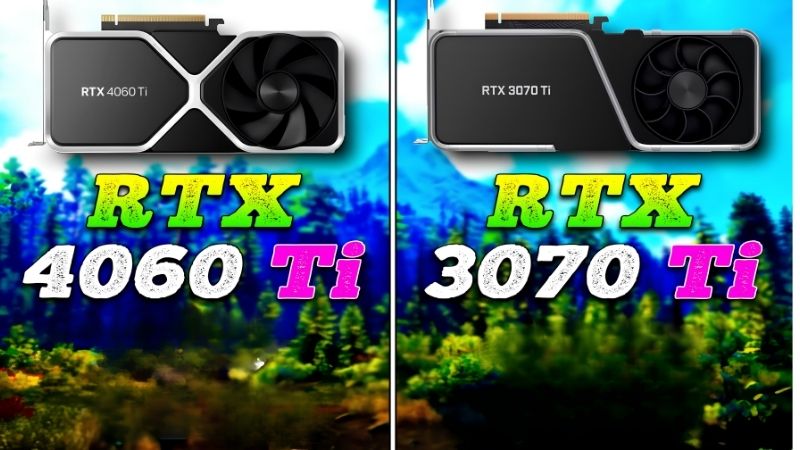
Quick Verdict: RTX 3070 vs RTX 4060 Ti
The RTX 4060 Ti 16GB is the right buy, and it is the only version of this comparison with a clean answer. Against the 3070, it delivers roughly equivalent raster performance, adds Frame Generation, halves the power draw, and doubles the memory – which is the specification that decides whether a card is usable at high textures or stutters. The 3070 is cheaper on the used market and matches it on frames, but its 8GB is a wall you cannot tune around. The 4060 Ti 8GB is the trap: same problem as the 3070, higher price, and no advantage worth paying for.
As an Amazon Associate we earn from qualifying purchases at no extra cost to you.


Why the Frame Rate Is Not the Story
At 1080p high, these two trade within a few percent – call it 85-105 fps on both in modern AAA titles. At 1440p the 3070 sometimes edges ahead thanks to its 256-bit bus against the 4060 Ti’s 128-bit, which is one of the few places the older card’s wider memory configuration shows up.
The threshold where a GPU difference feels transformative is roughly 40-50%. Below 25%, most people cannot reliably tell in a blind test. A few percent is not near either number. So if you are comparing these on frames, you are comparing them on the one axis where they are functionally identical.
What that means practically: ignore the benchmark bars entirely. This comparison is decided by memory, features, and power – three things the fps chart does not show you.
The 8GB Wall Both Cards Can Hit
Here is the specification that actually decides this, and it applies to the 3070 permanently and the 4060 Ti conditionally.
The RTX 3070 has 8GB. Full stop, no variants, no upgrade path. In 2026, 8GB is at or below the working floor for modern titles at high textures. And the failure mode matters more than the number: a card short on shader power runs slower – predictable, tunable, you drop a setting. A card short on VRAM hitches, streams textures in late, and its 1% lows collapse while the average frame rate stays deceptively healthy. You cannot tune around it except by dropping textures, which is the setting people notice most.
The 4060 Ti ships in 8GB and 16GB versions sharing the same die and clocks. In light workloads they are within 1-2%. In VRAM-heavy ones the 8GB version does not lose 10% – its 1% lows drop 30-50% and it starts hitching, exactly like the 3070.
This produces the clean rule for this whole comparison: the 4060 Ti 16GB is a different product from the other two cards on this page. The 3070 and the 4060 Ti 8GB share the same fate. Only one card here has a future, and it costs about $50 more than the one that does not.
Full Comparison Table
Three cards, because pretending the 4060 Ti is one product misleads you.
| Specification | RTX 3070 8GB | RTX 4060 Ti 8GB | RTX 4060 Ti 16GB |
|---|---|---|---|
| Typical price | $220-260 used | $379-399 | $429-449 |
| VRAM | 8GB | 8GB | 16GB |
| Memory bus | 256-bit | 128-bit | 128-bit |
| Board power | ~220W | ~160W | ~165W |
| Recommended PSU | 650W | 550W | 550W |
| 1080p high (avg) | ~85-105 fps | ~85-105 fps | ~85-105 fps |
| VRAM-heavy 1440p | Stutters | Stutters | Holds |
| DLSS | DLSS 2/3, no Frame Gen | DLSS 3 + Frame Gen | DLSS 3 + Frame Gen |
| AV1 encoding | No | Yes | Yes |
| Age | ~6 years | ~3 years | ~3 years |
| Verdict | Cheap dead end | The trap | The buy |
Read the sixth row and the seventh row together and the entire comparison collapses. All three cards deliver the same frames. Only one holds under load. That is a $50 decision producing a three-year outcome, and it is the most consequential $50 in this tier.
Deep Dive: Frame Generation and the Power Gap
Two things separate the 4060 Ti from the 3070 beyond memory, and both are worth understanding before you decide the used card is the value play. Neither shows up in a raster benchmark.
What Frame Generation Actually Gives You
Frame Generation is Nvidia’s technology for creating additional frames between the ones the card actually renders, using AI to interpolate the motion. It requires Ada-generation hardware or newer, which means the 4060 Ti has it and the 3070 never will – no driver update changes this.
The honest evaluation: it works, and it matters more than the marketing deserves. On a 144Hz panel, a card rendering 70 fps natively can present motion that genuinely feels like the panel is being used. Whether generated frames satisfy you is personal – some people notice a slight difference in responsiveness, and in competitive shooters that matters. In single-player titles, most people find it convincing.
What makes it strategically relevant is the trajectory. Nvidia’s software cadence has repeatedly added capability to cards after purchase – DLSS today is meaningfully better than DLSS at launch, and the transformer model upgrade landed on hardware people had already bought. Buying into the Ada feature set is buying into a curve that has been rising. The 3070 is on a curve that stopped.
The Power and Heat Difference Nobody Mentions
This is where the 4060 Ti quietly wins and where used-card shoppers get surprised.
The 3070 draws roughly 220W. The 4060 Ti draws roughly 160-165W. That is a 35% difference, and it cascades. The 4060 Ti runs comfortably on a 550W supply and drops into budget prebuilts and OEM machines without a PSU upgrade. The 3070 wants 650W. If your existing supply is 550W, the 3070 is not a $240 card – it is $240 plus a $70 power supply, and the value argument inverts.
Heat follows power. 220W in a small case with one intake fan is a card that throttles, and a six-year-old 3070 with dried-out thermal paste throttles harder. The 4060 Ti’s lower draw makes it far more forgiving of a mediocre case, which for a lot of buyers is the actual deciding factor.
Add the age tax. A 3070 in 2026 needs a repaste – budget $15-25 for paste and pads and an afternoon. Its fans have six years of hours on them. Test it the day it arrives: twenty minutes of a real game, watching for artifacts, driver timeouts, or temperatures above 80C. Every dead-card story starts with someone who tested it next weekend.
Pros and Cons: 3070 vs 4060 Ti
| RTX 3070 8GB | RTX 4060 Ti 16GB | |
|---|---|---|
| Pros | Roughly $200 cheaper than the 16GB 4060 Ti; matches it on raw frames; 256-bit bus holds up slightly better at 1440p in non-VRAM-limited titles; still a capable 1080p card today | 16GB is the reason to buy it – no stutter, no texture compromises; Frame Generation on a feature curve that keeps improving; 165W on a 550W PSU; AV1 encoding for streaming; new with warranty and no thermal history |
| Cons | 8GB is a permanent wall with no variant to escape to; no Frame Generation, ever; 220W wants 650W; six years old – repaste, worn fans, no warranty, real risk; no AV1 | $429-449 is a lot for 1080p-class frames; 128-bit bus limits it; poor fps per dollar on paper; the 8GB version shares the name and is a genuine trap |
The asymmetry is the whole point. The 3070’s weaknesses are structural and permanent – 8GB does not become 16GB, and Frame Generation does not arrive in a driver. The 4060 Ti’s main weakness is price, which is a problem you solve once. One of these cards gets worse every year on its own.
Why the VRAM Decision Costs More Than It Used To
Everything above rests on today’s prices, and the pricing situation is precisely what turns the VRAM question from a preference into a decision with a bill attached.
Prices Have Flattened but Are Not Falling
The memory-driven surge through late 2025 lifted component and laptop pricing broadly, and used GPUs followed with a lag – the used market prices against the cheapest new alternative rather than against age. That is why a six-year-old 3070 still commands $240.
The genuinely positive news is narrow but real: the steep climb seen at the end of 2025 has stopped, and manufacturers including Framework have reported a period of relative stability, while still warning openly that volatility has not ended.
Flat is not falling, and that inverts the classic budget strategy. Buying the 3070 now and upgrading when 8GB becomes intolerable assumes upgrades get cheaper. They are not. Choosing 8GB in 2026 is not deferring a cost – it is scheduling one at full price, in a market with no discount coming.
New Memory Capacity Arrives in 2027 or 2028
Genuine relief is under construction. OEMs can now source DDR5 from Chinese suppliers such as CXMT, and Micron is building two fabrication plants in Idaho – funded, structural additions to global supply rather than speculation.
The obstacle is the calendar. Those Idaho plants do not come online until 2027-2028. Fabrication capacity takes years to stand up, and any purchase made this year concludes long before that supply reaches a shelf.
So the strategic conclusion is uncomfortable but clean: buy the memory now. The 16GB card is not a luxury in a flat market – it is the option that does not require you to spend again in two years at prices nobody expects to improve.
The Alternative If Neither Fits
If $429 is out of reach and the 3070’s 8GB genuinely worries you, two options deserve a price check. The RTX 5060 Ti 16GB is the current-generation equivalent at a similar price with newer features and the same memory buffer – frequently the better buy simply by being newer. The Intel Arc B580 offers 12GB at an aggressive price, with the caveat that it requires Resizable BAR and is inconsistent in older titles.
And if you already own the 3070 and are wondering whether the 4060 Ti is an upgrade: it is not, on frames. It is a VRAM and Frame Generation purchase. Before spending anything, check your temperatures – a six-year-old card at 82C in a case with one intake fan is losing performance you already paid for.
See More:
- A fan curve msi afterburner
- amd radeon rx 9070 vs rtx 5070
- 5060 ti vs 5070 benchmark
- rx 6600 vs rtx 3050
- 2060 vs 3060
Final Verdict and Recommendation
On 3070 vs 4060 ti, the frames are a tie and the future is not – which makes this an easier decision than it looks once you stop reading benchmark charts.
Buy the RTX 4060 Ti 16GB if you can reach $429. It matches the 3070 on frames, adds Frame Generation, runs on a 550W supply, comes with a warranty and no thermal history, and carries the memory buffer that decides whether you are adjusting sliders or living with stutter in 2028. That is the buy.
Buy the RTX 3070 only if your budget genuinely stops around $240 and you play at 1080p medium-high. It is a capable card and it will serve you now. Just be clear-eyed that you are buying a dead end – 8GB does not improve, and the games do not get lighter.
Do not buy the RTX 4060 Ti 8GB. It costs $150 more than a 3070 and shares its single fatal flaw. It is the worst purchase on this page, and it exists mainly to make the 16GB version look expensive.
Frequently Asked Questions
Is the RTX 3070 still faster than the RTX 4060 Ti in 2026?
In pure rasterization the two trade blows. The 3070 usually edges ahead in older DirectX 11 engines and at 1440p where memory bandwidth matters, since it uses a 256-bit bus versus the 4060 Ti narrow 128-bit bus. The 4060 Ti wins in newer titles that lean on its larger L2 cache and higher clocks.
Does the 16GB version of the 4060 Ti actually help?
Yes, but only in specific cases. Ray-traced titles with high texture packs, 1440p with frame generation enabled, and local AI or video work all benefit. In ordinary 1080p rasterized gaming the 16GB card performs within a couple of percent of the 8GB card, so pay the premium only if your workload needs the buffer.
How different are the power and PSU requirements?
The 3070 draws around 220W and Nvidia suggests a 650W supply, with transient spikes that punish cheap units. The 4060 Ti sits near 160W and runs happily on a quality 500W to 550W unit using a single 8-pin connector. Over a few years of daily gaming that difference is real money on your power bill.
Can the RTX 3070 use DLSS frame generation?
No. Ampere cards like the 3070 support DLSS super resolution and ray reconstruction, including the newer transformer model, but hardware frame generation requires the Ada optical flow accelerator found in the 40 series. The 4060 Ti can therefore post much higher frame counters in supported games, though input latency does not improve the same way.
Which one fits better in a small case?
The 4060 Ti is the easier fit. Most partner models are dual-slot, under 250mm long, and some compact designs drop below 200mm. The 3070 is usually a chunkier triple-fan card with a longer PCB and more heat to dump. Measure your case clearance and check the front intake spacing before committing either way.
Ready to decide? Our #1 pick for 2026 is the Typical price.
Live price & availability on Amazon.




Write Your Review
No reviews yet. Be the first to share your experience!