
Top Rtx 5070 4080 New Tech Picks for 2026
Here are our current top rtx 5070 4080 new tech picks, compared on real Amazon owner reviews, price, and features. Live prices update below.
- Top Rtx 5070 4080 New Tech Picks for 2026
- The Quick Verdict: RTX 5070 vs 4080 in 30 Seconds
- Deep Dive Face-Off: Native Power vs AI Frames
- 2026 Market Forces: H200 Exports and Rising Prices
- Final Verdict: Pros, Cons, and the Smart Alternative
- Conclusion
- Related Guides
- Frequently Asked Questions
- Related Articles

Prime
Best Seller
ASUS SFF-Ready Prime NVIDIA GeForce RTX 5070 Graphics Card (PCIe 5.0, 12GB GDDR7, HDMI/DP 2.1, 2.5-Slot, Axial-tech Fans, Dual BIOS), 3 Year Warranty
Dropped $2.52


Dropped $4.44

RTX 5070 vs 4080 is the cross-generation matchup Nvidia itself invited when it claimed the $549 Blackwell midranger could deliver “4090-class” experiences with AI frame generation — a claim that put it on a collision course with the entire Ada high end, including the former $1,199 RTX 4080. The truth, as usual, lives in the data: the 4080 is meaningfully faster in raw rendering, while the 5070 counters with DLSS 4 Multi Frame Generation, GDDR7 memory, half the price, and a fraction of the power draw. Which one deserves your money in 2026 depends on whether you buy frames the traditional way or the AI way — and on the used-versus-new calculus, since the 4080 is no longer in production. This comparison settles it with specs, benchmarks, feature analysis, and a hard look at where prices are heading.
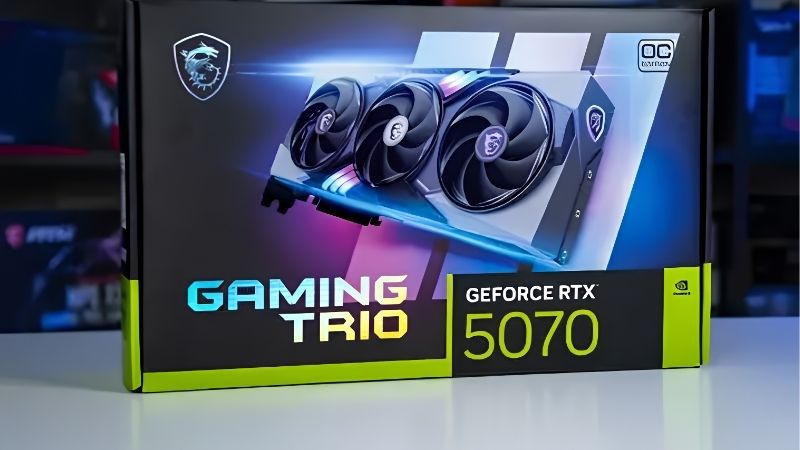
The Quick Verdict: RTX 5070 vs 4080 in 30 Seconds
The short answer: in pure rasterization and ray tracing without frame generation, the RTX 4080 wins by roughly 25–35% — it is simply a bigger, stronger GPU with 16GB of VRAM. The RTX 5070 wins on price (new at $549 versus used-market 4080 pricing), efficiency (250W vs 320W), warranty, and exclusive access to DLSS 4 Multi Frame Generation, which in supported titles produces higher on-screen frame rates than the 4080 can reach at all. For most buyers in 2026, a new 5070 is the smarter, safer purchase; the 4080 only wins if you find a clean used unit at a steep discount and you prioritize raw native performance. Check the 5070’s live price on Amazon first — at MSRP, it is hard to argue against.
The Case for the RTX 5070
The value math is straightforward: $549 buys 6,144 Blackwell CUDA cores, 12GB of GDDR7 at 672GB/s — bandwidth nearly matching the 4080’s despite a narrower bus — and the full DLSS 4 feature set including Multi Frame Generation, which generates up to three AI frames per rendered frame. In MFG-supported titles, the 5070’s on-screen output can exceed what the 4080 produces with its older 2x Frame Generation.
Add a 250W power budget that works on a 650W PSU, compact partner designs, a fresh three-year warranty, and an architecture Nvidia will optimize for years — the total ownership package is the strongest in this price class.
The Case for the RTX 4080
Raw silicon does not lie: 9,728 CUDA cores, 16GB of GDDR6X, and a 256-bit bus make the 4080 roughly 25–35% faster in native rendering and the clear winner in games without frame generation support, in competitive titles where added latency is unacceptable, and in VRAM-heavy 4K scenarios where 12GB runs tight.
The catch is acquisition. Discontinued since the Blackwell launch, the 4080 trades on the used market at $550–$700 for clean units — meaning at the low end it costs 5070 money while delivering a genuine performance tier above it. That overlap zone is exactly where this comparison gets interesting.
Specs Comparison Table
The quantitative foundation for everything that follows.
| Specification | RTX 5070 | RTX 4080 |
|---|---|---|
| Architecture | Blackwell (GB205) | Ada Lovelace (AD103) |
| CUDA Cores | 6,144 | 9,728 |
| VRAM | 12GB GDDR7 | 16GB GDDR6X |
| Memory Bandwidth | 672 GB/s | 716.8 GB/s |
| TGP (Power) | 250W | 320W |
| Frame Generation | DLSS 4 MFG (up to 4x) | DLSS 3 (2x) |
| Launch MSRP | $549 | $1,199 |
| 2026 Availability | New, in retail | Used market only |
| Recommended PSU | 650W | 750W |
Deep Dive Face-Off: Native Power vs AI Frames
This matchup is really a referendum on how you want your frames made. Below, we compare the two GPUs across native benchmark performance, the DLSS 4 question that defines the 5070’s pitch, and the practical realities of power, VRAM, and used-market risk that spec sheets never show.
Native Performance: The 4080’s Domain
At 1440p native, aggregated testing puts the 4080 ahead by 25–30% on average — typically 130–160 fps versus 100–125 fps in demanding AAA titles. At 4K the gap holds or widens slightly to 30–35%, aided by the 16GB buffer and wider bus, with the 4080 sustaining 60–80 fps natively where the 5070 lands in the 50–65 range and leans on upscaling.
Ray tracing without frame generation follows the same pattern: more RT cores and bandwidth keep the 4080 comfortably ahead. If your library skews toward competitive shooters, simulators, or older titles without DLSS 4 support, the 4080’s advantage is the one you will actually experience daily.
The 5070’s counterpunch is frame-time consistency per dollar: its GDDR7 subsystem produces remarkably steady 1% lows for its class, and at half the price of a used 4080’s upper range, its native performance per dollar is decisively better even while losing the absolute race.
DLSS 4 Multi Frame Generation: The Equalizer
Here is the experimental frontier that defines this comparison. MFG uses Blackwell’s AI hardware to generate up to three frames per rendered frame; in supported titles, a 5070 producing 60 base fps can present 180–200+ fps on screen — figures the 4080’s 2x Frame Generation caps well below. For high-refresh monitor owners playing supported single-player titles, the 5070 literally shows more frames than the stronger card.
The honest caveats: MFG inherits the base frame rate’s latency, so it flatters smoothness more than responsiveness, and support — while growing fast through 2026 — is not universal. Both cards share the improved DLSS transformer upscaler; only the 5070 gets the multiplier. Whether that multiplier outweighs 25–30% native deficit depends entirely on your game list, which is why this verdict splits by buyer rather than crowning one card.
Driver trajectory adds a temporal layer to the comparison: Blackwell is Nvidia’s active optimization target, and the 5070 has gained measurable performance in several engines through 2025–2026 driver branches, while Ada sits in stable maintenance mode. The card you benchmark today is the slowest 5070 you will ever own; the 4080 is already its final self.
Power, VRAM, and the Used-Market Reality
Practical ownership favors the 5070 across the board: 250W versus 320W means smaller coolers, easier cases, a 650W PSU instead of 750W, and roughly $20–$40 a year less electricity for a daily gamer. The 4080’s 16GB versus 12GB is the practical counterweight — at 4K with maxed textures, 12GB is adequate today but the tighter fit going forward.
Then there is risk. Every 4080 purchase in 2026 is a used purchase: unknown thermal history, warranty status varying by brand and transfer policy, and the standard hazards of peer-to-peer hardware. A sealed 5070 with full warranty removes all of it — a value component that never appears in benchmark charts but absolutely belongs in the decision.
2026 Market Forces: H200 Exports and Rising Prices
Two current news stories shape what both cards cost. The United States has approved Nvidia’s sale of the H200 — one of its most powerful AI chips — to China, and laptop and component prices continue climbing industry-wide. For this particular matchup, the two stories push the new card and the used card in revealing directions.
H200 Demand Tightens New-Card Supply
The export approval opens enormous additional demand for Nvidia’s advanced wafers and memory output — the same finite manufacturing pool that produces GeForce silicon and GDDR7. Historical pattern: when AI allocation surges, consumer GPU supply tightens and street prices drift 5–15% above MSRP within a couple of quarters.
The 5070, as current-generation Blackwell silicon sharing fab capacity with AI products, sits directly in that pressure zone. Listings at the $549 MSRP increasingly behave like flash sales — visible, then gone.
Component Inflation Lifts the Used Market Too
Memory and component costs have risen for consecutive quarters and laptop prices have already followed at retail. Used hardware prices are anchored to new alternatives, so as new cards firm up, the 4080’s used pricing has stopped its post-launch decline and plateaued — the $450 fire-sale 4080 many buyers waited for has simply not materialized.
Quantitatively: used 4080 listings that fell steadily through early 2025 have flattened in the $550–$700 band, and clean low-end listings sell within days.
What This Means for Your Timing
Both paths reward acting on a fair price rather than waiting. If you choose the 5070, an at-MSRP listing is the buy signal — the supply backdrop offers no catalyst for discounts this year. If you choose the 4080, a verified clean unit under about $600 is the threshold where its raw-performance advantage clearly outprices the new card’s package.
Either way, anchor to live numbers: check the RTX 5070’s current Amazon price today, compare it against what used 4080s actually close at, and let the real spread — not launch-day MSRPs — make the final call.
Final Verdict: Pros, Cons, and the Smart Alternative
This comparison ends in a split decision by design — the two cards win different games for different buyers. Here is the honest ledger, the third option that resolves most tie-breakers, and the final recommendation by profile.
Pros and Cons of Each Card
RTX 5070 — Pros: $549 new with full warranty; DLSS 4 Multi Frame Generation produces the highest on-screen frame rates in supported titles; 250W efficiency and compact designs; GDDR7 bandwidth near 4080 levels; years of driver optimization ahead. Cons: 25–35% slower natively; 12GB VRAM is the tighter long-term fit at 4K; street prices frequently exceed MSRP.
RTX 4080 — Pros: decisively faster native rendering and ray tracing; 16GB buffer with real 4K margin; excellent flagship-class coolers; strong in titles without frame-gen support. Cons: used-market only, with warranty and history risk; 320W draw and larger size; locked out of MFG; price floor propped up by market conditions.
The Alternative: RTX 5070 Ti Ends the Debate for $200 More
If you find yourself genuinely torn, the RTX 5070 Ti at $749 MSRP is the tiebreaker: 16GB of GDDR7, native performance matching or beating the 4080, full DLSS 4 MFG, and a new-card warranty. It is everything both cards in this comparison offer, with neither one’s weakness.
The only argument against it is budget — and if $749-class spending is on the table, it converts this entire matchup into a one-card answer. For strict $549-and-under shoppers, the 5070 remains the pick; for used-market bargain hunters, the 4080 under $600 remains a live option.
Who Should Buy Which
Buy the RTX 5070 if you want a new card with warranty, play DLSS 4-supported titles on a high-refresh 1440p monitor, value efficiency, or simply refuse used-hardware risk — it is the default recommendation for most readers. Buy the RTX 4080 only if you can verify a clean, ideally warrantied unit at $600 or below and your library rewards native horsepower over AI frames.
And if your budget reaches $749, skip both for the 5070 Ti — the rare case where the alternative is the actual answer.
See More:
Conclusion
The rtx 5070 vs 4080 matchup is a genuine philosophical split: the 4080 remains the stronger raw GPU, but the 5070 delivers the smarter 2026 purchase for most people — new, warrantied, efficient, half the launch-tier price, and armed with DLSS 4 Multi Frame Generation that out-frames the bigger card in supported titles. With H200 exports squeezing silicon supply and component costs rising, neither the new card’s MSRP listings nor the used card’s plateau prices are likely to improve, so the right move is matching the card to your library and acting on today’s numbers. Tap through to check the latest RTX 5070 price and stock on Amazon — and if the used 4080 route tempts you, let that live price be your benchmark.
Frequently Asked Questions
What is the best rtx 5070 4080 in 2026?
The best rtx 5070 4080 depends on your budget and how you plan to use it. The options compared above are our top-rated picks based on real customer ratings, build quality, and overall value — start with the highest-rated model that fits your budget.
How much should I expect to spend on a rtx 5070 4080?
Prices vary by brand and features. Budget options cover the essentials, while mid-range and premium models add durability, performance, and extra features. Compare the prices in the list above to find the best value for your needs.
What should I look for when buying a rtx 5070 4080?
Focus on what matters most for your use case — build quality, compatibility, performance, warranty, and verified customer reviews. Every pick above is selected to balance these factors.
Are budget rtx 5070 4080 options worth it?
Yes. For most people a well-reviewed budget or mid-range rtx 5070 4080 delivers excellent value. You only need to spend more if you specifically require premium materials or top-tier performance.
How did we choose these rtx 5070 4080 picks?
We compare current Amazon ratings, review counts, key features, and price to surface the options with the best real-world value. The list is refreshed as ratings and availability change.










Write Your Review
No reviews yet. Be the first to share your experience!