

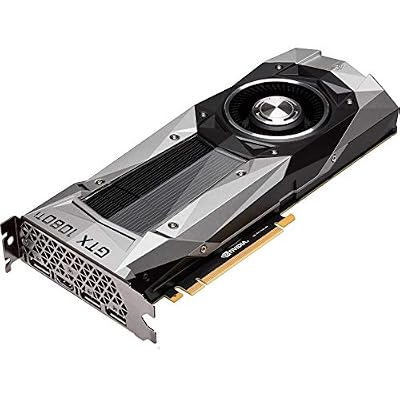


gtx 1080 ti vs rtx 2060 is a comparison the internet mostly answered in 2019 and then stopped updating, which is unfortunate, because the answer has changed. Back then the argument was about ray tracing and nobody had DLSS worth using. Nine years into the 1080 Ti’s life, the question is entirely different: does raw power plus 11GB of memory beat a weaker card with access to AI upscaling? That is a genuinely close call in 2026, and it is not the call the old videos made. Verdict below, numbers in a table, and the used-market checks that actually matter.
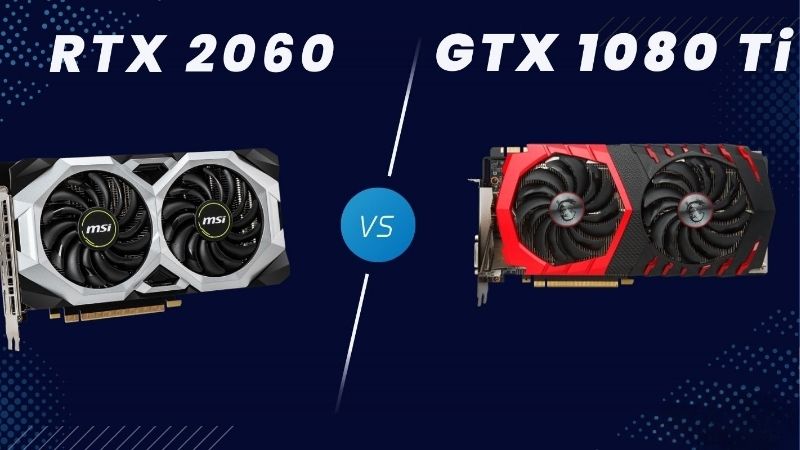
Quick Verdict: GTX 1080 Ti vs RTX 2060
The GTX 1080 Ti still wins for most people, and the reason is 11GB against 6GB. In rasterised games the 1080 Ti is roughly 10-20% faster, and it carries nearly double the memory – which in 2026 is the difference between adjusting settings and living with stutter. The RTX 2060’s counter is DLSS, and it is a real one: in titles that support it, upscaling can erase the raw performance gap entirely. But DLSS cannot manufacture VRAM, and 6GB is where the 2060 runs out of road first.
As an Amazon Associate we earn from qualifying purchases at no extra cost to you.





Why the 1080 Ti Refuses to Die
The 1080 Ti was an outlier and it is worth understanding why, because the reason is exactly what keeps it relevant.
Nvidia shipped it with 11GB on a 352-bit bus in 2017 – a configuration nobody expected at the time and nobody has repeated at that price since. It was a flagship built with no cost discipline, and the memory subsystem was absurdly generous relative to its era. Nine years later, that generosity is the entire reason it still works: it has more VRAM than an RTX 5070 selling new today.
Raw performance holds up too. At 1080p high the 1080 Ti typically delivers roughly 70-85 fps in modern AAA titles where the 2060 manages 55-70. At 1440p the gap widens, because the 352-bit bus and 11GB buffer both scale where the 2060’s 192-bit and 6GB do not.
What it does not have is any AI hardware at all. No DLSS, no Tensor cores, no ray tracing worth the name. That is permanent – no driver update changes it, and it is the argument against the card in a sentence.
What DLSS Actually Does for the 2060
This is the 2060’s whole case and it deserves to be made properly rather than dismissed.
DLSS renders the game at a lower resolution and uses AI to enlarge it intelligently. On a card as weak as the 2060, that is not a luxury feature – it is often the difference between 45 fps and 65 fps, which is the difference between a game being playable and not. In titles with DLSS support, the 2060 can close or eliminate the 1080 Ti’s raw performance lead entirely.
What makes this strategically interesting is the trajectory. Nvidia has repeatedly improved DLSS after purchase – the transformer model upgrade landed on hardware people had already owned for years, and it made those cards visibly better than they were at launch. The 2060 has received value it did not pay for. The 1080 Ti has received nothing and never will.
The limits are real though. DLSS support is broad but not universal, and it is thinnest in exactly the older and niche titles a budget buyer often plays. And crucially: DLSS reduces the rendering load, not the memory load. Textures still occupy the same VRAM at the same settings. A 6GB card running DLSS is a faster 6GB card, not an 8GB one – which means DLSS answers the performance question and does nothing about the wall the 2060 actually hits.
Full Comparison Table
The whole thing in one scan. Prices reflect used-market reality since neither card is sold new.
| Specification | GTX 1080 Ti | RTX 2060 6GB |
|---|---|---|
| Typical used price | $130-180 | $110-150 |
| VRAM | 11GB GDDR5X | 6GB GDDR6 |
| Memory bus | 352-bit | 192-bit |
| Board power | ~250W | ~160W |
| Recommended PSU | 600W | 500W |
| 1080p high (avg) | ~70-85 fps | ~55-70 fps |
| 1080p with DLSS | Not supported | ~75-95 fps |
| 1440p high | ~50-62 fps | ~40-50 fps |
| VRAM-heavy titles | Holds | Stutters |
| Ray tracing | None | Technically, unusably |
| Age | ~9 years | ~7 years |
| Best for | Raster, 1440p, high textures | DLSS titles, small cases, low power |
Rows seven and nine are the whole argument and they point in opposite directions. With DLSS on, the 2060 beats the 1080 Ti outright at 1080p. In VRAM-heavy titles, the 2060 stutters where the 1080 Ti holds. Both are true. Which one describes your library decides this.
Deep Dive: Buying Nine-Year-Old Silicon
There is a second comparison hiding inside this one that the old videos never had to address: both of these cards are now old enough that condition matters more than specification. A perfect 2060 beats a neglected 1080 Ti every time.
What to Check Before You Pay
Four checks, in order of how much money they save you.
Ask for a photo of the card under load with GPU-Z or Afterburner open, showing core clock and temperature. Thirty seconds of the seller’s time filters out most problems. A 1080 Ti idling at 60C in someone else’s case will not be cooler in yours.
Budget for a repaste regardless of the answer. Nine years is far past the pump-out point for factory thermal paste, and the 1080 Ti is a 250W card – it was hot when new. $15-25 for paste and pads plus an afternoon is not optional on either card, it is part of the purchase price.
Test it the same day. Twenty minutes of a real game, watching for artifacts, driver timeouts, or temperatures above 80C. Every dead-card story starts with someone who tested it next weekend, after the return window closed.
And check driver support honestly. The 1080 Ti is on Pascal, an architecture whose driver attention is winding down. It works today. It is not receiving optimisation for new releases the way the 2060’s Turing architecture still is – and that gap widens every year.
Pros and Cons: GTX 1080 Ti vs RTX 2060
| GTX 1080 Ti | RTX 2060 6GB | |
|---|---|---|
| Pros | 11GB is why it still works – more VRAM than cards costing three times as much; 10-20% faster in raster; 352-bit bus holds up at 1440p; genuinely usable at high textures | DLSS erases the raw performance gap in supported titles and keeps improving after purchase; 160W on a 500W PSU; compact models common; Turing still receives driver attention; two years younger |
| Cons | No DLSS, no Tensor cores, no ray tracing – permanently; 250W and 600W PSU; nine years old with worn fans and dried paste; Pascal driver support winding down | 6GB is below the 2026 floor and fails as stutter, not slowdown; DLSS cannot fix a VRAM wall; slower in raster; weakest at 1440p; also seven years old |
The asymmetry is what makes this interesting. The 1080 Ti’s weakness is a missing feature – annoying, but static. The 2060’s weakness is a memory ceiling that gets worse every year on its own, because games do not get lighter. One card is missing something. The other is running out of something.
The Hidden Cost: 250W vs 160W
This is where the 2060 quietly claws back ground that benchmark charts never show.
The 1080 Ti draws 250W and wants a 600W supply. The 2060 draws 160W and runs on 500W. If you are upgrading an old prebuilt or an OEM machine with a 450-500W unit, the 1080 Ti is not a $150 card – it is $150 plus a $70 power supply, and the value comparison inverts completely.
Physical size follows. 1080 Ti models are typically large dual or triple-fan designs; 2060 variants include compact and even low-profile options. For a small case or an office prebuilt, the 2060 may be the only one of the two that physically fits and runs – which makes the entire performance discussion academic.
Why Nine-Year-Old Cards Still Cost Real Money
Something is wrong with a market where a 2017 flagship still commands $150. Understanding why explains more about your purchase than any benchmark does.
Used Prices Followed the Component Surge
The memory-driven surge through late 2025 lifted laptop and component costs broadly, and used GPUs followed with a lag. The used market prices against the cheapest new alternative rather than against age – so when entry-level new cards got expensive, everything beneath them got pulled up with them.
The genuinely positive news is narrow but real: the steep climb seen at the end of 2025 has stopped, and manufacturers including Framework have reported a period of relative stability, while still warning openly that volatility has not ended.
Flat is not falling. A $150 1080 Ti is unlikely to be a $110 1080 Ti by spring. Your leverage comes from finding a motivated seller, not from waiting the market out – and the classic strategy of buying the weaker card now and upgrading when things get cheap does not survive contact with a market that is not getting cheap.
New Memory Capacity Arrives in 2027 or 2028
Genuine relief is under construction. OEMs can now source DDR5 from Chinese suppliers such as CXMT, and Micron is building two fabrication plants in Idaho – funded, structural additions to global supply rather than speculation.
The obstacle is the calendar. Those Idaho plants do not come online until 2027-2028. Fabrication capacity takes years to stand up, and any purchase you make this year concludes well before that supply reaches a shelf.
Which sharpens the VRAM argument rather than softening it. If cards got cheaper annually, buying 6GB now and escaping later would be a plan. In a flat market, choosing the smaller buffer is not deferring a cost – it is scheduling one at full price, two years from now, with no discount coming.
The Alternative Worth Considering First
Before committing to nine-year-old silicon, price an RTX 3060 12GB. It typically costs $160-210 used and gives you both the memory buffer and DLSS – the two things these cards each have only half of. That is usually the correct answer to this entire comparison, and it is only $30-60 more than a 1080 Ti.
Below that, an RX 6600 offers more raw performance than either card for similar money, without DLSS. And if you already own either card and it feels slow, check its temperature before spending anything – a nine-year-old card with dried paste in a case with one intake fan is throttling, losing performance you already paid for.
See More:
- A fan curve msi afterburner
- amd radeon rx 9070 vs rtx 5070
- 5060 ti vs 5070 benchmark
- rx 6600 vs rtx 3050
- 2060 vs 3060
Final Verdict and Recommendation
On gtx 1080 ti vs rtx 2060, the 2019 answer was ray tracing and the 2026 answer is memory – which is why the old videos are no longer useful.
Buy the GTX 1080 Ti if you play at 1080p high textures or want any 1440p capability, if your PSU is 600W or better, and if your library is not DLSS-dependent. The 11GB is the reason this card outlived its generation, and it is still the reason. Budget $25 for a repaste and test it the day it arrives.
Buy the RTX 2060 if your PSU is 500W, your case is small, or your library leans heavily on DLSS-supported titles where upscaling erases the gap. It is the more modern card and it will keep receiving driver attention longer. Just be clear that 6GB is a wall, not a limit you can tune around – and DLSS will not move that wall.
Honestly though: spend the extra $30-60 on an RTX 3060 12GB if you possibly can. It is the only card in this conversation that has both the memory and the upscaling, and in a market where nothing is getting cheaper before 2027, buying half a solution twice is the expensive path.
Frequently Asked Questions
Which is faster in traditional rasterized games?
The GTX 1080 Ti wins clearly, typically by around twenty-five to thirty-five percent at 1440p. It was a flagship card with a 352-bit memory bus and far more raw shader throughput than the mid-range RTX 2060. In pure raster terms it remains the more capable card, which is why it retained enthusiast reputation long after Pascal was superseded.
Does the RTX 2060 win on features?
Yes, decisively. The 2060 has RT cores and tensor cores, unlocking hardware ray tracing and DLSS, while the Pascal-based 1080 Ti has neither. DLSS in particular can more than close the raster gap in supported titles by rendering internally at lower resolution. The 2060 also has a newer NVENC encoder that produces noticeably better streaming quality.
How does the memory compare?
The GTX 1080 Ti carries 11GB of GDDR5X on a wide 352-bit bus, which is a genuine advantage for high texture settings and modded games. The standard RTX 2060 has only 6GB of GDDR6 on 192-bit, which is now a real constraint in modern titles. A later 12GB RTX 2060 variant exists and largely removes that weakness.
What about power consumption and heat?
The GTX 1080 Ti is rated at 250W and needs an 8-pin plus 6-pin connector, while the RTX 2060 sits around 160W on a single 8-pin. That is a substantial efficiency difference, meaning the Turing card runs cooler and quieter and works in systems with weaker power supplies. In a small or poorly ventilated case that matters considerably.
Which is the safer used purchase today?
Both are old enough to warrant caution, but the RTX 2060 is roughly two years younger, uses less power, and retains driver feature support that Pascal has lost. The 1080 Ti offers more raw performance and more memory but carries higher failure risk from aging thermal pads and fans. Inspect any used card under sustained load before committing.
Ready to decide? Our #1 pick for 2026 is the Typical used price.
Live price & availability on Amazon.




Write Your Review
No reviews yet. Be the first to share your experience!