
- Top Pick: GIGABYTE Radeon RX 9070 XT Gaming OC 16G Graphics Card, PCIe 5.0, 16GB GDDR6, GV-R9070XTGAMING OC-16GD Video Card
- Best Value: XFX Swift AMD Radeon RX 9070XT Triple Fan White Gaming Edition with 16GB GDDR6 HDMI 3xDP, AMD RDNA 4 RX-97TSWF3W9
- Premium Choice: ASRock Radeon RX 9070 Challenger 16GB OC Graphics Card, RDNA 4, 2520MHz Boost, 16GB GDDR6 256-bit, PCIe 5.0, Triple Fans, 0dB Silent, LED Indicator


amd radeon rx 9070 xt vs nvidia rtx 5070 ti is the matchup both companies actually designed against each other, which makes it the most honest comparison in this generation and the hardest one to call. Same 16GB. Same 256-bit bus. Raster performance within a few percent. And $150 between them. If you have been reading multiple reviews and opening tabs because nobody gives you a straight answer, that is because there genuinely is not an easy one – the cards are close enough that the decision rests on two features rather than on frames. This article makes the case on both sides and then commits to a verdict.
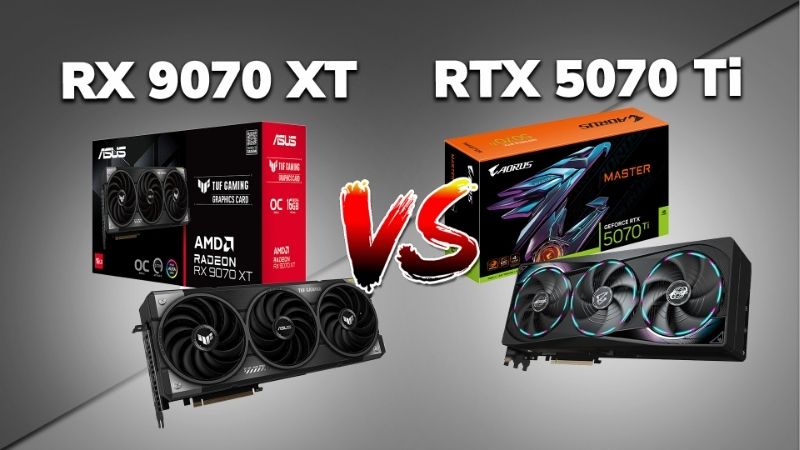
Quick Verdict: The Real Tier Match of This Generation
Raster is effectively a tie – the two trade within a few percent at 1440p, with the 5070 Ti typically nosing ahead by low single digits. Ray tracing is not a tie: the 5070 Ti leads by roughly 20-30% in RT-heavy titles. Both carry 16GB, which removes the longevity argument entirely. So the question reduces cleanly: is 20-30% more ray tracing plus DLSS 4 worth $150 to you? If you enable RT regularly or own a high-refresh panel where Multi Frame Generation earns its keep, yes. If you are a rasteriser, the 9070 XT is $150 of free money.
As an Amazon Associate we earn from qualifying purchases at no extra cost to you.


Why Raster Performance Is a Genuine Tie
This is unusual and worth stating precisely, because most comparisons manufacture a winner where none exists.
At 1440p high with ray tracing off, expect roughly 100-125 fps from both cards in modern AAA titles. Individual games favour one or the other by a few percent depending on how they lean on the architecture – some titles suit RDNA 4’s compute layout, others suit Blackwell’s. Neither pattern is consistent enough to call a winner.
At 4K the same picture holds, with both cards working comfortably and both benefiting substantially from upscaling in demanding titles. The 5070 Ti’s faster GDDR7 gives it slightly more bandwidth headroom; the 9070 XT compensates with raw silicon. Net: a wash.
The practical translation: if your monitor is 1440p at 144Hz or 165Hz, both cards saturate it in rasterised games. The frames are not the decision. Anyone who tells you one of these cards is meaningfully faster in normal gaming is either measuring one title or selling a thumbnail.
The 16GB Tie That Removes the Usual Tiebreaker
Here is the detail that makes this comparison harder than the others in this generation, and it is the one that usually resolves them.
Normally one card has more memory, and that argument does the heavy lifting – buy the bigger buffer, keep the card longer, done. The RX 9070 vs RTX 5070 comparison turns almost entirely on 16GB against 12GB. Here both cards carry 16GB on a 256-bit bus. The 5070 Ti has faster GDDR7; the 9070 XT has GDDR6. Bandwidth differs. Capacity does not.
That distinction matters because capacity is what causes stutter and bandwidth is what causes frame rate. A card short on bandwidth runs slower – predictable and tunable. A card short on capacity hitches, streams textures in late, and its 1% lows collapse while the average stays deceptively healthy. Both of these cards reach that wall at the same point.
So neither card ages better than the other. In three or four years, when 16GB starts feeling tight at 4K with maxed textures, they will feel it together. You cannot buy your way out of the future here for $150 – which strips away the comfortable justification and forces the decision onto features you either use or do not.
Full Spec Comparison Table
Everything that decides this in one scan.
| Specification | AMD RX 9070 XT | Nvidia RTX 5070 Ti |
|---|---|---|
| Launch MSRP | $599 | $749 |
| VRAM | 16GB GDDR6 | 16GB GDDR7 |
| Memory bus | 256-bit | 256-bit |
| Board power | ~304W | ~300W |
| Recommended PSU | 750W | 750W |
| Power connector | 2x 8-pin | 1x 16-pin (12V-2×6) |
| Raster 1440p (avg) | ~100-125 fps | ~100-125 fps |
| Raster (relative) | 100% | ~100-105% |
| Ray tracing (relative) | 100% | ~120-130% |
| Upscaling | FSR 4 | DLSS 4 + Multi Frame Gen |
| Price (relative) | 100% | ~125% |
| Best for | Raster, value, 8-pin simplicity | Ray tracing, creator apps, 144Hz+ |
Read rows eight, nine, and eleven together and the whole comparison is there. Raster scales at 100-105%. Ray tracing at 120-130%. Price at 125%. The 5070 Ti’s premium is funded almost exactly by its ray tracing advantage and nothing else – which means the card is fairly priced if you use RT and overpriced if you do not. That is a cleaner answer than most of these comparisons produce.
Deep Dive: The Two Features the $150 Buys
With raster tied and VRAM tied, this decision comes down to two things. Both are real. Neither is universal. Working out whether they describe you is the entire job.
Ray Tracing: A Real 20-30% That Most People Do Not Use
The gap is genuine. In mixed RT titles at 1440p the 5070 Ti leads by roughly 20-30%, and in the heaviest path-traced showcases it pulls further ahead – those titles are typically built around Nvidia’s toolchain, and AMD’s RT hardware has less headroom to absorb them despite RDNA 4’s substantial improvements.
The honest test costs nothing: look at what you actually played in the last three months. If ray tracing was off in all of it and you did not notice its absence, this argument does not apply to you regardless of how appealing it sounds in a review. A lot of people buy RT capability and then leave it off because the frame cost annoys them.
If you do use it, the calculation flips completely. A 20-30% RT advantage on a $150 premium is proportionate rather than generous, and it is the difference between running path tracing with compromises and running it comfortably.
DLSS 4 and Multi Frame Generation on a High-Refresh Panel
This is the more forward-looking argument and it deserves more weight than the benchmark charts give it.
DLSS 4’s transformer model still holds an edge over FSR 4 on temporal stability – fine detail in motion, foliage, fences, hair. FSR 4 closed most of the gap and is genuinely good rather than a compromise, but the edge remains and Nvidia’s game support list is longer.
Multi Frame Generation is the piece that matters specifically on a 144Hz or 240Hz panel. It exists to fill high-refresh displays, and on that hardware it changes how the game feels rather than how it benchmarks. On a 60Hz or 75Hz monitor it is close to pointless. On a 240Hz panel it is arguably the single most valuable feature on the card.
The longer view is worth weighing if you keep hardware for four years. Nvidia’s software cadence has repeatedly added capability to cards after purchase – the transformer model landed on hardware people already owned and made those cards visibly better than they were at launch. Buying into that curve is buying something unquantifiable but real. Whether it is worth $150 depends on how much you value a trajectory versus a number.
Pros and Cons: 9070 XT vs 5070 Ti
| AMD RX 9070 XT | Nvidia RTX 5070 Ti | |
|---|---|---|
| Pros | $150 cheaper for the same raster and the same 16GB; conventional 2x 8-pin cables with no adapter or seating risk; AMD historically discounts more aggressively; $150 left for a monitor, PSU, or RAM | 20-30% better ray tracing; DLSS 4 with the longer support list; Multi Frame Generation that earns its keep on 144Hz+; CUDA for Blender, Resolve and local AI; NVENC for streaming; stronger resale |
| Cons | RT deficit is structural and widens in path-traced titles; no CUDA – a hard blocker rather than a slowdown; FSR 4 coverage thinner than DLSS; nothing to gain from Nvidia’s post-purchase feature cadence | 25% more money for 0-5% more raster; the same 16GB as the cheaper card means no longevity advantage; 16-pin connector must be fully seated; premium unfunded if RT stays off |
Notice how clean the trade is. This is not a case of one card being better and one being cheaper. It is a case of $150 buying exactly one thing – ray tracing and the Nvidia feature stack – with everything else held constant. That is rare, and it means you can answer this honestly rather than guessing.
Why the $150 Gap Will Not Close
Everything above assumes today’s prices, and the $150 is doing all the work in this decision. So it is worth knowing whether it is likely to move.
Prices Have Flattened but Are Not Falling
The memory-driven surge through late 2025 lifted component and laptop pricing broadly. The genuinely positive development is narrow but real: the steep climb seen at the end of 2025 has stopped, and manufacturers including Framework have reported a stretch of relative stability – while still warning openly that further volatility remains possible.
Flat is not falling. Neither card is likely to be meaningfully cheaper in three months, which means the $150 is durable rather than something that closes on its own. The panic-buy urgency has eased; the reward for patience never arrived.
This matters more here than usual because of the shared 16GB. In most comparisons you justify paying up by buying memory headroom that outlasts the cheaper card. That argument does not exist in this matchup – so in a flat market, the $150 buys ray tracing and nothing that protects you from the future.
The H200 Decision and Why Nvidia Holds Its Price
The US has cleared Nvidia to sell the H200 – among its most capable AI accelerators – to China. That reads like data centre news, but it explains why the 5070 Ti’s premium is unlikely to erode.
Nvidia has finite advanced packaging and high-bandwidth memory allocation, and every unit gets assigned somewhere. AI silicon carries margins gaming cards cannot approach. Opening a large additional market for H200 increases the pull on the same upstream supply that feeds GDDR7 production and board partner allocation – and it removes any commercial pressure on Nvidia to compete on price in the mid-high gaming bracket.
The practical read: do not wait for the 5070 Ti to fall to $649. Nvidia’s attention and wafer allocation are pointed elsewhere. If anything, AMD has historically been the one to move on price at this tier – which means the gap could widen in the 9070 XT’s favour rather than close.
What to Buy Alongside Either Card
Both cards draw roughly 300W and want a 750W supply with genuine intake airflow. That is not optional – a 300W card in a chassis with one intake fan throttles, and a throttled 5070 Ti is a very expensive 9070 XT.
If you go Nvidia, buy the native 12V-2×6 cable for your specific PSU rather than using the bundled adapter. Partial seating is the mechanism behind essentially every melted connector, and $25 removes that risk permanently. If you go AMD, the 2x 8-pin cables you already own work and there is nothing to think about – a small advantage that is worth more than people give it credit for.
See More:
- A fan curve msi afterburner
- amd radeon rx 9070 vs rtx 5070
- 5060 ti vs 5070 benchmark
- rx 6600 vs rtx 3050
- 2060 vs 3060
Final Verdict and Recommendation
On amd radeon rx 9070 xt vs nvidia rtx 5070 ti, the cards are close enough that the honest answer is a question rather than a winner – and the question is whether you turn ray tracing on.
Buy the RX 9070 XT at $599 if you are a rasteriser. Same frames, same 16GB, same PSU requirement, simpler cables, and $150 back. Given that the memory is tied and the raster is tied, that $150 is buying you a feature you have to actually use for it to be worth anything – and most people do not. This is the rational default and the majority of readers should stop here.
Buy the RTX 5070 Ti at $749 if ray tracing is genuinely part of your play, if your panel is 144Hz or above where Multi Frame Generation earns its money, if you stream, or if you use Blender, Resolve, or local AI where CUDA is a requirement rather than a preference. The premium is proportionate to the RT gain – it is fair, not generous.
And decide on today’s window rather than a hoped-for correction. With component pricing flat and Nvidia’s supply attention firmly on AI silicon, the $150 is not closing this year. The only variable genuinely worth optimising is the board partner spread – which on identical silicon can be $60 of the gap you are agonising over.
Frequently Asked Questions
Is the RTX 5070 Ti worth a $150 premium over the RX 9070 XT?
It depends entirely on what you play. If your library is mostly rasterized games at 1440p, the Radeon delivers comparable frames for meaningfully less money and the premium is hard to justify. If you play heavy ray traced titles, stream, or run CUDA-accelerated creative and AI applications, the GeForce card earns back the difference through capability rather than raw frame rate.
How large is the ray tracing gap in practice?
Significant. RDNA 4 improved substantially over previous Radeon generations, but Blackwell RT cores still lead by roughly twenty to thirty percent in typical ray traced workloads and considerably more in path traced titles like the heaviest showcase games. If ray tracing is a feature you will actually enable rather than just benchmark, that gap is the main argument for NVIDIA.
Do both cards have the same amount of memory?
Yes, both carry 16GB on a 256-bit bus. The RTX 5070 Ti uses GDDR7 with higher effective bandwidth while the RX 9070 XT uses GDDR6. Capacity parity means neither card has a future-proofing advantage on frame buffer size, which removes what is often the deciding factor in cross-brand comparisons at this price level.
How do power draw and PSU needs compare?
They are near-identical, with the RTX 5070 Ti rated near 300W and the RX 9070 XT near 304W. A quality 750W supply covers either. The practical difference is the connector: most Radeon models use two or three standard 8-pin PCIe cables, while the GeForce card uses a 12V-2×6 that ideally wants a native cable from an ATX 3.x supply.
Which has the better software ecosystem?
AMD Adrenalin is an excellent all-in-one package with tuning, recording, Anti-Lag and Chill built in. NVIDIA counters with broader DLSS game support, the industry-standard NVENC encoder for streaming, and near-universal CUDA compatibility across creative and AI software. For gaming alone the two are close; for anything beyond gaming, NVIDIA still holds a clear ecosystem advantage.
Ready to decide? Our #1 pick for 2026 is the Launch MSRP.
Live price & availability on Amazon.

Write Your Review
No reviews yet. Be the first to share your experience!