
Top Rtx 5080 3090 New Speed Picks for 2026
Here are our current top rtx 5080 3090 new speed picks, compared on real Amazon owner reviews, price, and features. Live prices update below.
- Top Rtx 5080 3090 New Speed Picks for 2026
- RTX 5080 vs 3090: Quick Verdict and Core Specifications
- Deep Dive Face-Off: Gaming, AI Workloads, and Running Costs
- The 2026 Market: Why Both Cards Cost More Than They Should
- Final Verdict: Who Should Buy Which GPU?
- Conclusion
- Related Guides
- Frequently Asked Questions
- Related Articles

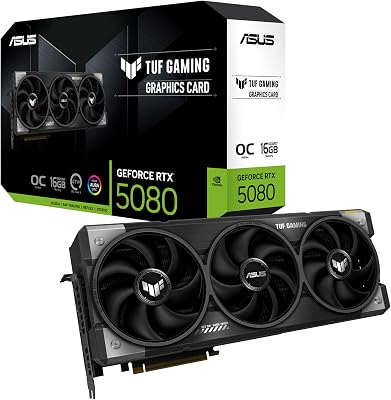


RTX 5080 vs 3090 is a comparison between two cards built around opposite philosophies: raw modern speed against sheer memory capacity. The RTX 3090 launched in 2020 at $1,499 as Ampere’s halo card, and its 24GB of VRAM has kept it relevant in AI circles long after its gaming crown slipped. The RTX 5080 arrived in 2025 at $999 with 16GB of GDDR7, DLSS 4, and performance the 3090 cannot approach. In 2026, with the 3090 selling used for a fraction of its launch price, this matchup is really a question about what you do with a GPU. This comparison answers it with specs, benchmarks, and current market data.
RTX 5080 vs 3090: Quick Verdict and Core Specifications
Five years and two architectures separate these cards, yet their core counts and bandwidth figures look strangely similar on paper. The spec sheet below shows why paper similarity is deceiving — and the verdict explains who should still care about the older card.
The Quick Verdict for Busy Buyers
The RTX 5080 wins for gaming, and it is not close: roughly 50 to 60 percent faster at 4K raster, more than double the effective performance in path-traced titles with DLSS 4 Multi Frame Generation, and all of it with a warranty at $999 MSRP.
The RTX 3090 survives for exactly one buyer: the budget AI and creative user whose models or scenes need more than 16GB of VRAM. Its 24GB buffer at a used price around $650 to $750 remains the cheapest path to that capacity. For everyone else, check the RTX 5080’s current price on Amazon — it is the answer.
Specification Comparison Table
Here are the numbers side by side. Note how close the core counts and bandwidth are, then look at the clock speeds — that gap, plus five years of architectural work, is where the performance difference lives.
| Specification | RTX 3090 | RTX 5080 |
|---|---|---|
| Architecture | Ampere (2020) | Blackwell (2025) |
| CUDA Cores | 10,496 | 10,752 |
| Boost Clock | 1.70 GHz | 2.62 GHz |
| VRAM | 24GB GDDR6X | 16GB GDDR7 |
| Memory Bandwidth | 936 GB/s | 960 GB/s |
| Board Power | 350W | 360W |
| DLSS Support | DLSS 2 (Super Resolution) | DLSS 4 (Multi Frame Generation) |
| Launch Price | $1,499 | $999 |
Nearly identical core counts delivering wildly different performance is the clearest illustration in Nvidia’s lineup of how much work each generation extracts per core.
Pros and Cons of Each Card
A fair RTX 5080 vs 3090 assessment puts the liabilities next to the headlines, because both cards carry one weakness large enough to redirect certain buyers entirely.
RTX 3090 pros: 24GB of VRAM at the lowest price per gigabyte on the market; NVLink support for paired-card AI setups; still adequate 4K raster for older titles; abundant used supply. Cons: 350W draw with notoriously hot GDDR6X memory on the rear of the board; no Frame Generation of any kind; many units ran mining or training workloads around the clock; performance per watt is poor by 2026 standards.
RTX 5080 pros: 50-plus percent faster with the full Blackwell feature set; GDDR7 with 960 GB/s of bandwidth; DLSS 4 Multi Frame Generation and Reflex 2; new-card warranty and strong resale trajectory. Cons: 16GB ceiling disqualifies it for the largest local AI models; street prices frequently exceed the $999 MSRP; requires a 16-pin connector and a quality 850W power supply.
Deep Dive Face-Off: Gaming, AI Workloads, and Running Costs
The two cards diverge so sharply by workload that averages mislead. These four sections separate the gaming story, the system story, the AI story, and the money story.
4K and 1440p Gaming Performance
At 4K raster, the RTX 3090 manages 50 to 65 fps in demanding 2024-2026 titles at high settings — playable, but requiring upscaling for comfort. The RTX 5080 delivers 95 to 125 fps in the same games, saturating 4K 120Hz displays natively and leaving headroom for maximum settings.
At 1440p both cards exceed 100 fps in nearly everything, but the 5080 pairs properly with 240Hz panels while the 3090 increasingly hits engine and CPU interactions that cap its scaling. The newer card’s steadier one-percent lows are visible even when averages converge. DLSS treatment differs too: the 3090 receives the improved transformer upscaler through drivers — a genuine free upgrade — but remains locked out of every form of frame generation, so its frame-rate ceiling is whatever it renders natively.
Ray tracing ends the contest. The 3090’s second-generation RT cores predate the path-tracing era; in fully path-traced games it falls to slideshow territory without aggressive upscaling. The 5080 with DLSS 4 Multi Frame Generation holds 150-plus presented fps in those same showcases with latency managed by Reflex.
Power, Thermals, and System Compatibility
Board powers are nearly identical — 350W against 360W — so neither card is the efficient choice in absolute terms, but the 5080 produces roughly 1.6 times the frames from the same wattage. A quality 850W power supply is the sensible floor for either; the 3090’s transient spikes are harsher and have tripped many 750W units that looked sufficient on paper, particularly older designs predating the ATX 3.0 transient specifications.
Thermals are the 3090’s known weak point: half its GDDR6X modules sit on the board’s rear, and on used cards with dried thermal pads those chips routinely exceed 100C, throttling performance. Budget for a pad replacement on any secondhand unit — a $20 fix that routinely recovers lost performance and silences fan ramping on these cards. The 5080’s memory runs dramatically cooler, and its coolers — typically 2.5 to 3 slots — manage 360W quietly.
Connectors differ by era: most 3090s take standard 8-pin plugs, while the 5080 uses the 12V-2×6 connector, so plan for an ATX 3.0/3.1 PSU or careful adapter routing with no tight bends.
AI, Creative Work, and the 24GB Question
This is the only arena where the 3090 still wins arguments. Local language models, high-resolution video generation, and large rendering scenes that exceed 16GB simply do not fit on the 5080 — and a model that does not fit runs at unusable speeds or not at all. For those workloads, a used 3090’s 24GB at $700 remains the budget benchmark, with NVLink offering a 48GB pooled path no consumer Blackwell card matches. Several popular local-AI communities still list the 3090 as their default budget recommendation for exactly this reason: capacity gates capability, and no amount of newer-generation speed substitutes for a model that loads.
Everywhere under that ceiling, the 5080 dominates: its fifth-generation Tensor Cores with FP4 support deliver two to three times the inference throughput, its dual encoders accelerate modern video pipelines, and Nvidia’s current software optimization targets Blackwell first. The honest summary: capacity belongs to the 3090, speed belongs entirely to the 5080.
Value per Frame: The Cost Math
Quantify it with 2026 street prices. A used 3090 at $700 averaging 58 fps across a 4K test suite costs about $12.07 per frame. The RTX 5080 at $999 averaging 110 fps costs $9.08 per frame — the new card is roughly 25 percent cheaper per unit of gaming performance despite the higher sticker.
Ownership horizons widen the gap. The 5080 carries a warranty and a credible five-year service life; the used 3090 is a six-year-old card with elevated failure risk and a thermal maintenance bill pending. Amortized per comfortable year, the comparison is not competitive for gamers.
The math only inverts for VRAM-bound work: if your workload needs 20GB, the 5080’s price per useful frame is infinite, and the 3090 wins by forfeit. Buy by workload, not by benchmark.
The 2026 Market: Why Both Cards Cost More Than They Should
Two current industry developments are propping up prices on both sides of this comparison — one new card and one five-year-old card that refuses to depreciate. Factor them into your timing.
The H200 China Approval and Its Ripple Effects
The US has cleared Nvidia to sell the H200 — one of its most powerful AI accelerators — to China, releasing a backlog of data-center demand into supply chains already running hot. Accelerators and GeForce cards compete for the same memory output and packaging capacity, and Nvidia allocates toward its highest margins.
The 5080 feels this as tightened MSRP availability. The 3090 feels it more unusually: renewed AI build-out raises demand for any 24GB card, and used 3090 prices have firmed on exactly that logic. Both sides of this matchup are being bid up by the same macro force.
Rising Component and Laptop Prices
In parallel, laptop and PC component prices continue trending upward, led by memory. GDDR7 competes with server DRAM for constrained fab capacity, holding new-card costs firm, while elevated prices for new hardware push more buyers into the used market and support secondhand values.
The actionable read: neither a cheaper 5080 nor a cheaper 3090 is likely in the coming quarters. Price trackers show used 3090s flat to slightly up year over year — an extraordinary trajectory for a card this old.
Buy Now or Wait?
If the workload exists today, buy today. A 5080 at or near $999, or a clean 3090 under $720 with a return window, are both fair 2026 prices with more upside risk than downside.
Set Amazon price alerts on both and act on your target — in this market, hesitation has been the expensive strategy for two years running.
Final Verdict: Who Should Buy Which GPU?
The recommendation splits cleanly by use case, with almost no overlap between the two buyer profiles. Here is each, plus the card that resolves the dilemma for buyers who need both speed and memory.
Who Should Buy the RTX 3090
Buy a used 3090 only if your AI or creative workloads demonstrably exceed 16GB and your budget cannot reach modern 24GB options. At $650 to $720 it remains the cheapest serious VRAM on the market.
Inspect aggressively: stress test immediately, monitor rear-memory temperatures, and assume thermal pads need replacing. Prefer listings with returns over private sales.
Who Should Buy the RTX 5080
Everyone buying for gaming should buy the RTX 5080. It is 50 to 60 percent faster, dramatically better in ray tracing, equipped with DLSS 4, and cheaper per frame than the used flagship it replaces in this comparison.
When Amazon stock appears at or near $999, it moves fast — set the alert and be ready.
The Alternative: Used RTX 4090
If you genuinely need both speed and memory, a used RTX 4090 at $1,200 to $1,400 splits the difference: 24GB of VRAM, performance within 15 percent of the 5080 in raster, and DLSS 3 Frame Generation.
It costs more than either card here, but it is the only option that wins both halves of this comparison at once — price it on Amazon before committing to either extreme.
See More:
- Nvidia Reflex low latency
- RTX 4070 vs 5060 Ti
- Zephyr RTX 4070
- RTX 3080 Ti price
- Nvidia RTX 2060 Super
Conclusion
The RTX 5080 vs 3090 decision reduces to one question: do you need more than 16GB of VRAM? If yes, the 3090’s 24GB at used prices keeps it alive as the budget AI workhorse. If no — and for virtually all gamers the answer is no — the 5080 is 50 to 60 percent faster, far more efficient per frame, equipped with DLSS 4, and protected by a warranty. With the H200 export approval and rising component prices supporting values on both sides, waiting earns nothing. Settle your side of the RTX 5080 vs 3090 question, then check current Amazon listings and buy at today’s price.
Frequently Asked Questions
What is the best rtx 5080 3090 in 2026?
The best rtx 5080 3090 depends on your budget and how you plan to use it. The options compared above are our top-rated picks based on real customer ratings, build quality, and overall value — start with the highest-rated model that fits your budget.
How much should I expect to spend on a rtx 5080 3090?
Prices vary by brand and features. Budget options cover the essentials, while mid-range and premium models add durability, performance, and extra features. Compare the prices in the list above to find the best value for your needs.
What should I look for when buying a rtx 5080 3090?
Focus on what matters most for your use case — build quality, compatibility, performance, warranty, and verified customer reviews. Every pick above is selected to balance these factors.
Are budget rtx 5080 3090 options worth it?
Yes. For most people a well-reviewed budget or mid-range rtx 5080 3090 delivers excellent value. You only need to spend more if you specifically require premium materials or top-tier performance.
How did we choose these rtx 5080 3090 picks?
We compare current Amazon ratings, review counts, key features, and price to surface the options with the best real-world value. The list is refreshed as ratings and availability change.










Write Your Review
No reviews yet. Be the first to share your experience!