
- Top Pick: ZOTAC Gaming GeForce RTX 5070 Ti Solid SFF OC DLSS 4 16GB GDDR7 256-bit 28 Gbps PCIE 5.0 Gaming Graphics Card, IceStorm 2.0 Advanced Cooling, ZT-B50710J3-10A
- Best Value: ZOTAC Gaming GeForce RTX 5070 Ti Solid SFF OC DLSS 4 16GB GDDR7 256-bit 28 Gbps PCIE 5.0 Gaming Graphics Card, IceStorm 2.0 Advanced Cooling, ZT-B50710J3-10P
- Premium Choice: ZOTAC SOLID CORE OC White Edition GeForce RTX 5070 Ti 16GB GDDR7 PCI Express 5.0
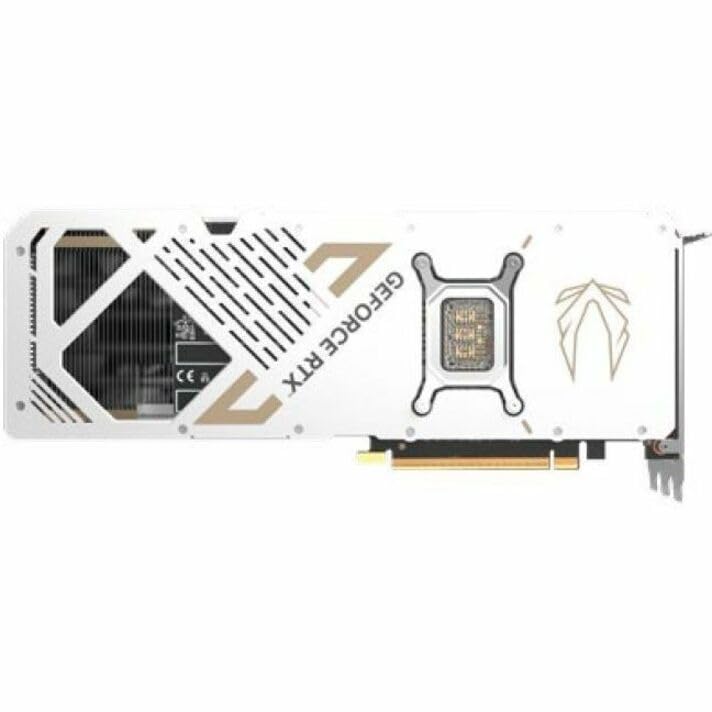


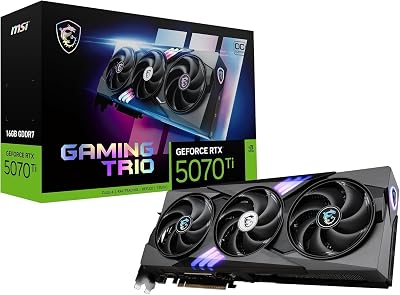
The zotac rtx 5070 ti solid oc lands in the part of the buying process almost nobody writes about properly: you have already chosen the GPU, and now you are choosing which company’s cooler goes on top of it. That decision gets almost no video coverage because the audience is too narrow – which is precisely why the information you need is written down instead. This review covers what the OC bin genuinely delivers, the clearance and power checks that decide whether it fits your build, and how Zotac’s positioning compares to the ASUS, MSI and Gigabyte alternatives sitting next to it in the results.
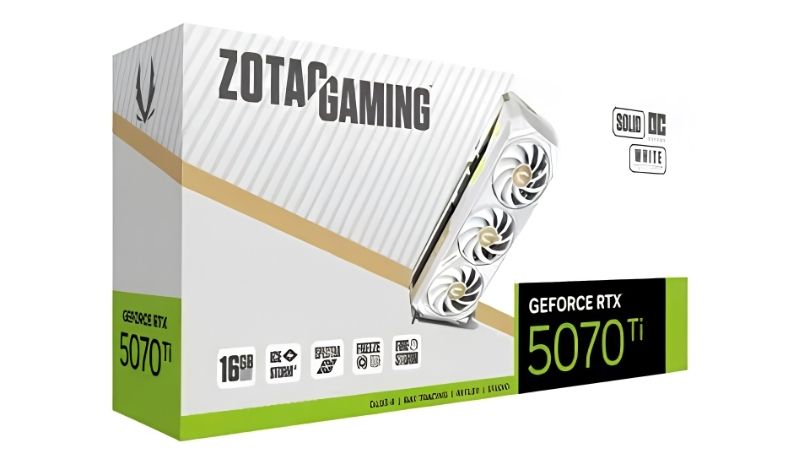
What the Zotac RTX 5070 Ti Solid OC Actually Is
Start with the part that matters most and is least understood: every RTX 5070 Ti on the market runs the same silicon. Roughly 8,960 CUDA cores, 16GB of GDDR7 on a 256-bit bus, a 300W board power figure, and a $749 MSRP. Zotac does not change any of that. What Zotac sells you is a cooler, a factory clock bin, a warranty, and a price – and those four things are the entire decision.
As an Amazon Associate we earn from qualifying purchases at no extra cost to you.


What the OC Bin Genuinely Buys You
Factory overclocked cards get sold on a number and bought on a hope. The honest reality: a typical factory OC on this class of card adds somewhere in the region of 2-4% over reference clocks. In frames, on a card delivering 100 fps, that is 102-104 fps. You will not feel it.
The reason is that modern Nvidia cards are not clock-limited in any meaningful sense – they are power and thermal limited. GPU Boost already pushes the card as far as its power budget and temperature allow, dynamically, every second. A factory OC raises the ceiling on a system that was already running into a different wall.
What actually determines your sustained clocks is the cooler and the airflow feeding it. A card held at 65C will hold higher boost bins indefinitely than the same silicon at 78C, and that gap is worth considerably more than any factory OC on the box. So the honest way to read a model like this is: ignore the OC suffix, evaluate the cooler, and treat the extra clocks as a rounding error you get for free.
The Clearance and Power Checks to Do Before You Order
This is where 5070 Ti purchases actually go wrong, and it has nothing to do with performance.
Measure your case first, front to back, in millimetres. Cards in this class commonly run in the 300-340mm range and 2.5 to 3 slots thick. Thickness is the detail people forget – a 3-slot card blocks the PCIe slot beneath it, which matters if you have a capture card, sound card, or NVMe expansion. Check the exact length and slot width on the product listing before ordering, because board partners revise designs between batches and a number you read in a forum post from last year may not describe the card in the box.
Power second. A 300W card wants a 750W PSU as a sensible floor, and it uses the 16-pin 12V-2×6 connector. If your supply is ATX 3.0 or newer with a native 16-pin cable, use it. If not, you are using the bundled adapter – and the adapter must be fully seated until it clicks. Partial seating is the single most reported cause of melted 12V-2×6 connectors, and it is a user-installable failure rather than a design defect. Seat it, tug it, look at it. This thirty-second check has saved more cards than any warranty.
Airflow third. A 300W card in a case with one intake fan will throttle regardless of whose name is on the shroud. If your front panel is solid glass with no intake path, no cooler on the market saves you.
What Owners Consistently Report About This Class
Aggregate the feedback on triple-fan 5070 Ti models and the pattern is consistent enough to be useful.
Positive reports cluster around thermals and acoustics. Cards in this class typically settle in the mid-to-high 60s under sustained gaming load with a sensible fan curve, and the zero-RPM idle behaviour is near-universally appreciated – buyers repeatedly note the card being silent on the desktop, which is the state it spends most of its life in.
Critical reports cluster around three things, and none of them are performance. Coil whine is the most common, and it is genuinely a silicon lottery rather than a brand trait – it appears across every board partner and no review can predict your unit. Physical fit is second: buyers who did not measure. And software is third, with buyers noting they would rather not install another vendor utility just to control RGB and fan speed.
That last complaint has a free fix worth knowing. MSI Afterburner controls fan curves and clocks on any brand’s card regardless of who made it, which means you can skip the vendor utility entirely. A custom fan curve on a card like this typically drops sustained temperatures 8-12C and recovers 60-90 MHz of boost clock – considerably more than the factory OC you paid for.
How It Compares to the Alternatives Next to It
Nobody buys this card in isolation. You are looking at four or five 5070 Ti models in the same results page with a $60-100 spread between them, all running identical silicon. Here is how to read that spread rather than guess at it.
Zotac vs ASUS, MSI and Gigabyte at This Tier
Zotac’s positioning has been consistent for years: competitive coolers at lower prices, with a leaner brand presence. The company generally competes on value rather than prestige, and at this tier that usually means you are paying $30-70 less than the equivalent ASUS TUF or MSI Gaming Trio for a card whose sustained temperatures land within a few degrees.
Where the premium brands genuinely earn their money: build quality on the backplate and frame, marginally quieter fan hardware at matched duty cycles, and – the underrated one – RMA experience. Zotac’s warranty terms are competitive on paper, but service quality varies by region in a way spec sheets never capture. If you are in a market where Zotac has weak local support, that is a real cost that does not appear in the price.
The honest summary: at identical silicon, a $60 saving on the card is worth more than a 2C temperature difference or a slightly nicer backplate. If you are shopping value, Zotac is a rational pick. If you have been burned by an RMA process before, pay the premium for peace of mind and do not let anyone tell you that is irrational.
The one thing worth paying attention to across all brands is where the price actually lands week to week. Board partner pricing on the same GPU frequently spreads $60-100, and that spread moves.
Pros and Cons of the Zotac RTX 5070 Ti Solid OC
| Pros | Cons |
|---|---|
| 16GB GDDR7 on a 256-bit bus – the VRAM headroom that makes this tier age well, and more than the 5070 below it | The OC bin adds roughly 2-4%, which you will not feel – do not pay a premium for the suffix |
| Typically $30-70 below equivalent ASUS and MSI models running identical silicon | 300W board power demands a 750W PSU and genuine case airflow |
| Triple-fan cooler with zero-RPM idle – silent on the desktop where the card lives most of the time | The 16-pin 12V-2×6 connector must be fully seated; the adapter is a real risk if rushed |
| Strong 1440p card with headroom for 4K with DLSS 4 and Multi Frame Generation | 300-340mm and 2.5-3 slots blocks the PCIe slot below and does not suit small cases |
| Fan curve fully controllable in Afterburner – no vendor software required | RMA experience varies by region more than with the premium brands |
The balance is clean and it is the same balance Zotac has always offered. You are trading brand polish and RMA confidence for real money on identical silicon. Whether that trade is correct depends less on the card than on your postcode.
Who This Card Is Actually For
Buy it if you are running 1440p at high refresh, have a mid-tower with genuine intake airflow, own a 750W ATX 3.0 supply with a native 16-pin cable, and would rather have $60 than a nicer backplate. That is the profile this card serves well, and it serves it properly.
Do not buy it if your case is compact or your front panel is sealed glass, if your PSU is below 750W or lacks a native connector, or if you are in a region where Zotac support is thin. None of those are performance objections. All of them will cost you more than the $60 you saved.
And if you are buying it for the OC suffix, stop and reconsider – build a fan curve on any 5070 Ti and you will exceed what the factory bin gave you, for free, in ninety seconds.
Why 5070 Ti Pricing Is Not Improving
Everything above assumes today’s price. That assumption deserves scrutiny, because the reason a 5070 Ti costs what it does has very little to do with the 5070 Ti.
Component Prices Have Flattened but Not Fallen
The memory-driven surge through late 2025 lifted component and laptop pricing broadly. The genuinely positive development is narrow but real: the steep climb seen at the end of 2025 has stopped, and manufacturers including Framework have reported a stretch of relative stability – while continuing to warn openly that further volatility is possible.
Read the distinction precisely. Flat is not falling. This card is unlikely to be meaningfully cheaper in three months. The urgency to panic-buy has gone; the reward for waiting never materialised.
What that changes for a model-level decision like this one: since the GPU price is not moving, the only meaningful saving available to you is the board partner spread. That $60-100 gap between Zotac and the premium brands is not a rounding error in a flat market – it is the entire discount that exists on this purchase.
The Nvidia H200 Decision and What It Signals
The US has cleared Nvidia to sell the H200 – among its most capable AI accelerators – to China. That looks like data centre news with no bearing on which cooler you buy, but the connection is direct enough to matter.
Nvidia has finite advanced packaging and high-bandwidth memory allocation, and every unit gets assigned somewhere. AI silicon carries margins that gaming cards cannot approach. Opening a large additional market for H200 increases the pull on the same upstream supply that feeds GDDR7 production and board partner allocation.
The practical read: do not build a purchase plan around 5070 Ti prices softening. The structural pressure points the other way, toward firm pricing and tight board partner supply. If this card at this price is right for your build, waiting is not a strategy – it is just a delay with the same bill at the end.
What to Buy Alongside the Card
Two accessories decide whether a 300W card performs the way its cooler promises, and both cost a fraction of the GPU.
A native 12V-2×6 cable for your specific PSU removes the adapter from the equation entirely. If your supply is ATX 3.0 or newer, the cable exists for it, and it is the cheapest insurance on this page against the one failure mode that actually kills cards at this tier.
Two 120mm or 140mm static-pressure intake fans are the other. A 300W card is only as good as the air you feed it, and a cooler working against a sealed front panel is a cooler throttling. Every degree you take out of the case air comes back as roughly a degree at the core – and on a card whose sustained clocks are thermally governed, that is free performance the factory OC never gave you.
See More:
- A fan curve msi afterburner
- amd radeon rx 9070 vs rtx 5070
- 5060 ti vs 5070 benchmark
- rx 6600 vs rtx 3050
- 2060 vs 3060
Final Verdict
The zotac rtx 5070 ti solid oc is a rational purchase for a specific person, and the OC in its name is the least interesting thing about it.
What you are actually buying is 16GB of GDDR7 with a competent triple-fan cooler at a price that typically undercuts ASUS and MSI by $30-70 on identical silicon. That is a genuinely good trade if you have the case clearance, a 750W supply with a native 16-pin cable, and real intake airflow. Verify the exact length and slot width on the listing before you order, and seat that connector until it clicks.
Skip it if your case is tight, your PSU is marginal, or your region has thin Zotac support – those costs exceed the saving. And whatever you buy at this tier, build a fan curve in Afterburner on day one. It will do more for your sustained clocks than the factory OC ever did, and it costs nothing.
Frequently Asked Questions
Is the Zotac Solid OC worth choosing over ASUS or MSI models?
Board partner differences at this tier are small. All 5070 Ti cards share the same 16GB GDDR7 configuration and near-identical power limits, so real-world frame rates land within two or three percent. Zotac usually undercuts ASUS and MSI on price while offering comparable cooling, which makes it a sensible value pick.
How much does the factory overclock actually add?
Typically two to four percent over reference clocks, which is inside the margin of run-to-run variance in many games. Factory overclocks matter less than the cooler and power limit, since Blackwell cards boost opportunistically. Do not pay a large premium for an OC badge alone.
What power supply does the RTX 5070 Ti need?
The card is rated around 300W and Nvidia recommends 750W. Use a modern ATX 3.0 or 3.1 unit with a native 12V-2×6 cable rather than the bundled adapter where possible, and seat the connector until it clicks. Transient spikes on this class of card can trip protection on older or low-quality supplies.
Will it fit a standard mid-tower case?
Most Solid OC models are triple-fan cards around 330mm long and just over two slots thick. That fits typical mid-towers but conflicts with front-mounted radiators and some drive cages. Measure the distance from the rear slot to the nearest obstruction and add a centimetre for the power cable bend radius.
Is 16GB enough for 4K gaming?
Yes for the foreseeable life of this card. Sixteen gigabytes on a 256-bit GDDR7 bus handles 4K ultra textures with ray tracing and DLSS in current titles without running dry. Path-traced showcase games with frame generation are the closest to the limit, and even those stay inside the buffer at sensible settings.

Write Your Review
No reviews yet. Be the first to share your experience!