
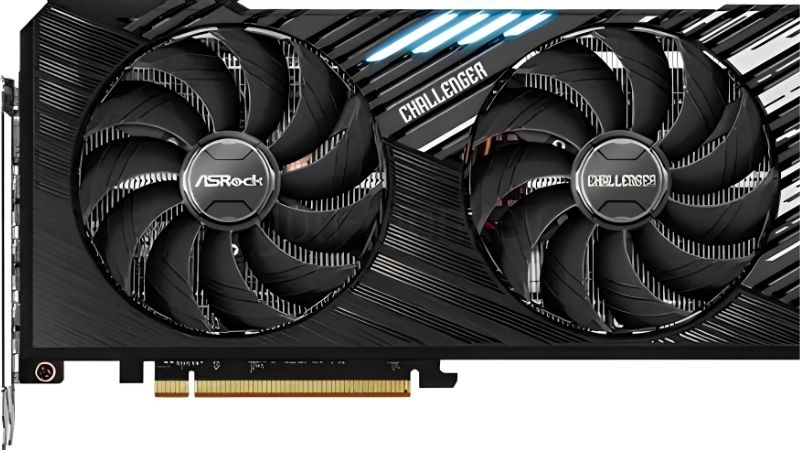
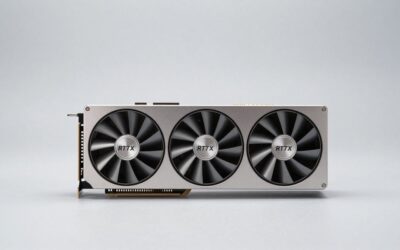
- Top Pick: ASRock Radeon RX 7700 XT Challenger 12GB OC Graphics Card, AMD RDNA 3 Architecture, 12GB GDDR6, 2584 MHz Boost Clock, 3X DisplayPort 2.1, 1x HDMI 2.1, Dual Fan Cooling
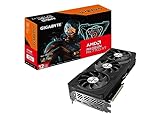
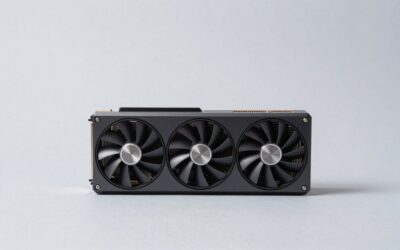
- Best Value: GIGABYTE Radeon™ RX 9070 XT Gaming OC ICE 16G Graphics Card (16GB GDDR6, 256-bit, PCIe 5.0, HDMI/DP 2.1, 2.7 Slot, Hawk Fan, Server-Grade Thermal Gel, Reinforced Structure)
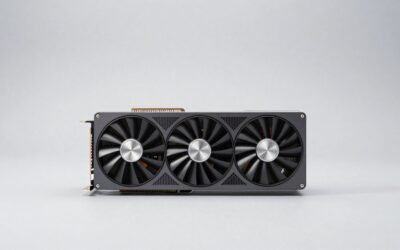
- Premium Choice: ASUS Prime Radeon RX 9070 XT 16GB GDDR6 OC Edition Gaming Graphics Card


RX 7700 XT vs 5070 looks like a straightforward value-versus-features question, and most comparisons treat it that way — AMD is cheaper, Nvidia has DLSS, pick your priority. That framing misses the thing that actually decides it. Both cards carry 12GB. Both target 1440p. But one of them is architecturally locked out of its own manufacturer’s current upscaler, and that is not a preference question, it is a capability gap. This page separates rasterisation, ray tracing and upscaling into three distinct comparisons rather than blending them into one misleading average, because the answer flips depending on which one you care about.
The Quick Verdict: RX 7700 XT vs 5070 in One Minute
The RTX 5070 is the better card and the gap is wider than the price difference suggests. In raw rasterisation it leads by roughly 25-35% at 1440p. In ray tracing the lead extends past 60%. And in upscaling it is not a lead at all but a capability difference: the 5070 gets DLSS 4.5 with multi-frame generation, while the RDNA 3-based 7700 XT does not get FSR 4, which AMD launched as an RDNA 4 feature. The 7700 XT’s remaining argument is price — it typically sits $100-150 below the 5070, and if that gap is large enough in your region and you play mostly rasterised titles at 1440p, it remains defensible. Below a $100 gap, there is no argument left.
As an Amazon Associate we earn from qualifying purchases at no extra cost to you.




Who Should Buy the RX 7700 XT
Buy it if the price gap in your market is $130 or more and your library is rasterised — competitive shooters, older single-player titles, strategy games. At 1440p High it clears 60 FPS in nearly everything and the money you save is real.
Buy it also if you are on Linux. AMD’s open-source driver stack remains meaningfully less painful than Nvidia’s proprietary route, and for a Linux gaming build that consideration outweighs a 30% raster deficit for many people.
And buy it if you have a strict PSU limit. At 245W it runs comfortably on a quality 650W supply with two 8-pin connectors — cables most builds already have.
Who Should Buy the RTX 5070
Buy the 5070 if you play anything from the last three years, if you touch ray tracing at all, or if you plan to keep the card past 2028. The raster gap alone justifies it, and the upscaling gap makes it lopsided.
Buy it if you stream or record. NVENC on Blackwell handles H.264, HEVC and AV1 with a quality-per-bitrate advantage that AMD’s encoder still has not matched, and for anyone pushing to Twitch or YouTube that difference is visible rather than theoretical.
And buy it if you do any GPU compute — Blender, Stable Diffusion, machine learning coursework. CUDA’s ecosystem remains far ahead of ROCm, and this is a software reality that no hardware specification will fix for you.
The FSR 4 Problem Nobody Warns AMD Buyers About
This is the single most important paragraph on this page and it is missing from almost every comparison of these two cards.
AMD launched FSR 4 as an RDNA 4 feature. The RX 7700 XT is RDNA 3. That means the card is stuck on FSR 3.1 — a decent upscaler, but one that trails the current generation visibly at 1440p Quality, particularly on fine detail and thin geometry in motion. Meanwhile the 5070 gets DLSS 4.5’s second-generation transformer model, which Nvidia ships through the Nvidia app as an override, meaning it applies to over 400 titles without waiting for developers to patch anything.
The practical consequence is that the performance gap you see in native benchmarks understates the real-world gap. Both cards get faster with upscaling on, but the 5070 gets faster while also looking better, and it can stack frame generation on top. If a comparison tells you these cards are close, check whether it tested upscaling at all — most do not, and that omission flatters the 7700 XT considerably.
Specs and 1440p Frame Rates Side by Side
The specification table explains the raster gap cleanly, and the bandwidth row is where the generational difference shows up most starkly. Both cards are 192-bit and 12GB — the memory type is what separates them.
Core Specifications Compared
| Specification | RX 7700 XT | RTX 5070 |
|---|---|---|
| Architecture | RDNA 3 (Navi 32) | Blackwell (GB205) |
| Launch year | 2023 | 2025 |
| Shader units | 3,456 | 6,144 |
| VRAM | 12GB GDDR6 | 12GB GDDR7 |
| Memory bus | 192-bit | 192-bit |
| Bandwidth | ~432 GB/s | ~672 GB/s |
| Current upscaler | FSR 3.1 (no FSR 4) | DLSS 4.5 |
| Frame generation | FSR 3 FG | DLSS 4.5 MFG |
| Board power | ~245W | ~250W |
| Power connector | 2x 8-pin | 1x 12V-2×6 |
| PSU recommended | 650W | 650W |
The bandwidth row is the quiet story. Same bus width, but GDDR7 delivers 672 GB/s against GDDR6’s 432 GB/s — a 55% advantage from memory technology alone. At 1440p, where the working set frequently exceeds cache, that gap does real work.
Note the power connector row before you plan your build. The 7700 XT takes two familiar 8-pins. The 5070 uses a 12V-2×6, and if your supply is older ATX 3.0 or earlier you will be using the bundled adapter. It works, but it is bulky and it needs bend clearance above the card.
1440p Frame Rates in 2026 Games
1440p, High preset, no upscaling, so the hardware is isolated. Ctrl+F your title.
| Game (1440p High) | RX 7700 XT | RTX 5070 | Gap |
|---|---|---|---|
| Counter-Strike 2 | ~210 FPS | ~265 FPS | +26% |
| Call of Duty (recent) | ~104 FPS | ~138 FPS | +33% |
| Horizon Forbidden West | ~78 FPS | ~102 FPS | +31% |
| Cyberpunk 2077 (no RT) | ~72 FPS | ~95 FPS | +32% |
| Cyberpunk 2077 (RT Ultra) | ~26 FPS | ~43 FPS | +65% |
| Alan Wake 2 | ~52 FPS | ~69 FPS | +33% |
| Black Myth: Wukong | ~48 FPS | ~64 FPS | +33% |
| Elden Ring | ~60 FPS (capped) | ~60 FPS (capped) | Tie* |
The pattern is consistent: roughly a third faster in raster, and the gap roughly doubles the moment ray tracing enters. The Elden Ring row is capped at 60 by the game and tells you nothing — ignore it.
Now add upscaling to that picture. The 5070 with DLSS 4.5 Quality gains roughly 35-45% on top of these numbers with better image quality than the 7700 XT gets from FSR 3.1 Quality. The native table above is the 7700 XT’s best case, not its typical one.
Power, PSU and Case Fit
Near-identical power draw — 245W and 250W — and both run on a quality 650W supply. Neither presents a thermal challenge in a case with basic airflow.
Physically, most 7700 XT models are 2.5-slot dual or triple fan around 270-320mm. 5070 partner cards run similar, with some compact 2-slot options available. Neither is a clearance nightmare, but measure to the side panel rather than the drive cage if you are getting the 5070, because the 12V-2×6 adapter needs room to bend.
Deep Dive Face-Off: Raster, Ray Tracing, Upscaling
Blending these three into one average is how comparisons of these cards go wrong. Treated separately, the answer is different in each — and knowing which one you actually care about is the whole decision.
Rasterization: Closer Than the Rest of the Picture
In pure traditional rendering the 5070 leads by 26-33%. Significant, but this is the 7700 XT’s strongest showing, and it is where the price argument lives. At a $150 gap, the 7700 XT delivers roughly 75% of the performance for roughly 73% of the money — a fair trade on this axis alone.
If your monitor is 1440p 144Hz and your library is competitive shooters, both cards saturate it and the 7700 XT is genuinely sufficient. That is a real scenario and the card serves it honestly.
Ray Tracing and the Upscaling Divide
Turn on ray tracing and the comparison stops being close. RDNA 3’s ray accelerators trail Blackwell’s dedicated RT cores badly, and the 65% gap in the Cyberpunk RT row is representative rather than cherry-picked. At 1440p RT Ultra, the 7700 XT’s 26 FPS is not a playable result and the 5070’s 43 is a starting point that upscaling can rescue.
Upscaling is where it becomes lopsided rather than merely one-sided. DLSS 4.5’s second-generation transformer model was trained with roughly five times the compute of the original and reaches over 400 titles via the Nvidia app’s override — no developer patch required. The 7700 XT gets FSR 3.1 and will not get FSR 4.
Frame generation compounds it. The 5070 can layer DLSS multi-frame generation on top of upscaling; the 7700 XT has FSR 3 frame generation, which works but produces more visible artefacts in fast motion. If you own a high refresh panel, this stacking is where the 5070 pulls furthest ahead of what any native benchmark chart shows.
Pros and Cons of Each Card
| RX 7700 XT | RTX 5070 | |
|---|---|---|
| Pros | $100-150 cheaper; 12GB is genuinely enough at 1440p; two 8-pins, no adapter; excellent Linux driver support; 245W on a 650W PSU | 26-33% faster raster, 65% faster RT; DLSS 4.5 with MFG; GDDR7 gives 672 GB/s on the same bus; better NVENC; CUDA for compute work |
| Cons | No FSR 4 — locked to FSR 3.1 permanently; RT is not realistically usable; weaker encoder; ROCm trails CUDA badly; RDNA 3 is two generations back | Costs $100-150 more; 12V-2×6 adapter is bulky on older PSUs; 12GB will tighten at 4K; Linux setup is still more work |
The asymmetry is the point. The 7700 XT’s advantages are all about today’s price and today’s cables. The 5070’s advantages are about what the card can still do in three years — and one of them, FSR 4, is a door that has already closed on the AMD side.
Price Reality and the Alternatives
Everything above assumes the $100-150 gap holds. In this market that is not a safe assumption, and for a purchase in this bracket the price trajectory deserves real attention.
Why 12GB Cards Are Holding Their Price
Component and laptop prices have continued trending upward rather than settling, and the mid-range is where that pressure bites hardest. On a $500 card, memory is a substantial fraction of the bill of materials — and the 5070’s GDDR7 is newer, supplied by fewer manufacturers, and priced accordingly.
The result is a segment where the traditional second-year price drift has simply not happened. The 7700 XT is a 2023 card that has not become cheap the way a three-year-old card historically would, because the new cards above it have not fallen to make room. Its price is anchored from above rather than set by its own age.
For this decision that means the gap between these two is unlikely to widen in your favour by waiting. Buyers who spent 2025 waiting for the mid-range to correct mostly paid more later than they would have paid on day one.
Prices Flattened, But Relief Is Years Out
The good news is real and should be stated precisely rather than hopefully. The steep climb of late 2025 has eased. Framework, which publishes unusually candid component pricing updates, has described a stretch of relative stability while continuing to caution that volatility has not ended. Flat is not cheaper.
New capacity is coming. OEMs can now source DDR5 from Chinese manufacturers such as CXMT, and Micron is building two fabs in Idaho. Both are genuine additions to a tight supply base. Neither arrives before 2027-2028 — by which point you will be shopping for a different card entirely.
The honest summary: prices have stopped rising, they have not started falling, and meaningful relief is two to three years away. Compare what these cards cost today and decide on that basis.
The Alternative: The Card Between Them
If the 5070 is out of reach but the 7700 XT’s FSR 4 exclusion bothers you — and it should — the obvious answer is the RX 9070. It is RDNA 4, so it gets FSR 4, it carries 16GB rather than 12, and it typically sits between these two on price. For an AMD buyer in 2026, it is the card the 7700 XT wishes it were.
On the Nvidia side, a used RTX 4070 Super offers similar performance to the 5070 with 12GB and DLSS support, minus multi-frame generation, often at a discount. Compare current pricing across the 7700 XT, RX 9070 and 5070 before committing — the ordering shifts month to month, and the card that looked cheapest last quarter frequently is not the best value this one.
See More:
- GTX 1650 vs RTX 3050
- Nvidia DIGITS
- Nvidia cuDNN
- Radeon RX 9070 XT vs RTX 5090
- PNY GeForce RTX 5080 review
Final Verdict: RX 7700 XT vs 5070
The rx 7700 xt vs 5070 question resolves in Nvidia’s favour, and the reason is not the 30% raster gap that the benchmark charts show. It is the upscaler. The 5070 gets DLSS 4.5 with multi-frame generation and a second-generation transformer model across 400+ titles. The 7700 XT is RDNA 3 and does not get FSR 4 — that door is closed permanently, and it means the native benchmarks flatter the AMD card relative to how the two actually perform in real use.
Buy the RX 7700 XT if the gap in your region is $130 or more, your library is rasterised, and you are on Linux where AMD’s driver stack still earns its keep. That buyer exists and the card serves them fine. Everyone else should either find the extra $100-150 for the 5070, or spend it on an RX 9070 instead and get FSR 4 with 16GB. With mid-range pricing flat rather than falling, the card in stock at a sane price today beats the one you are waiting for.
Frequently Asked Questions
Both have 12GB, so what is the real difference?
Capacity is the same but everything else is not. The RTX 5070 uses GDDR7 with far more bandwidth and is roughly 35 to 50 percent faster overall, with much stronger ray tracing. The RX 7700 XT is the previous generation value pick, so the comparison really comes down to price rather than memory.
Is 12GB going to be enough at 1440p?
For 1440p, yes for the practical life of both cards. 12GB clears the threshold that breaks 8GB cards in current titles with high textures and ray tracing. At 4K with path tracing and frame generation, 12GB becomes tight, which is the main criticism levelled at the 5070.
How do power draw and connectors compare?
The RX 7700 XT is 245W with two 8-pin connectors and a 700W recommendation. The RTX 5070 is 250W and typically uses a single 12V-2×6 connector with a 650W recommendation. If your supply lacks a native 12V-2×6 cable, budget for either an adapter that came in the box or a new unit.
Which is better for streaming and content creation?
The RTX 5070, comfortably. NVENC on Blackwell has better AV1 and H.265 quality at the same bitrate, broader support in OBS and editing suites, and CUDA acceleration in Premiere, Resolve and Blender is more mature than the AMD equivalents. AMD encoders are fine for casual capture but lag in professional tooling.
When does the 7700 XT still make sense?
When the price gap is large, typically 180 dollars or more, and you play mostly rasterised games at 1440p without caring about ray tracing or frame generation. It is also the better pick if you already own a strong PSU with two 8-pin cables and want to avoid the 12V-2×6 connector entirely.

Write Your Review
No reviews yet. Be the first to share your experience!