
PNY Nvidia GeForce RTX 5080 Epic-X is a card nobody has reviewed on video, because there are no views in the third-cheapest 5080 on the shelf. You are looking at it because you have already decided PNY is the value play and now you are staring at two PNY models separated by roughly $80, with product pages that describe both in identical marketing language. This page answers the only question you have: what does the Epic-X actually give you over the base VERTO, and is your case even going to fit it. Measurements below, in millimetres.
What the Epic-X Is and Is Not
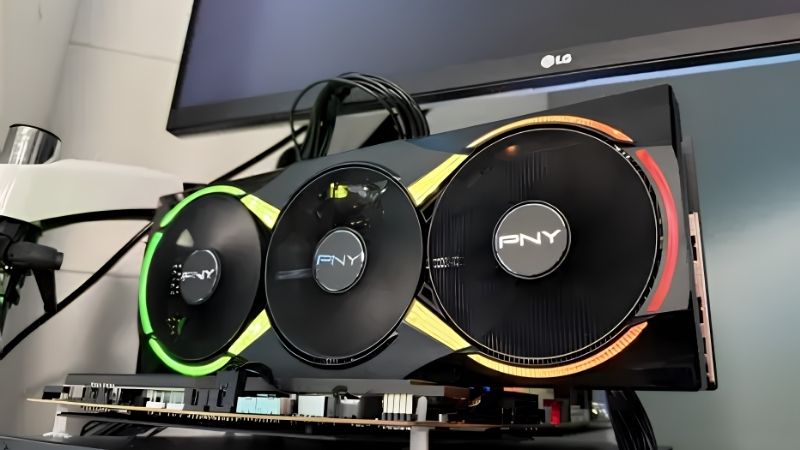
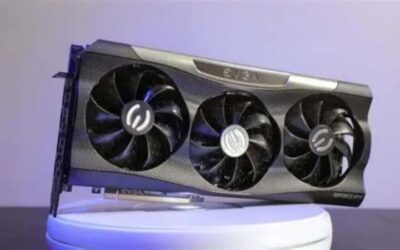
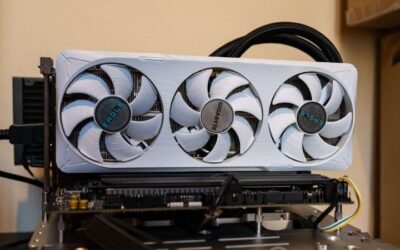
The Epic-X sits at the top of PNY’s consumer 5080 range, under the XLR8 Gaming banner. It is a triple-fan, three-slot card with RGB, positioned above the base VERTO and below nothing — PNY does not make a halo model. Understanding exactly what that positioning buys is the whole point of this page, because it is less than the price gap implies and more than the cynics claim.
The Silicon Is Identical to Every Other 5080
Establish this first because it removes 90% of the confusion. The GB203 die inside the Epic-X is the same GB203 inside the base VERTO, inside a $1,250 ASUS ROG Strix, and inside the Founders Edition. Same 10,752 CUDA cores, same 16GB of GDDR7 on a 256-bit bus, same 960 GB/s, same 360W board power. Nvidia sets the specification and no partner can change it.
What partners control: the cooler, the VRM design, the factory clock, the backplate, the RGB and the warranty. That is the complete list.
The Epic-X carries a higher factory overclock than the base VERTO, and here is the honest number: that translates to roughly 2-4% in real frame rates. On a 100 FPS scene, two to four frames. If you are paying $80 for the overclock, you are paying $20-40 per frame, and you should stop reading and buy the base model.
What the Epic-X Actually Adds
The overclock is not the product. The cooler is.
| Attribute | VERTO (base) | XLR8 Epic-X | Difference |
|---|---|---|---|
| Cooler | Triple fan, 2.5-slot | Triple fan, 3-slot | More mass |
| Load temp | ~68-74C | ~64-69C | 4-6C cooler |
| Load noise | ~38-42 dBA | ~34-37 dBA | ~4 dBA quieter |
| Factory clock | Reference | Higher OC | 2-4% frames |
| RGB | Minimal | Full | Preference |
| Length | ~305-320mm | ~330-340mm | +25mm |
| Typical premium | — | +$60-100 | — |
So the real product is 4-6C and 4 dBA. Whether that is worth $80 is a question about your case, not about the card — and that is the framing nobody uses.
In a mesh-front case with three fans, the base VERTO’s 68-74C is thermally uneventful and the Epic-X is solving a problem you do not have. In a glass-front case with two fans, or a PC that sits on your desk rather than under it, those same numbers are the difference between a card you notice and one you do not.
Which Epic-X Variant You Are Looking At
PNY’s naming is genuinely confusing and two Epic-X SKUs exist. The XLR8 Gaming VERTO Epic-X RGB is the standard version. The XLR8 Epic-X RGB OC carries a higher factory clock again, for another $20-40 on top.
The guidance is blunt: if you have decided the Epic-X cooler is worth paying for, buy the non-OC version. The OC variant’s additional clock is worth 1-2% and costs real money. You can apply the same overclock yourself in Afterburner in four minutes, for free, on the standard card.
Thermals, Noise and Whether It Fits
The section that decides the purchase, and the one that does not exist anywhere else for this specific model.
Temperatures Under Load
Aggregating owner reports produces a consistent picture: roughly 64-69C on the GPU core under sustained gaming load, with memory junction around 72-80C, in a case with reasonable airflow.
Those numbers are comfortable. Blackwell throttles at 90C and GDDR7 is rated to 105C, so the Epic-X has substantial headroom — enough that the fans rarely leave the lower third of their curve, which is where the noise advantage comes from.
The practical read: the Epic-X does not run cooler because it is a better card. It runs cooler because a larger heatsink lets the fans spin slower for the same result. You are buying quiet, and the temperature is a side effect.
Noise and the Zero-RPM Mode
Zero-RPM idle means the fans stop entirely below roughly 50C, so desktop use is silent — the base VERTO does this too, so it is not a differentiator.
Under load the Epic-X sits around 34-37 dBA at one metre against the base card’s 38-42. Four decibels sounds trivial written down. In practice, 42 dBA is a sound you become aware of during quiet passages in a game; 36 dBA generally is not.
The honest framing: if your PC is under the desk and you wear headphones, this difference is worth nothing to you. If it sits beside your monitor and you play with speakers, it is the entire reason to buy this card.
The Dimensions That Decide It
Measure before you order. This is the single most common cause of returns on cards in this class, and the Epic-X is worse than most because of one detail.
| Measurement | XLR8 Epic-X |
|---|---|
| Length | ~330-340mm |
| Height | ~130mm |
| Slots occupied | 3 |
| Power connector | 1x 12V-2×6 |
| Adapter supplied | 3x 8-pin to 12V-2×6 |
| PSU recommended | 850W |
Two warnings from owner feedback, both specific to this model. First: measure to the side panel, not to the drive cage. The 12V-2×6 connector sits on the top edge and needs clearance above the card for the cable bend. A 340mm card in a case rated for 345mm will not close if the cable has nowhere to go.
Second: three slots is not 2.5. If you have a capture card, a sound card or an AIC of any kind in the slot below, check the spacing on your motherboard before ordering. The base VERTO’s 2.5-slot design exists partly for this reason and it is a genuine advantage for anyone with a populated board.
Pros and Cons: Who Should Pay the Premium
The Epic-X is a good card. Whether it is the right card is a question with a clear answer, and it is not the same answer for everyone.
When the Premium Is Worth It
Three situations, and they are all about the machine rather than the card. Your case has restricted airflow — a glass front, two fans, or a compact chassis. Your PC sits on the desk beside you and you play with speakers rather than headphones. Or you keep hardware five years or more, where running consistently cooler is worth something in longevity terms.
Add a fourth if you care about it: you want RGB and the base VERTO’s minimal lighting bothers you. That is a legitimate reason to spend $80 and nobody should pretend otherwise.
When It Is Money Wasted
If your case has a mesh front and three or more fans, the base VERTO’s 68-74C is fine and you are paying $80 to solve nothing. If your PC lives under the desk and you use headphones, the 4 dBA is inaudible to you.
And if your motherboard’s second slot is occupied, the Epic-X’s three-slot design may not physically work where the base VERTO’s 2.5 does — in which case the premium buys you a card you cannot install.
The overclock is never a reason. 2-4% is not a purchase justification, and you can replicate it on the base card yourself in four minutes.
Pros and Cons Summary
| Pros | Cons |
|---|---|
| 4-6C cooler and ~4 dBA quieter than the base VERTO | +$60-100 for what is functionally the same card |
| Identical GB203 silicon to models costing $200 more | 3 slots may block an occupied second slot |
| Fans stay low in their curve; zero-RPM idle | 330-340mm plus connector bend clearance |
| Full RGB if that matters to you | The factory OC is worth 2-4% — not a reason to buy |
| Still meaningfully cheaper than premium brands | PNY’s three-year warranty and mixed RMA reputation apply here too |
Note the last row. The Epic-X premium buys a cooler, not better support. If warranty confidence is what you want, this is not the card that provides it.
Market Context Before You Order
The $80 question does not exist in isolation. It is a percentage of a total, and that total has moved a great deal.
Why the Cooler Premium Looks Different Now
Component and laptop prices have kept trending upward rather than settling back, and graphics cards absorbed a disproportionate share because of memory. GDDR7 is new, supplied by very few manufacturers, and this card carries 16GB of it.
Here is the interesting consequence, and it runs opposite to intuition. As the base card gets more expensive, an $80 cooler premium becomes a smaller share of the total. On a $900 card, $80 is 9%. On a $1,100 card, it is 7%. The Epic-X’s relative cost has quietly fallen even as its absolute price held, simply because everything underneath it got dearer.
That does not make it correct for you — the airflow and slot-clearance questions still decide that. But it does mean the reflexive “just buy the cheapest one” answer is weaker in 2026 than it was two years ago, because the gap you are arguing about is a smaller fraction of what you are spending either way.
Prices Flattened, But Not Fallen
The good news is real and deserves stating precisely rather than hopefully. The steep climb of late 2025 has eased. Framework, which publishes unusually candid component pricing updates, has described a period of relative stability while continuing to warn that volatility persists. That is stabilisation, not a decline.
Genuine new capacity is coming. OEMs can now source DDR5 from Chinese manufacturers such as CXMT, and Micron is constructing two fabs in Idaho. Both add real supply. Neither begins production before 2027-2028, well beyond this purchase.
So do not structure this decision around a discount that is not scheduled to arrive. Compare what the two PNY models cost today and decide on your case, not on a future price.
Which One to Actually Buy
Go and look at your case before you look at another product page. Mesh front, three fans, PC under the desk? Buy the base VERTO and put the $80 toward something else — it is the same card and you will never hear the difference.
Glass front, two fans, PC on the desk, or a five-year hardware cycle? The Epic-X earns it, and 4-6C plus 4 dBA is a real improvement in exactly that scenario.
Either way, measure to the side panel including connector clearance first. Compare current pricing on the PNY base VERTO, the Epic-X and the Epic-X OC before ordering — the gap between them moves week to week, and on some weeks the Epic-X sits close enough to the base model that the decision makes itself.
See More:
- GTX 1650 vs RTX 3050
- Nvidia DIGITS
- Nvidia cuDNN
- Radeon RX 9070 XT vs RTX 5090
- PNY GeForce RTX 5080 review
Final Verdict: PNY Nvidia GeForce RTX 5080 Epic-X
The PNY Nvidia GeForce RTX 5080 Epic-X is not a faster card than the base VERTO in any way you will notice — the factory overclock is worth 2-4% and you could apply it yourself for free. What the $60-100 actually buys is a heavier cooler producing 4-6C lower temperatures and roughly 4 dBA less noise, and whether that is worth the money is a question about your case and your desk rather than about the card.
Buy the Epic-X if your airflow is mediocre, your PC sits beside you, or you keep hardware five years. Buy the base VERTO if your case has a mesh front and three fans, or if your second PCIe slot is occupied — three slots is a real constraint that 2.5 avoids. And skip the Epic-X OC variant entirely: another 1-2% for another $30 is the worst value in PNY’s stack. Whichever you choose, measure to 340mm including the cable bend before you order.
Frequently Asked Questions
Is the PNY Epic-X faster than a reference RTX 5080?
Barely. Most Epic-X SKUs ship at or a whisker above Nvidia reference clocks, so in-game differences are within one to three percent, which is inside run-to-run variance. What you actually pay for is the triple-fan cooler, quieter acoustics under sustained load and slightly more headroom for manual overclocking.
Will it fit in my case?
Triple-fan RTX 5080 designs are typically around 330mm long and 2.5 to 3 slots thick. Check clearance from the rear of the case to the front fan or radiator, and confirm your motherboard has three free slots below the PCIe x16. Compact ATX cases and most mATX chassis will struggle without removing a front fan.
What power supply and connector does it need?
The RTX 5080 is a 360W card using the 12V-2×6 connector. Nvidia recommends 850W, and an ATX 3.0 or 3.1 supply with a native 12V-2×6 cable is strongly preferred over the bundled four-way 8-pin adapter. Seat the connector fully until it clicks and avoid tight bends within about 35mm of the plug.
Is 16GB of VRAM enough for 4K?
For today games, yes. 16GB of GDDR7 on a 256-bit bus at around 960GB/s handles 4K ultra with ray tracing in essentially every current title. The caveat is path traced games with frame generation and high resolution texture packs, which can approach the limit and are the reason some buyers stretch to a 5090.
Does the extra cost over a cheaper 5080 make sense?
Only if you value acoustics and thermals. A cheaper dual-fan 5080 delivers the same frame rates but runs hotter and louder under long sessions. If the Epic-X premium is under about 60 dollars it is reasonable; beyond that, put the money toward a better power supply or a faster CPU instead.
As an Amazon Associate we earn from qualifying purchases at no extra cost to you.


Ready to decide? Our #1 pick for 2026 is the Cooler.
Live price & availability on Amazon.


Write Your Review
No reviews yet. Be the first to share your experience!