
- Top Pick: ASUS Dual GeForce RTX 3050 6GB GDDR6 OC Edition Gaming Graphics Card
- Best Value: msi Gaming RTX 3050 Ventus 2X 6G OC Graphics Card (NVIDIA RTX 3050, 96-Bit, Boost Clock: 1492 MHz, 6GB GDDR6 14 Gbps, HDMI/DP, Ampere Architecture)
- Premium Choice: maxsun GeForce RTX 3050 6GB Graphics Cards GDDR6 Video Graphics Card GPU for Gaming PC Mini Small Form Factor SSF Slim Low Profile Design PCI Express 4.0, HDMI 2.1, DisplayPort 1.4a
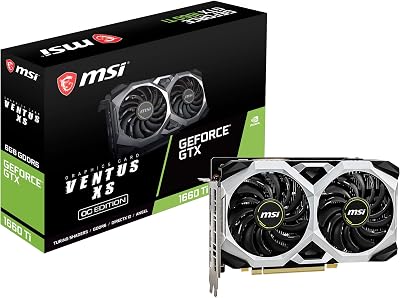


GTX 1660 Ti vs RTX 3050 produces a result that makes people check the chart twice: the 2019 card is faster than the 2022 one in raw rasterisation. That is not a typo and it is not cherry-picked — the 1660 Ti edges ahead in a meaningful share of titles despite being three years older and having 1,024 fewer CUDA cores. So the real question is not “which is faster”, it is whether DLSS and two extra gigabytes of VRAM are worth giving up a raw performance lead. This page answers that with 2026 data, including one catch about DLSS on these cards that almost nobody mentions.
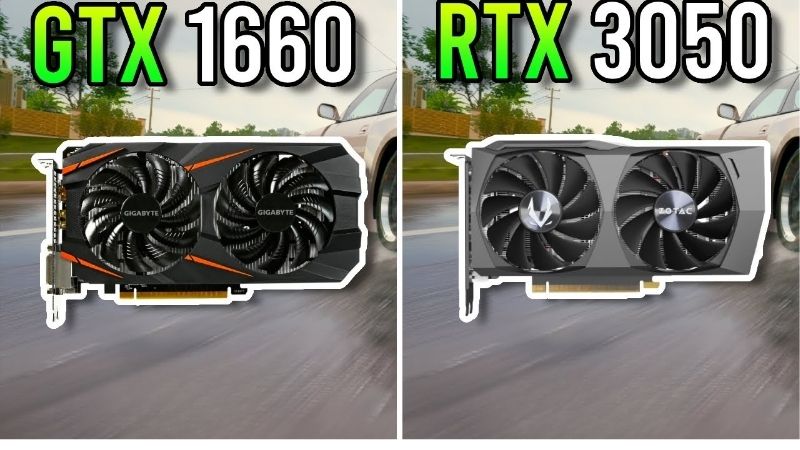
The Quick Verdict: GTX 1660 Ti vs RTX 3050 in One Minute
Buy the RTX 3050, but understand what you are buying and what you are giving up. In pure rasterisation the two are within a few percent and the 1660 Ti wins several titles outright. What the 3050 gives you is 8GB against 6GB, DLSS access the 1660 Ti can never have, ray tracing that neither can really use, and a newer encoder. The 8GB is the deciding factor, not the DLSS — because a 6GB card in 2026 hits a wall that no upscaler rescues. If the 1660 Ti is $40 or more cheaper and your library is esports, it is genuinely the better buy. Above that gap, or if you play anything modern, take the 3050.
As an Amazon Associate we earn from qualifying purchases at no extra cost to you.


Why the Newer Card Is Slower
This surprises people and the explanation is worth understanding because it recurs across Nvidia’s lineup.
The 1660 Ti has 1,536 CUDA cores on a 192-bit bus delivering 288 GB/s. The 3050 has 2,560 cores on a 128-bit bus delivering 224 GB/s. The 3050 has 67% more cores and 22% less bandwidth. Ampere’s doubled FP32 throughput per SM looks enormous on a spec sheet, but the second pipeline shares resources with integer work, so the real gain is far below what the core count implies — and the narrower bus claws back much of what remains.
The result: two cards that benchmark within a few percent of each other despite three years and a full architecture between them. The 3050 was a value proposition, not a performance one, and it was never positioned honestly as such.
Who Should Buy the GTX 1660 Ti
One clear case: esports at 1080p on a tight budget. CS2, Valorant, Rocket League, League of Legends — the 1660 Ti clears 120+ FPS in all of them and 6GB never binds at those settings. If it is $40+ cheaper on your used market, that money is genuinely saved rather than a false economy.
A second, narrower case: if you already own one. Do not sell a working 1660 Ti to buy a 3050 — the raster performance is a wash and you would be paying a transaction cost plus the risk of someone else’s used card for 2GB and an upscaler. Skip a tier and wait.
Outside those two, the 1660 Ti is a card with a shrinking runway.
Who Should Buy the RTX 3050
Anyone who plays modern single-player titles. 8GB against 6GB is the whole reason, and it is enough on its own. The moment a game’s allocation exceeds the buffer, performance does not degrade smoothly — it produces stutter and late-loading textures that no average frame rate reveals.
Also anyone who streams or records. The 3050’s Ampere-era NVENC handles H.264 and HEVC with a clear quality-per-bitrate edge over Turing’s older block. For a Discord streamer or a beginner on YouTube, that difference is visible.
And anyone touching AI or CUDA coursework. The 1660 Ti has no tensor cores at all — not fewer, none. For anything that dispatches mixed-precision kernels, that is a capability gap rather than a speed gap.
Specs and Real 2026 Frame Rates
The table below explains the anomaly cleanly. Read the bandwidth row against the CUDA core row — they run in opposite directions, and that is the whole story.
Core Specifications Side by Side
| Specification | GTX 1660 Ti | RTX 3050 (8GB) |
|---|---|---|
| Architecture | Turing (TU116) | Ampere (GA106) |
| Launch year | 2019 | 2022 |
| CUDA cores | 1,536 | 2,560 |
| Boost clock | ~1.77 GHz | ~1.78 GHz |
| VRAM | 6GB GDDR6 | 8GB GDDR6 |
| Memory bus | 192-bit | 128-bit |
| Bandwidth | 288 GB/s | 224 GB/s |
| Tensor cores | None | 80 |
| RT cores | None | 20 |
| TDP | 120W | 130W |
| PSU recommended | 450W | 550W |
The bandwidth row is bolded because it is the row that explains everything and the row nobody reads. A 192-bit bus on a 2019 card beats a 128-bit bus on a 2022 one, and at 1080p that gap does real work.
The tensor core row is the other half. “None” is not a small number — it is an architectural absence that locks the 1660 Ti out of DLSS permanently, at any settings, in any game, forever.
Frame Rates: Where Each Card Wins
1080p High, no upscaling, so the hardware is isolated. Asterisks mark where 6GB becomes the constraint.
| Game (1080p High) | GTX 1660 Ti | RTX 3050 | Winner |
|---|---|---|---|
| Counter-Strike 2 | ~198 FPS | ~205 FPS | 3050, marginally |
| Valorant | ~245 FPS | ~240 FPS | 1660 Ti |
| GTA V Enhanced | ~104 FPS | ~98 FPS | 1660 Ti |
| Elden Ring | ~50 FPS | ~48 FPS | 1660 Ti |
| Cyberpunk 2077 | ~40 FPS* | ~42 FPS | 3050 |
| Hogwarts Legacy | ~34 FPS* | ~40 FPS | 3050, clearly |
| Black Myth: Wukong | ~26 FPS* | ~31 FPS | 3050, clearly |
Read the top four rows and the bottom three as two separate stories. In esports and older engines the 1660 Ti wins or ties — a 2019 card beating a 2022 one, which is the anomaly this page opened with. In titles from the last three years the 3050 pulls 15-20% ahead, and the asterisks tell you why: the 1660 Ti has run out of memory, not out of shaders.
Now add DLSS. The 3050 running DLSS Quality gains roughly 30% on top of its numbers. The 1660 Ti gains nothing, because it cannot run DLSS at all. That is where a comparison that looked like a coin flip becomes one-sided — but read the next section before you assume DLSS is a clean win here.
Power, PSU and Used-Card Checks
The 1660 Ti’s 120W is genuinely modest and runs on a quality 450W supply. The 3050’s 130W wants 550W. Both take a single 8-pin. If you are dropping either into an old OEM prebuilt, the 1660 Ti is the safer bet on power headroom — though neither is a 75W slot-powered card, so check you have the connector.
Both are used purchases now. Ask for a photo of the card running with a temperature reading. Ask about mining history — the 1660 Ti was a popular mining card in 2020-2021 and many were run continuously. And on a 2019 card, budget $15 for thermal paste; at six or seven years old it is maintenance, not optional.
Deep Dive Face-Off: Does DLSS Close the Gap?
The 3050’s case rests almost entirely on features rather than speed. That case is real, but it is weaker than the marketing suggests and stronger than the benchmarks imply, in ways worth separating out.
The 6GB Wall Is the Real Divider
Set DLSS aside for a moment, because it is not what decides this. 6GB at 1080p High is insufficient in a growing number of 2026 titles, and the failure is not graceful.
A card that is 15% slower delivers a consistently slightly lower frame rate. A card that is out of memory delivers a normal average punctuated by second-long freezes, with textures resolving visibly late as you turn. The first is a compromise you accept. The second is a defect in the experience. In Hogwarts Legacy the 1660 Ti’s 1% lows drop below 15 FPS during traversal while its average reads 34.
That is the argument for the 3050 and it stands entirely on its own, with no upscaler required.
DLSS, Ray Tracing and the FP8 Catch
The 3050 can run DLSS and the 1660 Ti cannot — a capability difference, absolute and permanent. In a supported title, DLSS Quality at 1080p recovers roughly 30% for a minor image cost.
But here is the catch that almost nobody mentions, and it matters if you are about to buy the 3050 specifically for this. DLSS 4.5’s newer second-generation transformer models — Model M and Model L — rely on native FP8 support. Ampere does not have it. On an RTX 3050, selecting those newer models costs more performance than the image quality gain justifies, and Nvidia’s own guidance is that RTX 30 series owners should generally remain on Model K, the DLSS 4.0 model. So the 3050 gets DLSS, but it does not get the current DLSS at full benefit. Anyone telling you to set DLSS Override to “Recommended” on a 3050 is giving you bad advice.
On ray tracing: do not factor it in. The 3050’s RT cores exist and enabling ray tracing at 1080p costs more frames than the card can spare. It is a checkbox, not a feature.
Pros and Cons of Each Card
| GTX 1660 Ti | RTX 3050 | |
|---|---|---|
| Pros | 288 GB/s beats the 3050’s 224; wins or ties in esports and older titles; 120W on a 450W PSU; usually cheaper used; runs cool and quiet | 8GB survives 2026 titles; DLSS access at all; better NVENC for streaming; tensor cores for CUDA and AI work; better frame times where it counts |
| Cons | 6GB is the hard wall; zero tensor cores means no DLSS ever; older encoder; collapses in new AAA titles; near-zero resale | Slower than a 2019 card in raster; 128-bit bus is a real handicap; no FP8, so DLSS 4.5’s best models hurt it; no Frame Generation ever |
An unusual table: both cards have genuinely embarrassing entries in their cons column. The 1660 Ti cannot upscale. The 3050 is slower than a card three years its senior. The 8GB is what tips it, and it tips it decisively.
What the Used Market Is Doing to Both
Both are used purchases, and used prices are set from above rather than by age. Understanding that anchor explains why a 2019 card still costs what it does.
Why a 2026 Card Still Is Not Cheap
Component and laptop prices have kept trending upward rather than settling back, and entry-level new cards have absorbed the sharpest share because memory is a large fraction of their bill of materials. When a new RTX 5060 refuses to fall below its launch price, every card beneath it on the used market is held up by it.
That mechanism is why a GTX 1660 Ti — a card released in early 2019, with no tensor cores, on an architecture two generations retired — still commands money that feels absurd for its age. Its price is not set by what it is worth. It is set by what the cheapest acceptable new alternative costs, and that number has not moved.
The practical read for this comparison: neither of these cards is going to get cheap. The thing that would make it happen is not happening.
Prices Flattened, Relief Is Years Away
There is genuine good news and it deserves to be stated precisely rather than hopefully. The steep climb through late 2025 has eased. Framework, which publishes unusually candid component pricing updates, has described a stretch of relative stability while continuing to caution that volatility has not ended. Stabilisation is not a decline.
New supply is arriving. OEMs can now source DDR5 from Chinese manufacturers such as CXMT, and Micron is constructing two fabs in Idaho. Both are real additions to a tight market. Neither begins production before 2027-2028 — by which point both of these cards will be genuinely unusable rather than merely dated.
So the honest summary is: flat, not falling, with meaningful relief years away. If a 3050 at a fair price is in front of you today, waiting to save $30 is a plan with no evidence behind it.
The Alternative: If Both Feel Like Poor Value
They largely are, and that reaction is correct. Two options sit nearby. A used RX 6600 typically lands near 3050 money with 8GB and meaningfully stronger raster, though you lose DLSS and the encoder quality. An Intel Arc B580 is new rather than used, carries 12GB, and comes with a warranty — which on a purchase this old is worth real money.
If you can stretch to a new RTX 4060, you get Frame Generation, which neither of these cards will ever have, plus a card that will still be sensible in 2029. Compare current used and new pricing across the 1660 Ti, 3050 and their nearest alternatives before you commit — in this segment the ordering shifts monthly and the cheapest listing is frequently not the cheapest way to solve your problem.
See More:
- GTX 1650 vs RTX 3050
- Nvidia DIGITS
- Nvidia cuDNN
- Radeon RX 9070 XT vs RTX 5090
- PNY GeForce RTX 5080 review
Final Verdict: GTX 1660 Ti vs RTX 3050
The gtx 1660 ti vs rtx 3050 comparison is stranger than most, because the older card genuinely wins on raw speed and still loses the argument. Buy the RTX 3050 — not for the DLSS, which is real but hobbled on Ampere by the missing FP8 support, and not for the ray tracing, which is a technicality. Buy it for the 8GB. A 6GB card in 2026 does not run slower, it runs badly, and that difference is worth more than the few percent of raster the 1660 Ti holds.
Buy the GTX 1660 Ti only if it is $40 or more cheaper and your library is esports and older single-player titles — in which case it is faster, cheaper and draws less power, and that is a genuinely good outcome for that buyer. And if you already own one, keep it and skip a tier; this is not an upgrade worth paying a transaction cost for. With used prices anchored by a new market that is not falling, the card available at a sane price today is a better plan than the one you are waiting for.
Frequently Asked Questions
Why does the older GTX 1660 Ti often beat the RTX 3050?
Because the desktop RTX 3050 8GB is a heavily cut Ampere part. In pure rasterised games the two are within a few percent of each other, and the 1660 Ti wins in a meaningful number of titles. Nvidia positioned the 3050 on features rather than raw speed over the previous generation.
Where does the RTX 3050 pull ahead?
Anywhere DLSS is supported, since the 1660 Ti has no tensor cores and cannot use it at all. The 3050 also has 8GB against 6GB, working ray tracing at low settings, AV1 decode and the newer NVENC encoder, which matters for OBS streaming and video editing timelines.
Is the 6GB VRAM on the 1660 Ti a real problem?
Increasingly, yes. Several 2023 onward releases exceed 6GB at 1080p high with the texture setting at high or above, and the symptom is stutter and pop-in rather than a lower average frame rate. Dropping textures one notch usually fixes it, but that is a compromise the 8GB 3050 does not force.
What about the 6GB version of the RTX 3050?
That is a different and slower card. The RTX 3050 6GB has fewer cores, a 96-bit bus and a 70W power envelope with no external connector, which makes it an excellent low profile or prebuilt upgrade but roughly 20 to 25 percent slower than the 8GB model and clearly behind the 1660 Ti.
Which should I buy used?
If prices are similar take the RTX 3050 8GB for DLSS and the larger buffer. If the 1660 Ti is 40 dollars or more cheaper, take it and accept the missing features. Either way, the Arc B580 or a used RTX 3060 12GB is a far better card if your budget can stretch.

Write Your Review
No reviews yet. Be the first to share your experience!