
GTX 1660 Ti vs RTX 4060 is still one of the most searched budget GPU matchups in 2026, and for good reason. One is a beloved 1080p workhorse from 2019 with no ray tracing and no DLSS. The other is a current-generation card with DLSS 4 upscaling, Frame Generation and 8GB of VRAM. If you are shopping on a tight budget, the wrong pick can cost you roughly 30% of your frame rate or leave you stuck with 6GB of memory in games that now ask for more. This head-to-head breaks both cards down by measured performance, memory, power draw, price and long-term value so you can decide in a few minutes.
Quick answer: Our top pick in 2026 is the Architecture — our #1 rated choice. See the full ranked comparison, alternatives and buying advice below.
GTX 1660 Ti vs RTX 4060: The Quick Verdict
For almost anyone buying a graphics card new today, the RTX 4060 is the correct answer. It is a newer architecture, ships with 8GB of VRAM instead of 6GB, and unlocks DLSS 4 and Frame Generation that the GTX 1660 Ti physically cannot run. The 1660 Ti only makes sense in one narrow case: you find it used for a very low price and you play older or esports titles at 1080p. The table below shows why the gap is wider than the model numbers suggest.
| Spec | GTX 1660 Ti | RTX 4060 |
|---|---|---|
| Architecture | Turing (2019) | Ada Lovelace (2023) |
| VRAM | 6GB GDDR6 | 8GB GDDR6 |
| Memory bus | 192-bit | 128-bit |
| CUDA cores | 1,536 | 3,072 |
| Ray tracing | No | Yes (3rd-gen RT) |
| DLSS 4 upscaling | No | Yes |
| Frame Generation | No | Yes (single) |
| Typical board power | ~120W | ~115W |
| Interface | PCIe 3.0 x16 | PCIe 4.0 x8 |
Who Wins for Budget 1080p Gaming
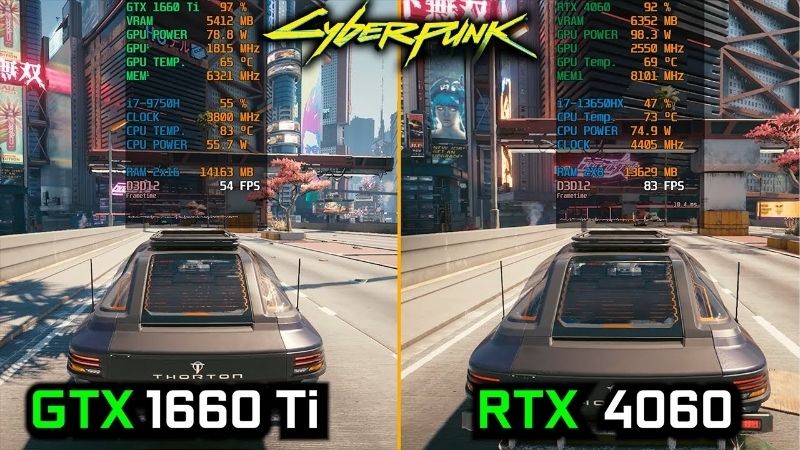
At native 1080p in older and lighter titles, the two cards are closer than the spec sheet implies, but the RTX 4060 still leads by a comfortable margin. Across a mix of modern games the 4060 delivers roughly 25% to 40% more frames per second than the 1660 Ti, and the lead grows in newer engines that lean on the 4060’s stronger shader and cache design.
The GTX 1660 Ti is not obsolete for esports. In titles like CS2, Valorant and older competitive shooters it can still push well past 100 FPS at 1080p on high settings. If that is all you play, the raw gap matters less than the price you pay.
For anything demanding released in the last two years, the difference becomes the story. The 1660 Ti frequently drops below 60 FPS where the 4060 stays above it, and only the 4060 can lean on Frame Generation to smooth things further.
Where the RTX 4060 Pulls Ahead
The RTX 4060’s biggest structural advantage is not clock speed, it is the feature set. Ray tracing, DLSS 4 Super Resolution and Frame Generation are simply absent on the 1660 Ti because Turing’s GTX line has no RT or tensor hardware. That means the 4060 can turn on upscaling to reclaim frames the 1660 Ti has no way to recover.
Memory is the second advantage. The extra 2GB and Ada’s larger L2 cache help the 4060 hold higher texture settings without the stutter that a 6GB buffer increasingly causes. In several 2025 and 2026 releases, 6GB is the setting that forces you to compromise first.
Quick Verdict by Use Case
If you are building or upgrading and buying new, the RTX 4060 wins on every axis that matters: frames, features and VRAM headroom. It is the safer card to keep for three or four years.
If you already own a GTX 1660 Ti and only play esports at 1080p, there is no urgent reason to upgrade yet. Your money is better saved until you feel the frame rate ceiling in the games you actually play.
If you are hunting the used market, the 1660 Ti only makes sense at a genuine bargain. The moment its used price approaches a new 4060, the comparison is over.
GTX 1660 Ti vs RTX 4060 Deep Dive: Specs and Performance
Numbers explain the gap better than adjectives. The RTX 4060 roughly doubles the CUDA core count and moves to a far more efficient node, so even with a narrower 128-bit bus it comfortably outpaces the wider-bus 1660 Ti. Below, the deep dive compares raw output, memory behavior and the proprietary NVIDIA features that separate a 2019 card from a 2023 one.
Raw Performance and Frame Rates
In rasterized 1080p testing across a broad game library, the RTX 4060 typically lands around 100 to 130 FPS on high settings, while the GTX 1660 Ti sits closer to 70 to 95 FPS in the same titles. That is a real generational jump, not a marketing one.
Push both cards to 1440p and the 1660 Ti falls off quickly, often dipping into the 40s in heavier games. The 4060 can hold 60-class averages at 1440p in many titles, especially once upscaling is enabled, though 1080p remains its natural home.
The gap also depends heavily on how CPU-bound your system is. Paired with a modest processor, both cards can bottleneck in esports titles and post similar numbers, which is exactly why some 1660 Ti owners feel little urgency. Pair either card with a capable CPU in a graphics-heavy game, though, and the 4060’s extra shader throughput pulls clear again.
VRAM, Memory Bandwidth, and 1440p
The 1660 Ti’s 192-bit bus gives it more raw bandwidth per clock than the 4060’s 128-bit bus, which surprises people. In practice, Ada’s large L2 cache offsets that narrow bus, so the 4060 still moves more effective data where it counts.
Capacity is the practical concern. The 4060’s 8GB versus the 1660 Ti’s 6GB is the difference between running high textures and being forced to medium in a growing list of modern games.
For 1440p specifically, neither card is a native high-refresh solution, but the 4060 with DLSS is the only one of the two that makes 1440p genuinely playable in demanding titles without gutting the settings.
DLSS 4, Efficiency, and Power Draw
DLSS 4 is where the experimental, future-proofing argument lands squarely on the 4060. Its improved transformer-based upscaling model produces sharper images at the same performance target, and Frame Generation can add substantial smoothness in supported games. The 1660 Ti cannot access any of this.
Efficiency also favors the newer card. Both draw a similar ~115 to 120W, but the 4060 extracts far more performance from that budget, which matters for small builds and modest power supplies.
On the practical side, the 4060 uses a PCIe 4.0 x8 link. On older PCIe 3.0 motherboards that link runs at reduced bandwidth, costing a few percent of performance. It is rarely a dealbreaker, but budget builders on older boards should know it exists.
Price, Value, and the Smart Alternative in 2026
Value is where this matchup gets timely, because 2026 pricing is not behaving the way budget buyers hoped. Before you commit to either card, it is worth understanding where GPU and component prices sit right now, which card protects your money better over time, and what third option to grab if your budget can stretch even slightly.
GPU Prices in 2026: Should You Buy Now?
The good news is that the steep price climb of late 2025 has cooled. Prices are no longer spiking week to week, and some hardware makers, including Framework, have reported a stretch of relative stability, even while warning that conditions can still swing. For a budget buyer, that means the panic-buying window has passed, but it does not mean a discount is coming soon.
The relief that matters most for card prices sits further out. New memory supply is opening up, with OEMs able to source DDR5 from Chinese suppliers such as CXMT, and Micron building two new fabs in Idaho. The catch is timing: those plants are not expected to come online until 2027 to 2028. In other words, prices have flattened rather than fallen, and real cost relief is still a year or two away.
There is a second effect budget buyers should watch: memory pressure. Because rising DDR5 and GDDR costs feed straight into board prices, the cheapest cards are the ones squeezed hardest, and entry GPUs like these have seen the least room for discounts. That makes bargain hunting harder at the very bottom of the stack, where the 1660 Ti and 4060 live.
The practical takeaway is simple. If you need a card now, buying at today’s flattened prices is reasonable, and the RTX 4060 is the more future-proof place to put your money. Waiting only pays off if you can hold out well into 2027, and even then the savings are uncertain. Chasing a used GTX 1660 Ti to save a little today can backfire if 6GB forces another upgrade before real price relief arrives.
Pros and Cons of Each Card
The GTX 1660 Ti’s pros are its low used price, its still-solid esports performance and its very modest power needs. Its cons are serious for a 2026 buyer: no ray tracing, no DLSS, only 6GB of VRAM, and a raster ceiling that newer games now push through routinely.
The RTX 4060’s pros are the higher frame rates, the full DLSS 4 and Frame Generation stack, 8GB of VRAM and strong efficiency. Its cons are the narrow 128-bit bus, the PCIe x8 link on old boards, and the fact that 8GB itself is starting to feel like the new minimum rather than comfortable headroom.
Weighed together, the 4060’s cons are minor annoyances while the 1660 Ti’s cons are structural limits. That is the core reason the newer card wins for most people.
The Best Alternative if Your Budget Flexes
If you can stretch a little past the RTX 4060, the RTX 4060 Ti 16GB is the smartest step up for anyone worried about VRAM longevity, giving you double the memory for higher textures and light 1440p work. It is the card to grab if you plan to keep your GPU for four years or more.
On the AMD side, the Radeon RX 7600 competes directly with the 4060 on raw raster and sometimes on price, though you trade away DLSS for FSR. And on the used market, a well-priced RTX 3060 12GB remains a clever pick precisely because of its generous memory buffer.
Whichever way you lean, checking the current price on each card before you buy is the single highest-value move you can make, since budget GPUs shift in price constantly. You can compare today’s live pricing on the RTX 4060, the 4060 Ti 16GB and the RX 7600 through the links in this guide.
See More:
Final Verdict: Which Budget GPU Should You Buy?
When you line up GTX 1660 Ti vs RTX 4060 on specs, frame rates, features and future support, the RTX 4060 is the card to buy new in 2026. It gives you meaningfully more performance, 8GB of VRAM, and the entire DLSS 4 and Frame Generation toolkit, all for a similar power draw. The GTX 1660 Ti remains a capable esports card, but only worth buying if you find it cheap on the used market and you already know your games are light.
Buy the RTX 4060 if you want a single card that handles modern 1080p, dabbles at 1440p, and stays relevant for years. Buy the GTX 1660 Ti only if budget is absolutely fixed, you play older or competitive titles, and the used price is genuinely low. With prices flattened but not falling until 2027 or later, locking in the more future-proof card now is the safer play. Check the latest prices through the links above and grab the card that fits your budget before stock and pricing shift again.


Write Your Review
No reviews yet. Be the first to share your experience!