
Best NVMe SSD for gaming is not simply the drive with the biggest sequential number on the box. Game loading is dominated by small random reads, not bulk transfers, which is why a well-designed Gen4 drive often matches a Gen5 flagship in the only benchmark that matters: how long you stare at a loading screen.
As an Amazon Associate we earn from qualifying purchases at no extra cost to you. Product prices and availability are accurate as of the date shown and are subject to change.


As an Amazon Associate we earn from qualifying purchases at no extra cost to you. Product prices and availability are accurate as of the date shown and are subject to change.
By Ryan Cole
How to Choose the Best NVMe SSD for Gaming
Choosing the best nvme ssd for gaming comes down to four things: random read performance, how the drive behaves when full, capacity per pound, and whether it needs to fit a console. Sequential speed barely enters the picture.
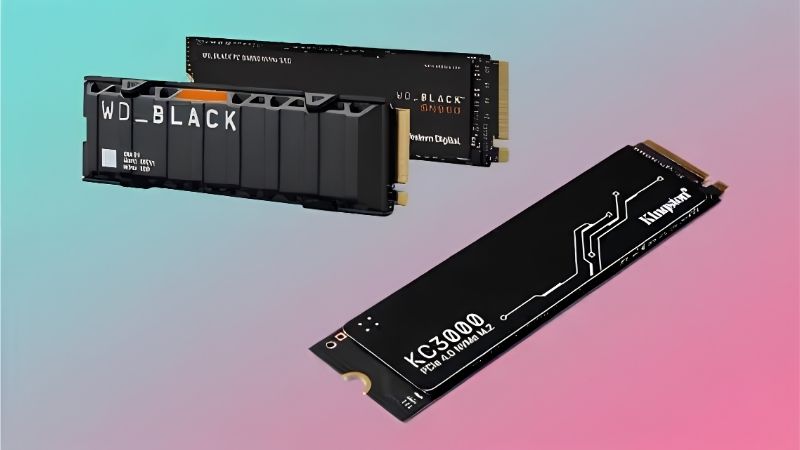
Random Reads Matter More Than Sequential Speed
Game engines request thousands of small assets rather than one enormous file. That workload is measured in IOPS at low queue depth, where a Samsung 990 PRO rated at 1,400K random read IOPS pulls ahead of drives quoting higher sequential figures.
The practical gap between a good Gen4 drive and a Gen5 flagship in actual game loading is usually under a second. Anyone telling you Gen5 halves loading times is quoting a synthetic sequential test that games never generate.
DRAM Cache Versus Host Memory Buffer
Drives with onboard LPDDR4 keep their address mapping table locally, which holds random performance steady as the drive fills. DRAM-less designs borrow a small slice of system memory instead through Host Memory Buffer.
For a drive holding a game library, HMB designs like the Samsung 990 EVO Plus perform close enough that the price saving is usually worth it. If the same drive also hosts Windows and heavy multitasking, onboard DRAM is the safer choice.
Capacity, SLC Cache and Staying Fast When Full
Two terabytes is the sensible baseline in 2026 given how large modern installs have become. Every SSD writes into a fast pseudo-SLC zone before folding data down, and that zone shrinks as the drive fills.
Leaving roughly ten percent of capacity free keeps garbage collection comfortable and prevents the drive falling back to native TLC write speed during large installs. Buying one size up is cheaper than living with a permanently full drive.
Console Fitment and DirectStorage
PlayStation 5 requires a drive rated at 5,500 MB/s or faster with total height under 11.25mm including any heatsink. Bare drives paired with a thin aftermarket sink are the reliable route; tall factory heatsinks will not clear the bay.
On PC, DirectStorage support is a Windows and game engine feature rather than something a drive advertises. Any NVMe drive works with it, though the benefit is largest on drives with strong low queue depth random read performance.
Top Picks: Best NVMe SSD for Gaming Builds
These six cover the range from a flagship gaming drive to a value option and a 2230 model for handhelds. All specifications are manufacturer-rated at 2TB as of August 2026.
| Drive | Interface | Rated Read/Write | Cache | Endurance |
|---|---|---|---|---|
| WD_BLACK SN850X 2TB | PCIe 4.0 x4 | 7,300 / 6,600 MB/s | DRAM | 1,200 TBW |
| Samsung 990 PRO 2TB | PCIe 4.0 x4 | 7,450 / 6,900 MB/s | DRAM | 1,200 TBW |
| Crucial T500 2TB | PCIe 4.0 x4 | 7,400 / 7,000 MB/s | DRAM | 1,200 TBW |
| Samsung 990 EVO Plus 2TB | PCIe 4.0 x4 | 7,250 / 6,300 MB/s | HMB | 1,200 TBW |
| Lexar NM790 2TB | PCIe 4.0 x4 | 7,400 / 6,500 MB/s | HMB | 1,500 TBW |
| Crucial P310 2TB | PCIe 4.0 x4 | 7,100 / 6,000 MB/s | HMB | 440 TBW |
WD_BLACK SN850X 2TB – Best Overall for Gaming
This is the drive built specifically for the job and the best nvme ssd for gaming in most builds. Game Mode 2.0 predicts and pre-loads frequently accessed data, and the combination of onboard DRAM with strong low queue depth random reads is exactly what game engines ask for.
The WD Dashboard software is heavier than it needs to be and nags about updates. Firmware history on this family has also been less smooth than Samsung’s, so check you are on a current release before loading a large library onto it.
Samsung 990 PRO 2TB – Highest Random Performance
Rated at 1,400K random read IOPS, the 990 PRO leads this list where it counts. The Elpis controller holds performance steady as the drive fills, and the five-year warranty covers 1,200 TBW at this capacity.
Samsung discounts it less aggressively than rivals discount theirs, so you often pay a premium for a difference measured in fractions of a second. The heatsink version is also too tall for a PlayStation 5 bay.
Crucial T500 2TB – Best Value at the Top Tier
Built on the Phison E25 controller with onboard DRAM, the T500 matches the flagship drives in practical game loading while typically sitting a tier below them in price. It runs cooler than most Gen4 drives under sustained load.
It gives up a little in sustained large-file writes compared to the SN850X, and Crucial’s Storage Executive software is basic. Neither matters for a drive that mostly holds installed games.
Samsung 990 EVO Plus 2TB – Best Value Without QLC
This drive uses TLC NAND with Host Memory Buffer instead of onboard DRAM, landing close to flagship sequential speed at a lower price. For a pure game library it is genuinely difficult to distinguish from the 990 PRO.
The gap appears in mixed read-write workloads and heavy multitasking, where the absence of local DRAM shows. It is a secondary game drive rather than the ideal choice for a single do-everything system disk.
Lexar NM790 2TB – Best Capacity per Pound
The NM790 offers a 1,500 TBW endurance rating that beats several drives above it and consistently sits at one of the lowest prices per terabyte in the Gen4 tier. For bulk game storage, that combination is hard to argue with.
It is DRAM-less, so sustained random performance trails the flagships, and Lexar’s software and firmware support is thinner than the major brands. Treat it as a library drive rather than a boot drive.
Crucial P310 2TB – Best for Handhelds
Available in the compact 2230 form factor as well as standard 2280, this is the drive for upgrading a Steam Deck, ROG Ally or similar handheld where full-size drives simply do not fit.
The 440 TBW endurance rating is low for the capacity, and it is DRAM-less with modest sustained write behaviour. In a handheld that mostly reads installed games, neither limitation causes real problems.
How 2026 Storage Pricing Affects Gaming Builds
Flash pricing has moved more in the last year than in the previous five, which changes when and how much to spend on the best nvme ssd for gaming.
NAND Prices Are Still Rising Into Q4
TrendForce raised its forecasts again for the second half of 2026, projecting NAND contract prices up 10-15% quarter over quarter in Q3. The easing from earlier peaks reflects buyer resistance rather than supply improving.
New manufacturing capacity is not expected before late 2027. For a gaming drive purchase specifically, that means the price today is unlikely to be beaten by waiting a month or two for better conditions.
Black Friday Will Not Fix SSD Pricing This Year
Stock arriving for the November sales was manufactured from flash bought at 2026 contract prices, so the discount headroom retailers normally carry is largely absent. The standard advice to wait does not apply to storage this year.
Genuine deals still exist in coolers, fans, cases and power supplies. If you are budgeting a full gaming build, plan for savings on those parts and treat the drive as a fixed cost rather than a sale target.
Buy the Capacity You Need Now
The usual strategy of buying a smaller drive and adding a second later is working against people this year, because the second drive will almost certainly cost more per terabyte than the first did.
If your build has one M.2 slot and your library is growing, buying 2TB rather than 1TB today is the sensible hedge. That is a pricing observation rather than a scare tactic – prices could stabilise, but nothing in the supply picture suggests it soon.
Frequently Asked Questions
The best nvme ssd for gaming debate produces the same handful of follow-up questions once buyers start comparing specification sheets rather than prices.
Does the best nvme ssd for gaming need to be PCIe 5.0?
No. Game loading is dominated by low queue depth random reads, where Gen4 drives already exceed what current engines request. Gen5 is worth paying for if you move very large project files, not because it shortens loading screens.
How much difference does an SSD make to frame rates?
Almost none while you are playing. The drive affects loading times and texture streaming in open-world titles, where a slow drive can cause pop-in. Once assets are in memory, the graphics card and processor determine frame rate.
Is 1TB enough for a gaming drive in 2026?
It is workable if you rotate games regularly, but several major titles now exceed 100GB installed. Two terabytes is the comfortable baseline, and the price gap per terabyte between 1TB and 2TB is usually small enough to justify the step up.
Do I need a heatsink on a gaming SSD?
For Gen4 drives, the motherboard M.2 shield is sufficient in a case with normal airflow. Gen5 drives need substantial cooling or they throttle under sustained load, which is another reason Gen4 makes more sense for a gaming build.
See More:
- Best 4TB NVMe SSD
- Best thermal grizzly paste
- Best thermal paste for 7800X3D
- Best CPU case fans
- Best motherboard for gaming computer
Final Thoughts
The best nvme ssd for gaming is a Gen4 drive with strong random read performance and enough capacity to hold your library comfortably. The SN850X and 990 PRO lead on outright performance, the T500 and 990 EVO Plus deliver almost the same experience for less, and the NM790 wins on capacity per pound. With NAND pricing still climbing into Q4 2026, buy the capacity you actually need now rather than planning to add more later.

Write Your Review
No reviews yet. Be the first to share your experience!