
- Top Pick: SURALLOW RX 580 8GB Graphics Card, 2048SP,GDDR5,256 Bit Graphics Card for Gaming PC,PCIE 3.0,Twin Fans Computer Video Card with 3XDP,HDMI Ports
- Best Value: MSI Gaming Radeon RX 580 8G GDRR5 256-bit HDCP Support DirectX 12 VR Ready Single Fan Crossfire Graphics Card (RX 580 8G) (Renewed)
- Premium Choice: XFX Radeon RX 580 GTS Black Edition 1425MHz OC+, 8GB GDDR5, VR Ready, Dual BIOS, 3xDP HDMI DVI, AMD Graphics Card (RX-580P8DBD6) (Renewed)
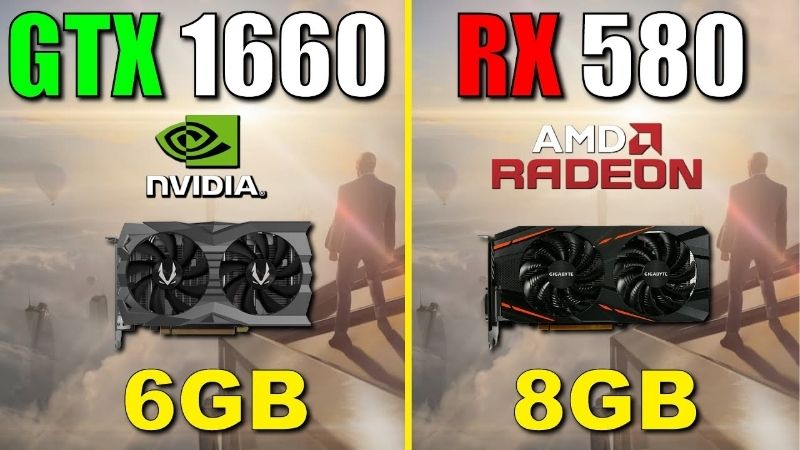
GTX 1660 Super vs RX 580 pits two of the most legendary budget cards in PC gaming history against each other on the used market. One is newer and more efficient; the other is older but packs more VRAM for less money. For bargain hunters trying to build a capable 1080p rig for pennies, this side-by-side lays out the specs, the real frame rates, and a clear verdict on which classic GPU is the smarter used buy in 2026.
The Quick Verdict and Full Spec Comparison
Here is the short answer before the deep dive. These cards represent two different eras of budget gaming, and they trade blows in a way that makes the winner depend on your priorities—efficiency and speed, or raw VRAM and rock-bottom price. The table below shows exactly where each card stands.
As an Amazon Associate we earn from qualifying purchases at no extra cost to you.




Quick Verdict: Who Wins at a Glance
For most buyers, the GTX 1660 Super is the better all-round card. It is roughly 15–25% faster than the RX 580, runs much cooler and quieter, and uses far less power, making it the easier and more efficient 1080p gaming choice.
The RX 580 8GB fights back on value. It is usually cheaper on the used market and carries 8GB of VRAM versus the 1660 Super’s 6GB, which can help in a handful of texture-heavy titles.
Short version: buy the GTX 1660 Super for speed and efficiency, and choose the RX 580 only when it is clearly cheaper and you want the extra VRAM buffer.
Full Spec Comparison Table
Numbers first. These specs explain every difference you will notice in games and in your electricity bill.
| Spec | RX 580 8GB | GTX 1660 Super |
|---|---|---|
| Architecture | Polaris (GCN) | Turing |
| VRAM | 8GB GDDR5 | 6GB GDDR6 |
| Memory bus | 256-bit | 192-bit |
| Stream/CUDA units | 2,304 | 1,408 |
| Board power | ~185W | ~125W |
| Power connector | 1x 8-pin | 1x 8-pin |
| Recommended PSU | 500W | 450W |
| Typical used price | ~$90–$120 | ~$120–$150 |
The RX 580 has more VRAM and a wider memory bus, but the GTX 1660 Super’s newer Turing architecture and faster GDDR6 memory let it do more with less, delivering higher frame rates while drawing far fewer watts.
What the Raw Numbers Actually Mean
Architecture beats brute force here. The RX 580’s higher unit count and 256-bit bus look impressive, but its older Polaris design is less efficient per watt, so the leaner GTX 1660 Super still comes out ahead in most games.
The VRAM split is the RX 580’s real selling point. Its 8GB buffer versus the 1660 Super’s 6GB can prevent texture stutter in a few demanding modern titles, even though the 1660 Super’s faster memory usually wins on overall speed.
Power efficiency is the decisive practical gap. At around 185W, the RX 580 runs hot and hungry compared to the 1660 Super’s 125W, which means more heat, more fan noise, and a slightly beefier power supply requirement.
That efficiency difference compounds over time. A 60W gap may sound minor, but across long gaming sessions it means a warmer case, louder fans, and marginally higher running costs for the RX 580. None of this makes the RX 580 a bad card, but it does mean the 1660 Super delivers its higher performance while asking less of your power supply and cooling—a combination that is hard to argue against for a set-and-forget build.
Deep Dive Face-Off: Performance, Features, and Real-World Fit
Averages only tell part of the tale. To choose correctly you need to see how these cards handle real games, what features separate them, and how each fits a budget build in practice. This is where the GTX 1660 Super vs RX 580 rivalry gets settled by your priorities.
Rasterization Performance at 1080p
In modern AAA titles at 1080p high settings, the GTX 1660 Super generally holds a steady lead, keeping more games comfortably playable where the RX 580 sits a notch lower and occasionally needs reduced settings.
In esports and older titles, both cards perform well and feed a 60–100 fps experience easily, though the 1660 Super again edges ahead and pushes higher toward high-refresh territory in lighter games.
The exception is any title that genuinely needs more than 6GB of VRAM, where the RX 580’s 8GB buffer can hold textures the 1660 Super has to drop—a narrow but real advantage.
Put into real games, the picture is nuanced. In most modern AAA titles at 1080p, the GTX 1660 Super delivers the higher and more consistent frame rate, but in a handful of VRAM-hungry games with ultra texture packs, the RX 580’s larger buffer keeps textures loading cleanly where the 1660 Super shows pop-in. For the majority of a typical game library, though, the 1660 Super’s speed advantage is the one you will feel more often.
Efficiency, Encoding, and Feature Set
The GTX 1660 Super’s Turing media engine gives it a strong hardware encoder, making it the better pick for lightweight streaming and recording. The older RX 580’s encoder is more dated by comparison.
Neither card offers ray tracing or modern AI upscaling, so both are judged purely on rasterized performance and efficiency. In that light, the 1660 Super’s newer design keeps it more relevant as games grow more demanding.
The RX 580 counters with driver longevity and a large community, and its 8GB of VRAM gives it a small measure of future-proofing that belies its age—part of why it remains a cult favorite among budget builders.
That community factor is worth more than it sounds. Years of optimization, guides, and tuning tips mean an RX 580 owner rarely runs into a problem someone has not already solved, and undervolting the card can meaningfully cut its heat and power. The 1660 Super needs less of that attention out of the box, but the RX 580’s deep support base makes it forgiving for a tinkerer willing to spend a little time dialing it in.
Power, Heat, and System Compatibility
This is the GTX 1660 Super’s clearest win. Its 125W draw keeps temperatures and noise low and works comfortably on a modest 450W supply, making it an easy, cool-running upgrade.
The RX 580’s roughly 185W appetite runs hotter and louder and wants a 500W or stronger supply, so it demands better case airflow and a healthier power supply to stay happy.
Both need a single 8-pin connector and fit standard mid-tower cases, but if quiet, cool, and efficient matters to you, the 1660 Super is the more comfortable card to live with day to day.
Over the life of the card, that efficiency gap adds up in ways beyond noise. The RX 580’s higher draw means more heat dumped into your case, which can nudge up the temperature of nearby components and push case fans to work harder. In a small or poorly ventilated build, the cooler-running 1660 Super is simply the easier card to keep quiet and stable, while the RX 580 rewards a roomier case with good airflow.
Value, the 2026 Used Market, and Final Verdict
Performance leans toward the 1660 Super, but on the used market price and timing decide real value. With component costs rising again and the second-hand market shifting, when you buy matters as much as which card you pick. Here are the trade-offs, the market picture, and a clear recommendation.
Pros and Cons of Each Classic Budget GPU
Both legends come with compromises. Here is the direct breakdown so you can line the trade-offs up against your own priorities before deciding.
RX 580 8GB
- Pros: Usually cheapest, 8GB VRAM buffer, wide 256-bit bus, strong driver support and community.
- Cons: Higher power and heat, slower in most titles, dated encoder, aging architecture.
GTX 1660 Super
- Pros: Faster overall, far more efficient, cooler and quieter, better encoder for streaming.
- Cons: Costs a bit more, only 6GB VRAM, no ray tracing or DLSS.
Should You Buy Now? What the Used Market Is Doing
Timing has become part of this decision. Because both cards live almost entirely on the second-hand market, they are especially sensitive to broader price pressure—and component prices have been drifting upward again, nudging used listings for these classics higher than they were a year ago.
The reassuring news is that the market has calmed. Prices have stopped rising as sharply as they did in late 2025 and have settled into a stretch of relative stability, though more volatility remains possible. Additional memory supply is also coming, with new fabrication facilities in the pipeline, but those are not expected to be running until 2027–2028, so any real price relief is still years away rather than imminent.
For a value hunter, the practical conclusion is clear: when a clean GTX 1660 Super or RX 580 shows up at a fair price today, buy it rather than waiting for a discount the market is not signaling. Set a target price, watch listings for a few days to learn the going rate, and act when a healthy card lands at or below it. You can compare current used listings on both cards through the links here in seconds.
See More:
The Alternative and Final Recommendation
If your budget can stretch a little, a used RX 6600 is the natural upgrade, offering a big performance and efficiency jump over both cards for not much more money—well worth pricing out before you commit. Within this matchup, though, the decision is simple.
Choose the GTX 1660 Super if you want the faster, cooler, more efficient card for everyday 1080p gaming and streaming. Choose the RX 580 only when it is clearly cheaper and you value the extra 8GB of VRAM over outright speed.
Prices move constantly on the used market, so compare live listings before you buy. You can check current deals on both cards through the links on this page.
To make the call concrete: if your priority is the smoothest, coolest, most hassle-free 1080p experience and you may stream or record, lean 1660 Super. If your priority is spending the absolute minimum while keeping a generous VRAM buffer for a few demanding titles, and you have a case with decent airflow, the RX 580 still delivers remarkable value. Both remain legitimate picks in 2026, which is exactly why this matchup has stayed relevant for so long.
Ultimately, the GTX 1660 Super vs RX 580 battle is a clash of eras, and for most gamers the newer GTX 1660 Super wins on speed, efficiency, and everyday comfort. The RX 580 endures as a bargain hero for those who want maximum VRAM at the lowest price and do not mind the extra heat. Match the card to your priorities, buy while the used market is stable, and either of these classics can still power a great-value 1080p build in 2026.
Top-Rated Picks


| Product | Brand | Rating | Reviews | Price |
|---|---|---|---|---|
| ARCTIC MX-4 (4 g) – Premium Performance Thermal Paste… | ARCTIC | ★ 4.8 | 104k | $4.99 |
| ARCTIC MX-4 (incl. Spatula, 4 g) – Premium Performanc… | ARCTIC | ★ 4.8 | 71.9k | $5.49 |
| Crucial 8GB DDR4 RAM 3200MHz (PC4-25600), Downclockab… | Crucial | ★ 4.8 | 62.8k | $74.99 |
| AMD Ryzen 5 5600X 6-core, 12-thread unlocked desktop … | — | ★ 4.8 | 30.2k | $177.60 |
| NVIDIA Shield Remote; Voice Search, Motion-Activated,… | — | ★ 4.7 | 10.6k | $25.99 |
Frequently Asked Questions
How much faster is the GTX 1660 Super than the RX 580?
The GTX 1660 Super is roughly 30 to 40 percent faster than an 8GB RX 580 at 1080p in most modern titles. Its GDDR6 memory delivers 336GB/s of bandwidth versus 256GB/s on the Radeon, and the Turing architecture is significantly more efficient per clock.
Does the RX 580 eight gigabytes of VRAM beat the 1660 Super six gigabytes?
Capacity favors the RX 580, and in a handful of texture-heavy titles that extra 2GB avoids stutter. However, the RX 580 usually lacks the raw shading power to run those settings smoothly anyway, so the GTX 1660 Super remains the better overall 1080p experience despite less VRAM.
What are the power and PSU requirements?
The RX 580 is power hungry at roughly 185W to 200W depending on the model, typically using an 8-pin connector and wanting a genuine 500W to 550W supply. The GTX 1660 Super draws about 125W from a single 8-pin and is happy on a decent 450W unit.
Are used RX 580 cards risky because of mining?
Many RX 580s spent years in mining rigs, so fan bearings, thermal pads, and VRAM thermals are common failure points. Ask for the original BIOS, check for a stable core clock under load, and inspect for repasting or missing shrouds. The GTX 1660 Super was also mined but generally less heavily.
Which card has better driver support going forward?
Both are on mature architectures. Polaris cards like the RX 580 have moved to less frequent AMD driver updates, while Turing-based GTX 1660 Super cards still receive Nvidia Game Ready drivers and support NVENC for streaming. For longevity and encoding quality, the GTX 1660 Super is the safer used pick.





Write Your Review
No reviews yet. Be the first to share your experience!