
Best 4K 27 inch gaming monitor options deliver roughly 163 pixels per inch, which is the sharpest image available in mainstream gaming displays today. The trade-offs are desktop scaling and cost, and whether that sharpness is worth the cost of a graphics card capable of feeding it at high refresh rates.
As an Amazon Associate we earn from qualifying purchases at no extra cost to you. Product prices and availability are accurate as of the date shown and are subject to change.





As an Amazon Associate we earn from qualifying purchases at no extra cost to you. Product prices and availability are accurate as of the date shown and are subject to change.
By Ryan Cole
How to Choose the Best 4K 27 Inch Gaming Monitor
This size sits in an unusual position: sharper than any 32 inch panel but requiring more compromise on the desktop. These four checks decide whether the best 4K 27 inch gaming monitor suits how you work and play.
Understand What 163 PPI Means in Practice
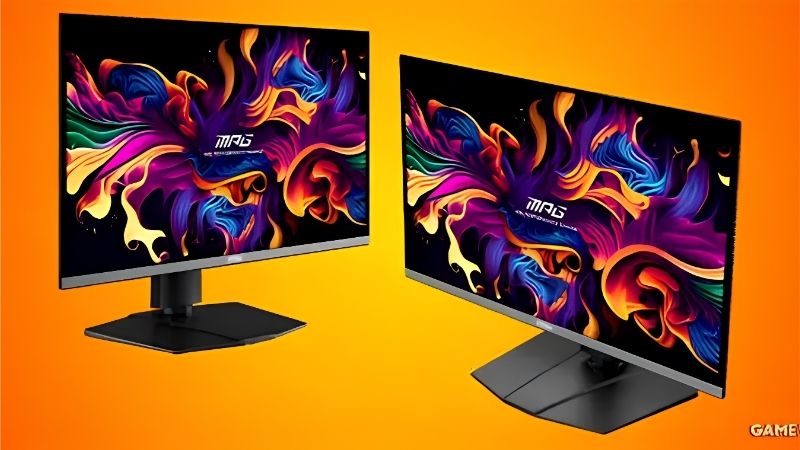
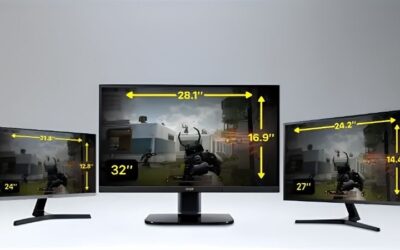
At 27 inches, 4K produces roughly 163 pixels per inch, compared with about 138 on a 32 inch panel. Individual pixels are effectively invisible at normal desk distance, which makes text and fine detail exceptionally clean.
The cost is interface size. Most people run 125% or 150% scaling in Windows, which reduces the usable desktop space compared with running a 32 inch panel unscaled at the same resolution.
If your priority is workspace rather than sharpness, a 32 inch 4K panel or a 27 inch 1440p screen may serve better. This size rewards people who value image quality over screen real estate.
Choose the Panel Technology Deliberately
QD-OLED at this size delivers per-pixel contrast and near-instant response, but the subpixel layout affects text rendering, which is more noticeable at higher density.
IPS panels are brighter across the full screen, cheaper and better for long desktop sessions. Contrast is the weakness, with grey blacks in dark scenes and backlight uniformity issues on some units.
Mini-LED is rare at this size, since the panel area leaves less room for dimming zones. If contrast matters most, OLED is effectively the only option at 27 inches.
Set Refresh Rate Against Your Graphics Card
Driving 4K at 240Hz requires a high-end card and usually upscaling with frame generation. At 160Hz, a strong mid-range card can keep pace in most titles with upscaling enabled.
Consoles cap at 4K 120Hz over HDMI 2.1, so anything above that is PC-only. Match the refresh to the hardware you own rather than the hardware you might buy later.
Adaptive sync range matters more than the headline number. A panel that holds smooth frame pacing from 48fps upward is more useful than one advertising a ceiling you rarely reach.
Check Ports, Stand and Coating
HDMI 2.1 is essential for consoles, and DisplayPort 1.4 with DSC handles 4K high refresh from a PC. USB-C with power delivery is worth having if a laptop shares the desk.
Panel coating matters more at this density. A glossy finish preserves the sharpness that makes this size appealing, but shows reflections clearly in a bright room.
Stand height adjustment is worth checking too. At high pixel density you sit closer than usual, so a screen fixed slightly too high becomes uncomfortable over a long session.
Top Picks: Best 4K 27 Inch Gaming Monitor Options
The best 4K 27 inch gaming monitor for you depends on panel type and budget, so these six run from premium QD-OLED to affordable IPS. Specifications come from manufacturer documentation, and pricing in this segment shifts frequently, so compare current listings.
| Monitor | Panel | Refresh | Key Feature | Best For |
|---|---|---|---|---|
| ASUS ROG Swift PG27UCDM | QD-OLED | 240Hz | Highest density OLED | Best overall |
| Gigabyte M27U | IPS | 160Hz | KVM switch | Best value |
| ASUS ROG Strix XG27UCS | Fast IPS | 160Hz | Balanced tuning | Mixed gaming |
| Acer Nitro XV275K P3 | IPS | 160Hz | Wide colour coverage | Colour work and play |
| LG UltraGear 27GN950-B | Nano IPS | 144Hz | Mature, widely stocked | Reliable IPS choice |
| Samsung Odyssey G7 G70D | IPS | 144Hz | Smart platform | Console-focused desks |
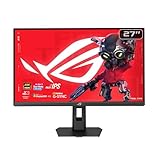
ASUS ROG Swift PG27UCDM
A 27 inch 4K QD-OLED at 240Hz, this combines the highest pixel density available on an OLED gaming panel with per-pixel contrast and effectively instant response times.
It is the most expensive option here by a wide margin, and text rendering on the triangular subpixel layout is imperfect for long document sessions. Purely for gaming, it is the best image on the list.
Burn-in mitigation is handled by pixel shifting and periodic refresh cycles, with warranty cover on most current OLED panels. Varied content is fine; a static bright HUD left on for hours is the risk case.
Gigabyte M27U
4K at 160Hz with HDMI 2.1, USB-C and a built-in KVM makes this the practical value choice. It covers a console, a desktop and a laptop from one screen without extra hardware.
The stand is basic and HDR is nominal rather than genuine, so treat the certification as marketing. Neither issue affects the core proposition, which is a sharp, fast panel with the right ports at a sensible price.
ASUS ROG Strix XG27UCS
A fast IPS panel at 160Hz with well-judged overdrive tuning, meaning motion is clean without the overshoot artefacts some competitors show at higher settings.
Contrast is typical IPS and the feature set is plainer than the Gigabyte, with no KVM switch included. It is a straightforward, well-executed panel rather than a standout on specifications, which suits buyers who simply want reliable motion handling.
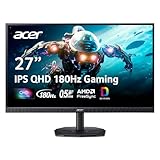
Acer Nitro XV275K P3
Wide colour coverage and 160Hz refresh make this useful for anyone editing photos or video alongside gaming. Factory calibration is better than most panels in this bracket, which saves buying a colorimeter for casual creative work.
Build quality is functional rather than premium and the on-screen menu is dated by current standards. For a dual-purpose desk that handles both creative work and gaming, it offers more than the price suggests.
LG UltraGear 27GN950-B
An older but well-proven Nano IPS panel at 144Hz with HDMI 2.1, still widely stocked and frequently discounted. Colour accuracy out of the box has always been a strength here.
It has been surpassed on refresh rate and HDR capability by newer models, and the HDR mode in particular is nominal rather than useful. Buy it when the discount is meaningful rather than paying full price for an older panel.
Samsung Odyssey G7 G70D
4K at 144Hz with Samsung’s smart platform built in, which suits a desk where the screen doubles as a media display without a connected device.
The smart interface adds startup delay and menu complexity, and the panel itself is unremarkable against cheaper alternatives with similar specifications. Buy it for the built-in platform rather than the image quality.
What 2026 GPU Pricing Means at This Resolution
Sharpness at 27 inches is only useful if the graphics card can drive it, and that side of the build has changed significantly this year.
The Card Costs More Than the Screen
NVIDIA cut partner supply by roughly 20% and global GPU pricing rose around 19% from late 2025, with several models increasing further since. High-refresh 4K is now an expensive proposition.
That is worth weighing when choosing the best 4K 27 inch gaming monitor. A 160Hz IPS panel plus a stronger graphics card usually produces better results than a 240Hz OLED fed by a weaker one.
Memory Type Is Driving the GPU Squeeze
The bottleneck centres on GDDR7 modules, where 3GB parts cost far more than 2GB equivalents. Radeon RX 9000 cards use GDDR6 and have seen smaller increases as a result.
Check both brands when budgeting rather than assuming the usual price relationships still hold. The gap between comparable cards has widened noticeably over the past year, and the cheaper option is not always the one you would expect.
Panels Are Not Affected the Same Way
Displays have avoided the memory-driven price pressure hitting RAM, SSDs and prebuilt systems, and still discount normally during major sales. If you are not in a hurry, waiting for a sale on the screen itself is a reasonable strategy this year.
Nothing significant launches before CES in January 2027, so there is no new panel generation to hold out for. Buy when the price is right rather than waiting on a roadmap.
That applies to the rest of the build as well. Coolers, cases and fans still discount normally, while memory and prebuilt systems are locked to expensive 2026 contract pricing.
Frequently Asked Questions
These four questions decide most purchases of the best 4K 27 inch gaming monitor, where the sharpness advantage comes with real trade-offs.
Is 4K worth it at 27 inches?
If you value image sharpness and can drive the resolution, yes. If you want more usable desktop space or run a mid-range card, 1440p at this size or 4K at 32 inches makes more sense.
Do I have to use display scaling?
Most people run 125% or 150% scaling. Some can work at 100%, but interface elements become small enough to strain at typical desk distance, particularly in applications with dense menus and small toolbar icons.
Is 240Hz usable at 4K?
Only with a high-end graphics card and upscaling. In demanding titles, most systems land well below that, so a 160Hz panel is the more realistic target for a mid-range build.
Does this size work for consoles?
Yes, provided the panel has HDMI 2.1. Consoles output 4K at up to 120Hz, and the higher pixel density at 27 inches makes console games look noticeably crisper than the same output on a larger screen.
See More:
Final Thoughts
The best 4K 27 inch gaming monitor for most buyers is a 160Hz IPS panel with HDMI 2.1 and a KVM, with QD-OLED reserved for people who prioritise contrast and can absorb the cost. Decide whether you want sharpness or desktop space first, then match the refresh rate to the graphics card you already own rather than one you hope to buy.

Write Your Review
No reviews yet. Be the first to share your experience!