
- Top Pick: ARCTIC MX-4 (4 g) – Premium Performance Thermal Paste for All Processors
- Best Value: ARCTIC MX-4 (incl. Spatula, 4 g) – Premium Performance Thermal Paste
- Premium Choice: ARCTIC MX-6 (8 g) – Ultimate Performance Thermal Paste for CPU, Consoles, Graphics Cards, laptops, Very high Thermal Conductivity, Long Durability, Non-Conductive
Best thermal paste for 7800X3D matters more than it does on a normal CPU, because the stacked V-Cache sits above the cores and pushes heat through an extra layer of silicon before it ever reaches the heatspreader. This guide covers what that changes, which compounds handle it best, and how to apply them on AM5.
As an Amazon Associate we earn from qualifying purchases at no extra cost to you. Product prices and availability are accurate as of the date shown and are subject to change.


As an Amazon Associate we earn from qualifying purchases at no extra cost to you. Product prices and availability are accurate as of the date shown and are subject to change.
By Ryan Cole
How to Choose the Best Thermal Paste for 7800X3D Builds
Before picking the best thermal paste for 7800X3D systems, understand the chip: eight cores, 96MB of total L3 cache, a 120W TDP and a 162W package power limit. It does not draw huge power, but it concentrates heat in a small area and hits its 89C thermal limit sooner than raw wattage suggests.
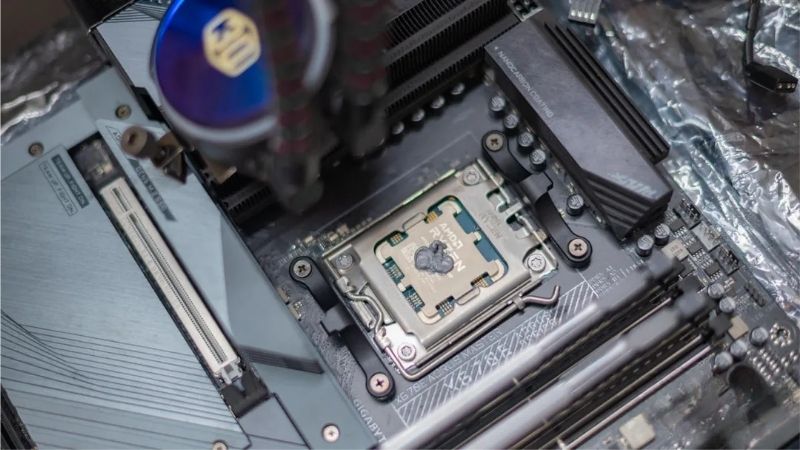
Why V-Cache Changes the Thermal Picture
On this design the additional 64MB cache die is bonded on top of the CCD. Heat generated in the cores has to travel through that layer before reaching the heatspreader, which raises the effective thermal resistance of the package itself.
The practical result is a chip that reports high temperatures at moderate power draw. Seeing 80C during a gaming session on a 7800X3D is not the same warning sign it would be on a non-X3D part running the same wattage.
That also means the interface material has slightly more leverage here than on a cooler-running chip. A good compound will not transform the numbers, but two to three degrees is enough to keep boost clocks from dipping in long sessions.
Conductivity Ratings Worth Paying For
Anything from about 8.5 W/mK upward performs acceptably on this CPU. Between a mid-tier compound at 8.5 W/mK and a premium one at 14 W/mK, expect roughly two degrees under a sustained gaming load with the same cooler and mount.
Liquid metal is a poor fit here for most people. The AM5 heatspreader is thick and its exposed surface-mount components sit close to the edges, so the risk of a shorted board outweighs a gain that a well-mounted paste largely captures anyway.
Pump-Out Resistance and Long Sessions
The AM5 heatspreader is noticeably convex, which creates uneven pressure across the contact patch. Combined with repeated heating and cooling, that is the classic recipe for pump-out where compound gradually migrates away from the centre.
Phase-change materials such as PTM7950 solve this by softening at operating temperature and reflowing rather than being squeezed out. On a chip that will stay in the socket for years, that stability often beats a slightly higher day-one rating.
Cooler Choice Sets the Ceiling
No compound compensates for an undersized cooler. This CPU is comfortable on a good dual-tower air cooler or a 240mm AIO; on a stock-class cooler it will run into its thermal limit regardless of what sits between the die and the block.
Mounting pressure is the other half. AM5 brackets vary in how evenly they clamp, and an uneven mount costs more degrees than any paste choice. Retighten in a cross pattern and check the spread pattern if temperatures look wrong.
Top Picks: Best Thermal Paste for 7800X3D Owners
Each of these is a credible best thermal paste for 7800X3D pick, from a budget compound that does the job to a phase-change pad for people who never want to reapply. Ratings are manufacturer figures as of August 2026.
| Compound | Rated Conductivity | Type | Strength |
|---|---|---|---|
| Thermal Grizzly Kryonaut | 12.5 W/mK | Paste | Best all-round numbers |
| Noctua NT-H2 | Not published | Paste | Easiest application |
| Arctic MX-6 | 8.5 W/mK | Paste | Value per gram |
| Thermalright TFX | 14.3 W/mK | Paste | High rating, low price |
| Honeywell PTM7950 | 8.5 W/mK | Phase change | No pump-out |
| Cooler Master CryoFuze | 14 W/mK | Paste | Wide temperature range |
Thermal Grizzly Kryonaut – The Reliable Benchmark
Kryonaut is the compound most 7800X3D owners should start with. It is electrically non-conductive, thick enough to stay put on a convex heatspreader, and consistently lands at or near the top of independent comparisons at this power level.
Its weakness is service life on hot-running chips. Because this CPU regularly sits in the high seventies during gaming, expect performance to drift after a couple of years. Plan on reapplying rather than assuming it is permanent.
Noctua NT-H2 – Best for a First Application
NT-H2 spreads predictably, does not run when warm, and lands within about a degree of the best compounds on a chip in this power class. Noctua includes cleaning wipes in the retail box, which removes a step from the job.
You pay a premium per gram and Noctua does not publish a conductivity figure, which frustrates spec comparisons. It also comes in small tube sizes, so anyone repasting several machines will find it expensive relative to alternatives.
Arctic MX-6 – Best Value in a Large Tube
At 8.5 W/mK, MX-6 trails the premium options by roughly two degrees on this CPU, which in practice means a slightly higher fan curve rather than lost performance. The 8g tube costs less than 1g of some rivals.
It is noticeably thick and requires firm pressure to spread properly across the AM5 heatspreader. Applying it cold in a cool room is harder than it needs to be; warming the tube in your hand first makes a real difference.
Thermalright TFX – High Rating at Low Cost
Rated at 14.3 W/mK, TFX offers flagship-class conductivity at a mid-tier price and performs accordingly on a 7800X3D under a large air cooler. It is non-conductive, so socket spills are not a hazard.
The consistency of manufacturer ratings in this price bracket is worth treating carefully, and independent testing usually places it slightly behind the headline figure suggests. Application is also stiff, similar to MX-6.
Honeywell PTM7950 – The Long-Term Answer
PTM7950 is a phase-change sheet rather than a paste. It softens at operating temperature and reflows into the gap, which eliminates pump-out entirely – exactly the failure mode a convex AM5 heatspreader encourages over years of use.
It needs a proper heat cycle before it reaches full performance, so the first boot will look disappointing. It is also sold in sheets that must be cut to size, and counterfeit listings are common, so buy from a reputable seller.
Cooler Master CryoFuze – Wide Operating Range
Rated at 14 W/mK with a stated operating range from -50C to 240C, CryoFuze is a strong performer that stays workable in cold rooms where thicker compounds become difficult to spread evenly.
Tube sizes are small and the nozzle design makes precise dosing awkward on a large heatspreader. It also sits at a higher price tier than its real-world advantage over MX-6 on this particular CPU justifies.
What the 2026 Upgrade Market Means for X3D Owners
The wider component market makes a case for maintaining this chip rather than replacing it, which is why the best thermal paste for 7800X3D owners is worth more thought than usual right now.
Cheap Upgrades Still Deliver Real Gains
With graphics card pricing up sharply and no new CPU architectures arriving before CES in January 2027, holding a 7800X3D for another cycle is the sensible plan for most gamers. Cooling improvements are where the accessible gains are.
A fresh application plus a better cooler can move a 7800X3D from bumping its 89C limit to sitting comfortably in the low seventies, which shows up as steadier boost behaviour and a quieter fan curve rather than dramatic frame rate changes.
AM5 Is Supported Through 2029
AMD has confirmed that the AM5 socket will continue receiving new processors through 2029. A 7800X3D owner therefore has a genuine drop-in upgrade path later without replacing the motherboard, memory or cooler.
That makes spending on cooling hardware now a durable investment rather than a sunk cost, since the same cooler and bracket will carry over to whatever AM5 chip you move to in two or three years.
Where Discounts Are and Are Not Real
Thermal compound, coolers, fans and cases are still discounting normally through the late-2026 sales period, unlike memory and storage where sale stock was built at elevated contract prices. Buying cooling parts in November is legitimately worthwhile.
There is no urgency beyond that. Prices in this category are stable, so there is nothing lost by waiting for a specific compound to hit a good price rather than paying full retail today.
Frequently Asked Questions
Most best thermal paste for 7800X3D questions come from owners seeing high temperature readings and assuming something is wrong with the mount.
What temperature is normal for a 7800X3D under load?
Anywhere from the mid-sixties to the high seventies during gaming with a competent cooler is entirely normal. The chip is designed to run up to 89C and will manage itself safely at that point; hitting the limit briefly is not damage.
Does the best thermal paste for 7800x3d need to be liquid metal?
No, and it usually should not be. The gain over a good conventional compound on a soldered, non-delidded AM5 chip is small, while the risk from a spill onto exposed board components near the socket edge is permanent.
How should I apply paste on the AM5 heatspreader?
A five-dot pattern, with one dot in the centre and four toward the corners, spreads more evenly across the AM5 shape than a single pea. Let the cooler pressure do the spreading rather than trying to smooth it manually.
How often should I reapply on this CPU?
With a standard compound, every two to three years is a reasonable interval given how warm this chip runs. With a phase-change material such as PTM7950, you can realistically leave it for the life of the build.
See More:
- Best 4TB NVMe SSD
- Best thermal grizzly paste
- Best CPU case fans
- Best motherboard for gaming computer
Final Thoughts
Picking the best thermal paste for 7800X3D comes down to whether you want the best day-one numbers or the least maintenance. Kryonaut and NT-H2 are the safe high performers, MX-6 is the value option that gives up very little, and PTM7950 is the choice for anyone who wants to mount the cooler once and forget it. With AM5 supported through 2029 and no new architecture until 2027, spending on cooling this chip properly is money that keeps paying back.



Write Your Review
No reviews yet. Be the first to share your experience!