
- Top Pick: WD_Black SN8100 4TB NVMe SSD – PCIe 5.0×4, M.2 2280, Up to 14,900MB/s Read Speed, up to 11,000MB/s Write Speed, Best for AI Applications, Gaming, and Video Editing – WDS400T1X0M
- Best Value: Western Digital 4TB WD Blue SN5000 NVMe Internal Solid State Drive SSD – PCIe Gen 4.0, M.2 2280, Up to 5,500 MB/s – WDS400T4B0E [New Generation]
- Premium Choice: WD Blue 4TB SN5100 NVMe SSD – M.2 2280, PCIe Gen 4.0, Internal Solid State Drive – Read Speeds Up to 6,900MB/s, Upgrade Storage for PC/Laptops – WDS400T5B0E
Best 4TB NVMe SSD shopping has changed in 2026, because game installs, 4K project files and local AI models fill a 2TB drive faster than ever. This guide covers what actually matters at 4TB – sustained write speed, DRAM cache, thermals and endurance – then names the drives worth buying, plus the ones to skip.
As an Amazon Associate we earn from qualifying purchases at no extra cost to you. Product prices and availability are accurate as of the date shown and are subject to change.

![Western Digital 4TB WD Blue SN5000 NVMe Internal Solid State Drive SSD - PCIe Gen 4.0, M.2 2280, Up to 5,500 MB/s - WDS400T4B0E [New Generation]](https://m.media-amazon.com/images/I/31nPv-dYopL._SL160_.jpg)




As an Amazon Associate we earn from qualifying purchases at no extra cost to you. Product prices and availability are accurate as of the date shown and are subject to change.
By Ryan Cole
How to Choose the Best 4TB NVMe SSD
Capacity is the easy part. Picking the best 4TB NVMe SSD comes down to controller design, cache behaviour and heat, and those three decide whether the drive still feels fast when it is 80% full.
Controller, DRAM Cache and Why 4TB Behaves Differently
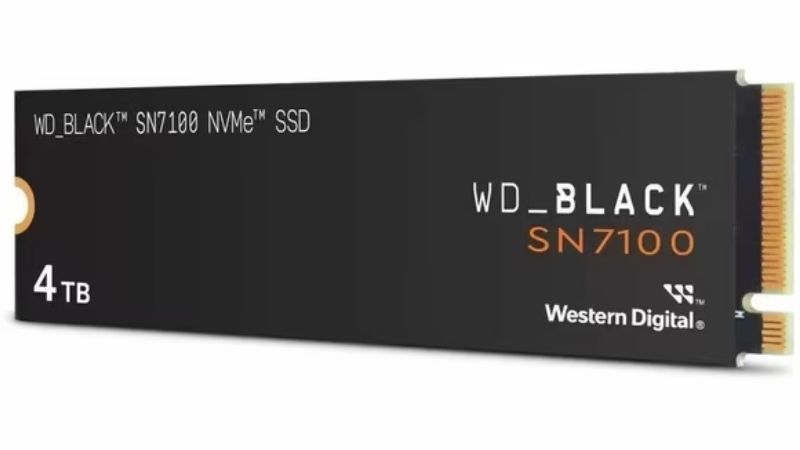
A 4TB drive needs roughly 4GB of mapping table space. Drives with onboard LPDDR4 keep that table on the SSD itself, which is why the Samsung 990 PRO and WD_BLACK SN850X hold their random read speed as the drive fills toward capacity.
DRAM-less drives borrow system memory through Host Memory Buffer instead. HMB is capped at a few dozen megabytes on most platforms, so at 4TB the controller ends up walking to NAND more often for lookups. Everyday use is fine; heavy random workloads are where the gap opens.
PCIe Gen4 Versus Gen5 at This Capacity
Gen4 drives top out near 7,400 MB/s sequential, Gen5 drives such as the Crucial T705 are rated up to 14,100 MB/s. Those numbers are real, but game load times and Windows responsiveness barely move because both formats already saturate what the OS asks for.
Gen5 earns its place in specific jobs: moving 200GB video projects, 8K scratch disks and loading large model weights. If your workload is games plus general use, Gen4 is the better value and runs cooler.
Endurance Ratings and Real Write Volume
Terabytes Written is the manufacturer warranty limit, not a failure point. Most 4TB TLC drives are rated at 2,400 TBW, while Seagate rates the FireCuda 530 at 5,100 TBW at this capacity – the highest figure in the mainstream class.
For context, a gamer reinstalling a full 4TB library monthly writes about 48TB a year, so even a modest rating covers decades. Endurance only decides things for video editors, database work or cache duty.
Heat, Heatsinks and PS5 Compatibility
Gen5 controllers pull noticeably more power and will throttle without a heatsink. The T705 ships in bare and heatsink versions; if your motherboard has a thick M.2 shield, the bare drive is usually the smarter buy since two heatsinks will not fit.
For PlayStation 5 the requirement is a low-profile heatsink under 11.25mm total height and a drive that clears the bay. Bare Gen4 drives with a thin aftermarket sink work well, and Sony recommends 5,500 MB/s or faster, which every Gen4 pick here exceeds.
Top Picks: Best 4TB NVMe SSD Drives Worth Buying
Every drive below is a credible best 4TB NVMe SSD candidate, spanning a Gen5 workstation option down to budget QLC for bulk storage. Specifications are manufacturer-rated as of August 2026; pricing moves weekly right now, so treat tier labels rather than exact figures as the guide.
| Drive | Interface | Rated Read/Write | Endurance | Cache |
|---|---|---|---|---|
| Samsung 990 PRO 4TB | PCIe 4.0 x4 | 7,450 / 6,900 MB/s | 2,400 TBW | LPDDR4 DRAM |
| WD_BLACK SN850X 4TB | PCIe 4.0 x4 | 7,300 / 6,600 MB/s | 2,400 TBW | DRAM |
| Crucial T705 4TB | PCIe 5.0 x4 | 14,100 / 12,600 MB/s | 2,400 TBW | DRAM |
| Seagate FireCuda 530 4TB | PCIe 4.0 x4 | 7,300 / 6,900 MB/s | 5,100 TBW | DRAM |
| Samsung 990 EVO Plus 4TB | PCIe 4.0 x4 / 5.0 x2 | 7,250 / 6,300 MB/s | 2,400 TBW | HMB |
| Crucial P3 Plus 4TB | PCIe 4.0 x4 | 5,000 / 4,200 MB/s | 800 TBW | HMB |
Samsung 990 PRO 4TB – The Balanced Default
This suits builders who want one drive to handle the OS, the game library and occasional editing without thinking about it. The Elpis controller with onboard DRAM keeps random performance steady as the drive fills, and the five-year warranty covers 2,400 TBW.
The downside is price positioning: Samsung rarely discounts the 990 PRO as hard as competitors discount theirs, so you often pay a premium for the badge. The heatsink model also adds height that some GPU backplates and mATX boards will not clear.
WD_BLACK SN850X 4TB – The Gaming-Focused Alternative
The SN850X trades a fraction of sequential speed for stronger sustained behaviour on large file copies, and Game Mode 2.0 keeps frequently used data in the fast zone. It is the drive to pick when the 990 PRO is priced above it.
The weak spot is the WD Dashboard software, which is heavier than it needs to be and occasionally nags about updates. Firmware history on this family has also been bumpier than Samsung’s, so check you are on current firmware before loading it up.
Crucial T705 4TB – Gen5 for Real Sequential Work
If you regularly move multi-hundred-gigabyte project files or run local model weights off disk, the T705 is the one that changes your day. The Phison E26 controller paired with Micron 232-layer TLC delivers rated sequentials no Gen4 drive can approach.
It runs hot and it is expensive. Without proper cooling the controller throttles under sustained load, and the drive draws meaningfully more power than a Gen4 equivalent, which matters in small form factor cases with limited airflow.
Seagate FireCuda 530 4TB – Highest Endurance in Class
The 5,100 TBW rating is more than double what most rivals offer at 4TB, which makes this the pick for editors, archivists and anyone using the drive as a working scratch disk. Seagate also bundles three years of Rescue data recovery.
It is an older Phison E18 platform, so idle power draw is higher than newer designs and it is a poor choice for laptops. The heatsink version is tall enough that it will not fit a PlayStation 5 bay without swapping the sink.
Samsung 990 EVO Plus 4TB – Best Value Without QLC
This drive uses TLC NAND and HMB instead of onboard DRAM, landing close to flagship sequential speed at a lower tier. For a game library and general storage it is genuinely hard to tell apart from the 990 PRO in normal use.
The compromise appears in sustained random work and in mixed read-write loads, where the lack of local DRAM shows. It also supports PCIe 5.0 x2, which is only useful on the handful of boards that expose a two-lane Gen5 slot.
Crucial P3 Plus 4TB – Bulk Storage on a Budget
When the goal is simply getting 4TB of fast-enough storage for installed games, this is the cheapest sensible way there. Rated at 5,000 MB/s read, it still loads games indistinguishably from drives twice the price.
It is QLC with an 800 TBW rating, and once the SLC cache is exhausted on a large write the speed drops sharply. Use it for a library you mostly read from, not as a scratch disk or a video capture target.
What the 2026 NAND Market Means for 4TB Buyers
Storage pricing is the strangest it has been in a decade, which changes when to buy. Two developments matter if you are shopping for the best 4TB NVMe SSD this quarter.
Prices Are Still Climbing Into Q4
TrendForce raised its forecasts again for the second half of 2026, projecting NAND contract prices up 10-15% quarter over quarter in Q3. The slowdown from earlier peaks reflects buyer resistance rather than supply catching up.
New fabrication capacity is not expected to come online before late 2027, and major suppliers have already sold out allocation for the year. For a 4TB drive specifically, that means the price you see today is unlikely to be beaten by simply waiting a month.
Black Friday 2026 Will Not Rescue SSD Pricing
The usual advice to hold out until late November does not apply to flash storage this year. Stock arriving for the November sales was manufactured from NAND bought at 2026 contract prices, so the discount room retailers normally have is largely gone.
Genuine deals still exist elsewhere in a build – coolers, thermal paste, fans, cases and power supplies are all discounting normally. If you are budgeting a full system, shift the savings expectation onto those parts rather than the drive.
When It Still Makes Sense to Wait
If your current drive still has free space, holding off on the best 4TB NVMe SSD purchase costs nothing but is unlikely to save money either. Buy when you need the capacity rather than timing a bottom forecasters do not see arriving.
The one case for patience is Gen5. Second-generation Gen5 controllers with lower power draw are expected around CES in January 2027, and they should make heatsink-free Gen5 practical. If you do not need 14,000 MB/s today, a Gen4 drive now is the sane call.
Frequently Asked Questions
These are the questions that come up most often once builders start comparing 4TB drives against each other rather than against smaller capacities.
Is the best 4tb nvme ssd always a Gen5 drive?
No. Gen5 wins on sequential transfer benchmarks, but game loading, application launches and Windows responsiveness are dominated by random reads and queue depth, where Gen4 drives are already at the point of diminishing returns. Gen5 is a workload decision, not a default upgrade.
Will a 4TB drive slow down as it fills up?
Every SSD does, because the pseudo-SLC cache shrinks as free blocks disappear. Drives with onboard DRAM degrade more gracefully. Leaving about 10% free is enough to keep garbage collection working on a 4TB drive.
Do I need a heatsink on a 4TB NVMe drive?
For Gen4 drives, the motherboard M.2 shield is sufficient in almost every case with normal airflow. Gen5 drives genuinely need active cooling or a substantial passive sink; without one they will throttle within minutes of a sustained write.
Can I use one of these drives in a PlayStation 5?
Yes, provided total height including the heatsink stays under 11.25mm and the drive is rated at 5,500 MB/s or faster. Bare Gen4 models with a thin aftermarket sink are the safest route; tall factory heatsinks will not fit.
See More:
- Best thermal grizzly paste
- Best thermal paste for 7800X3D
- Best CPU case fans
- Best motherboard for gaming computer
Final Thoughts
Choosing the best 4tb nvme ssd comes down to matching the controller to the work: DRAM-equipped Gen4 drives for balanced builds, a Gen5 drive only if you move very large files, and QLC for bulk libraries you mostly read. Given where NAND pricing sits heading into Q4 2026, buy when you need the capacity rather than waiting for a discount that the supply picture does not support.


Write Your Review
No reviews yet. Be the first to share your experience!