
- Top Pick: GPVHOSO RTX 2060 8GB Super Graphics Card 256Bit GDDR6,
- Best Value: ZER-LON GeForce GTX 1660 Super 6GB Graphics Cards, GDRR6 192Bit PCIE 3.0X16 Computer Gaming Gpu, Dual Freeze Fans Video Card with HDMI/DP/DVI Ports Support 4K and 8K HD
- Premium Choice: Nvidia Geforce RTX 2060 Super Founders Edition Graphics Card (Renewed)
RTX 2060 vs 1660 Super is the budget buyer’s real question about whether ray tracing and DLSS are worth paying for. These two Turing cards often sit only a little apart in price on the used market, yet one unlocks Nvidia’s AI features and the other does not. This side-by-side breaks down the specs, the true frame-rate gap, and a clear verdict on which card gives budget gamers the smarter deal in 2026.
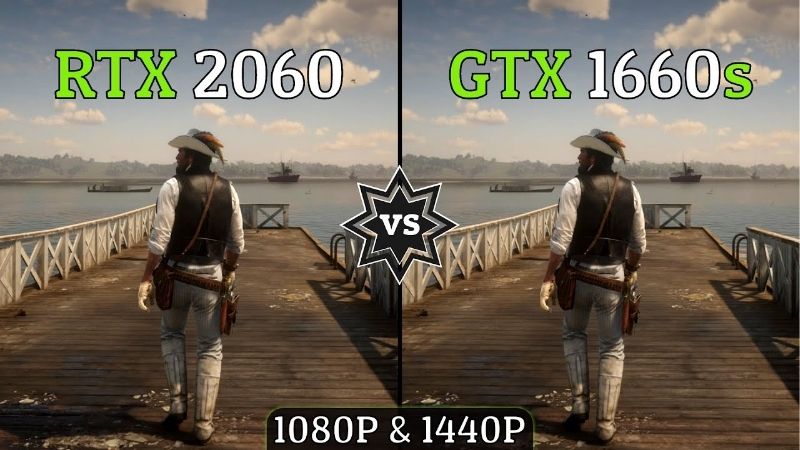
The Quick Verdict and Full Spec Comparison
Let us lead with the answer, then prove it. The core decision here is not just about raw speed—it is about whether the RTX 2060’s extra features justify its higher price and power. The table below lays out every spec that shapes that call, so you can see exactly what your money buys.
As an Amazon Associate we earn from qualifying purchases at no extra cost to you.



Quick Verdict: Who Wins at a Glance
For most buyers, the RTX 2060 is the better card. It is roughly 15–25% faster than the GTX 1660 Super and adds ray tracing plus DLSS support, which makes it noticeably more future-ready for a small price premium.
The GTX 1660 Super is the value pick for pure rasterized gaming. If you never plan to use ray tracing or DLSS, it delivers most of the 1080p experience for less money and less power.
Short version: buy the RTX 2060 for DLSS, light ray tracing, and extra performance, and choose the GTX 1660 Super only to save money on straight 1080p gaming.
Full Spec Comparison Table
Numbers first. These reference specs drive every difference you will feel in real games.
| Spec | GTX 1660 Super | RTX 2060 |
|---|---|---|
| Architecture | Turing (GTX) | Turing (RTX) |
| VRAM | 6GB GDDR6 | 6GB GDDR6 |
| Memory bus | 192-bit | 192-bit |
| CUDA cores | 1,408 | 1,920 |
| Ray tracing | No | Yes (RT cores) |
| DLSS | No | Yes (Tensor cores) |
| Board power | ~125W | ~160W |
| Typical used price | ~$120–$150 | ~$150–$190 |
Both cards share 6GB of GDDR6 on a 192-bit bus, so the real differences are the RTX 2060’s higher core count and its dedicated RT and Tensor cores, which unlock features the 1660 Super physically cannot run.
What the Raw Numbers Actually Mean
The core-count gap explains the raw performance lead. The RTX 2060’s extra CUDA cores translate into a consistent frame-rate advantage at 1080p and make it the more comfortable card for higher settings.
The RT and Tensor cores are the bigger story, though. They let the RTX 2060 run DLSS, Nvidia’s AI upscaler, which can boost frame rates substantially in supported games—a capability the 1660 Super has no hardware to access.
Shared 6GB of VRAM is the common ceiling. It is enough for 1080p in most titles, but both cards can brush against it at ultra textures, so neither is a limitless future-proof option.
Deep Dive Face-Off: Performance, Features, and Real-World Fit
Spec sheets set the stage; real use decides the winner. To choose well you need to see how these cards compare in raw frames, what the RTX features actually deliver, and how each fits a real budget build. This is where the RTX 2060 vs 1660 Super debate comes down to how you actually play.
Rasterization Performance at 1080p and 1440p
At 1080p high settings, both cards run modern AAA titles well, but the RTX 2060 holds a steady lead, often keeping demanding games comfortably above 60 fps where the 1660 Super sits closer to that line.
Step up to 1440p and the RTX 2060’s extra muscle becomes more valuable, holding playable frame rates in more titles while the 1660 Super starts needing lowered settings to keep up.
For a gamer eyeing a 144Hz 1080p panel or an occasional jump to 1440p, that consistent margin makes the RTX 2060 the more flexible performer of the two.
Specific titles show the split clearly. In demanding games like Cyberpunk 2077 or a modern Assassin’s Creed at 1080p high, the RTX 2060 holds a smoother average while the GTX 1660 Super sits closer to the edge of comfortable play. Turn on DLSS in a supported game and the gap widens further, because the 2060 can recover frames the 1660 Super has no way to reclaim—effectively giving the RTX card two levers to pull where the GTX card has only one.
Ray Tracing, DLSS, and the Nvidia Feature Advantage
This is where the RTX 2060 justifies its name. Its Tensor cores run DLSS, reconstructing a sharp image from a lower internal resolution to lift frame rates, which is especially useful for squeezing ray tracing or higher settings out of a budget card.
Its RT cores also enable entry-level ray tracing. It is not a high-end RT experience, but paired with DLSS it makes ray-traced effects genuinely playable in a way the GTX 1660 Super simply cannot attempt.
Because Nvidia keeps investing in DLSS and AI-driven rendering, owning an RTX card also means access to a feature set that continues to evolve, giving the RTX 2060 more long-term relevance than the feature-locked 1660 Super.
It is fair to set expectations honestly, though. The RTX 2060 is a first-generation ray tracing card, so heavy ray-traced titles will run best at 1080p with DLSS carrying the load rather than at maxed settings. Think of its RT support as a way to sample the technology and lean on DLSS for real frame-rate gains, not as a ticket to flawless path-traced visuals—that remains the domain of newer, pricier cards.
Power, Size, and System Compatibility
The GTX 1660 Super is the lighter card on your system, drawing around 125W and running comfortably on a modest power supply with a single 8-pin connector.
The RTX 2060 pulls roughly 160W and benefits from a slightly stronger supply, so owners of very basic prebuilts should confirm their PSU has the headroom before upgrading.
The difference is modest in absolute terms but easy to overlook. Around 35W separates the two cards, which translates into a little more heat and fan noise from the RTX 2060 under load. In a well-ventilated tower this is a non-issue, but in a cramped case it is one more reason to make sure your cooling and power supply are up to the task before choosing the faster card.
Both are standard dual-slot cards that fit most mid-tower builds. The practical difference is small, but the 1660 Super’s lower draw makes it the easier fit for the weakest systems.
If you are upgrading an older prebuilt, the RTX 2060’s higher draw is the main thing to verify first. A quality 500W supply with a spare 8-pin connector covers it comfortably, but bargain-basement units in budget office machines sometimes fall short. The 1660 Super’s lighter appetite gives it a bit more margin on those weaker supplies, which can save you from an unexpected power supply purchase on top of the card itself.
Value, the 2026 Market, and Final Verdict
Performance and features favor the RTX 2060, but smart buying still depends on price and timing. With component costs climbing again and the used market in flux, when you buy matters. Here are the honest trade-offs, the current market picture, and a clear recommendation.
Pros and Cons of Each Budget GPU
Both cards involve trade-offs. Here is the direct breakdown.
Weigh these against how you actually play. If your games rarely support DLSS and you never touch ray tracing, several of the RTX 2060’s advantages go unused, which strengthens the 1660 Super’s value case. If your library increasingly includes DLSS-supported titles, those same advantages become the deciding factor.
GTX 1660 Super
- Pros: Lower price and power, strong pure 1080p raster value, easy to power, dependable used pick.
- Cons: No ray tracing or DLSS, slower than the RTX 2060, less future-ready.
RTX 2060
- Pros: Faster overall, DLSS and ray tracing support, better at 1440p, more long-term feature relevance.
- Cons: Higher used price, more power draw, still only 6GB VRAM.
Should You Buy Now? What Rising Prices Signal
Timing genuinely affects this decision. Across the PC market, component and system prices have been trending upward again, and used graphics cards have followed, so both of these GPUs cost a little more than they did a year ago. Waiting for a steep drop is fighting the current direction of the market.
There is a silver lining worth knowing. Nvidia’s strong focus on AI and data-center hardware—underlined by the US now permitting sales of its powerful H200 chips to China—keeps the company investing heavily in the very AI features, like DLSS, that make an RTX card such as the 2060 more valuable over time than a feature-locked GTX card. In other words, the RTX side of this matchup is aligned with where Nvidia is putting its energy.
The takeaway is practical: prices are stable but not falling, so if a fairly priced RTX 2060 or GTX 1660 Super appears today, it is smarter to buy than to wait. You can compare live listings on both cards through the links here in seconds.
See More:
The Alternative and Final Recommendation
If your budget can stretch, a used RX 6600 or RTX 3050 is worth pricing out, as both can offer more modern efficiency or features for a small step up. But within this specific matchup, the choice is clear-cut.
Choose the RTX 2060 if you want DLSS, entry-level ray tracing, and stronger all-round performance for a modest premium. Choose the GTX 1660 Super only if you are certain you will never use RT or DLSS and want to spend as little as possible on solid 1080p gaming.
Prices shift constantly, so compare current listings before you commit. You can check the latest deals on both cards through the links on this page.
One last framing helps the decision. If you view a graphics card as a multi-year purchase, the RTX 2060’s DLSS support is the feature most likely to extend its useful life, since more games keep adding AI upscaling that the 1660 Super can never use. If you view it as a stopgap to be replaced soon, the 1660 Super’s lower cost makes it the pragmatic short-term buy. Your upgrade horizon, as much as your budget, should guide the final call.
In the end, the RTX 2060 vs 1660 Super decision rewards the RTX 2060 for most buyers, since it adds DLSS, ray tracing, and extra performance for only a little more money and lines up with Nvidia’s ongoing AI investment. The GTX 1660 Super remains a fine value choice for pure rasterized 1080p gaming on the tightest budget. Match the card to whether you want features or the lowest price, buy while pricing is stable, and you will get the best deal your budget allows.
Top-Rated Picks


| Product | Brand | Rating | Reviews | Price |
|---|---|---|---|---|
| ARCTIC MX-4 (4 g) – Premium Performance Thermal Paste… | ARCTIC | ★ 4.8 | 104k | $4.99 |
| ARCTIC MX-4 (incl. Spatula, 4 g) – Premium Performanc… | ARCTIC | ★ 4.8 | 71.9k | $5.49 |
| Crucial 8GB DDR4 RAM 3200MHz (PC4-25600), Downclockab… | Crucial | ★ 4.8 | 62.8k | $74.99 |
| AMD Ryzen 5 5600X 6-core, 12-thread unlocked desktop … | — | ★ 4.8 | 30.2k | $177.60 |
| NVIDIA Shield Remote; Voice Search, Motion-Activated,… | — | ★ 4.7 | 10.6k | $25.99 |
Frequently Asked Questions
How much faster is the RTX 2060 than the GTX 1660 Super?
In rasterized 1080p gaming the RTX 2060 is typically 12 to 18 percent faster. Both carry 6GB of GDDR6, but the RTX 2060 uses a 192-bit bus for about 336GB/s versus 336GB/s on a 192-bit bus for the 1660 Super, with more shading units doing the real work.
Is ray tracing genuinely usable on an RTX 2060?
In lighter implementations, yes. Ray-traced shadows or reflections in titles like Control or Metro Exodus are playable at 1080p with DLSS enabled. Heavy ray tracing or path tracing is not realistic on first-generation RT cores with only 6GB of VRAM. Treat it as a partial feature, not a headline capability.
Does DLSS support alone justify the RTX 2060?
For many buyers it does. The GTX 1660 Super has no tensor cores and therefore no DLSS, leaving only FSR or XeSS. DLSS Quality mode often gives the RTX 2060 a substantial frame rate lift with better image stability, effectively widening the gap in supported modern titles.
What power supply do these cards need?
The RTX 2060 has a 160W TDP and uses an 8-pin connector, so a good 500W to 550W unit is recommended. The GTX 1660 Super draws about 125W from a single 8-pin and works on a quality 450W supply. Both are easy fits for standard mid-tower builds.
Is 6GB of VRAM a problem for either card?
Increasingly yes, in recent AAA releases at high texture settings, where both cards can exceed 6GB at 1080p and stutter. The RTX 2060 feels it more because ray tracing and higher settings consume additional memory. Dropping textures one notch usually resolves it on either card.





Write Your Review
No reviews yet. Be the first to share your experience!