
- Top Pick: Omen by HP Obelisk Gaming Desktop Computer, 9th Generation Intel Core i9-9900K Processor, NVIDIA GeForce RTX 2080 SUPER 8 GB, HyperX 32 GB RAM, 1 TB SSD, VR Ready, Windows 10 Home (875-1023, Black)
- Best Value: MSI PRO DP400 AI 2NVV-023US Desktop Computer – Intel Core Ultra 7 265F – 64 GB RAM – 2 TB SSD – Black – Intel B860 Chip – Windows 11 Home – NVIDIA GeForce RTX 5080 – DVD-Writer
- Premium Choice: HP Omen Obelisk Gaming Desktop Computer, Intel Core i9-9900K Processor, NVIDIA GeForce RTX 2080 Ti 11 GB, HyperX 16 GB RAM, 1 TB SSD, VR Ready, Windows 10 Home (875-1022, Black)
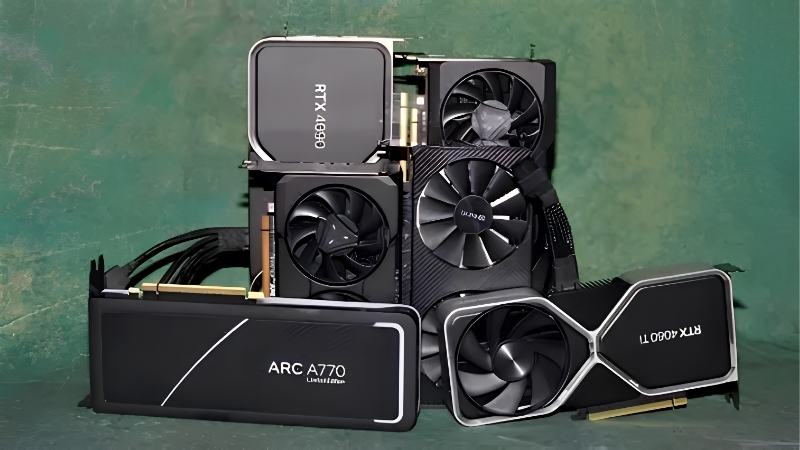
The intel arc vs nvidia question carries real weight in 2026, now that Intel’s Arc graphics cards have matured into legitimate competitors against Nvidia’s GeForce RTX line. For budget and mainstream builders, the choice is no longer automatic: Intel undercuts on price and packs in more VRAM, while Nvidia counters with the most refined software and the widest game support. This comparison weighs both brands across value, features, drivers, and real-world use, so you can decide which ecosystem actually deserves your money in your next build.
The Quick Verdict: Intel Arc vs Nvidia
For the reader who wants the answer up front: Intel Arc is the value and VRAM champion, delivering more memory and performance per dollar in the budget tier, while Nvidia is the premium all-rounder with the best drivers, the broadest DLSS support, and a card at every price point. If you are building a budget or mid-range 1080p or 1440p PC and want maximum specs for the money, Arc is now a genuinely smart choice. If you want proven software, the widest feature support, or anything above the mid-range, Nvidia remains the safer and more complete option. The details below explain when each brand wins.
As an Amazon Associate we earn from qualifying purchases at no extra cost to you.



When Intel Arc Is the Better Buy
Intel Arc shines hardest in the budget bracket, where cards like the Arc B580 offer 12GB of VRAM for around $249 — more memory than similarly priced GeForce cards. That extra buffer directly translates to smoother performance at 1440p and in texture-heavy modern games.
Arc also punches above its price in ray tracing, an area where budget GPUs traditionally struggle. For a value-focused gamer, the combination of low price, generous memory, and capable RT is a compelling package.
The trade-off is that Arc’s advantage is concentrated at the lower end; Intel does not currently field high-end enthusiast cards, so the brand is strongest precisely where budget buyers shop.
Arc’s media capabilities add another reason to look Intel’s way. The cards include a strong AV1 hardware encoder that arrived earlier and more broadly than on some rivals, which is a genuine advantage for streamers, YouTubers, and anyone who records gameplay regularly.
For a first-time builder assembling an affordable but modern system, the message is simple: Arc gives you more of the specifications that matter — memory, encoding, ray tracing — for less money, provided your platform meets its requirements.
When Nvidia Is the Better Buy
Nvidia’s strengths are breadth and polish. Its GeForce lineup spans every price point from entry-level to flagship, so no matter your budget there is an RTX card built for it, which Intel cannot match at the high end.
The software advantage is just as important. DLSS is supported in a vast library of games, the drivers are famously stable across old and new titles, and features like Reflex, Broadcast, and frame generation form a mature ecosystem.
For buyers who value reliability, want the widest upscaling coverage, or plan to game above 1440p, Nvidia is the more complete and lower-risk choice despite the higher price per frame.
Nvidia’s ecosystem also extends beyond gaming in ways that matter to some buyers. Tools like Broadcast for AI-powered streaming, robust productivity and AI-acceleration support, and a long track record in professional applications make GeForce cards a versatile choice for people who do more than play. If your PC doubles as a workstation, that breadth can justify the premium on its own.
Representative Comparison Table
The table below pits Intel and Nvidia’s popular budget cards against each other to make the value and memory differences concrete.
| Factor | Intel Arc (B580) | Nvidia (RTX 4060) |
|---|---|---|
| Typical price | $249 | $299 |
| VRAM | 12GB | 8GB |
| Upscaling | XeSS 2 | DLSS 3 + Frame Gen |
| Driver maturity | Improving fast | Very mature |
| Game support breadth | Good | Excellent |
| Lineup range | Budget to mid-range | Entry to flagship |
| ReBAR needed | Yes | No |
Deep Dive Face-Off: Value, Features, and Software
A one-line verdict hides the nuances that actually decide a purchase, so this section compares the two brands across the criteria that matter most: how much performance and memory your dollar buys, how their ray-tracing and upscaling technologies stack up, and how their drivers and software ecosystems compare in daily use. Each of these can tip the decision, and they rarely all favor the same brand.
Price and VRAM per Dollar
On raw value, Intel Arc currently leads the budget tier. Its cards consistently offer more VRAM at a given price, and in 2026 that memory advantage matters more than ever as games grow hungrier for it.
Nvidia’s budget cards are more efficient and better supported, but they often ship with less memory at the same price, which can shorten their useful life in the most demanding titles. The 8GB versus 12GB gap in the mainstream tier is the clearest example.
The analytical bottom line: dollar for dollar, Arc gives you more hardware, while Nvidia gives you more polish. Which is worth more depends on whether you prioritize raw specs or ecosystem maturity.
Longevity is the deciding sub-factor for many buyers. As modern games push past 8GB of VRAM even at 1080p, a card’s memory buffer increasingly determines how gracefully it ages. Here Arc’s extra memory can mean the difference between dropping textures in two years and continuing to run them comfortably, which reframes the value comparison in Intel’s favor for anyone keeping their card a long time.
Ray Tracing, XeSS, and DLSS
Both brands invest heavily in ray tracing and AI upscaling. Intel’s Arc architecture handles ray tracing well for its price class, and its XeSS upscaler runs at its highest quality on Arc’s dedicated XMX engines.
Nvidia’s DLSS remains the benchmark for adoption and, at the high end, for frame-generation quality. The sheer number of games with DLSS support means you are more likely to find it in whatever you play, which is a real everyday advantage.
The experimental edge here belongs to Nvidia’s longer head start, but Intel is iterating quickly, and XeSS on Arc hardware is genuinely competitive rather than a mere fallback. For a budget buyer, neither brand leaves you without a strong modern upscaler.
Drivers, Software, and the ReBAR Factor
Practical daily use still favors Nvidia. Its drivers are battle-tested across decades of games, so obscure and legacy titles almost always run correctly, and the control-panel software is refined and feature-rich.
Intel’s drivers have improved dramatically and are far more stable than Arc’s early reputation, but they remain younger, and occasional older-game quirks still surface. There is also a hard requirement to know: Arc cards need Resizable BAR enabled to reach full performance.
That ReBAR dependency means Arc is best paired with a reasonably modern platform, whereas an Nvidia card runs at full speed on nearly anything. If you are reviving an older system, that difference alone can decide the brand.
It is worth putting the driver concern in perspective, though. Intel ships frequent updates, and the day-one experience for popular current releases is now generally smooth. The remaining risk sits mostly with older or obscure titles, where Nvidia’s decades of optimization still give it the edge. For a library of modern games, both brands feel reliable in daily use.
Choosing a Brand, the Alternative, and 2026 Prices
With value favoring Intel and polish favoring Nvidia, your decision comes down to priorities, platform, and timing. This section distills the pros and cons, introduces a third brand worth considering, and sets the choice against 2026’s GPU pricing so you know whether to buy now or wait for a drop that may not come.
Intel Arc vs Nvidia: Pros and Cons
Here is the side-by-side summary to anchor your decision.
Intel Arc — Pros: excellent value, more VRAM per dollar, capable ray tracing for the price, strong AV1 media encoding. Cons: younger drivers, requires ReBAR, and no high-end enthusiast option.
Nvidia — Pros: the most mature drivers, broadest DLSS and game support, a card at every price point, and a deep software ecosystem. Cons: higher price per frame and often less VRAM at the same budget.
The Alternative: AMD Radeon
Intel and Nvidia are not the only choices. AMD’s Radeon line sits between them on many fronts, frequently offering strong rasterized performance and generous VRAM at competitive prices, along with the open FSR upscaler.
Radeon is especially worth a look in the mid-range and above, where Intel does not compete and where AMD often undercuts Nvidia while matching it in raw frames.
If neither Arc’s driver maturity nor Nvidia’s pricing sits right with you, a Radeon card may hit the balance you want, so include it in your shortlist before deciding.
Seen this way, the modern GPU market is genuinely a three-way contest rather than a duopoly. Intel drives budget value, Nvidia leads on software and the high end, and AMD covers the middle with strong rasterized performance. The healthiest approach is to compare all three at your target price rather than assuming any single brand is automatically the answer.
2026 Pricing and the Buy-Now Case
Timing is part of any brand decision. Following the sharp increases at the end of 2025, GPU and component pricing has steadied into a calmer stretch, but calm here means flat rather than falling, and volatility hasn’t fully left the market.
More memory supply is coming, with OEMs able to source DDR5 from makers such as CXMT and Micron building two plants in Idaho, yet that capacity won’t be online until 2027–2028. Meaningful price relief is therefore years away, not months.
For a buyer choosing between Arc and Nvidia today, that makes waiting a weak strategy. Whichever brand fits your build, check the current price through the link on this page and buy while the market holds steady.
A practical way to decide is to set your budget first, then see what each brand offers at that exact price on the day you shop. Because the two trade blows so closely in the mainstream tier, the better buy is often simply whichever brand has the stronger deal or better stock when you are ready — so let live pricing, not brand loyalty, make the final call.
See More:
Conclusion
The intel arc vs nvidia decision rewards different priorities. Choose Intel Arc for unbeatable value, more VRAM per dollar, and surprisingly capable ray tracing in the budget and mid-range, and choose Nvidia for its mature drivers, the widest DLSS and game support, and a full lineup that reaches all the way to the high end. Both are strong choices in 2026, so the winner is simply the brand that matches your budget, your platform, and your appetite for a newer versus a proven ecosystem. Use the link above to compare live pricing and secure the card that fits your build before prices move again.
Top-Rated Picks


| Product | Brand | Rating | Reviews | Price |
|---|---|---|---|---|
| ARCTIC MX-4 (4 g) – Premium Performance Thermal Paste… | ARCTIC | ★ 4.8 | 104k | $4.99 |
| ARCTIC MX-4 (incl. Spatula, 4 g) – Premium Performanc… | ARCTIC | ★ 4.8 | 71.9k | $5.49 |
| Crucial 8GB DDR4 RAM 3200MHz (PC4-25600), Downclockab… | Crucial | ★ 4.8 | 62.8k | $74.99 |
| AMD Ryzen 5 5600X 6-core, 12-thread unlocked desktop … | — | ★ 4.8 | 30.2k | $177.60 |
| NVIDIA Shield Remote; Voice Search, Motion-Activated,… | — | ★ 4.7 | 10.6k | $25.99 |
Frequently Asked Questions
Is Intel Arc actually competitive with GeForce now?
In the budget bracket, yes. Battlemage cards like the B580 offer 12GB of VRAM at prices where Nvidia still ships 8GB, and raster performance is competitive with the RTX 4060 class. Above that segment Intel has no answer, so anyone shopping for a 1440p high refresh or 4K card is buying GeForce.
How do the driver experiences compare?
Nvidia remains ahead on day-one support for smaller releases and on the long tail of older games. Intel has improved enormously with the DirectX 11 rewrite and the DirectX 9 translation layer, and now ships regular Game On drivers. You will still hit occasional Arc-specific bugs that get fixed within weeks rather than days.
What about content creation and AI work?
Intel hardware encoding for AV1 and H.265 is excellent and widely supported in Premiere, Resolve and Handbrake, so video editors do well. For AI and 3D rendering, Nvidia CUDA and OptiX remain effectively mandatory in many pipelines. If your software list contains CUDA-only tools, that decision is already made for you.
Which is better on an older CPU?
Nvidia, clearly. Intel drivers carry heavier processor overhead, so Arc cards lose more performance than GeForce equivalents on aging quad cores at 1080p. If you are dropping a new GPU into a system with a Ryzen 5 2600 or an eighth generation Core i5, GeForce is the safer upgrade.
What about power and PSU requirements?
Nvidia holds an efficiency advantage: the RTX 4060 draws around 115W against 190W for the B580, so GeForce is easier on older or smaller supplies. On the other hand Arc cards use conventional 8-pin connectors rather than 12VHPWR, avoiding the adapter and seating concerns of Nvidia high-end models.





Write Your Review
No reviews yet. Be the first to share your experience!