
- Top Pick: ASRock Radeon RX 7600 Challenger Pro 8GB OC, AMD RDNA 3, 8GB GDDR6, PCIe 4.0, Triple Fans, 0dB Silent, 2695MHz Boost, Triple Fan Graphics Card
- Best Value: XFX Speedster SWFT210 Radeon RX 7600 Graphics Card with 8GB GDDR6 HDMI 3xDP, AMD RDNA 3 RX-76PSWFTFY
- Premium Choice: ASRock Radeon RX 7600 Challenger 8GB OC, RDNA 3, 2695MHz Boost, 8GB GDDR6 128-bit, PCIe 4.0, Dual Fans, 0dB Silent, HDMI 2.1, DisplayPort 1.4
The rx 7600 vs rtx 4060 debate is still the first question almost every budget PC builder asks in 2026. Both cards sit in the $250–$300 window, both ship with 8GB of GDDR6 on a 128-bit bus, and both are engineered for smooth Full HD gaming rather than 4K. Yet they win in very different ways: one leans on raw price-per-frame, the other on a deeper software feature set. This comparison skips the marketing hype and lines them up the way a real buyer decides — frames, money, power draw, physical fit, and how long the card stays relevant. By the end you will know exactly which of these two budget GPUs belongs in your next build.
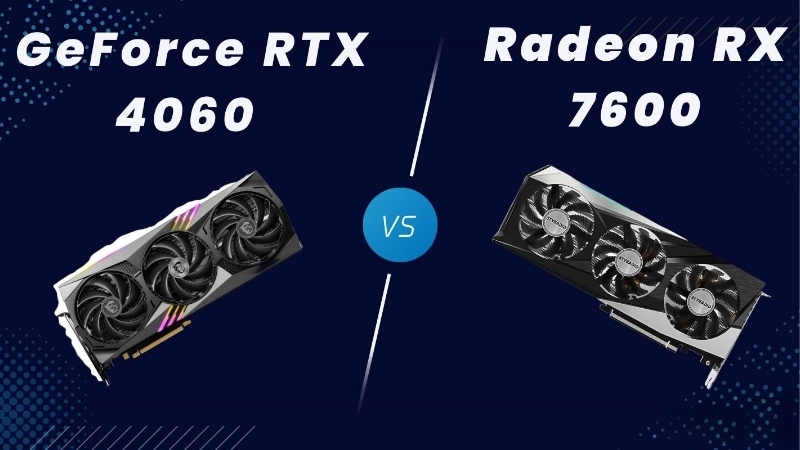
The Quick Verdict: RX 7600 vs RTX 4060
If you want the short answer before scrolling, here it is: buy the RX 7600 if your only goal is the cheapest card that runs modern games at 1080p on High settings, and buy the RTX 4060 if you value DLSS Frame Generation, lower power draw, and stronger ray tracing that will age better. In pure rasterized (non-ray-traced) 1080p titles the two trade blows within roughly 3–7%, close enough that a sale on either can flip the value equation. The gap widens once you enable upscaling and frame generation, where Nvidia’s toolset currently pulls ahead. Below is who each card is genuinely built for.
As an Amazon Associate we earn from qualifying purchases at no extra cost to you.





RX 7600 — the pure price-per-frame pick
The Radeon RX 7600 launched at $269 and frequently dips below that, which is its single biggest weapon. For competitive esports titles like Valorant, CS2, or Apex Legends at 1080p, it comfortably pushes past 144 FPS and feeds a high-refresh monitor without breaking a sweat.
It is the card for the builder who counts every dollar and plays mostly rasterized games. You accept slightly higher power draw and weaker ray tracing in exchange for keeping cash in your pocket for a stronger CPU, a faster SSD, or a better display.
In short, the RX 7600 is a specialist. It does one job — affordable 1080p frames — and it does that job very well, which is exactly what a large slice of budget buyers actually need.
RTX 4060 — the feature-rich all-rounder
The GeForce RTX 4060 launched at $299 and justifies the small premium through efficiency and software depth. Its 115W board power is remarkably low, letting it drop into tiny cases and modest power supplies without demanding an upgrade first.
Its real headline feature is DLSS 3 Frame Generation. In supported titles it inserts AI-generated frames that lift on-screen smoothness well beyond what the raw silicon alone would produce. For single-player, graphically heavy games, that is a meaningful experiential advantage rather than a spec-sheet footnote.
Add better ray-tracing hardware and a mature driver stack, and the RTX 4060 becomes the safer long-term pick for players who want their card to stay capable as games lean harder on AI features.
Head-to-Head Specs Comparison Table
The table below visualizes the core specifications side by side, so you can see exactly where the two cards diverge before we dig into the details. Note how similar the memory and resolution targets are, and how different the power figures are — that contrast drives much of the real-world decision.
| Spec | RX 7600 | RTX 4060 |
|---|---|---|
| Launch price (MSRP) | $269 | $299 |
| Architecture | RDNA 3 | Ada Lovelace |
| VRAM | 8GB GDDR6 | 8GB GDDR6 |
| Memory bus | 128-bit | 128-bit |
| Board power | ~165W | ~115W |
| Recommended PSU | ~550W | ~450W |
| Upscaling | FSR 3 | DLSS 3 + Frame Gen |
| Best resolution | 1080p | 1080p |
Deep Dive Face-Off: Where Each GPU Pulls Ahead
Specs on paper only tell part of the story. What matters is how those numbers translate into gameplay, and the two cards separate along three clear lines: raw raster output, the upscaling and ray-tracing stack, and physical fit inside a real system. Reviewing each of these criteria in turn is the honest way to compare them, because a card that wins one category can easily lose another. Here is the breakdown that decides most builds.
1080p Raster Performance and 1% Lows
Averaged across a broad modern game suite at 1080p High, the RX 7600 and RTX 4060 land within a handful of frames of each other. In several rasterized titles the RX 7600 nudges ahead by 3–5%; in others the RTX 4060 reclaims the lead. Neither is a night-and-day upgrade over the other in raw frames, which is why price so often becomes the deciding factor here.
The more telling metric is 1% lows, which measure stutter and consistency. The RTX 4060’s larger L2 cache tends to deliver marginally smoother frame pacing in demanding scenes, and many players feel that as a steadier experience even when the average FPS reads identical.
For fast-paced multiplayer where you chase the highest possible frame rate, the RX 7600 is a fantastic value; for cinematic single-player where consistency matters more than peak numbers, the RTX 4060’s smoothness earns its keep.
Ray Tracing, FSR, and DLSS Frame Generation
Turn on ray tracing and the RTX 4060 opens a clear gap. Ada Lovelace’s RT cores are simply more capable, and in ray-tracing-heavy titles the RTX 4060 can lead by double-digit percentages at 1080p, making effects like ray-traced shadows and reflections far more playable.
The upscaling story also leans Nvidia’s way. DLSS 3 with Frame Generation uses dedicated AI hardware to reconstruct and interpolate frames, and its optical-flow approach frequently produces cleaner motion than FSR 3. AMD’s FSR 3 is open and runs on almost any GPU, which is genuinely valuable, but the experimental edge in AI-driven frame generation and future software optimization currently belongs to the RTX 4060.
If you play cutting-edge single-player games and care about how Nvidia’s proprietary AI features will keep improving through driver updates, that feature stack is the strongest reason to spend the extra $30.
Power Draw, Card Size, and PSU Compatibility
This is where practical reality bites. The RTX 4060 draws around 115W and Nvidia officially recommends a 450W PSU, so it slots into pre-built or small-form-factor systems with a weaker power supply without forcing an upgrade.
The RX 7600 pulls closer to 165W and pairs best with a 550W unit. If you are dropping a card into an older office PC or a compact build, check your PSU wattage and case clearance before you buy — a mismatch here is the most common real-world headache.
It is a quiet but expensive detail: a “cheaper” card that forces a new power supply is no longer the cheaper card. Measuring your case and reading your PSU label first can save you a return and a second shipping wait.
Price, Value, and the 2026 Component Crunch
Value is where this matchup is actually decided, and 2026 has made pricing more important than usual. Component costs have been climbing, memory supply is tight, and the old advice to simply “wait for a price drop” is riskier than it was a year ago. Understanding the current market before you buy is the difference between a smart purchase and a frustrating one. Here is how the money and the supply picture currently line up for both cards.
What RX 7600 and RTX 4060 Cost Right Now
Street pricing tends to place the RX 7600 a little below the RTX 4060, roughly matching their $30 MSRP gap. That difference is small enough that a single sale can flip the value equation overnight, so checking the live price on both cards before you commit is the smartest habit you can build as a budget buyer.
Because listings move constantly, treat any fixed number as a snapshot rather than a guarantee. The card that offers the best price-per-frame this week may not next week, and jumping on a genuine discount is often worth more than agonizing over spec-sheet minutiae.
A useful rule of thumb: set a price ceiling for each card based on your budget, then buy whichever one dips under that ceiling first. Because their raw 1080p performance is so close, letting the current deal decide is a perfectly rational strategy rather than a lazy one.
Will GPU Prices Drop? The Memory Supply Reality
Here is the honest picture. The steep price climb of late 2025 has cooled, and the market has entered a period of relative stability — but “stabilized” is not the same as “falling.” Prices have merely stopped racing upward, and that plateau is the good news, not a coming discount.
New memory supply is on the way: OEMs can now source DDR5 from Chinese suppliers such as CXMT, and Micron is building two new plants in Idaho. The catch is timing. Those facilities are not expected to come online until 2027–2028, so meaningful relief for graphics-card pricing is still years out.
The practical takeaway for a 1080p buyer is straightforward: waiting for a dramatic 2026 price collapse is a gamble the supply data does not support. If a card fits your budget and your build today, buying now is a defensible decision rather than an impatient one.
RX 7600 vs RTX 4060: Pros, Cons, and the Alternative
To summarize the trade-offs cleanly, here is the pro-and-con view for each card, followed by a third option if neither quite fits your needs.
RX 7600 — Pros: lowest price, strong rasterized 1080p, excellent for high-refresh esports. Cons: weaker ray tracing, higher power draw, FSR 3 trails DLSS in motion clarity.
RTX 4060 — Pros: DLSS 3 Frame Generation, very low power draw, better ray tracing and smoother 1% lows. Cons: costs a little more, and 8GB can feel tight in a few future titles at maxed textures.
The alternative: if you can stretch the budget, stepping up to an RX 7700 XT or RTX 4060 Ti buys more VRAM headroom and longer relevance; if you are shopping used, a second-hand RTX 3060 12GB is worth a look for its larger memory buffer. Ready to lock in your pick? Check the current price and availability on the card that matches your priorities through the link on this page before stock or pricing shifts again.
See More:
Conclusion
The rx 7600 vs rtx 4060 verdict comes down to what you value most. Choose the RX 7600 for the absolute best raw price-per-frame in rasterized 1080p gaming, and choose the RTX 4060 for DLSS Frame Generation, lower power draw, and stronger ray tracing that will age more gracefully. Both are excellent Full HD cards, and neither is a mistake. With component prices only stabilizing rather than dropping, the smartest move is to decide which feature set matters more to you and secure the card today — use the link above to compare live pricing and grab the one that fits your build before the market moves.
Top-Rated Picks


Best Seller
XFX Speedster SWFT210 Radeon RX 7600 Graphics Card with 8GB GDDR6 HDMI 3xDP, AMD RDNA 3 RX-76PSWFTFY


| Product | Brand | Rating | Reviews | Price |
|---|---|---|---|---|
| ARCTIC MX-4 (4 g) – Premium Performance Thermal Paste… | ARCTIC | ★ 4.8 | 104k | $4.99 |
| ARCTIC MX-4 (incl. Spatula, 4 g) – Premium Performanc… | ARCTIC | ★ 4.8 | 71.9k | $5.49 |
| Crucial 8GB DDR4 RAM 3200MHz (PC4-25600), Downclockab… | Crucial | ★ 4.8 | 62.8k | $74.99 |
| AMD Ryzen 5 5600X 6-core, 12-thread unlocked desktop … | — | ★ 4.8 | 30.2k | $177.60 |
| NVIDIA Shield Remote; Voice Search, Motion-Activated,… | — | ★ 4.7 | 10.6k | $25.99 |
Frequently Asked Questions
Which is faster at 1080p?
They are extremely close in raster performance, usually within a few percent either way depending on the title. The RTX 4060 pulls ahead noticeably once ray tracing is enabled, thanks to stronger RT cores, while the RX 7600 sometimes leads in pure raster engines that favour RDNA 3 shader throughput.
Do both really only have 8GB of VRAM?
Yes, and it is the weak point of both cards in 2026. The RX 7600 uses a 128-bit bus with 8GB, as does the RTX 4060. Several recent titles exceed 8GB at 1080p ultra with ray tracing, so plan on high rather than ultra textures, or consider the 16GB RX 7600 XT instead.
What are the power requirements?
The RTX 4060 is much more efficient at roughly 115W, running on a 450W supply with a single 8-pin connector. The RX 7600 draws around 165W and wants a 550W unit. In a small case or a prebuilt with a modest PSU, the GeForce card is the easier fit.
How do the upscaling options compare?
Nvidia has the edge. DLSS 4 with the transformer model runs on the RTX 4060 and looks better than FSR 3 at matching presets, and the 4060 also supports DLSS frame generation. The RX 7600 is RDNA 3, so it cannot run FSR 4 and is limited to FSR 3.1 plus AFMF.
Which offers better value?
The RX 7600 usually costs less and delivers the same raster performance, so on price per frame it wins. The RTX 4060 justifies its premium with lower power draw, better ray tracing, superior upscaling and CUDA support. If ray tracing and DLSS matter to you, the extra spend is defensible.





Write Your Review
No reviews yet. Be the first to share your experience!