
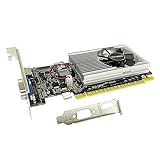
- Top Pick: ARDIYES GT 740 4GB GDDR5 Low Profile GPU Graphics Card, 4X HDMI Ports for Quad Multi-Monitor Setup, PCI Express 3.0 x16, Silent Cooling, Ideal for Office and Home Theater
- Best Value: MOUGOL AMD Radeon RX 580 8GB GDDR5 Gaming Graphics Card HDMI/DP/DVI – White
- Premium Choice: msi Gaming GeForce GT 1030 4GB DDR4 64-bit HDCP Support DirectX 12 DP/HDMI Single Fan OC Graphics Card (GT 1030 4GD4 LP OC)
Best 100 dollar graphics card shopping in 2026 means being realistic: the new options at this price are very limited, and the used market covers most of what is worth buying. This guide separates the cards that still make sense from the ones that only look cheap, and sets honest expectations for 1080p.
As an Amazon Associate we earn from qualifying purchases at no extra cost to you. Product prices and availability are accurate as of the date shown and are subject to change.






As an Amazon Associate we earn from qualifying purchases at no extra cost to you. Product prices and availability are accurate as of the date shown and are subject to change.
By Ryan Cole
How to Choose the Best 100 Dollar Graphics Card
Finding the best 100 dollar graphics card means accepting hard limits and then deciding which ones hurt least. Four specifications separate a usable budget card from a wasted purchase.
VRAM Capacity Is the First Filter
Four gigabytes is the realistic ceiling at this price for new cards, and several current titles exceed that even at 1080p with medium textures. When memory runs out the result is stuttering rather than a gradual frame rate drop.
Anything with only two gigabytes should be avoided entirely for gaming. Those cards exist as display adapters for office machines and will struggle with titles released in the last five years regardless of settings.
Memory bus width compounds the problem. A card pairing four gigabytes with a narrow 64-bit bus runs short of both capacity and bandwidth, which is why some budget cards fall behind older models with wider buses.
PCIe Lane Count and Older Motherboards
Several budget cards use only four PCIe lanes rather than the usual sixteen. On a PCIe 4.0 board that is tolerable, but on an older PCIe 3.0 system the available bandwidth halves and performance drops noticeably.
This catches people upgrading old office machines, which is exactly the scenario these cards are usually bought for. Check your board generation before choosing a four-lane card, because the same card performs very differently across platforms.
Power Connectors and Prebuilt Constraints
Cards rated at 75W or below draw everything from the motherboard slot and need no auxiliary cable, which is the only realistic route for prebuilt machines with small proprietary power supplies.
Anything needing a six or eight-pin connector requires both the wattage and the physical cable. Adapters from SATA or Molex are a common source of instability and should be avoided in a machine you rely on.
Physical length is worth checking on prebuilt machines too. Office chassis are often shallow enough that even a short dual-slot card fouls a drive cage, so measure the available space before ordering anything.
Video Encoding and Modern Features
Hardware encoding matters if you record or stream at all. Intel Arc cards include AV1 encoding even at the very bottom of the range, while older budget cards from the other vendors frequently include nothing useful.
Upscaling support is the other differentiator. AMD FSR runs on essentially anything including competitors, which is why it matters most here, while vendor-specific options need matching hardware to work.
Driver support duration is worth a thought as well. Older cards continue receiving security and stability fixes long after new feature work stops, but they will not gain the upscaling improvements newer hardware receives.
Top Picks: Best 100 Dollar Graphics Card Options
These six cover both new cards near this budget and the used models that outperform them. Pricing at this tier moves constantly, so treat the categories rather than exact figures as the guide.
| Card | VRAM | Board Power | Connector | Availability |
|---|---|---|---|---|
| Intel Arc A310 | 4GB GDDR6 | 75W | None | New |
| AMD Radeon RX 6400 | 4GB GDDR6 | 53W | None | New |
| AMD Radeon RX 6500 XT | 4GB GDDR6 | 107W | 1x 6-pin | New |
| NVIDIA GTX 1650 | 4GB | 75W | None | New and used |
| NVIDIA GTX 1660 Super | 6GB GDDR6 | 125W | 1x 8-pin | Used |
| AMD Radeon RX 6600 | 8GB GDDR6 | 132W | 1x 8-pin | Used |
AMD Radeon RX 6600 Used – Best Overall at This Budget
If you are willing to buy secondhand, this is the best 100 dollar graphics card available and where the money should go. Eight gigabytes on a 128-bit bus handles 1080p high settings across most current titles, and a 132W rating means a modest supply with one 8-pin cable suffices.
You give up warranty coverage and any way to verify how the card was used. Prices also fluctuate, and at busy times these drift above the hundred dollar mark, so patience matters more than with new stock.
NVIDIA GTX 1660 Super Used – Reliable Secondhand Alternative
Six gigabytes and solid 1080p performance make this a dependable used pick, and NVENC encoding is genuinely useful for recording. It is one of the most common cards on the secondhand market, so supply is steady.
It has no ray tracing hardware and no DLSS support, and six gigabytes is thin for the newest titles. As an older design, driver feature updates have largely stopped even though security and stability fixes continue.
Intel Arc A310 – Best New Card Under the Budget
Slot-powered at 75W with no auxiliary connector, the A310 includes AV1 encoding that no other card near this price offers. For a media machine or a light gaming build in a prebuilt, that combination is unmatched.
Gaming performance is modest and it depends heavily on Resizable BAR being enabled, which older motherboards may not support. Four gigabytes also limits texture settings in anything recent.
AMD Radeon RX 6400 – Lowest Power Draw
At 53W this is the least demanding card here and needs no auxiliary power at all, making it the safest choice for an office prebuilt with a small proprietary supply and minimal airflow.
It uses only four PCIe lanes and lacks hardware video encoding entirely. On a PCIe 3.0 motherboard the bandwidth limitation is severe enough to undermine what performance it has.
AMD Radeon RX 6500 XT – Slightly Above Budget
Usually sitting a little over the hundred mark, this offers more performance than the A310 or RX 6400 for older and less demanding titles, with a 107W rating that most supplies can handle.
It shares the four-lane limitation and has no video encoding. Given how close it often sits to used cards that are considerably faster, it is only worth buying when the secondhand market is picked over.
NVIDIA GTX 1650 – The Widely Available Fallback
Still stocked years after launch and running on slot power alone, the GTX 1650 fits practically any machine and handles esports titles and older games at 1080p without complaint.
There is no ray tracing, no DLSS and no AV1 encoding, and four gigabytes is limiting. It is only sensible at a genuine discount, since it frequently sits close in price to considerably better options.
What the 2026 Market Means at This Price
The best 100 dollar graphics card segment has been reshaped by decisions made much further up the product stack, and that explains why this budget buys so little.
Supply Cuts Pushed Everything Upward
NVIDIA reduced partner supply by roughly 20%, and global graphics pricing rose about 19% from late 2025 onward. Mid-range cards absorbed most of that, but the effect cascaded down and squeezed the entry tier hard.
The practical result is that cards which sold near a hundred dollars two years ago now sit meaningfully higher, while genuinely new products at this price have largely stopped appearing.
The Budget Segment Is Disappearing
Manufacturers have concentrated on mid and high-tier products as entry-level unit sales declined, and promotional pricing policies tightened in early 2026. Several sub-hundred models have quietly left listings entirely.
That is why the used market now covers most of this segment properly. It is not a temporary situation, and waiting for new budget cards to appear is unlikely to be rewarded.
Nothing New Arrives Before CES 2027
Refreshed lineups from both major vendors slipped to January 2027, so there is no imminent launch that will push older cards down in price. Waiting means waiting most of a year for a release that may not reach this tier anyway.
If your current card still runs what you play, there is no reason to spend into a stretched market. If it does not, buying a used card from a seller with return protection is the sensible route.
Frequently Asked Questions
The best 100 dollar graphics card question usually arrives with these, from people upgrading an old machine on the tightest possible budget.
Is the best 100 dollar graphics card enough for modern games?
For esports titles and older releases at 1080p, yes comfortably. Recent demanding games will need low settings and upscaling, and titles that exceed four gigabytes of video memory will stutter regardless of what you set.
Should I buy new or used at this price?
Used, in most cases. A previous-generation mid-range card bought secondhand substantially outperforms anything new at this budget. Buy from a seller with return protection, since you cannot verify how the card was treated.
Will these cards work in an old prebuilt?
The slot-powered models will, provided the case has physical room. Cards needing auxiliary power often will not, because proprietary supplies in office machines frequently lack the cable and the wattage headroom.
Is 4GB of video memory still workable?
For older and less demanding titles, yes. Several current releases exceed it at 1080p even on medium textures, and the resulting stutter is more disruptive than a lower frame rate. Prioritise 6GB or 8GB where the budget allows.
See More:
- Best 4TB NVMe SSD
- Best thermal grizzly paste
- Best thermal paste for 7800X3D
- Best CPU case fans
- Best motherboard for gaming computer
Final Thoughts
The best 100 dollar graphics card in 2026 is almost always a used one, with the Radeon RX 6600 leading if you can find it at this price and the GTX 1660 Super as the steady alternative. Among new cards the Arc A310 offers the most for a prebuilt thanks to slot power and AV1 encoding. With supply constraints holding prices up and nothing new before CES 2027, the secondhand market is where this budget actually works.









Write Your Review
No reviews yet. Be the first to share your experience!