
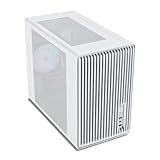
Best Mini ITX Case Airflow is a question of surface area rather than volume. A ten litre chassis wrapped in mesh can outperform a twenty litre one with solid panels, because in small form factor builds every component is breathing the air its neighbour just heated.
As an Amazon Associate we earn from qualifying purchases at no extra cost to you. Product prices and availability are accurate as of the date shown and are subject to change.




As an Amazon Associate we earn from qualifying purchases at no extra cost to you. Product prices and availability are accurate as of the date shown and are subject to change.
By Ryan Cole, hardware writer at NVIDIAReview.
How to Judge the Best Mini ITX Case Airflow
Small cases have no spare air, so the best mini itx case airflow comes from how directly each component pulls from outside the chassis. These four checks describe that better than litres alone.
Mesh Area Matters More Than Volume
In a compact build, the graphics card and cooler are usually inches from a panel. If that panel is solid, both are recirculating warm air regardless of how much empty space exists elsewhere in the case.
Look at how much of the shell is actually open. Cases with mesh on both side panels and the roof let each component pull from outside, which is the single biggest factor in small form factor temperatures.
Decorative panels change this immediately. A wood or steel front with narrow venting looks excellent and costs several degrees, which is a fair trade only if you know you are making it.
Sandwich Layouts Versus Traditional ITX
Sandwich designs place the motherboard and graphics card back to back on either side of a divider, each with its own mesh panel. That keeps their heat separated and is why so many of the smallest cases use the layout.
Traditional layouts put the card below the board in a taller chassis, which allows bigger air coolers but means the card exhausts into the same space the processor is drawing from.
Neither is automatically better. Sandwich cases suit blower-style flow and liquid cooling, while traditional layouts suit a large low-profile or tower cooler and are easier to build in.
Cooler Height, Radiator Support and What Fits
Cooler clearance is the specification that decides your processor options. Many compact cases stop between 47 and 70 mm, which rules out tower coolers and puts you on low-profile air or a 240 mm loop.
A 240 mm radiator solves high heat loads in a small volume, but it consumes the panel space a graphics card might otherwise be breathing through. Check what the radiator blocks before assuming it is the better option.
Power supply choice feeds into this too. An SFX unit frees interior space and shortens the airflow path, while a full ATX supply in a compact case often sits directly in the way of the intake you need most.
Feeding the Graphics Card Directly
The card is usually the largest heat source in a small build. A side panel with open mesh directly against the card’s intake fans is worth more than any amount of case volume elsewhere.
Clearance from the panel matters too. A few millimetres of gap lets the fans draw properly, while a card pressed flat against a panel will starve regardless of how open the mesh is.
Card thickness decides that gap. A three-slot cooler in a two-and-a-half slot space will physically fit in some cases while leaving its intake fans almost touching the panel, which costs more than the extra fin area gains.
Top Picks for the Best Mini ITX Case Airflow
These six range from around ten to eighteen litres. Volumes and clearances are manufacturer figures and vary by revision, and retail pricing at the time of writing in August 2026 shifts weekly.
| Case | Approx volume | Layout | Cooler clearance | Notes |
|---|---|---|---|---|
| Cooler Master NR200P V2 | About 18 L | Traditional ITX | Around 155 mm | Mesh panels, easy to build |
| SSUPD Meshlicious | About 15 L | Sandwich | Around 73 mm | Mesh on all sides |
| Lian Li Q58 | About 14 L | Sandwich | Around 67 mm | Mesh and glass versions |
| Fractal Design Ridge | About 14 L | Vertical sandwich | Around 70 mm | Console-style footprint |
| Lian Li A4-H2O | About 11 L | Sandwich | Liquid cooling focused | 240 mm radiator support |
| Fractal Design Terra | About 10 L | Sandwich | Around 77 mm | Wood front, restricted intake |
Cooler Master NR200P V2
At roughly eighteen litres this is the forgiving option. Mesh side and top panels, support for a tower cooler up to about 155 mm and room for a long graphics card make it the easiest small case to cool properly.
It is noticeably larger than the sandwich designs, which defeats the point for anyone chasing minimum volume. Included fans are basic, and the glass panel version costs airflow if you choose it.
SSUPD Meshlicious
Mesh on effectively every surface is the entire concept, and it delivers the best mini itx case airflow in this group. Both the graphics card and the processor cooler draw directly from outside the chassis, which keeps temperatures closer to a full tower than the size suggests.
Cooler clearance limits you to low-profile air or a radiator, and cable routing in a case this dense takes patience. Dust ingress is higher than in filtered designs, so cleaning is more frequent.
Lian Li Q58
The Q58 is the sandwich case most people start with. Around fourteen litres, it supports a 240 mm radiator, long graphics cards and a choice of mesh or glass panels depending on how much airflow you are willing to trade.
Choose the mesh version if temperatures matter, since the glass panel meaningfully restricts the card. Cooler clearance near 67 mm rules out tower coolers entirely.
Fractal Design Ridge
The Ridge stands vertically with a console-like footprint and a vented shell, separating the card and board into their own chambers. It suits a living room or desk where a conventional case would dominate.
Cooler height is tight, and a hot high-end card will still run warmer than in an open mesh case. The vertical orientation also means it needs clear space around it to breathe.
Lian Li A4-H2O
At around eleven litres this is one of the smallest cases that still handles a 240 mm liquid cooler, which is what makes a high-power processor viable in the volume. The card gets its own mesh panel on the opposite side.
It is a liquid cooling case first, so air cooling options are severely limited. Building in it requires planning cable lengths carefully, and a thick radiator plus fans leaves very little margin.
Fractal Design Terra
The Terra is the design piece of the group, with a walnut front panel and an adjustable internal spine that lets you allocate space between the card and the cooler within roughly ten litres.
Airflow is its weak point. The solid front restricts intake, hot components sit close together, and undervolting the processor and graphics card is close to mandatory for comfortable temperatures under load.
What 2026 Conditions Mean for Small Form Factor Builders
Small builds are the most affected by component pricing and heat, so conditions matter more when chasing the best mini itx case airflow. Three points stand out.
Keeping the Card You Have Running Cool Is the Cheap Move
Graphics card pricing remains elevated, with supply constrained and no new generation arriving before CES in January 2027. Improving airflow around an existing card costs a fraction of replacing it.
In a compact chassis that usually means undervolting, replacing dried thermal compound and adding or repositioning a single intake fan. Together those steps often recover several degrees.
Cooling Components Have Drifted Up in Price
Manufacturers concentrated on mid and upper tiers as budget demand fell, and cooling and power supply pricing has moved up roughly six to eight percent, with entry-level promotional pricing ending in early 2026.
Small form factor parts feel this most, since low-profile coolers and SFX power supplies were never cheap. Buying a case that cools well without exotic parts is the more economical route.
Cases and Fans Still See Real November Discounts
Memory, drives and prebuilt systems are unlikely to see genuine Black Friday reductions this year because stock was manufactured against high contract pricing. Cases, fans, coolers and paste remain honest deal categories.
A chassis change is rarely urgent, so waiting is reasonable. If your current build is throttling, an undervolt and a repositioned fan will hold you over at no cost.
Frequently Asked Questions
These come up most often once someone has shortlisted cases and is weighing size against the best mini itx case airflow they can get.
Are small form factor builds always hotter?
Warmer, usually, but not necessarily hot. A well-ventilated compact case with an undervolted processor and graphics card can hold temperatures comparable to a mid-tower, at slightly higher fan speeds.
Do I need a liquid cooler in a mini ITX case?
Only if cooler clearance rules out air. Plenty of compact cases accept a 155 mm tower, and where they do, air cooling is simpler, quieter at idle and has no pump to fail.
Does undervolting really help in a small case?
Considerably. Lower voltage means less heat at the same clocks, and in a chassis with limited air that translates directly into lower fan speeds and better sustained performance.
Should I avoid glass panels entirely?
Not entirely, but expect a cost. A glass side panel next to the graphics card is the worst place for one; glass on the opposite side of a sandwich layout matters far less.
See More:
- What Is the Best Thermal Paste
- Best PC Case Fans 120mm
- Thermal Paste Best Brand
- Best Thermal Paste Brands
- Best CPU Cooler Reddit
Final Thoughts
The best mini itx case airflow comes from mesh directly against the components that generate heat, not from extra litres. Meshlicious and the mesh version of the Q58 lead on raw thermals, the NR200P V2 is the easiest to build in, and design-led cases like the Terra ask you to undervolt in exchange for how they look.


Write Your Review
No reviews yet. Be the first to share your experience!