
- Top Pick: TGDGAMER MATX Micro ATX Case, High Airflow Slim PC Case with 80mm Fan-Black
- Best Value: S300 – Mini-ITX PC Gaming Case – Front I/O USB 3.0 Type – C Port – SFX Power Supply 100-130mm – Cable Management System – luminum Mini-ITX Motherboard Small Portable PC Case (PCIe 3.0 16X Riser Cable)
- Premium Choice: Vetroo M06 White Micro-ATX/Mini-ITX Mid Tower Gaming PC Case
Best mini ITX PC case shortlists get much easier once you decide which size class you are targeting. A 10 litre sandwich chassis and an 18 litre box are completely different projects, with different cooling limits, different budgets and very different levels of assembly patience required from you on build night.
As an Amazon Associate we earn from qualifying purchases at no extra cost to you. Product prices and availability are accurate as of the date shown and are subject to change.
By Ryan Cole, PC hardware writer at NvidiaReview
How to Choose the Best Mini ITX PC Case
Choosing the best mini ITX PC case is a sequence, not a single decision. Settle on a size class, then work out how the machine will breathe, then decide whether you want the cooling and power supply bundled or bought separately. Everything else follows from those three answers.
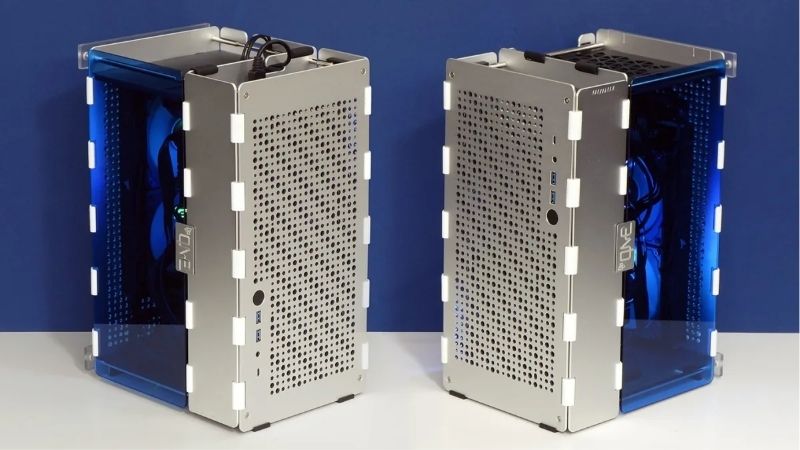
Decide Your Size Class Before Anything Else
Roughly three brackets exist in this category. Chassis from 10 to 12 litres are console-sized sandwich designs that demand either low-profile air cooling or a slim radiator. The 13 to 15 litre group opens up 240mm and 280mm liquid cooling and full-length graphics cards while still fitting comfortably on a desk surface.
Above 16 litres you can run a proper tower cooler and treat the build almost like a normal machine. Each step down costs clearance and adds assembly time, so be honest about whether the extra few litres actually matter in the space where the finished computer will sit.
Airflow, Panel Design and Noise
Mesh panels move far more air than perforated or slatted aluminium, and in a volume this small that difference shows up directly in sustained clock speeds. The penalty is acoustic: mesh lets fan and coil noise out as freely as it lets air in, and there is no internal volume to damp it.
Fan quality therefore matters more here than in a full tower. Two good 120mm fans with strong static pressure will outperform four cheap ones in a restricted chassis, and they will do it at a lower noise level. Plan intake and exhaust paths before you buy rather than adding fans afterwards.
Bundled Kits Versus Buying Components Separately
Some chassis ship with a matched power supply and cooler already installed, which removes the two hardest compatibility questions in small form factor building. That convenience usually costs less than sourcing an equivalent SFX unit and radiator separately, and it guarantees the cables fit.
The catch is inflexibility. If the bundled supply is not powerful enough for a future graphics card, or the radiator is smaller than your processor needs, replacing either can be awkward or impossible. Buy a kit when you want a finished result; buy separately when you expect to upgrade.
Top Picks: Best Mini ITX PC Case by Size Class
These five candidates for the best mini ITX PC case span all three size classes, covering both bundled kits and standalone chassis. All clearances are vendor-published figures and should be checked against your exact graphics card. Availability was verified in August 2026 and shifts frequently.
| Case | Volume | Cooling approach | PSU | Best for |
|---|---|---|---|---|
| Fractal Design Terra | 10.4 L | Low-profile air | SFX / SFX-L | Smallest footprint |
| Lian Li Q58 | 14.5 L | Up to 280mm AIO | SFX or ATX | Flexible mid class |
| NZXT H1 V2 | Approx 15.6 L | Bundled 140mm AIO | Included 750W SFX-L | Complete kit |
| Cooler Master NR200P MAX | 18.25 L | Bundled 280mm AIO | Included 850W SFX | High-end kit |
| Cooler Master NR200P V2 | 18.25 L | Tower air or AIO | SFX / SFX-L | Easiest assembly |
Cooler Master NR200P V2 – Best 16 to 19 Litre Choice
The V2 is the default recommendation in the largest class for good reason. Roughly 153mm of cooler clearance means a proper tower heatsink fits, graphics cards up to around 330mm slide in without drama, and the bundled PCIe 4.0 riser lets you mount the card vertically if you prefer.
It is the least compact option here, reading as a small desktop rather than a console. Steel construction also feels plainer than the aluminium alternatives at similar prices. If assembly stress is what worries you about small form factor building, this is the chassis that removes most of it.
Lian Li Q58 – Best 13 to 15 Litre All-Rounder
At 14.5 litres the Q58 hits the sweet spot: full-length triple-slot graphics cards fit, a 280mm radiator is possible in SFX power supply mode, and swappable mesh or glass side panels let you choose between airflow and appearance without buying a different chassis entirely.
Air cooling is restricted to low-profile heatsinks, so a liquid cooler is effectively required for warm processors, and routing AIO tubing here takes real patience. Switching to an ATX supply eats the radiator space. Within those limits, it remains one of the most adaptable designs available.
Fractal Design Terra – Best Under 12 Litres
The Terra squeezes 10.4 litres into a 343 by 153 by 218mm aluminium body with a walnut front, and the adjustable spine shifts space between the graphics card and cooler sides across seven marked positions. Cards up to 322mm long fit, with up to 72mm of thickness in the widest setting.
Every millimetre given to the card is taken from the cooler, and at maximum GPU width you are down to 48mm of heatsink height, which limits you to slim coolers and modest chips. Liquid cooling is restricted to a 120mm radiator with a much shorter card. It looks superb; it is not forgiving.
NZXT H1 V2 – Best Complete Kit
The H1 V2 arrives with a 750W SFX-L Gold power supply, a 140mm all-in-one cooler and a PCIe 4.0 riser already installed in a vertical tower footprint. You add a board, processor, memory, storage and a graphics card, and the two hardest compatibility questions are answered before you start.
You are locked into that supply and radiator, which caps how far the build can grow, and a 140mm cooler is modest for a high-TDP processor under sustained all-core load. Replacing either component later is fiddly. As a route to a finished compact machine with minimal research, it works well.
Cooler Master NR200P MAX – Best High-End Kit
The MAX version takes the familiar 18.25 litre shell and ships it with an 850W SFX Gold power supply, a 280mm all-in-one cooler and a PCIe 4.0 riser preinstalled. That combination handles a strong graphics card and a warm processor without any compatibility guesswork on your part.
It carries a significant premium over the standard chassis, and buying the same parts separately can cost less if you shop patiently. The preinstalled radiator also removes the option of tower air cooling. For a powerful compact build assembled in one evening, the convenience is genuinely worth it.
What the 2026 Market Means for Compact Builds
Small form factor machines are more exposed to component pricing than standard builds, because the supporting parts carry premiums of their own. Three market realities are worth understanding before you commit to a size class, a chassis and the parts list that follows from both.
Bundled Kits Look Better as Power Supply Prices Rise
Power supply pricing has risen roughly 6 to 10 percent, and SFX units start from a higher base than standard ATX ones because of the format premium. Promotional pricing policies were withdrawn in February 2026, so the discounts that used to close that gap are appearing far less often.
That arithmetic has quietly improved the case for bundled chassis. When a quality 750W SFX-L unit and a 280mm cooler are both carrying increases, a kit that includes them at a fixed price becomes more competitive than it looked a year ago, particularly for a single-build project.
Manufacturers Are Retreating From the Budget End
Across motherboards, power supplies and cooling, vendors have concentrated their attention on mid-range and premium products as overall unit sales have fallen. The cheapest compact chassis are becoming harder to recommend, since corners get cut on panel fit, fan quality and cable clearance.
In a case this size, those details matter. A poorly fitting panel or a rattling stock fan is much more noticeable when the machine sits on your desk. Spending one tier up buys tool-less panels, a decent riser cable and enough clearance tolerance to avoid a frustrating build night.
Late-Year Sales Still Apply to Cases and Cooling
The advice to wait for November discounts does not hold for memory or storage this year, because that inventory was built from expensive contract components. Chassis, fans, coolers and power supplies are a different story and continue to see real reductions in that window.
If the chassis is the last piece of your build, buying now is reasonable and the swing will be modest. If you are ordering a case, supply and cooler together, waiting until late November is a defensible plan. Everything described here reflects pricing conditions in August 2026.
Frequently Asked Questions
Common questions from builders working out which size class fits their parts: where to start, what bundled kits cost you in flexibility, whether high-end graphics cards fit, and whether the best mini ITX PC case needs to be built from aluminium rather than plain steel.
What size class should a first small build target?
Something around 18 litres. The best mini ITX PC case for a first attempt gives you tower cooler support, standard card clearance and room to route cables without pulling parts back out. Once you know how the process works, dropping to a 12 or 14 litre chassis for a second build is far less stressful.
Do bundled kits limit future upgrades?
To a degree, yes. The included power supply sets a ceiling on what graphics card you can add later, and the preinstalled radiator dictates your cooling headroom. If you expect to upgrade the card within two years, buying the chassis, supply and cooler separately keeps more options open.
Can these cases handle a high-end graphics card?
Most accept cards around 320 to 336mm long, which covers the majority of current models, but thickness is the real constraint in sandwich layouts. Check the vendor width figure against your specific partner card, since three-slot designs are excluded from several popular compact chassis.
Is aluminium worth paying extra for over steel?
It is a finish and weight decision rather than a thermal one. Aluminium chassis feel more premium and weigh less, which matters if the machine travels. Steel cases like the NR200P are more rigid and cheaper, and they cool just as well when the panel design moves air properly.
See More:
- Best thermal compound paste
- Thermal paste at Best Buy
- Graphics card at Best Buy
- Best AM4 CPU for gaming
- Best motherboard for 9800x3d
Final Thoughts
The best mini ITX PC case is the one matched to a size class you have actually thought about. Around 18 litres buys forgiveness and tower cooling, roughly 14 litres balances footprint against flexibility, and 10 to 12 litre designs look spectacular in exchange for constraints. Decide the class first, then check clearances against the parts you own.
As an Amazon Associate we earn from qualifying purchases at no extra cost to you. Product prices and availability are accurate as of the date shown and are subject to change.







Write Your Review
No reviews yet. Be the first to share your experience!