
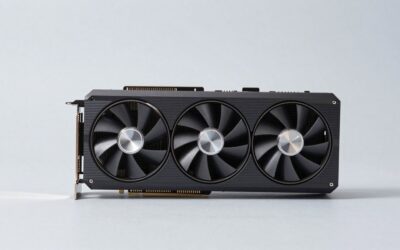
- Top Pick: GIGABYTE Radeon™ RX 9070 XT Gaming OC ICE 16G Graphics Card (16GB GDDR6, 256-bit, PCIe 5.0, HDMI/DP 2.1, 2.7 Slot, Hawk Fan, Server-Grade Thermal Gel, Reinforced Structure)
- Best Value: GIGABYTE Radeon RX 9070 XT Gaming OC 16G Graphics Card, PCIe 5.0, 16GB GDDR6, GV-R9070XTGAMING OC-16GD Video Card
- Premium Choice: Sapphire 11348-03-20G Pulse AMD Radeon™ RX 9070 XT Gaming Graphics Card with 16GB GDDR6, AMD RDNA 4


Best Seller
XFX Swift AMD Radeon RX 9070XT Triple Fan Gaming Edition with 16GB GDDR6 HDMI 3xDP, AMD RDNA 4 RX-97TSWF3BA

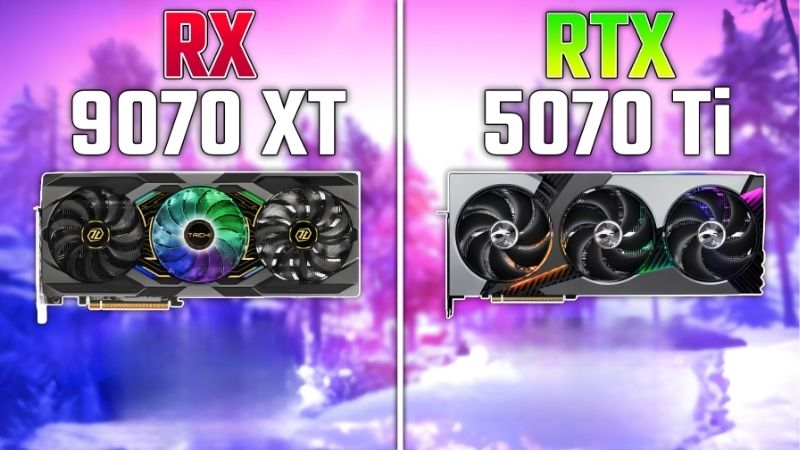
amd rx 9070 xt vs rtx 5070 is a mismatched fight that a lot of buyers stumble into by accident, and the mismatch is the whole story. These are not two cards at the same tier – the 9070 XT sits a full step above the RTX 5070 in raster performance, and it costs $50 more to prove it. That changes the question completely. It is no longer which card wins; it is whether the RTX 5070 has any argument left once it loses on frames, VRAM, and price-per-frame simultaneously. It does, and this article covers it honestly. Verdict first, table second, no montage.
Quick Verdict: RX 9070 XT vs RTX 5070 at a Glance
The RX 9070 XT wins on raw performance by a wide enough margin that it is not really a debate – roughly 15-20% faster than the RTX 5070 at 1440p in rasterised games, with 16GB against 12GB, for $599 against $549. On price-per-frame the XT is the better card and it is not close. The RTX 5070 keeps exactly two arguments: ray tracing, where it closes most of the gap, and DLSS 4 with Multi Frame Generation. If those two things matter to you, the comparison is live. If they do not, save your reading time – buy the XT.
As an Amazon Associate we earn from qualifying purchases at no extra cost to you.


Why This Is Not a Fair Fight on Paper
The tier mismatch is the first thing to understand. The RX 9070 XT is AMD’s answer to the RTX 5070 Ti, not the RTX 5070. Comparing it to the 5070 is comparing a $599 card to a $549 card that sits a rung below it – and the results reflect exactly that.
In rasterised games at 1440p high, expect roughly 100-125 fps from the XT where the 5070 delivers 85-105. At 4K the gap widens slightly, to around 20-25%, because the XT’s wider memory configuration and larger buffer both scale better upward while the 5070’s 192-bit bus starts working harder.
The price-per-frame calculation is where it gets awkward for Nvidia. Performance scales at roughly 118%. Price scales at roughly 109%. That means the more expensive card is also the better value – which almost never happens in a GPU stack and only happens here because these cards are not really competitors, they are neighbours.
The Two Arguments the RTX 5070 Still Has
Losing on raster does not end the conversation, and pretending it does is how people buy the wrong card for their library.
Ray tracing is the first argument and it is genuine. With RT enabled at 1440p, the 5070 closes most of the raster gap – the XT’s lead compresses to low single digits in mixed RT titles, and in the heaviest path-traced showcases Nvidia can actually pull ahead despite being a tier down. If path tracing is on your list and you intend to actually use it, this comparison inverts entirely.
DLSS 4 is the second, and it is the more forward-looking one. Nvidia’s transformer-model upscaling still holds an edge over FSR 4 on temporal stability, particularly on fine detail in motion. Multi Frame Generation matters more than the raw numbers suggest on a high-refresh panel – it is built specifically to fill 144Hz and above, and on that hardware it changes how the game feels rather than how it benchmarks.
There is a longer-horizon version of that argument worth weighing. Nvidia’s software cadence has repeatedly added capability to cards after purchase, and its AI-driven feature direction suggests the 5070 you buy in 2026 will do things in 2028 it cannot do today. That is real value, and it is also unquantifiable – which means it is worth something to you or nothing at all, and only you know which.
Full Spec Comparison Table
Everything that decides this, in one scan.
| Specification | AMD RX 9070 XT | Nvidia RTX 5070 |
|---|---|---|
| Launch MSRP | $599 | $549 |
| VRAM | 16GB GDDR6 | 12GB GDDR7 |
| Memory bus | 256-bit | 192-bit |
| Board power | ~304W | ~250W |
| Recommended PSU | 750W | 650W |
| Power connector | 2x 8-pin | 1x 16-pin (12V-2×6) |
| Raster 1440p (avg) | ~100-125 fps | ~85-105 fps |
| Raster (relative) | ~118% | 100% |
| Ray tracing (relative) | ~102-105% | 100% |
| Upscaling | FSR 4 | DLSS 4 + Multi Frame Gen |
| Price (relative) | ~109% | 100% |
| Best for | Raster, 1440p high refresh, 4K | Ray tracing, creator apps, SFF |
Two rows carry the decision and they are not the fps rows. Board power: 304W against 250W is a 54W difference that decides whether your PSU survives. Ray tracing relative: 102-105% means the XT’s 18% raster lead almost completely evaporates the moment you turn RT on. Those two rows are the entire case for the 5070, and they are strong enough to matter.
Deep Dive: Where Each Card Actually Wins
Averages hide the interesting part. These two cards fail in different places, and knowing which failure you can live with is more useful than knowing which one has a bigger bar on a chart.
Power, PSU and the Practical Build Reality
This is where the RTX 5070 quietly claws back ground, and where spec sheets get skimmed.
The XT draws roughly 304W against the 5070’s 250W. That 54W gap decides real things. The XT wants a 750W supply as a sensible floor; the 5070 runs on 650W. If you own a 650W unit, the XT is not a $50 upgrade – it is a $50 upgrade plus a $90 PSU, and the value argument inverts completely.
The connector cuts the other way. The XT uses conventional 2x 8-pin cables that work with any PSU and carry no seating anxiety. The 5070 uses the 16-pin 12V-2×6, which on an older supply means the bundled adapter – and partial seating is the single most reported cause of melted connectors at this tier. Neither is a dealbreaker. Both are things to check before you order rather than after.
Heat follows power. 304W in a case with one intake fan is a card that throttles, and a throttling XT gives back the performance lead you paid for. If your front panel is sealed glass, the 5070 is genuinely the more realistic card regardless of what the benchmark says.
The VRAM Gap and What It Means Long Term
16GB against 12GB is the other structural difference, and it compounds with everything above.
At 1440p today, both are adequate. The 5070’s 12GB handles current titles at high settings without complaint. The divergence is not about now – it is about whether the settings you enjoy in 2029 still fit in 12GB on a card you intend to keep.
What matters is the failure mode. A card short on shader power runs slower: annoying, predictable, tunable. A card short on VRAM hitches, streams textures in late, and its 1% lows collapse while the average stays deceptively healthy. At 1440p with maxed textures plus ray tracing, several current titles already brush past 12GB – and that is exactly the configuration a 5070 buyer would choose.
The awkward part for Nvidia: the cheaper AMD card has more memory, and in a market where replacement cost is flat rather than falling, headroom is worth more than it used to be. Your escape route from a VRAM problem is not getting cheaper.
Pros and Cons: RX 9070 XT vs RTX 5070
| AMD RX 9070 XT | Nvidia RTX 5070 | |
|---|---|---|
| Pros | 15-20% faster at 1440p for only 9% more money; 16GB with genuine longevity value; better price-per-frame; conventional 8-pin cables with no adapter risk; scales to 4K meaningfully better | Ray tracing performance that erases the raster gap; DLSS 4 and Multi Frame Generation; 250W on a 650W PSU; CUDA for Blender and Resolve; NVENC for streaming; smaller and cooler in tight cases |
| Cons | 304W demands a 750W supply and real airflow; RT lead vanishes and can invert; no CUDA, a hard blocker for creator work; FSR 4 game coverage thinner than DLSS | Loses on raster to a card only $50 dearer; 12GB against 16GB on the more expensive-per-frame option; 16-pin connector seating risk; less headroom at 4K |
Notice the asymmetry. The XT’s weaknesses are conditions – if you have the PSU, the airflow, and no CUDA dependency, they evaporate. The 5070’s weaknesses are structural: 12GB does not become 16GB with a driver update, and it does not get faster than a card a tier above it.
Pricing Reality: Why the $50 Gap Will Not Close
Everything above assumes today’s prices, and that assumption deserves scrutiny – because the $50 separating these cards is doing an enormous amount of work in the value argument.
Prices Have Flattened but Are Not Falling
The memory-driven surge through late 2025 lifted component and laptop pricing broadly. The genuinely positive development is narrow but real: the steep climb seen at the end of 2025 has stopped, and manufacturers including Framework have reported a stretch of relative stability – while still warning openly that further volatility remains possible.
Parse it precisely, because it changes the strategy. Flat is not falling. Neither card is likely to be meaningfully cheaper in three months, which means the $50 gap is a durable, real $50 rather than something that closes on its own.
This tilts the VRAM argument decisively. If GPUs were getting cheaper annually, buying 12GB now and replacing it in three years would be rational planning. In a flat market, the 16GB card is quietly worth more than its benchmark position implies – because the upgrade you were counting on as an escape hatch is not getting affordable.
The Nvidia H200 Decision and What It Signals
The US has cleared Nvidia to sell the H200 – among its most capable AI accelerators – to China. That reads like data centre news, but it explains something directly relevant to why a card a tier below costs almost as much as one a tier above.
Nvidia has finite advanced packaging and high-bandwidth memory allocation, and every unit gets assigned somewhere. AI silicon carries margins that gaming cards cannot approach. Opening a large additional market for H200 increases the pull on that upstream supply and reduces any commercial pressure on Nvidia to fight aggressively on price in the mid-range gaming bracket.
The practical read: do not expect the 5070 to get discounted into a better value position. Nvidia’s attention and its wafer allocation are pointed elsewhere. If anything, AMD has historically been the one to move on price at this tier – which means the gap could widen in the XT’s favour rather than close.
The Alternative If Neither Fits
If $599 is a stretch or your PSU cannot feed 304W, the plain RX 9070 at $549 is the obvious middle path – same 16GB buffer, roughly 220W instead of 304W, and a 650W PSU requirement. It gives up perhaps 10-12% against the XT and lands right on top of the 5070 in raster while keeping the VRAM advantage.
If ray tracing is genuinely your priority and the 5070 feels thin, the RTX 5070 Ti at $749 is the honest answer rather than forcing the 5070 into a job it was not built for. And before you spend anything on a PSU upgrade to feed the XT, check your case airflow – a 304W card in a sealed chassis throttles away the lead you paid for.
See More:
- A fan curve msi afterburner
- amd radeon rx 9070 vs rtx 5070
- 5060 ti vs 5070 benchmark
- rx 6600 vs rtx 3050
- 2060 vs 3060
Final Verdict and Recommendation
On amd rx 9070 xt vs rtx 5070, the raster chart says AMD emphatically and the rest of the decision says it depends – which is a more useful answer than the chart alone.
Buy the RX 9070 XT at $599 if you are a rasteriser: 1440p high refresh or 4K, a 750W supply already in the case, real intake airflow, no CUDA dependency, and ray tracing you can take or leave. You get 15-20% more frames, 16GB instead of 12GB, and better price-per-frame – for $50. In a flat-priced market, that is the best value on this page by a clear margin.
Buy the RTX 5070 at $549 if ray tracing is non-negotiable, if you use Blender or Resolve, if you stream, if your PSU is 650W and staying that way, or if your case is tight enough that 304W is a genuine thermal problem. Those are real reasons and they hold up. Brand loyalty is not one.
And decide on today’s window. With component pricing flat rather than falling and Nvidia’s supply attention firmly on AI silicon, that $50 gap is not closing on its own – and the card that is better value today will still be better value in the spring.
Frequently Asked Questions
Is the RX 9070 XT worth the extra money over the RTX 5070?
For most 1440p and 4K gamers yes. The 9070 XT is generally the faster rasterization card and carries 16GB versus 12GB, which matters as texture budgets grow. The 5070 justifies its lower price only if you specifically want multi frame generation, CUDA workloads, or the strongest path tracing performance.
How different are the power requirements?
The 9070 XT is rated near 304W and the 5070 near 250W. Plan on a good 750W supply for the Radeon and 650W to 750W for the GeForce. The Radeon typically uses two or three 8-pin connectors while most 5070 models use a single 12V-2×6 with a supplied adapter.
Does 16GB versus 12GB really change anything today?
It changes settings headroom rather than average frame rate. At 1440p most games fit inside 12GB, but 4K with ultra textures, ray tracing and frame generation can push past it, producing stutter instead of a lower average. Sixteen gigabytes is the more future-proof buffer for a card you plan to keep several years.
How do FSR 4 and DLSS 4 compare now?
FSR 4 finally uses a machine-learning model on RDNA 4 hardware and closes most of the historic image quality gap. DLSS 4 with the transformer model still holds a small lead in fine detail stability and has far wider game support, which is a practical advantage in older or smaller titles.
Will either card fit a mid-tower without trouble?
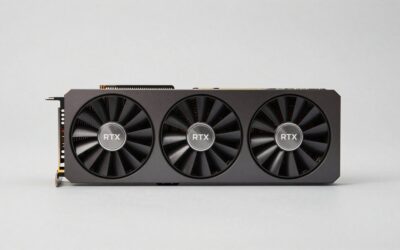
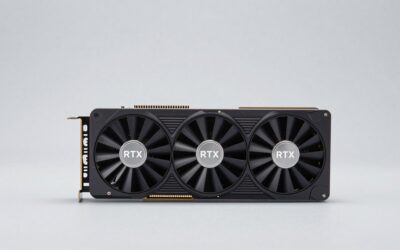
Most 9070 XT models are triple-fan cards between 300mm and 330mm long and 2.5 to 3 slots thick, so check clearance carefully. The 5070 is generally the smaller card, with several dual-fan designs under 250mm that suit compact builds. Measure from the rear bracket to your front radiator or drive cage.
Ready to decide? Our #1 pick for 2026 is the Launch MSRP.
Live price & availability on Amazon.

Write Your Review
No reviews yet. Be the first to share your experience!