
- The Quick Verdict for the RX 9060 XT vs RTX 5060 Matchup
- RX 9060 XT vs RTX 5060 Specs and Benchmark Comparison
- Deep Dive Face-Off: Software, Efficiency and Everyday Use
- The Market Right Now: Rising Prices and AMD’s Value Angle
- Final Verdict and Recommendation
- Related Guides
- Frequently Asked Questions
- Related Articles

Prime
Editor's Pick
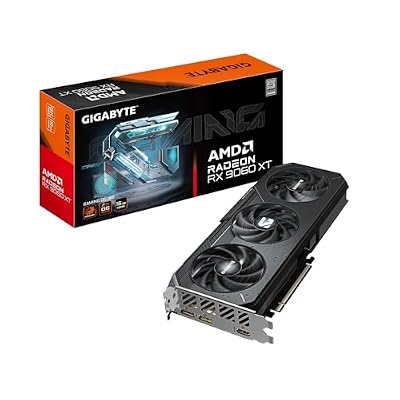
ASUS Dual Radeon RX 9060 XT 16GB GDDR6 Graphics Card, AMD, for Desktop (PCIe 5.0, HDMI 2.1b, DisplayPort 2.1a, 2.5-Slot, Axial-tech Fan, 0dB Technology, and More)

RX 9060 XT vs RTX 5060 is the classic AMD-versus-Nvidia standoff playing out in the most popular price bracket, and it is closer than brand loyalty on either side would admit. AMD leans on raw raster value and a generous memory option, while Nvidia counters with a more mature feature set and stronger upscaling. This comparison breaks down performance, VRAM, ray tracing, software and price so you can decide which card actually deserves a spot in your build.
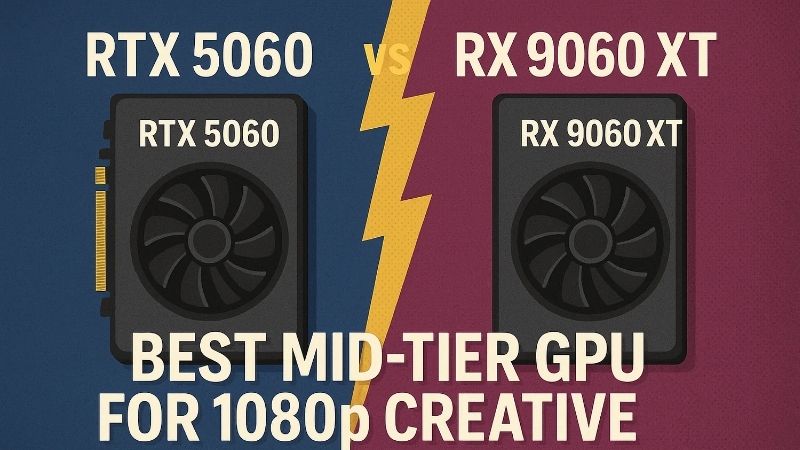
The Quick Verdict for the RX 9060 XT vs RTX 5060 Matchup
If you want the compressed answer, both cards are excellent 1080p performers, and the winner depends on what you value: raw frames and memory, or features and upscaling quality. Here is who each card suits best.
As an Amazon Associate we earn from qualifying purchases at no extra cost to you.


Best Pick for Raw Value and VRAM
The RX 9060 XT is the stronger choice if you want the most raster performance per dollar and generous memory. Its 16GB variant, in particular, offers a frame buffer that the standard RTX 5060 simply cannot match at this price.
For a straight rasterized 1080p experience without heavy ray tracing, AMD often delivers more frames for the money. That makes the 9060 XT appealing to players who prioritize high frame rates over the latest Nvidia features.
If you keep textures high and want headroom for future games, the extra VRAM is a real, tangible advantage rather than a spec-sheet talking point. That memory headroom also protects your build as engines evolve. Recent releases keep pushing texture budgets upward, and a 16GB card is far less likely to force you into lowering settings a year or two after purchase.
Best Pick for Features and Upscaling
The RTX 5060 is the pick if you value Nvidia’s software ecosystem. DLSS 4 Multi Frame Generation remains the most widely supported and polished upscaling and frame-generation solution, and it is a genuine day-to-day advantage.
Nvidia also holds an edge in ray tracing and in professional and AI applications, where its drivers and wider support matter. For a buyer who wants the most future-facing feature set, the 5060 leads.
Its efficiency is a bonus too, drawing modest power and fitting neatly into small, quiet builds. For many mainstream gamers, that polish is worth paying a little for. Frame generation deserves special mention. In supported games, DLSS 4 can lift on-screen frame rates well beyond the raw output, and because so many titles support it, the 5060 tends to feel faster than benchmarks alone suggest.
When the Choice Comes Down to Price
Because these cards are so evenly matched, the live price on the day you shop often breaks the tie. A meaningful discount on either one can instantly make it the better buy.
The 16GB 9060 XT and the 8GB 5060 sometimes sit close in price, which shifts the value heavily toward AMD. In other moments Nvidia bundles or discounts flip the math back.
The sensible approach is to decide which feature set you prefer first, then let the current price confirm or override that lean. Neither card is a mistake at the right price. It also helps to weigh which features you will actually use. If you rarely touch ray tracing and mostly play raster titles, AMD’s value case strengthens; if you lean on upscaling in every game, Nvidia’s ecosystem earns its premium.
RX 9060 XT vs RTX 5060 Specs and Benchmark Comparison
The spec sheets tell a story of two different philosophies: AMD prioritizing memory and raster, Nvidia prioritizing bandwidth and features. The table lays out the essentials before we translate them into gameplay.
Core Specs and Architecture Side by Side
Note the memory difference in particular, since AMD offers a 16GB configuration while the standard 5060 sticks with 8GB. That single line drives much of this comparison.
| Spec | RX 9060 XT | RTX 5060 |
|---|---|---|
| Architecture | RDNA 4 | Blackwell |
| Memory | 8GB or 16GB GDDR6 | 8GB GDDR7 |
| Upscaling / FG | FSR 4 | DLSS 4 (Multi FG) |
| Ray tracing | Improved on RDNA 4 | Strong, mature |
| Typical board power | ~160-180W | ~145W |
| Launch price | ~$299-$349 | $299 |
The headline takeaway is that AMD trades faster GDDR7 for more total capacity, while Nvidia counters with efficiency and a stronger feature stack. Neither approach is wrong; they suit different buyers.
Rasterization Performance at 1080p
In pure rasterized 1080p gaming, the two cards trade blows and often land within a handful of frames of each other, with the exact result swinging by title. The 9060 XT frequently edges ahead in raw raster, which is where AMD has traditionally been strong.
For competitive and esports games, both cards deliver high, smooth frame rates that will satisfy the vast majority of players. You are unlikely to feel a meaningful difference in that category.
The practical takeaway is that for classic 1080p gaming without heavy effects, value comes down to price and VRAM more than raw speed, since the speed is so close. Frame-time consistency is worth checking alongside averages. Both cards deliver smooth pacing in most titles, but the 16GB 9060 XT can hold steadier in memory-hungry games where an 8GB card would occasionally stutter.
Ray Tracing, FSR 4 and DLSS 4
Ray tracing is where Nvidia keeps a clearer lead. The 5060 handles ray-traced effects more gracefully, and its wider game support means you will find the feature usable in more titles.
On upscaling, AMD’s FSR 4 has closed much of the historic gap and looks genuinely good, but DLSS 4 still holds an edge in image quality and, crucially, in how many games support it. That adoption advantage is hard to overstate.
If ray tracing and best-in-class upscaling are priorities, the 5060 is the safer choice. If you rarely enable ray tracing, that Nvidia advantage matters far less to your daily experience. The trajectory matters too. FSR 4 is improving quickly and its game support is expanding, so AMD’s upscaling gap is narrowing over time. For now, though, DLSS 4’s head start in adoption is a practical edge you feel today.
Deep Dive Face-Off: Software, Efficiency and Everyday Use
Beyond frame rates, these cards differ in the ecosystem and the build experience around them. Here is how they compare on the things you live with after purchase.
Drivers, Software and Ecosystem
Nvidia’s software suite and driver maturity are long-standing strengths, and for creators or anyone using GPU-accelerated professional apps, that ecosystem support is a real factor. Many production tools are simply tuned for Nvidia first.
AMD’s software has improved substantially and its control panel is well regarded, so day-to-day gaming is smooth on either side. The gap is narrower than it once was for pure gamers.
Recording, streaming and encoding are worth a thought as well. Nvidia’s encoder has a strong reputation among streamers, so if you broadcast your gameplay, that is one more small point in the 5060’s favor. If your use extends beyond gaming into creation or AI tinkering, Nvidia’s ecosystem tilts the decision. For gaming alone, both are dependable. Update cadence is worth noting as well. Both companies ship regular driver improvements, so whichever card you pick will keep getting small performance and stability gains over its life.
Power, Thermals and Case Compatibility
The 5060’s lower power draw gives it an efficiency edge, making it friendly to smaller cases and modest power supplies. It tends to run cool and quiet without much effort.
The 9060 XT draws a bit more, which means slightly more heat and a marginally larger power budget to plan for. It is not demanding, but it is not quite as effortless as the Nvidia card in a tight build.
For a compact or quiet-focused build, the 5060 has a small but real advantage. For a standard tower, the difference is negligible in practice. Long-term running costs are a minor factor too. Over years of heavy use, the more efficient card shaves a little off your power bill, which is a small but genuine point in the 5060’s column for anyone gaming many hours a week.
Pros and Cons of the RX 9060 XT and RTX 5060
Here is the honest ledger for the RX 9060 XT vs RTX 5060 decision, drawn from the strengths and trade-offs of each card.
RX 9060 XT — Pros: strong raster value, an available 16GB memory option, improved RDNA 4 ray tracing, aggressive pricing. Cons: FSR 4 support trails DLSS 4 in game count, higher power draw, weaker for professional and AI apps.
RTX 5060 — Pros: DLSS 4 Multi Frame Generation, stronger ray tracing, excellent efficiency, mature drivers and ecosystem. Cons: only 8GB VRAM on the standard card, often less raw raster per dollar than AMD.
The Market Right Now: Rising Prices and AMD’s Value Angle
This matchup does not happen in a vacuum. Component prices have been climbing, and that backdrop tends to sharpen AMD’s traditional value pitch while making every purchase more timing-sensitive.
Why Prices Are Elevated Across the Board
Across GPUs and full systems, prices have trended up rather than settling into the usual decline. Memory is a major driver, since graphics cards compete with the wider market for tight supplies of modern DRAM.
In a pricier market, the card that offers more memory for the money looks more attractive, which often plays to AMD’s strengths. The 16GB 9060 XT can be especially compelling when the 8GB 5060 costs nearly the same.
The practical move is to treat a fair price as a good price and to compare both cards live rather than relying on launch figures that the market has already moved past.
The Faint Case for Waiting
There is some good news, but it is weak and distant. Prices have at least stopped climbing as steeply as they did in late 2025, and parts of the hardware market have seen a period of relative stability, though makers still warn that volatility is not over.
New supply is being built through expanded DDR5 sourcing and fresh fabs, but those facilities largely come online around 2027 to 2028. Real relief is years away, not months.
So waiting seldom pays off right now. Prices have flattened, not fallen, which argues for buying the card whose feature set you prefer as soon as the price is fair.
The Alternative: A Third Card Worth a Look
If neither of these two quite fits, there are other options nearby. A step up to a 5060 Ti, or to a higher AMD tier, adds performance and memory for a bit more money.
Equally, a well-priced previous-generation card can deliver most of the 1080p experience for less, which is worth considering if budget is the hard constraint.
The aim is to match the card to your resolution, feature priorities and budget without overpaying in a tight market. There is usually a sensible third choice between these two. Whatever you choose, set a firm price ceiling before you shop. In an inflated market, that discipline protects your wallet far more than agonizing over the last few frames between two closely matched cards.
See more:
- Nvidia gear store
- Nvidia number of employees
- Nvidia Jetson Xavier Developer Kit
- GeForce graphics driver
Final Verdict and Recommendation
In the RX 9060 XT vs RTX 5060 decision, choose the RX 9060 XT if you want the best raster value and a generous memory option, especially the 16GB version for future-proofing at 1080p. Choose the RTX 5060 if you want DLSS 4, stronger ray tracing, better efficiency and Nvidia’s mature ecosystem for gaming and creation alike. Both are outstanding 1080p cards, and in a market this tight the live price often settles a decision this close. Check the current price on both cards through the link below before you buy, so you lock in the better value today.
Frequently Asked Questions
Which card is faster at 1080p, the RX 9060 XT or the RTX 5060?
In raw rasterized 1080p performance the RX 9060 XT is generally a step ahead, particularly the 16GB model in games that stream large textures. The RTX 5060 closes or reverses that gap in heavy ray-traced titles, where Nvidia RT cores and DLSS ray reconstruction still hold a clear advantage.
Is 8GB of VRAM enough for these cards in 2026?
For 1080p with medium to high textures, 8GB still works in most games. Newer titles with high-resolution texture packs, frame generation and ray tracing can exceed it, causing stutter and texture pop-in. If you plan to keep the card three or more years, the 16GB RX 9060 XT is the safer buy.
What power supply do I need for either card?
Both are efficient. The RTX 5060 draws around 145W and the RX 9060 XT roughly 160 to 180W depending on model. A quality 450W to 550W unit with a single 8-pin PCIe connector handles either in a typical mid-range build. Higher-end CPUs push that recommendation toward 600W.
Does upscaling change the value equation?
Significantly. DLSS 4 with multi-frame generation on the RTX 5060 delivers cleaner image quality at aggressive upscaling ratios than FSR in most implementations, and it is supported in more shipped titles. AMD counters with wider hardware compatibility and no vendor lock, so weigh the games you actually play.
Which offers better price-to-performance today?
The RX 9060 XT usually wins on frames per dollar in rasterized games, especially when the 16GB version is close in price to an 8GB RTX 5060. The Nvidia card justifies its premium if you value NVENC encoding for streaming, CUDA for creative apps, or heavy ray tracing.


Write Your Review
No reviews yet. Be the first to share your experience!