
- Top Pick: GIGABYTE GeForce RTX 4070 Ti Super Eagle OC 16G Graphics Card, 3X WINDFORCE Fans, 16GB 256-bit GDDR6X, GV-N407TSEAGLE OC-16GD Video Card
- Best Value: ZOTAC Gaming GeForce RTX 4070 Ti Super Solid OC DLSS 3 16GB GDDR6X 256-bit 21 Gbps PCIE 4.0 Gaming Graphics Card, IceStorm 2.0 Advanced Cooling, ZT-D40730RC-10P
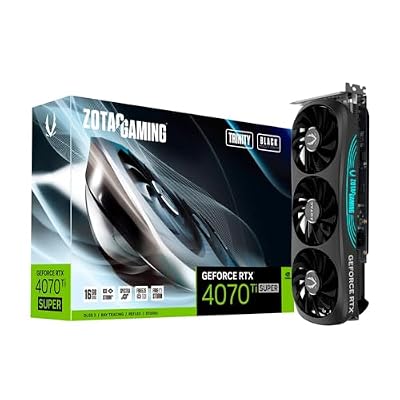
- Premium Choice: ZOTAC GAMING GeForce RTX 4070 Ti SUPER Trinity Black Edition 16GB GDDR6X
Top Rtx 4070 Super 5070 Which Picks for 2026
Here are our current top rtx 4070 super 5070 which picks, compared on real Amazon owner reviews, price, and features. Live prices update below.


Dropped $10.00

RTX 4070 Super vs 5070 Ti is a cross-generation step-up question: how much more do you get by moving from a popular Ada Lovelace mid-range card to a higher Blackwell tier? The RTX 4070 Super is an efficient $599 favorite for 1440p, while the RTX 5070 Ti adds more cores, a wider bus, a larger 16GB buffer, and exclusive DLSS 4 Multi Frame Generation at a higher price. Because the 5070 Ti sits a clear tier above, the real decision is whether the extra performance and features justify the additional cost, a question this comparison answers through specs, performance, and value.
As an Amazon Associate we earn from qualifying purchases at no extra cost to you. Product prices and availability are accurate as of the date shown and are subject to change.


Quick Verdict and Specifications
Here is the high-level read on this step-up matchup, followed by the spec sheet that shows how much separates the two cards.
The Bottom Line Up Front
The RTX 5070 Ti is clearly the stronger card, with more cores, a wider memory bus, a larger 16GB buffer, and exclusive DLSS 4 Multi Frame Generation. It is a genuine tier above the 4070 Super rather than a sidestep.
The RTX 4070 Super remains an excellent, efficient 1440p card at a lower price, so the decision is whether you need the 5070 Ti’s extra performance and 4K headroom or whether the cheaper card already meets your goals.
For high-refresh 1440p and entry 4K with longevity in mind, the 5070 Ti is worth the step up. For pure 1440p value, the 4070 Super is hard to beat.
Specifications Side by Side
The spec sheet shows a clear tier gap, with the 5070 Ti ahead on cores, bus width, and VRAM.
| Spec | RTX 4070 Super | RTX 5070 Ti |
|---|---|---|
| Architecture | Ada Lovelace | Blackwell |
| CUDA cores | 7168 | 8960 |
| VRAM | 12GB GDDR6X | 16GB GDDR7 |
| Memory bus | 192-bit | 256-bit |
| Total graphics power | 220W | 300W |
| Launch MSRP | $599 | $749 |
| DLSS support | DLSS 3 Frame Gen | DLSS 4 (Multi Frame Gen) |
The 5070 Ti leads on cores, bus width, and VRAM, and adds DLSS 4, while the 4070 Super counters with lower power draw and a lower price.
Reading the Spec Gap
The 5070 Ti’s 8960 cores against the 4070 Super’s 7168, combined with the wider 256-bit bus against 192-bit, point to a meaningful native-performance and bandwidth advantage. This is a clear tier step, not a marginal one.
Blackwell’s architectural gains and GDDR7 memory widen the real-world gap further, so the 5070 Ti extracts more from each core than the count alone implies, while also benefiting from greater effective bandwidth.
VRAM is a real divider: the 5070 Ti’s 16GB exceeds the 4070 Super’s 12GB, giving it more headroom for memory-heavy 4K gaming and longevity, while the 4070 Super’s 12GB remains comfortable at 1440p.
Performance Face-Off
The specs suggest a clear step up, and behavior across resolutions and features confirms exactly where the 5070 Ti pulls ahead.
1440p Gaming
At 1440p both cards excel, but the 5070 Ti posts notably higher native frame rates, giving it more headroom for high-refresh monitors and the most demanding titles at high settings.
The 4070 Super remains a superb 1440p card, comfortably handling modern games at high settings, and for many players it is entirely sufficient. The gap matters most for those chasing the highest refresh rates or planning to keep the card for years.
At 1080p both are overpowered, so the 1440p result and 4K ambitions should guide the decision rather than lower-resolution performance where neither card is challenged.
4K Gaming and VRAM
At 4K the 5070 Ti’s advantages compound. Its wider bus, larger 16GB buffer, and stronger architecture let it sustain higher frame rates and handle memory-heavy scenes more gracefully than the 4070 Super.
The 4070 Super can play at 4K with upscaling and trimmed settings, but its 12GB buffer and narrower bus make it more of an entry-4K card, while the 5070 Ti is genuinely comfortable at the resolution.
For buyers eyeing 4K now or soon, the 5070 Ti’s extra capability and buffer make it the far safer long-term choice over the 4070 Super.
Ray Tracing and DLSS 4
In ray tracing the 5070 Ti’s stronger hardware gives it a clear lead, and its DLSS 4 Multi Frame Generation, which the 4070 Super cannot access, extends that advantage further in supported titles.
The 4070 Super still supports DLSS 3 Frame Generation, a capable feature that boosts frame rates, but it is a generation behind. In DLSS 4 games the 5070 Ti can generate more on-screen frames and pull well ahead.
This makes the 5070 Ti the more future-proof choice as more titles adopt DLSS 4, though the 4070 Super’s DLSS 3 support keeps it competitive in the large existing library.
Value, Alternatives, and Market Forces
With performance favoring the 5070 Ti, price and the broader market decide whether the step up is worth it for you.
Price and Value per Frame
At a $749 launch price against the 4070 Super’s $599, the 5070 Ti costs more but delivers a tier’s worth of extra performance, more VRAM, and DLSS 4, which can justify the premium for the right buyer.
If the 5070 Ti stretches your budget, the 4070 Super remains a strong-value alternative for 1440p, or you could wait for a discount on either card. Match the choice to your resolution and how long you plan to keep it.
Resale and longevity favor the 5070 Ti thanks to its 16GB buffer and DLSS 4 support, while the 4070 Super’s lower entry cost is its main advantage for budget-focused builds.
Rising Prices and Why Timing Matters
Laptop and PC-component prices are trending upward and are expected to keep climbing. That makes securing a card at today’s price more appealing than waiting and risking a higher cost later.
For this matchup, rising prices reward deciding on your target card and buying promptly. If the 5070 Ti is the long-term pick, buying before further increases protects you from paying a premium down the line.
The reliable approach is to choose based on your resolution and budget, then act when a fair price appears, rather than waiting for cuts unlikely in the current market.
Nvidia’s AI Focus and GPU Supply
The U.S. recently cleared Nvidia to sell its H200 AI chips to China. The H200 is a data-center accelerator, not a GeForce card, so it does not directly change how either gaming card performs.
The indirect effect is on supply and pricing: heavy demand for Nvidia’s AI silicon can keep capacity and attention tilted toward accelerators, which historically firms up consumer GPU prices and slows discounts across the lineup.
That context reinforces buying at a fair price rather than waiting, since broader market pressure makes meaningful price drops on either card less likely in the near term.
Final Verdict: Which Should You Buy?
The 5070 Ti is the stronger card, so the decision rests on whether you need its extra performance and 4K headroom for the higher price.
Buy the RTX 5070 Ti if…
Choose the 5070 Ti if you want high-refresh 1440p with room to spare, plan to game at 4K, value the larger 16GB buffer, and want DLSS 4 Multi Frame Generation for future titles. It is the more future-ready card.
For buyers who want longevity and headroom, the step up is well justified, delivering a real tier of extra capability over the 4070 Super.
Buy the RTX 4070 Super if…
Choose the 4070 Super if you game at 1440p, want excellent value and efficiency, and do not need the 5070 Ti’s extra 4K headroom or 16GB buffer. It remains a superb mainstream card.
It suits budget-conscious builders who want strong 1440p performance at a lower price and lower power draw, especially if found at a competitive cost.
Pros and Cons Recap
Here is the concise trade-off summary for both cards.
RTX 5070 Ti pros: stronger performance, 16GB VRAM, wider bus, DLSS 4 Multi Frame Generation. Cons: higher price, higher 300W draw. RTX 4070 Super pros: excellent 1440p value, efficient at 220W, lower price, capable DLSS 3. Cons: 12GB buffer, narrower bus, no DLSS 4 Multi Frame Generation.
Frequently Asked Questions
Quick answers to the questions buyers most often ask when comparing the RTX 4070 Super with the RTX 5070 Ti.
Is the RTX 5070 Ti worth the extra money over the 4070 Super?
For high-refresh 1440p, 4K gaming, or longevity, yes, since it offers a clear tier of extra performance, more VRAM, and DLSS 4.
For pure 1440p value where the 4070 Super already meets your needs, the cheaper card can be the smarter spend.
A simple test is your monitor: if you are moving to 4K or a high-refresh 1440p panel, the 5070 Ti’s headroom pays off, otherwise the 4070 Super suffices.
Which has more VRAM?
The 5070 Ti has 16GB against the 4070 Super’s 12GB, giving it more headroom for 4K and texture-heavy games.
For longevity and demanding titles, that larger buffer is a meaningful advantage.
If you plan to keep the card through several years of heavier games, the extra 4GB is the safer long-term bet.
Do both cards support DLSS 4?
Only the 5070 Ti supports DLSS 4 with Multi Frame Generation, as a Blackwell card.
The 4070 Super supports DLSS 3 Frame Generation but cannot access the newer Multi Frame Generation.
In games that support DLSS 4, that exclusive feature can noticeably widen the 5070 Ti’s effective lead over the 4070 Super.
Conclusion
In the RTX 4070 Super vs 5070 Ti comparison, the 5070 Ti is the clearly stronger card, offering a genuine tier of extra performance, a larger 16GB buffer, a wider bus, and exclusive DLSS 4 Multi Frame Generation, making it the better choice for high-refresh 1440p, 4K, and longevity. The 4070 Super remains an excellent, efficient value for 1440p gamers who do not need that extra headroom. With component prices trending upward, the practical move is to pick the card that matches your resolution and buy it at a fair price, and for buyers wanting to step up and future-proof, the RTX 5070 Ti is well worth it in 2026.










Write Your Review
No reviews yet. Be the first to share your experience!