
- Top Pick: ASUS Dual GeForce RTX 4060 Ti EVO OC Edition 8GB GDDR6 (PCIe 4.0, 8GB GDDR6, DLSS 3, HDMI 2.1a, DisplayPort 1.4a, Axial-tech Fan Design, Auto-Extreme Technology), 3 Year Warranty
- Best Value: PNY GeForce RTX™ 4060 Ti 8GB Verto™ OC Dual Fan Graphics Card DLSS 3 (128-bit, PCIe 4.0, GDDR6, HDMI/DisplayPort, Supports 4k, 2 Slot)
- Premium Choice: MSI GeForce RTX 4060 Ti Ventus 3X 16G OC Graphics Card -NVIDIA RTX 4060 Ti, 16GB GDDR6 Memory, 18Gbps, PCIe 4.0, DLSS3


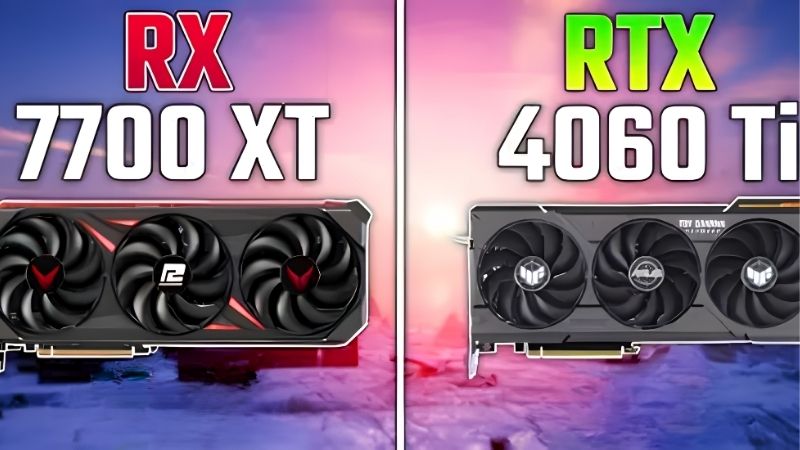
RX 7700 XT vs 4060 Ti is a comparison with a hidden question inside it: which 4060 Ti? Nvidia shipped two cards with the same name and 8GB or 16GB of memory, and choosing between them matters more than choosing between brands. Get that wrong and every benchmark you have read is describing a different card from the one you bought. This page separates the two variants, splits raster from ray tracing from upscaling instead of blending them into one misleading average, and covers the thing AMD buyers are not told about FSR 4.
The Quick Verdict: RX 7700 XT vs 4060 Ti in One Minute
The RX 7700 XT wins raster by roughly 10-20% and has 50% more memory bandwidth. The 4060 Ti wins ray tracing decisively and has Frame Generation, which the 7700 XT has no equivalent for. Against the 8GB 4060 Ti, the 7700 XT wins comfortably — 12GB against 8GB settles it and it is not close. Against the 16GB version, it becomes a genuine choice: faster raster and better bandwidth on one side, Frame Generation and better RT on the other. The tiebreaker is uncomfortable for AMD: the 7700 XT is RDNA 3 and does not get FSR 4, which means the gap in upscaling is permanent and widening.
As an Amazon Associate we earn from qualifying purchases at no extra cost to you.


Which 4060 Ti Are You Actually Looking At?
Settle this before anything else. Two cards, one name, roughly $100 apart.
The 8GB 4060 Ti is a good 1080p card and a bad 1440p one. At 1080p Ultra with texture packs and at 1440p generally, it exceeds its buffer, and its 128-bit bus makes the resulting spill across PCIe worse than it would be on a wider card. Against the 7700 XT’s 12GB, it loses on the specification that matters most in 2026.
The 16GB 4060 Ti is the same silicon with double the memory. It costs roughly $100 more and it is worth it — not because 16GB is needed at 1080p, but because it removes the ceiling entirely and makes the card viable at 1440p.
The listings are frequently unclear about which you are buying. Check the box. If a 4060 Ti price looks unusually good, it is the 8GB.
Who Should Buy the RX 7700 XT
Buy it if your library is rasterised — competitive shooters, older single-player games, strategy titles — and you play at 1080p or 1440p High. It is 10-20% faster in exactly those games and it carries 12GB on a wider bus.
Buy it if you are on Linux, where AMD’s open-source driver stack remains meaningfully less painful than Nvidia’s proprietary route.
And buy it if the price gap is significant. The 7700 XT typically undercuts the 16GB 4060 Ti, which makes the value argument straightforward against that variant.
Who Should Buy the 4060 Ti
The 16GB version, and buy it if you use ray tracing at all, if you stream or record, or if you want Frame Generation. That last one is not a small feature — it is Ada hardware the 7700 XT has no counterpart for.
Buy it also if power matters. At 160W against 245W, the 4060 Ti draws a third less and runs on almost any supply. In a small case or a hot room, that gap is real.
And buy it for CUDA work. Blender, Stable Diffusion, coursework — CUDA’s ecosystem advantage over ROCm is a software reality that no hardware specification fixes.
Specs and Frame Rates Side by Side
The specification table contains one row that explains most of the raster result, and it is not the core count.
Core Specifications Compared
| Specification | RX 7700 XT | RTX 4060 Ti |
|---|---|---|
| Architecture | RDNA 3 (Navi 32) | Ada Lovelace (AD106) |
| Shader units | 3,456 | 4,352 CUDA |
| VRAM | 12GB GDDR6 | 8GB or 16GB GDDR6 |
| Memory bus | 192-bit | 128-bit |
| Bandwidth | ~432 GB/s | ~288 GB/s |
| L2 cache | 4MB (+ Infinity Cache) | 32MB |
| Upscaler | FSR 3.1 (no FSR 4) | DLSS 4.5 |
| Frame generation | FSR 3 FG | DLSS FG (2X) |
| Board power | 245W | 160W |
| PSU recommended | 650W | 550W |
The bandwidth row is the story. 432 GB/s against 288 — the 7700 XT has 50% more, from a 192-bit bus against a 128-bit one. That is a large structural advantage and it is why the 7700 XT wins raster despite having fewer shaders.
Ada’s 32MB L2 cache is Nvidia’s answer, and at 1080p it works — the cache keeps data close and the narrow bus stops mattering. At 1440p the working set outgrows the cache and the bus reasserts itself. That single dynamic explains why these two cards trade places between resolutions.
Frame Rates by Resolution and Setting
High preset, no upscaling. The 16GB 4060 Ti shown, since the 8GB is a different card. Asterisks mark memory limits.
| Game | 7700 XT @1080p | 4060 Ti @1080p | 7700 XT @1440p | 4060 Ti @1440p |
|---|---|---|---|---|
| Counter-Strike 2 | ~275 FPS | ~265 FPS | ~210 FPS | ~185 FPS |
| Call of Duty (recent) | ~142 FPS | ~132 FPS | ~104 FPS | ~88 FPS |
| Cyberpunk (no RT) | ~98 FPS | ~88 FPS | ~72 FPS | ~60 FPS |
| Cyberpunk (RT Ultra) | ~34 FPS | ~46 FPS | ~26 FPS | ~33 FPS |
| Alan Wake 2 | ~72 FPS | ~64 FPS | ~52 FPS | ~43 FPS |
| Black Myth: Wukong | ~68 FPS | ~61 FPS | ~48 FPS | ~40 FPS |
Read the two 1440p columns. The 7700 XT’s lead widens from roughly 10% at 1080p to roughly 18-20% at 1440p — that is the bandwidth advantage showing up exactly where theory says it should, as the working set outgrows Ada’s cache.
Now read the RT Ultra row. The ordering flips completely: 46 against 34 at 1080p, a 35% Nvidia lead. RDNA 3’s ray accelerators are simply behind Ada’s dedicated RT cores, and this is not close.
So the honest summary is that these are two different cards for two different libraries, and the averages you have seen elsewhere blend them into a number that describes neither.
Power, PSU and What Fits
245W against 160W is a 53% difference and it is the 4060 Ti’s most underrated advantage. The 7700 XT wants a quality 650W supply and two 8-pins. The 4060 Ti runs on 550W and a single 8-pin, and in a small form factor build that gap is decisive.
At four hours a day, the 85W difference costs roughly $12-30 a year depending on your region. Modest — but it compounds with heat, noise and case constraints, and over three years it takes a bite out of the 7700 XT’s price advantage that no comparison chart shows you.
Physically both are unremarkable: mostly 2 to 2.5-slot cards around 240-300mm. Compact 4060 Ti models exist for ITX builds; 7700 XT options are fewer.
Deep Dive: Raster, Ray Tracing, Upscaling
Three separate comparisons with three different winners. Blending them is how this matchup gets reported wrong.
Rasterization: The Bandwidth Advantage Is Real
In traditional rendering the 7700 XT leads by 10-12% at 1080p and 18-20% at 1440p. The widening gap is the interesting part and it is entirely structural: Ada’s 32MB cache masks a 128-bit bus at low resolution and stops masking it as resolution climbs.
If your library is rasterised and your monitor is 1440p, the 7700 XT is the faster card and the argument is short. This is its strongest ground.
Ray Tracing and the FSR 4 Door That Closed
On ray tracing the 4060 Ti leads by 30-35% and the reason is architectural rather than incidental. RDNA 3’s ray accelerators trail Ada’s dedicated RT cores, and no driver closes that.
On upscaling, the gap is worse than it looks and this is the paragraph AMD buyers are not given. AMD launched FSR 4 as an RDNA 4 feature, and the RX 7700 XT is RDNA 3. It is stuck on FSR 3.1 permanently — a decent upscaler that trails the current generation visibly at 1440p Quality on fine detail and thin geometry in motion. Meanwhile the 4060 Ti gets DLSS 4.5’s second-generation transformer model, delivered through the Nvidia app’s override across over 400 titles without waiting for developers to patch anything.
Frame generation compounds it. The 4060 Ti is Ada, so it has the optical flow accelerator and gets DLSS Frame Generation. The 7700 XT has FSR 3 frame generation, which works but shows more artefacts in fast motion. Note the 4060 Ti gets 2X frame generation rather than Blackwell’s 5X and 6X multi-frame modes — that is a 50-series feature, and anyone telling you a 4060 Ti does multi-frame generation is wrong.
The practical consequence: native benchmark charts flatter the 7700 XT, because they exclude the thing that separates these cards in real use.
Pros and Cons of Each Card
| RX 7700 XT | RTX 4060 Ti 16GB | |
|---|---|---|
| Pros | 50% more bandwidth on a 192-bit bus; 10-20% faster raster, widening at 1440p; 12GB; two 8-pins, no adapter; excellent Linux drivers; usually cheaper | 16GB removes the ceiling entirely; 30-35% faster ray tracing; DLSS 4.5 in 400+ titles; Frame Generation; 160W on a 550W PSU; NVENC; CUDA for compute |
| Cons | No FSR 4 — RDNA 3 is locked out permanently; RT is not realistically usable; 245W; weaker encoder; ROCm trails CUDA badly | 128-bit bus caps it as resolution rises; loses raster at 1440p; the 8GB variant is a trap; costs ~$100 more than the 8GB; 2X frame gen only, not 5X/6X |
Both cons columns lead with a structural limit rather than a nitpick. The 7700 XT’s is a closed door — FSR 4 is not coming. The 4060 Ti’s is a bus width that Ada’s cache papers over at 1080p and cannot at 1440p.
Price Reality in the $400 Tier
Everything above assumes prices that have not behaved normally for two years, and in this tier the memory question and the price question are the same question.
Why the 16GB Variant Costs What It Does
Component and laptop prices have kept trending upward rather than settling back, and memory has been among the sharpest movers. That is the direct explanation for the roughly $100 gap between the 8GB and 16GB 4060 Ti — you are paying for eight gigabytes of GDDR6 at 2026 contract prices, on a card where memory is already a large fraction of the bill of materials.
It also explains why the 8GB variant still exists at all. In a normal market Nvidia would have quietly retired it; in this one it is the only way to hold a price point. The consequence for you is that the trap is deliberate rather than accidental — the cheap 4060 Ti is cheap because of the thing that makes it a bad buy.
The practical read: the gap between these cards is not going to close by waiting. Buyers who spent 2025 waiting for the $400 tier to correct mostly paid more later than they would have on day one.
Prices Flattened, But Relief Is Distant
The good news is real and deserves precision rather than optimism. The steep climb of late 2025 has eased. Framework, which publishes unusually candid component pricing updates, has described a stretch of relative stability while continuing to warn that volatility persists. Prices stopped accelerating; they did not reverse.
New capacity is coming. OEMs can now source DDR5 from Chinese manufacturers such as CXMT, and Micron is building two fabs in Idaho. Both add real supply. Neither begins production before 2027-2028, which is a full generation beyond this purchase.
So: flat, not falling, with relief two to three years out. Decide on the prices in front of you.
The Alternative: The Card That Beats Both
If the 7700 XT’s FSR 4 exclusion bothers you — and it should — the obvious answer is the RX 9070. It is RDNA 4, so it gets FSR 4, it carries 16GB, and it typically sits just above this tier on price. For an AMD buyer in 2026 it is the card the 7700 XT wishes it were.
On the Nvidia side, an RTX 5060 Ti 16GB is the newer equivalent with Blackwell’s multi-frame generation rather than 2X. And an Intel Arc B580 offers 12GB for considerably less, if your platform supports Resizable BAR.
Compare current pricing across the 7700 XT, RX 9070, 4060 Ti 16GB and 5060 Ti 16GB before committing — the ordering shifts month to month, and check which 4060 Ti variant any given listing is actually selling.
See More:
- GTX 1650 vs RTX 3050
- Nvidia DIGITS
- Nvidia cuDNN
- Radeon RX 9070 XT vs RTX 5090
- PNY GeForce RTX 5080 review
Final Verdict: RX 7700 XT vs 4060 Ti
The rx 7700 xt vs 4060 ti answer depends first on which 4060 Ti. Against the 8GB version, buy the 7700 XT without hesitation — 12GB against 8GB decides it and no amount of DLSS rescues a card that has run out of memory. Against the 16GB version, it is a real choice, and your library decides it: rasterised games at 1440p go to the 7700 XT, where 50% more bandwidth produces a widening 18-20% lead. Ray tracing and Frame Generation go to the 4060 Ti, which also draws 85W less.
The thing to weigh heaviest is the one nobody tells you: the 7700 XT is RDNA 3 and will never get FSR 4. That door is closed permanently, which means native benchmarks flatter it relative to how these cards actually perform in use. If that bothers you — and it is a reasonable thing to be bothered by — the honest recommendation is to look at an RX 9070 instead and get FSR 4 with 16GB. With prices flat rather than falling, the card in stock at a sane price today beats the one you are waiting for.
Frequently Asked Questions
Which card is actually faster at 1440p?
In pure rasterised games the RX 7700 XT leads the 8GB RTX 4060 Ti by roughly 20 to 30 percent at 1440p, helped by its 192-bit bus and 432GB/s of bandwidth against the 4060 Ti narrow 128-bit bus. In heavy ray tracing titles the gap closes and can reverse in favour of Nvidia.
Does 12GB of VRAM matter over 8GB right now?
Yes, more than it did two years ago. Titles like Hogwarts Legacy, The Last of Us Part I and Ratchet and Clank will exceed 8GB at 1440p with high textures and ray tracing, causing stutter and texture pop-in rather than just lower averages. The 7700 XT 12GB avoids that class of problem entirely.
How does DLSS and Frame Generation change the comparison?
DLSS upscaling still looks cleaner than FSR at 1440p quality mode, and Frame Generation can roughly double the reported frame rate in supported titles. But frame generation needs a solid base frame rate to feel good, and on an 8GB card it also adds VRAM overhead, so it does not fully rescue the 4060 Ti in memory heavy games.
What power supply and connectors do I need?
The RX 7700 XT is a 245W card, usually with two 8-pin PCIe connectors, and AMD suggests a quality 700W unit. The RTX 4060 Ti is only 160W with a single 8-pin, and runs happily on a decent 550W supply. If your PSU is older or low wattage, the Nvidia card is the easier drop-in.
Which one is the better price-to-performance buy?
If both cards sit at a similar street price, the 7700 XT wins for raster gaming and future VRAM headroom. Pick the 4060 Ti only if you specifically want lower power draw, a small quiet build, NVENC for streaming or recording, or ray tracing and DLSS in the specific games you play most.
Ready to decide? Our #1 pick for 2026 is the Architecture.
Live price & availability on Amazon.




Write Your Review
No reviews yet. Be the first to share your experience!