
- Top Pick: ASRock Radeon RX 7700 XT Challenger 12GB OC Graphics Card, AMD RDNA 3 Architecture, 12GB GDDR6, 2584 MHz Boost Clock, 3X DisplayPort 2.1, 1x HDMI 2.1, Dual Fan Cooling
- Best Value: ASUS Prime GeForce RTX 5060 Ti 16GB GDDR7 Gaming Graphics Card
- Premium Choice: GIGABYTE GeForce RTX 5060 Ti WINDFORCE OC 8G Graphics Card, 8GB 128-bit GDDR7, PCIe 5.0, WINDFORCE Cooling System, GV-N506TWF2OC-8GD Video Card
RX 7700 XT vs RTX 5060 Ti is the mid-range matchup budget-conscious 1440p gamers keep coming back to, because it pits AMD’s raster-and-VRAM value against NVIDIA’s feature stack. One card leans on 12GB of memory and strong rasterized performance, the other on DLSS 4, better ray tracing and far lower power draw. Pick wrong and you either leave frames on the table or run short on VRAM in the games you care about. This head-to-head compares both cards by measured 1440p performance, memory, upscaling, efficiency and price, then tells you exactly who should buy which, with a smart alternative if neither fits.
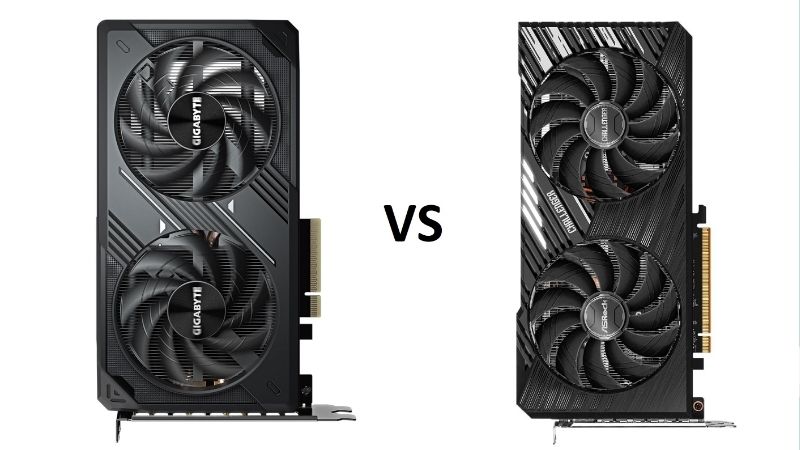
The short version is that this is not a case of one card being outright better. It is a genuine trade-off between AMD’s raster-and-VRAM value and NVIDIA’s feature-and-efficiency package, and the right answer changes depending on the games you play and the price you find on the day.
As an Amazon Associate we earn from qualifying purchases at no extra cost to you.


RX 7700 XT vs RTX 5060 Ti: The Quick Verdict
If you want the short answer, it depends on what you value most. The RX 7700 XT is the pick for pure rasterized frame rates and generous VRAM at a low price, while the RTX 5060 Ti 16GB is the smarter all-rounder thanks to DLSS 4, stronger ray tracing and much better efficiency. The one card to avoid for 1440p is the 8GB version of the 5060 Ti, whose memory fills too fast. The table below frames why.
| Spec | RX 7700 XT | RTX 5060 Ti (16GB) |
|---|---|---|
| Architecture | RDNA 3 | Blackwell (RTX 50) |
| VRAM | 12GB GDDR6 | 16GB GDDR7 |
| Memory bus | 192-bit | 128-bit |
| Ray tracing | Good (RDNA 3) | Stronger (RTX) |
| Upscaling | FSR 3.1 | DLSS 4 + Multi Frame Gen |
| Typical board power | ~245W | ~180W |
| Best resolution | 1440p | 1440p |
Who Wins for Rasterized 1440p Gaming
In pure rasterized workloads without upscaling or ray tracing, the RX 7700 XT is genuinely strong and often trades blows with or edges the RTX 5060 Ti at 1440p. Its wider 192-bit bus and RDNA 3 shader array push high frame rates in the raster-heavy titles that make up most game libraries.
That raster strength is the AMD card’s core argument. If you play a lot of competitive or older titles where ray tracing is irrelevant, the 7700 XT delivers the frames you actually see, and it does so while carrying 12GB of VRAM to keep textures high.
The RTX 5060 Ti is no slouch in raster, but it leans on its feature set to pull ahead rather than winning on brute force alone, which is exactly where the next section matters.
Who Wins on Features and Ray Tracing
Turn on ray tracing and switch on upscaling, and the RTX 5060 Ti takes control. Its RT hardware handles heavy lighting more gracefully, and DLSS 4 with Multi Frame Generation can multiply frame rates in supported games in a way FSR 3.1 cannot match yet.
DLSS 4’s transformer upscaling also holds image quality better in motion, so the 5060 Ti’s reclaimed frames come with fewer visual compromises. For anyone who values ray tracing, cleaner upscaling and future-facing features, the NVIDIA card is clearly ahead.
This is the classic divide in this matchup: AMD wins the raster-only argument, NVIDIA wins once the modern feature stack is switched on.
Quick Verdict by Use Case
Buy the RX 7700 XT if you prioritize rasterized frame rates and VRAM headroom on the tightest budget, and you rarely use ray tracing. It is the value raster champion of this pair.
Buy the RTX 5060 Ti 16GB if you want the best balance of features, efficiency and longevity, especially if ray tracing and DLSS 4 matter to you. Skip the 8GB 5060 Ti for 1440p, since its memory becomes the bottleneck before its core does.
For a mixed player who dabbles in everything, the tie-breaker is usually the ecosystem you want to live in. If you value AMD’s raw value and open features, the 7700 XT fits; if you want NVIDIA’s polish, broad app support and the strongest upscaling, the 5060 Ti 16GB is the safer long-term home.
RX 7700 XT vs RTX 5060 Ti Deep Dive: Specs and Performance
The headline verdict holds, but the details decide whether a card fits your system and your games. This deep dive compares raw output, the all-important VRAM question, and the efficiency and upscaling technologies that increasingly define value at this tier.
Raw Performance and Frame Rates
At 1440p in rasterized testing, both cards land in a similar high-frame-rate band, with the RX 7700 XT frequently a touch ahead in pure raster and the RTX 5060 Ti closing or reversing the gap once DLSS is enabled. In practice, neither card will disappoint at 1440p on high settings in most titles.
The separation appears in demanding, feature-heavy games. With ray tracing on, the 5060 Ti’s lead grows, and with DLSS 4 Multi Frame Generation active it can post frame rates the 7700 XT simply cannot reach. The honest read is that raw silicon favors AMD slightly, while the software stack favors NVIDIA decisively.
It is worth stressing how CPU-dependent these mid-range results can be. Paired with a weaker processor, both cards can bottleneck in esports titles and land close together, which flatters the cheaper option. Give them a capable CPU in a graphics-bound game and the real differences, raster on one side, features on the other, come through clearly.
VRAM and Memory: 12GB vs 8GB vs 16GB
Memory is where buyers must pay attention, because the RTX 5060 Ti comes in two very different capacities. The 8GB version is already tight for 1440p in modern titles, forcing texture compromises that undercut the card’s otherwise strong hardware.
The RX 7700 XT’s 12GB sits comfortably above that 8GB floor, which is a real advantage over the cheaper 5060 Ti. But the 16GB version of the 5060 Ti flips the comparison entirely, offering more memory than the AMD card while keeping every NVIDIA feature.
The practical guidance is simple: compare the RX 7700 XT against the 16GB 5060 Ti, not the 8GB one. At 1440p with an eye on the next few years, 12GB is fine and 16GB is better, while 8GB is the option to leave on the shelf.
Upscaling, Efficiency, and Power Draw
DLSS 4 versus FSR 3.1 is the experimental heart of this comparison. NVIDIA’s Multi Frame Generation and transformer upscaling are a generation ahead of the FSR 3.1 that the RDNA 3 based 7700 XT runs, giving the 5060 Ti a meaningful edge in both frame rate and image stability in supported games.
Efficiency is the other decisive gap. The RTX 5060 Ti draws around 180W against the RX 7700 XT’s roughly 245W, a large difference at this tier. That lower draw means a smaller power supply, less heat and quieter operation, which matters in compact or budget builds.
Over a multi-year ownership window, that efficiency also shows up on your power bill and in acoustics, subtle factors that rarely make spec sheets but shape daily satisfaction with a card.
On the practical side, the 7700 XT’s higher power appetite can require a beefier PSU than a budget builder planned for, so factor the whole system cost, not just the card price, into your decision.
Price, Value, and the Smart Alternative in 2026
Value ties everything together, and 2026 pricing shapes the choice. Before you commit, it helps to understand where GPU prices sit right now, weigh the honest pros and cons of each card, and know which third option to grab if your budget shifts.
GPU Prices in 2026: Should You Buy Now?
The good news for mid-range buyers is that the steep price climb of late 2025 has cooled, and cards are no longer spiking week to week. Some hardware makers, Framework among them, have reported a stretch of relative stability, while cautioning that conditions can still swing. The panic-buying window has passed, but a real discount is not around the corner.
The relief that would push prices down further is still out on the horizon. New memory supply is opening up, with OEMs able to source DDR5 from Chinese suppliers such as CXMT, and Micron building two new fabs in Idaho, but those plants are not expected to run until 2027 to 2028. Prices have flattened rather than fallen, so meaningful relief remains a year or two away.
For this matchup, that means buying now at flattened prices is reasonable if you need a card, and the deciding factor should be value per dollar today rather than a hoped-for future drop. Whichever card you lean toward, check its live price first, because at this tier a small price gap often decides the winner outright.
Pros and Cons of Each Card
The RX 7700 XT’s pros are strong rasterized 1440p performance, a healthy 12GB of VRAM and often a lower price. Its cons are weaker ray tracing, FSR 3.1 trailing DLSS 4, and notably higher power draw that can demand a larger PSU.
The RTX 5060 Ti 16GB’s pros are DLSS 4 with Multi Frame Generation, stronger ray tracing, excellent efficiency and a generous 16GB buffer. Its cons are a narrow 128-bit bus, a slightly higher price than the AMD card in some regions, and the confusing existence of the weaker 8GB variant that shares its name.
Weighed together, the AMD card wins on raw raster value while the NVIDIA card wins on features, efficiency and longevity, which is why the right pick depends on your priorities rather than one card being universally better.
The Best Alternative if Your Budget Flexes
If you can stretch a little higher, the RTX 5070 is the natural step up, adding more performance and the full DLSS 4 stack for genuinely comfortable 1440p and light 4K. It is the card to consider if you plan to keep your GPU for several years.
If your budget tightens instead, a previous-generation card like the RTX 4060 Ti 16GB or a well-priced used RX 7800 XT can deliver similar value, the former for features and VRAM, the latter for raw raster. Compare current prices on the 7700 XT, the 5060 Ti 16GB and these alternatives through the links here before deciding, since pricing at this tier moves constantly.
One more practical note on alternatives: at this price band, a modest sale can matter more than the spec gap between these cards. If one of them, or a strong alternative, drops meaningfully below the others in a given week, that discount often outweighs the small performance differences discussed here.
See More:
Final Verdict: Which Mid-Range GPU Should You Buy?
Lining up RX 7700 XT vs RTX 5060 Ti, there is no single winner, only the right winner for you. The RX 7700 XT is the raster-and-VRAM value pick for 1440p gamers who rarely use ray tracing, while the RTX 5060 Ti 16GB is the smarter all-rounder, pairing DLSS 4, stronger ray tracing and far better efficiency with a larger memory buffer. The 8GB 5060 Ti is the only clear misstep for 1440p.
Buy the RX 7700 XT if raw rasterized frames and a low price lead your list, and buy the RTX 5060 Ti 16GB if features, efficiency and future support matter more. With prices flattened but not falling until 2027 or later, there is little reason to wait if you are ready to upgrade. Check the latest prices through the links above and grab the mid-range card that fits your games and budget before pricing shifts again.
Frequently Asked Questions
Which card is faster in rasterized games?
The RX 7700 XT holds a modest lead in pure rasterization at 1440p thanks to its wider 192-bit bus and higher shader count. The 5060 Ti closes the gap or wins once ray tracing or DLSS upscaling enters the picture.
How do their VRAM configurations compare?
The 7700 XT has 12GB of GDDR6 on 192-bit. The 5060 Ti comes in 8GB and 16GB versions on a narrower 128-bit bus. The 16GB NVIDIA card offers the most capacity, the 8GB version the least, so the specific variant matters enormously here.
What are the power supply requirements?
The 7700 XT is a 245W card typically using two 8-pin connectors with a 700W recommendation. The 5060 Ti is far more efficient at 180W on a single 8-pin, running fine on a 550W supply. That efficiency gap is one of NVIDIA’s clearest advantages.
Does the PCIe x8 link on the 5060 Ti cause problems?
Only on older platforms. On PCIe 4.0 or 5.0 motherboards the eight-lane connection is a non-issue. On a PCIe 3.0 system the reduced bandwidth compounds with an 8GB framebuffer and can produce noticeable stutter in demanding titles.
Which is better for encoding and streaming?
NVENC on the 5060 Ti is the stronger encoder, producing cleaner output at low bitrates and offering solid AV1 support with broad software integration. AMD’s encoder has improved but still trails in quality and in third-party application support for professional workflows.
Ready to decide? Our #1 pick for 2026 is the Architecture.
Live price & availability on Amazon.

Write Your Review
No reviews yet. Be the first to share your experience!