
- Top Pick: maxsun GEFORCE GTX 1050 Ti 4GB GDDR5 128 Bit Video Gaming Graphics Card for Gaming PC Mini Small Form Factor SSF Slim Low Profile Design GPU, DisplayPort, HDMI (Low Profile)
- Best Value: MSI Gaming GeForce GTX 1050 Ti 4GB GDRR5 128-bit HDCP Support DirectX 12 TORX 2.0 Fan Graphics Card (GTX 1050 TI Gaming X 4G) (Renewed)
- Premium Choice: GIGABYTE Graphics Card – GeForce GTX 1050 Ti, OC 4GB GDDR5


Top Rated
GIGABYTE Geforce GTX 1050 Ti OC 4GB GDDR5 128 Bit PCI-E Graphic Card (GV-N105TOC-4GD) Black

GeForce GTX 1050 Ti remains one of the most quietly popular budget cards years after its launch, thanks to its low price, tiny power needs, and dependable 1080p performance in lighter games. But is it still worth buying in 2026, or has it finally been outpaced? This review gives you an honest look at what the card can and cannot do today, its standout no-power-connector convenience, real used prices, and whether to pick one up or spend a little more on something newer.
As an Amazon Associate we earn from qualifying purchases at no extra cost to you.





What the GTX 1050 Ti Offers in 2026
The GTX 1050 Ti earned its reputation as an easy, low-hassle upgrade, and much of that appeal still holds today. Understanding exactly what it brings to the table, and what it does not, is the key to deciding whether it fits your needs in the current landscape.
The honest framing is that this is a card for specific needs rather than a general recommendation. Judged against modern expectations it looks dated, but judged against its intended niche it still makes a lot of sense, and that distinction guides the whole review.
The No-Power-Connector Advantage
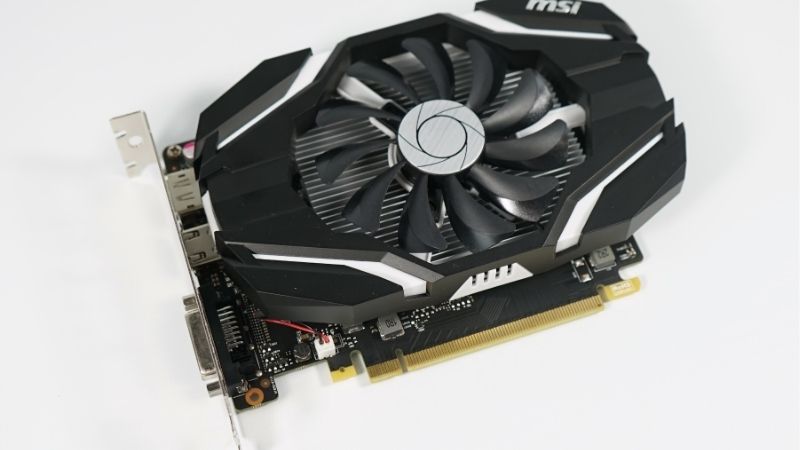
The GTX 1050 Ti’s standout feature is that most models need no separate power connector, drawing all their power from the motherboard slot. This makes it a uniquely easy upgrade for older or prebuilt PCs with weak power supplies.
For anyone upgrading a basic office PC into a light gaming machine, this is a genuine advantage. You can often drop it into a system with a modest power supply that could not handle a more demanding card.
This convenience is a big part of why the 1050 Ti stayed popular for so long. It removes the power-supply barrier that stops many casual upgraders in their tracks.
For a first-time upgrader nervous about compatibility, that simplicity is reassuring. There is no need to research power connectors or worry about overloading a basic supply, which lowers the barrier to a first taste of real gaming performance.
Core Specs and 4 GB VRAM
The GTX 1050 Ti is a Pascal-generation card with 4 GB of VRAM, aimed squarely at 1080p gaming in lighter and older titles. Its modest specs were fine at launch and remain adequate for undemanding games.
The 4 GB of memory is the key limitation today. Many modern games expect more VRAM, so while the card handles older and lighter titles well, newer releases push past what it can comfortably hold.
This is the clearest sign of the card’s age. When it launched, 4 GB was reasonable for 1080p, but modern games have grown far more memory-hungry, and that single figure now defines much of what the 1050 Ti can and cannot do.
Who It’s Still Good For
The 1050 Ti still suits specific users well: casual gamers, esports players, retro and older game enthusiasts, and anyone upgrading a weak prebuilt without touching the power supply. For these needs, it remains genuinely useful.
It is not for players who want to run the latest demanding games at high settings. Knowing which camp you fall into is the whole decision, since the card excels in its niche and struggles outside it.
The mismatch between expectation and reality is where most disappointment comes from. Buyers who understand its niche walk away happy, while those expecting it to handle the latest games are inevitably let down, so honesty about your own library is essential.
Real-World Performance Today
Setting realistic expectations is everything with an older budget card, so it helps to look honestly at what the 1050 Ti actually delivers in games now. Its performance is genuinely fine for some uses and clearly dated for others, and knowing the difference prevents disappointment.
The card has a split personality of sorts: entirely capable in one set of games and clearly overwhelmed in another. Mapping your own most-played titles onto that split is the fastest way to know whether it will satisfy you.
1080p and Esports Gaming
Where the 1050 Ti still shines is lighter 1080p gaming. Popular esports titles and older games run smoothly, often at high settings, which covers a huge swath of what many people actually play.
For competitive players focused on titles built to run on modest hardware, the card delivers a perfectly good experience. It hits playable frame rates in these games without breaking a sweat.
This is the core of its ongoing appeal. If your library is mostly esports and older games, the 1050 Ti remains a capable, low-cost option that gets the job done.
It is worth stressing just how much of modern gaming falls into this lighter category. A great many of the most-played titles are built to run on modest hardware, so for a large audience the 1050 Ti covers most of what they actually launch.
Where It Struggles
Modern, demanding games are where the card shows its age. Recent AAA titles will require low settings and still may not run smoothly, and the 4 GB of VRAM becomes a hard ceiling in games with large textures.
Ray tracing is off the table entirely, and modern upscaling standards are not supported. For anyone wanting to play the newest releases, these limitations are significant and point clearly toward a newer card.
If your wishlist includes recent AAA titles, ray tracing, or high settings, the 1050 Ti will frustrate you rather than satisfy. In that case, stretching to a newer budget card is not just better, it is necessary to play what you actually want.
Pros and Cons of the GTX 1050 Ti
The pros are its low price, no-power-connector convenience, cool and quiet operation, dependable 1080p performance in lighter games, and easy compatibility with weak systems. For its niche, it is a genuinely sensible choice.
The cons are the march of time: only 4 GB of VRAM, no ray tracing or modern upscaling, and real struggles in current demanding games. It is a card defined by its limits as much as its strengths, so it fits some buyers perfectly and disappoints others entirely, which the buying section below helps you sort out.
The key is that none of the cons are flaws so much as the natural limits of an older, low-power design. Accepting those limits up front is what turns the 1050 Ti from a disappointment into a smart, targeted purchase for the right buyer.
Buying, Value, and Alternatives
Since the 1050 Ti is an older card, buying smart in 2026 means understanding used prices and honestly weighing it against newer options. The wider market shapes that decision, so a quick look at value and alternatives helps you spend wisely.
The central question is simple: is a cheap 1050 Ti genuinely enough for you, or would a small extra spend on something newer serve you far better? Answering that honestly is worth more than any single benchmark.
Used Prices and What to Pay
The GTX 1050 Ti is discontinued, so you will find it used, usually at a low price that reflects its age. It should be genuinely cheap; paying much for one no longer makes sense given its limitations.
When buying used, favor a card from a reputable seller with clear photos and, ideally, some return protection. A well-kept 1050 Ti can serve reliably for years in its niche, but only at the right low price.
Overpaying for a 1050 Ti is the single biggest mistake to avoid, since its value rests entirely on being cheap. If a listing is priced anywhere near a newer budget card, the newer option almost always wins, so patience for a genuine bargain pays off.
The Alternative: A Modern Budget Card
Before buying a 1050 Ti, it is worth weighing a newer budget card, which brings far more VRAM, modern features, and much better performance for a modest step up in price. For anyone who plays newer games, that upgrade is often the wiser spend.
The wider market makes this worth considering. GPU prices have stabilized after the steep climb of late 2025 but have paused rather than fallen, with real supply relief from new fabs not expected until roughly 2027 to 2028. Even so, a modern budget card holds its value and capability far better over time, so compare the recommended options linked here against a cheap 1050 Ti before deciding.
The gap in real-world capability is often larger than the gap in price, which is what makes a newer card so tempting for anyone playing recent games. A little more spent now can mean years more usable life.
Should You Buy or Upgrade?
Buy a GTX 1050 Ti only if your needs are genuinely light: esports, older games, or a cheap upgrade for a weak prebuilt where its no-power-connector design is a real advantage. In those cases, at a low used price, it still makes sense.
If you want to play modern games or expect the card to last, a newer budget GPU is the smarter buy despite costing a bit more. Compare a cheap 1050 Ti against the recommended modern budget cards linked in this review to see which truly fits your games and budget.
As a simple guide, let your games decide. If everything you play already runs on modest hardware, a bargain 1050 Ti is fine; if your list includes anything demanding or recent, the extra outlay on a newer card is money well spent.
There is no shame in either choice, so long as it matches your needs. The 1050 Ti is a fine tool for a narrow job and a poor one for a broad job, and picking correctly is simply a matter of being honest about what you play.
Match the tool to the job and either path leaves you satisfied rather than second-guessing the purchase later on.
See More:
Final Verdict: Is the GeForce GTX 1050 Ti Still Worth It?
The GeForce GTX 1050 Ti remains a genuinely useful card in 2026 for a specific audience: casual and esports gamers, retro enthusiasts, and anyone upgrading a weak system where its no-power-connector convenience shines. Within that niche, at a low used price, it still earns its keep and delivers dependable 1080p gaming in lighter titles.
Outside that niche, though, its 4 GB of VRAM and lack of modern features leave it struggling with current games, and a newer budget card is the wiser long-term buy. With prices stable rather than falling, weigh a cheap 1050 Ti honestly against something newer. Compare the recommended budget GeForce cards linked throughout this review to decide whether to grab a bargain 1050 Ti or step up to a card built for today’s games.
Frequently Asked Questions
Is the GTX 1050 Ti still usable in 2026?
It remains fine for esports and older titles, handling CS2, League of Legends, Rocket League and Valorant at 1080p with medium settings. Modern AAA releases are out of reach because of the 4GB frame buffer and Pascal-era shader throughput, and many new games now list hardware requirements it cannot meet.
Does it need a PCIe power connector?
Most GTX 1050 Ti models draw under 75W entirely from the PCIe slot, so they need no supplementary connector at all. That makes the card a popular rescue option for prebuilt office machines with weak 300W power supplies, though a few factory overclocked versions did add a single 6-pin.
Does it still get driver updates?
NVIDIA has moved Maxwell, Pascal and Volta cards to a legacy branch, so the 1050 Ti no longer receives new Game Ready optimizations. Security and critical fixes continue for a limited period, which means the card stays stable in Windows but will not gain performance in newly released games.
Can it do ray tracing or DLSS?
No. Pascal has no RT cores or Tensor cores, so hardware ray tracing and DLSS are unavailable. Some games expose a software ray tracing fallback that runs far too slowly to be playable. You can use FSR or Intel XeSS in their compatibility modes, which help modestly at 1080p.
What should I upgrade to instead?
If your budget is tight, a used RTX 2060 or GTX 1660 Super roughly doubles performance and adds 6GB of VRAM. New buyers should look at an RTX 5060 or Intel Arc B580, but check that your power supply has a spare 8-pin connector and enough wattage headroom first.


Write Your Review
No reviews yet. Be the first to share your experience!