
- Top Pick: ASRock Intel Arc B570 Challenger 10GB OC GDDR6 Graphics Card, 2600 MHz GPU, 19 Gbps Memory, Dual Fan, Metal Backplate, HDMI 2.1a, DisplayPort 2.1, 0dB Cooling
- Best Value: ASRock Intel Arc A580 Challenger 8GB OC Graphics Card, Intel Xe HPG Architecture, 8GB GDDR6, PCIe 4.0, Dual Fans, 0dB Silent Cooling, DisplayPort 2.0
- Premium Choice: ASRock Intel Arc B570 Challenger 10GB OC & PRO-650G 650W 80+ Gold PSU | Smart 1440p Gaming Performance Bundle
intel arc b570 is Intel’s most affordable entry into its current graphics generation, bringing modern Battlemage technology and a healthy 10GB of memory to the tightest budgets. Positioned just below the well-received B580, it aims to deliver strong 1080p gaming for as little money as possible, making current-generation features accessible to first-time builders and cost-conscious upgraders. This review covers what the B570 offers, how it performs, and what owners praise and criticize, so you can decide whether it is the cheapest smart way into modern PC gaming.
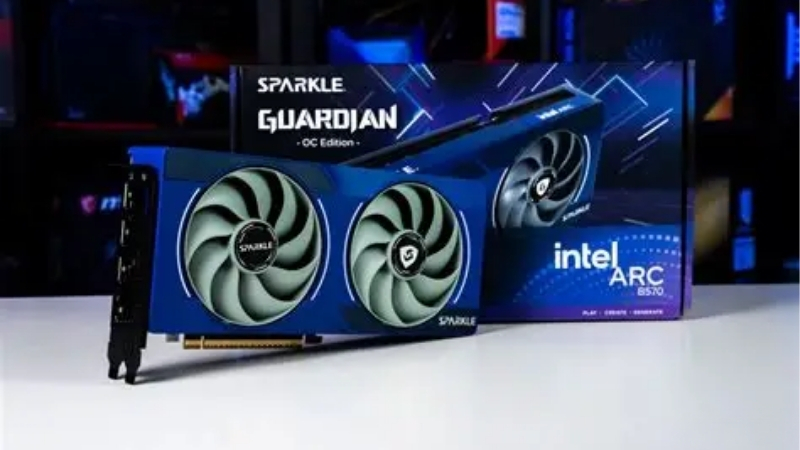
What the Intel Arc B570 Is
The Intel Arc B570 is a budget graphics card built on Intel’s Battlemage architecture, positioned as the more affordable sibling to the B580. It trims price and specifications slightly while keeping the modern feature set, targeting pure 1080p gamers who want current-generation technology on a strict budget. Understanding its core specifications, its efficiency, and its intended audience is the key to judging where it fits against both its sibling and the wider budget market.
As an Amazon Associate we earn from qualifying purchases at no extra cost to you.






A 10GB Battlemage Budget Card
The B570 pairs the Battlemage architecture with 10GB of GDDR6 memory on a 160-bit bus, less than the B580 but still comfortably ahead of the 8GB found on many budget rivals, which helps it avoid texture-related stutter.
At roughly $219, it undercuts the B580 while retaining the same generation’s core capabilities, including XeSS upscaling and respectable ray-tracing support for its class.
For a strict 1080p gamer, that combination of a current-generation feature set and a healthy memory buffer at the lowest possible price is exactly the point of the B570.
The 10GB buffer is the detail that separates the B570 from the cheapest cards on the market. Many budget rivals still ship with 8GB, which is increasingly tight even at 1080p in the newest, most demanding titles. By offering 10GB, the B570 gives itself a small but meaningful safety margin, helping it avoid the texture stutter that can plague 8GB cards and extending how long it stays comfortable as games grow heavier.
Key Specs and Efficiency
Beyond its memory, the B570 draws less power than the B580, around 150W, making it an easy fit for smaller builds and modest power supplies where efficiency matters and every watt counts.
It retains native XeSS support, so budget gamers can boost frame rates with a quality upscaler running on Arc’s dedicated hardware, and it handles light ray tracing better than many cards at its price.
The lower power and cost, combined with modern features, make the B570 a sensible foundation for an affordable, compact gaming PC that still runs current games well.
That efficiency also has knock-on benefits beyond the power bill, since a lower-power card runs cooler and quieter and places less strain on the rest of the system. For a small-form-factor or budget build with limited airflow, those characteristics make the B570 an easy component to work with.
Who the B570 Is For
The B570 targets budget-focused 1080p gamers, first-time builders, and anyone assembling an affordable system who wants current-generation technology without stretching to the B580’s price.
It suits players whose games are primarily competitive esports titles and mainstream releases at 1080p, where its performance and 10GB buffer are more than sufficient for a smooth experience.
As with all Arc cards, it requires Resizable BAR enabled to perform its best, so it is best paired with a reasonably modern platform to realize its full potential.
The B570 is also a natural fit for pre-built upgrades and budget office-to-gaming conversions, where its low power draw means it can often drop into an existing system without a new power supply. For someone turning a basic desktop into a capable 1080p gaming machine as cheaply as possible, that combination of low cost and modest power requirements makes the B570 an especially practical choice.
Real-World Performance and User Impressions
Specifications only tell part of the story, so a fair review blends measured performance with what owners report after using the card. Combining the enthusiastic 4-5 star feedback with the more critical 2-3 star reviews gives a balanced picture of where the B570 delivers value and where its limits show. Here is the consistent pattern from both the data and the community.
1080p Performance and XeSS
At its target resolution of 1080p, the B570 runs modern games smoothly on sensible settings and comfortably powers high-refresh esports titles, which is exactly what its audience needs.
XeSS support lets it stretch further in demanding games, boosting frame rates while maintaining good image quality on Arc’s dedicated hardware, which is a meaningful advantage over budget cards lacking a strong upscaler.
The analytical point is that for pure 1080p gaming, the B570 delivers most of what the pricier B580 offers, making it a smart choice for gamers who do not need 1440p headroom.
How you weigh that depends on your monitor and ambitions. If you game on a 1080p display and have no plans to move up, the B570 captures the great majority of the B580’s real-world experience for less money, which is a genuinely sensible saving. If there is any chance you will move to a 1440p monitor or keep the card for many years, the B580’s extra memory and performance make its small premium the wiser long-term investment.
What 4-5 Star Users Praise
Positive owners praise the value above all, appreciating current-generation features and a 10GB buffer at a rock-bottom price. For first-time builders, it is frequently described as an ideal entry point.
They also value the efficiency, noting that the lower power draw makes it easy to fit into modest systems without upgrading the power supply, which keeps overall build costs down.
The XeSS support and modern feature set earn praise for making the B570 feel like a genuine current-generation card rather than a stripped-back budget compromise.
First-time builders in particular express relief at getting a capable, modern card without blowing their budget, noting that the B570 leaves room in their build for a better CPU, more storage, or a nicer monitor. That balance, spending just enough on graphics to play current games well while directing savings elsewhere, is exactly what many entry-level builders are looking for, and it is a consistent thread in the card’s most positive feedback.
Common Complaints from 2-3 Star Reviews
The most common criticism is that the step down from the B580 is noticeable in the most demanding scenarios, so buyers who want 1440p headroom or maximum longevity often feel the B580 is worth the small extra cost.
As with all Arc cards, the Resizable BAR requirement frustrates users on older platforms, where the card can underperform until the setting is enabled or if the system does not support it well.
A minority also cite the familiar caution about Intel’s drivers and occasional older-game quirks, though the experience has improved substantially and continues to get better through updates.
As with the B580, these criticisms are best understood as caveats rather than dealbreakers. The Resizable BAR requirement is a one-time BIOS setting on any modern board, and the driver concerns have shrunk considerably from Arc’s early days. For the B570’s target buyer, a budget-conscious 1080p gamer on a reasonably current system, the practical impact of these issues is minor next to the card’s compelling price and feature set.
Value, Comparison, and Buying Advice
A budget card is judged on value, so it must be weighed against its sibling, its rivals, and the current market. This section compares the B570 with the B580 and competing cards, lays out the pros and cons, and frames the decision within 2026’s GPU pricing so your timing is sound in an unpredictable market.
B570 vs B580 and Rivals
Against the B580, the B570 trades some memory, bandwidth, and performance for a lower price, making it the smarter buy for pure 1080p gamers who do not need the extra headroom the B580 provides.
Against budget rivals from AMD and Nvidia, the B570 competes on price and memory, typically offering more VRAM than 8GB competitors while those rivals counter with more mature drivers or broader upscaling support.
The practical verdict is to choose the B570 for the cheapest current-generation 1080p experience, step up to the B580 if you want 1440p headroom, and weigh rivals based on whether driver maturity matters more to you than raw value.
One tip worth remembering is to watch the real-world price gap between the two Battlemage cards rather than their launch prices. When the B580 is on sale and the difference to the B570 shrinks, the extra memory and performance can make the B580 the better value even for a strict 1080p buyer. When the gap is at its widest, the B570’s lower cost is the more compelling proposition, so let the current pricing guide the final call.
Pros and Cons of the Arc B570
Here is the balanced summary drawn from the evidence and owner feedback.
Pros: excellent value, a healthy 10GB of VRAM, low power draw, native XeSS support, and current-generation features at a budget price. Cons: a noticeable step below the B580 in demanding scenarios, requires Resizable BAR, and Intel’s drivers remain younger than rivals’.
Because the B570’s whole appeal is value, if it fits your needs, checking current pricing through the link on this page is the logical next step before prices or stock change.
Is the B570 Worth Buying in 2026?
The B570’s budget appeal intersects with 2026’s market. Following the sharp increases at the end of 2025, graphics-card pricing has flattened into a steadier period, but flat is not the same as falling, and some volatility remains in the market.
Additional memory supply is on the way, with OEMs able to source DDR5 from suppliers such as CXMT and Micron building two Idaho plants, yet that capacity will not run until 2027–2028, so real relief stays years away.
For a budget buyer, waiting through 2026 for a big drop is a weak plan given that timeline. If the B570 fits your budget today, check its current price through the link on this page and buy while the market holds steady.
See More:
Conclusion
The verdict on the intel arc b570 is that it is the cheapest smart way into modern PC gaming, bringing current-generation Battlemage technology, a healthy 10GB buffer, and native XeSS to the tightest budgets while keeping power draw low. It is ideal for pure 1080p gamers and first-time builders who do not need the B580’s extra headroom, with the familiar caveats of the Resizable BAR requirement and Intel’s still-maturing drivers. For cost-conscious buyers, it is a genuinely appealing entry point — and with prices only holding steady rather than dropping, there is little reason to wait. Use the link above to compare live pricing on the Arc B570 and secure yours today.
Top-Rated Picks


| Product | Brand | Rating | Reviews | Price |
|---|---|---|---|---|
| ARCTIC MX-4 (4 g) – Premium Performance Thermal Paste… | ARCTIC | ★ 4.8 | 104k | $4.99 |
| ARCTIC MX-4 (incl. Spatula, 4 g) – Premium Performanc… | ARCTIC | ★ 4.8 | 71.9k | $5.49 |
| Crucial 8GB DDR4 RAM 3200MHz (PC4-25600), Downclockab… | Crucial | ★ 4.8 | 62.8k | $74.99 |
| AMD Ryzen 5 5600X 6-core, 12-thread unlocked desktop … | — | ★ 4.8 | 30.2k | $177.60 |
| NVIDIA Shield Remote; Voice Search, Motion-Activated,… | — | ★ 4.7 | 10.6k | $25.99 |
Frequently Asked Questions
What are the B570 specifications and how does it differ from the B580?
The B570 uses 18 Xe2 cores against 20 on the B580, carries 10GB of GDDR6 on a 160-bit bus instead of 12GB on 192-bit, and drops total board power from 190W to 150W. Real-world performance typically lands 8 to 12 percent behind the B580, for roughly 12 percent less money.
What power supply does the B570 need?
At 150W the B570 is one of the easiest modern cards to power. Reference designs use a single 8-pin PCIe connector, and Intel suggests a 550W supply. A good quality 450W to 500W unit will run it fine in a build with a mainstream six core CPU and a couple of SSDs.
Is 10GB of VRAM enough for 1080p gaming in 2026?
Yes for the resolution this card targets. Demanding titles with ray tracing and high texture packs can push past 8GB at 1080p, which is exactly where 8GB competitors start dropping frames. The extra 2GB gives the B570 headroom for ultra textures, which cost almost nothing in performance but noticeably improve image quality.
Will the B570 bottleneck on an older CPU?
It can. Intel drivers carry more processor overhead than Nvidia or AMD equivalents, so a Ryzen 5 1600 or Core i5-8400 will hold the card back at 1080p far more than it would hold back an RTX 4060. Pair it with a Ryzen 5 5600 or newer for full performance.
Does it fit in small form factor cases?
Most B570 partner cards are dual-fan, dual-slot designs between 200mm and 250mm long, so they clear the majority of mini tower and mATX cases. Check clearance against front radiators, and note that the low 150W draw means very little heat dumped inside a compact chassis compared with rival cards.



Write Your Review
No reviews yet. Be the first to share your experience!