
Top Nvidia Rtx 2060 Super Still Picks for 2026
Here are our current top nvidia rtx 2060 super still picks, compared on real Amazon owner reviews, price, and features. Live prices update below.


Dropped $25.00

Nvidia RTX 2060 Super is a 2019 graphics card being seriously shopped in 2026, and that sentence alone justifies a fresh review. Launched at $399 as Turing’s value correction, it gave the mainstream its first taste of ray tracing hardware and DLSS — and seven years later it trades hands at $120 to $140, making it the cheapest entry into Nvidia’s RTX feature ecosystem that still functions as a gaming card. The questions a 2026 buyer needs answered are different from a 2019 reviewer’s: what does it actually run today, how long will drivers keep coming, what do years of owner reports say, and who — exactly — should spend their money here instead of one tier up. This review answers all four.
As an Amazon Associate we earn from qualifying purchases at no extra cost to you. Product prices and availability are accurate as of the date shown and are subject to change.


What the RTX 2060 Super Is in 2026
Time has reframed every line of this card’s spec sheet: numbers that read mid-range in 2019 now read entry-level, while one of them — the memory capacity — aged better than the card around it. Start with the hardware reality, then what it delivers on a modern monitor.
Specifications, Reframed by Seven Years
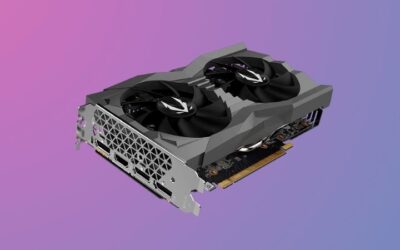
The card carries 2,176 Turing CUDA cores at a 1.65 GHz boost, 8GB of GDDR6 on a 256-bit bus delivering 448 GB/s, and a 175W board power fed by a single 8-pin connector. First-generation RT and Tensor cores round out the package — the very silicon that introduced hardware ray tracing and DLSS to the mainstream.
The 2026 translation: compute sits below every current-generation card including the $299 RTX 5060, but the 8GB allocation — generous for 2019 — keeps it ahead of where its raw power would otherwise place it, and that single 8-pin plus 175W draw means it drops into virtually any PC built in the last decade without a power supply conversation. Its spec sheet is entry-level; its compatibility is universal.
Real 1080p Performance Today
Measured against the games people actually play, the card splits cleanly. Esports staples run beautifully: well past 144 fps at 1080p competitive settings in the titles that fill most play hours, making it a legitimate partner for a high-refresh budget monitor.
Demanding 2024-2026 AAA releases tell the harder truth: 50 to 75 fps at 1080p high settings, with the newest engines pushing it toward medium presets to hold 60. DLSS Super Resolution — which Turing receives in its modern transformer form via drivers — is the card’s fountain of youth, routinely buying back 25 to 40 percent of frame rate in supported titles. Ray tracing, ironically the card’s launch headline, is best treated as a checkbox: first-generation RT cores make playable ray-traced settings a memory rather than a feature.
Driver Support: The Clock That Matters
The most 2026-specific line in this review: Turing remains on Nvidia’s supported list and still receives Game Ready drivers, but it is the oldest architecture in the rotation, and the industry pattern is unambiguous — architectures move to legacy status eventually, ending new-game optimization while security updates continue for a period.
Buyers should price that horizon in: a card purchased today likely sees its optimization era close within the ownership window. Existing titles will keep working fine for years — legacy status is not a kill switch — but day-one polish for new releases will belong to newer silicon. At $130, that trade is honest; it simply deserves stating plainly.
Owner Verdict: Seven Years of Reports, Synthesized
Few cards have a longer or more candid paper trail. The pattern across enthusiastic long-term owners and frustrated recent buyers alike is consistent enough to summarize as a verdict in three parts.
What Owners Consistently Praise
The five-star sentiment is about endurance: owners describe seven years of service without drama, fan bearings and thermals holding up better than the era’s premium cards, and DLSS extending relevance far past the silicon’s natural span. “It just keeps working” is the recurring phrase, and for a $399 purchase amortized across seven years, the value reports border on affectionate.
The second praise cluster is the ecosystem: RTX Video Super Resolution sharpening streams, stable drivers, and broadcast features arriving by software to a card that predates most of them. Budget buyers repeatedly note that the features, more than the frames, separate it from same-priced alternatives.
The Honest Complaints
The critical reports cluster predictably. Recent buyers expecting modern AAA performance at high settings register disappointment that a seven-year-old card cannot deliver — accurate, if predictable. Ray tracing draws the most pointed criticism: the launch feature that never quite worked at playable frame rates and certainly does not now.
The used-market complaints are structural rather than model-specific: cards this old arrive with aging thermal paste, tired fans on worn bearings, and zero warranty — and a meaningful share of listings ran mining duty in 2020-2021. Every negative pattern in the threads traces to age or seller, almost never to design, which is itself a quiet compliment to the hardware.
Pros and Cons of the RTX 2060 Super in 2026
Pros: the cheapest functional entry to RTX features at $120-140; genuine high-refresh esports performance at 1080p; 8GB aged far better than the era’s 6GB cards; single 8-pin, 175W universal compatibility; seven-year reliability record; modern DLSS upscaling via current drivers.
Cons: demanding new titles require settings management; ray tracing is nominal; driver optimization horizon is finite and approaching; used units carry age-related wear and mining-era risk; no warranty anywhere on this market.
The balance: an excellent purchase for a narrow, well-defined buyer — and a frustrating one for anyone shopping it as a shortcut to modern AAA gaming.
Who Should Buy One — and Exactly How
A seven-year-old card rewards precision in both the buyer profile and the buying process. This section supplies both, plus the alternatives that referee any listing priced too ambitiously.
The Right Buyers for This Card
Three profiles fit cleanly: the esports-focused budget build, where its 144-plus fps in competitive titles is everything the machine needs; the first PC for a young gamer, where $130 buys the full Nvidia ecosystem with stakes low enough for a used card; and the stopgap slot — a machine bridging six to eighteen months toward a real upgrade while prices are navigated.
The wrong buyer is equally clear: anyone whose library leans on current AAA releases at high settings, for whom the honest answer is saving toward the $299 RTX 5060 rather than buying disappointment at $130.
How to Buy a Seven-Year-Old GPU Safely
Process is protection at this age. Cap spending at $140 — listings above it are priced against the wrong decade — and insist on a return window, which makes Amazon Renewed-style listings worth their premium over private sales. Stress test the first week: thirty minutes of load while watching temperatures and listening to fans tells you most of what seven years did to the unit.
Inspect photos for bent fins, missing brackets, and connector condition, and ask directly about mining history; the tone of the answer is data even when the content is not. Budget $10 for thermal paste if temperatures run warm — a twenty-minute refresh that routinely restores these cards to launch behavior.
The Alternatives That Frame the Price
Two cards referee every 2060 Super listing. The used RTX 3060 12GB at $180-200 brings 50 percent more memory and a generation of efficiency for $60 more — the upgrade most shoppers at this tier should actually make. And the new RTX 5060 at $299 resets the whole conversation: current architecture, DLSS 4 Multi Frame Generation, warranty, and roughly double the performance.
The honest framing: the 2060 Super wins only when the budget is genuinely capped near $130, and both alternatives sit one decision away on Amazon — price them before committing to the veteran.
The 2026 Market: Why Even Veteran Cards Stopped Getting Cheaper
A 2019 card holding a firm price floor in 2026 is market commentary in itself, and two current industry forces explain it — along with what they mean for anyone timing a budget purchase.
The H200 China Approval Reaches the Bottom Shelf
The United States has approved Nvidia selling the H200 — one of its most powerful AI accelerators — to China, releasing data-center demand that tightens GeForce supply from the flagship down. The squeeze cascades tier by tier: new budget cards hold MSRP or drift above it, pushing overflow demand into used listings, where even Turing-era veterans inherit a bid that should not exist for seven-year-old silicon.
The 2060 Super’s flat $120-140 band across recent quarters — where normal cycles would have eroded it toward $100 — is this cascade reaching its final shelf.
Rising Component Prices and the Budget Buyer’s Clock
Simultaneously, laptop and PC component prices are climbing industry-wide, led by memory costs that hit budget hardware proportionally hardest. The traditional strategy of waiting for the tier below to get cheaper has quietly stopped working at every level, and the entry tier feels it first and most.
For this review’s readers the conclusion is practical: if the $130 veteran fits your profile, buy it now rather than betting on a slide the market has stopped delivering — and if your budget can stretch to the alternatives, stretch sooner rather than later, because their prices share the same upward pressure. Amazon alerts on all three cards turn the decision into a trigger rather than a vigil.
The Timing Bottom Line
At this tier, readiness is the discount: morning restock checks, saved payment details, and a firm ceiling beat any amount of patient waiting in the current market.
Decide the profile, set the alert, act on the first clean listing inside your band.
See More:
Conclusion
The Nvidia RTX 2060 Super earns a conditional but genuine 2026 recommendation: at $120 to $140 with a return window, it remains the cheapest working ticket into Nvidia’s RTX ecosystem — a high-refresh esports performer, a sensible first-PC card, and an honest stopgap, sustained by 8GB of well-aged memory and modern DLSS delivered to seven-year-old silicon. Its limits are equally honest: managed settings in new AAA titles, nominal ray tracing, and a driver-optimization horizon that is visible from here. Buy it for what it is, through listings with recourse, at prices that respect its age. And if your needs outgrow that description even slightly, the Nvidia RTX 2060 Super’s own alternatives — one click away on Amazon — are where your money belongs instead.
Frequently Asked Questions
What is the best nvidia rtx 2060 super in 2026?
The best nvidia rtx 2060 super depends on your budget and how you plan to use it. The options compared above are our top-rated picks based on real customer ratings, build quality, and overall value — start with the highest-rated model that fits your budget.
How much should I expect to spend on a nvidia rtx 2060 super?
Prices vary by brand and features. Budget options cover the essentials, while mid-range and premium models add durability, performance, and extra features. Compare the prices in the list above to find the best value for your needs.
What should I look for when buying a nvidia rtx 2060 super?
Focus on what matters most for your use case — build quality, compatibility, performance, warranty, and verified customer reviews. Every pick above is selected to balance these factors.
Are budget nvidia rtx 2060 super options worth it?
Yes. For most people a well-reviewed budget or mid-range nvidia rtx 2060 super delivers excellent value. You only need to spend more if you specifically require premium materials or top-tier performance.
How did we choose these nvidia rtx 2060 super picks?
We compare current Amazon ratings, review counts, key features, and price to surface the options with the best real-world value. The list is refreshed as ratings and availability change.


Write Your Review
No reviews yet. Be the first to share your experience!