
Nvidia Omniverse GitHub is a sprawling organisation with dozens of repositories, several of which are archived, a few of which moved somewhere else entirely, and no obvious front door telling you which one you need. If you landed here, you want a map: which repo to clone, what it actually does, what will break during the build, and what hardware it needs. This page is that map — repo names, clone commands, and the driver version requirement that silently causes half the setup failures.
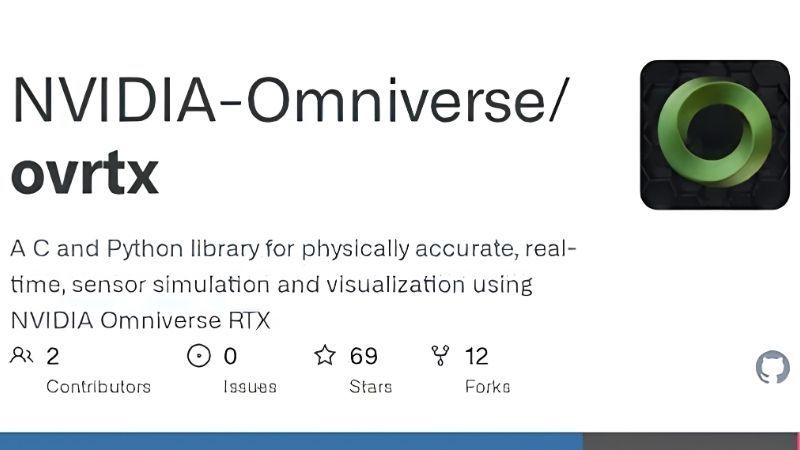
The Nvidia Omniverse GitHub Landscape
The organisation lives at github.com/NVIDIA-Omniverse and holds the open parts of the platform: templates, samples, tutorials and SDK bindings. What it does not hold is the platform itself. The Kit SDK is downloaded as a dependency during build, not cloned — which trips up people expecting a monolithic repo they can read.
The Repositories Worth Bookmarking
| Repository | What it is | Language |
|---|---|---|
| kit-app-template | The main entry point. Scaffolds Kit-based apps and extensions | Python / C++ |
| connect-samples | Connect SDK samples for correct USD authoring | C++ / Python |
| USD-Tutorials-And-Examples | OpenUSD learning material — start here if USD is new to you | Python |
| usd-plugin-samples | USD schema extension samples plus build tooling | C++ / Python |
| OpenUSD | Nvidia’s fork of Pixar’s OpenUSD | C++ |
| kit-extension-template-cpp | C++ extension template, Apache 2.0 | C++ |
| web-viewer-sample | Front-end client for a streamed Kit app, with messaging | TypeScript |
| content-agents | VLM-powered agents automating 3D content workflows, Apache 2.0 | Python |
| kit-app-template-launchable | Brev Launchable — runs the whole thing in a browser | Docker |
If you only take one thing from this table: kit-app-template is the repo you want. It is the most actively maintained in the organisation and it is the scaffold everything else assumes you have used. Roughly a thousand stars, several hundred forks, and commits landing regularly.
The second most useful for newcomers is USD-Tutorials-And-Examples. Omniverse is OpenUSD underneath, and developers who skip USD fundamentals spend their first fortnight confused about why scene composition behaves the way it does.
The Agent Skills Nobody Has Noticed Yet
The most interesting recent addition is not a template at all. Omniverse now publishes a set of development assistant skills — semantic search across 400+ Kit extensions, dependency graphs, API docs and code examples, plus separate assistants for OpenUSD and OmniUI covering class browsing, method signatures and examples.
These are distributed as plugins in the Claude Code and Codex marketplaces, and through Vercel’s Skill Marketplace under its Physical AI section. There is also an Nvidia Agent Skills catalog spanning the wider ecosystem.
This matters more than it sounds. The single hardest thing about Kit development has always been discovery — knowing which of the 400+ extensions does the thing you need. A semantic search tool over that surface is the closest thing to a solution the platform has ever shipped, and almost nobody is talking about it.
What Is Archived or Has Moved
This is where people waste an afternoon. Several repositories in the organisation are public archives rather than live projects — the Isaac Sim Dockerfiles repo, for instance, is archived despite still carrying over a hundred stars, which makes it look active in search results.
The general rule: robotics simulation has been migrating out of the Omniverse organisation into its own Isaac homes. If you arrived here looking for Isaac Sim or Isaac Lab, you are in the wrong org, and following the tutorials you find here will send you down a path that no longer exists.
Check the archived banner and the last-commit date before cloning anything. A repo untouched for a year in this ecosystem is not stable — it is abandoned.
Getting a Repo Actually Running
The setup is more straightforward than the repository sprawl suggests, provided you clear one prerequisite that the README mentions once and that causes most failures.
Prerequisites and the Driver Trap
Before anything else, check your driver. kit-app-template requires 550.54.15 or newer on Linux, 551.78 or newer on Windows. Newer versions generally work but are not equally validated. If your driver is older, the build completes and the app fails at launch with an error that does not mention drivers at all.
You also need Git, internet access for the SDK download, and on Windows for C++ work, Visual Studio 2019 or 2022 with the Desktop development with C++ workload selected. Not the workload’s default subset — the full workload.
One quirk worth knowing: the tooling now checks for whitespace in paths and for OneDrive paths, because both used to cause failures that were nearly impossible to diagnose. Clone to something like C:\dev\ rather than a Documents folder synced to the cloud.
Cloning and Creating Your First App
The whole flow is three commands and an interactive wizard:
git clone https://github.com/NVIDIA-Omniverse/kit-app-template.git
cd kit-app-template

# Windows
.\repo.bat template new

# Linux
./repo.sh template new
The wizard asks what you want to create and which template to use. The application templates are worth knowing before you pick:
- Kit Base Editor — minimal app for loading and rendering OpenUSD through a GUI. Start here.
- USD Composer — authoring complex scenes, e.g. configurators
- USD Explorer — exploring and collaborating on large scenes
- USD Viewer — viewport-only, built to be streamed to a web page
- Kit Service — headless service, no GUI
Extension templates cover Basic Python, Basic C++ and C++ With Python. Then build and launch:
./repo.sh build
./repo.sh launch
For CI or scripted setups, record the wizard answers with --generate-playback and replay them later with template replay — this is the part most people miss and then reconstruct by hand.
Common Build Failures
Three account for most of it. First, the driver version above — check it before debugging anything else. Second, path problems: whitespace or a OneDrive-synced directory. The tooling warns about these now, but only if you read the output.
Third, and the one that generates the most confused forum posts: you cloned a branch rather than a tag and got a Feature Branch of the Kit SDK. Feature Branches update frequently and suit prototyping. For production work you want the Production Branch of the Kit SDK from NGC, which is a different distribution channel entirely — not something you get by cloning harder.
Pros and Cons of the Omniverse GitHub Route
Going through GitHub rather than a packaged installer is the right call for developers, but it is not friction-free and the trade-offs are worth naming before you commit a week to it.
What the Open Repos Do Well
The template tooling is genuinely good. template new produces a working, buildable application in about five minutes, which for a platform this large is unusual. The modify command lets you add template layers to an existing app after the fact rather than starting over — a change that arrived in 107.3 and quietly removed a common source of restarts.
The containerisation path is also solid. package_container builds a deployable image on a configurable base — the default is Nvidia’s ov-base-ubuntu-22 — with runtime configuration through environment variables. If you are heading toward Kubernetes or cloud streaming, that path is well-trodden rather than improvised.
And the licensing on the newer repos is reasonable. Several, including the C++ extension template and content-agents, are Apache 2.0.
Where They Frustrate People
Discovery is the main complaint and it is legitimate. Dozens of repos, no clear hierarchy, archived projects that look alive in search results, and robotics content that has quietly relocated. Newcomers routinely clone the wrong thing.
The second frustration is that the platform is not really open source. The repos are templates and samples; the Kit SDK itself is downloaded as a binary dependency under Nvidia’s licence terms, and the SDK collects anonymous usage data by default. If you expected to read the engine source, you cannot.
Third: streaming configuration is a maze. There is Kit App Streaming, NVCF, legacy OVC streaming, and DGX Cloud — and standard streaming configurations are not DGX Cloud compatible. Deploying to DGXC requires an NVCF-compatible streaming layer specifically. Pick your target before you scaffold, not after.
Pros and Cons Summary
| Pros | Cons |
|---|---|
| template new gives a working app in ~5 minutes | Repo sprawl with archived projects that look current |
| Agent Skills give semantic search over 400+ extensions | Kit SDK is a binary dependency, not open source |
| template modify adds layers without starting over | Streaming configs are a maze; DGXC needs NVCF specifically |
| Container packaging path is mature | Driver requirement fails silently and confusingly |
| Apache 2.0 on several newer repos | Robotics content has moved out of the org |
Net: excellent if you know which repo you need, genuinely disorienting if you do not. Which is what the table at the top of this page is for.
The Hardware Underneath
Omniverse is RTX-native, and the GPU requirements are stated vaguely in the docs in a way that costs people real time. Here is the practical version.
The GPU Requirements Nobody Lists Clearly
You need an RTX card. Not “recommended” — the RTX renderer requires RT cores, and Omniverse on a GTX card is not a degraded experience, it is a non-starter. Anything from Turing onward qualifies architecturally.
But architectural support and usable performance are different things. In practice, an RTX 3060 with 12GB is the honest floor for learning and small scenes. Below that, you will spend your time waiting rather than developing.
VRAM Is the Real Ceiling
Once you clear the RTX requirement, memory becomes the constraint and stays there. USD scenes are memory-hungry in a way that surprises people coming from game engines — the composition model holds a great deal in flight.
Rough guidance: 12GB handles tutorials and modest scenes. 16GB is where a real configurator project stops fighting you. 24GB or more is where you can load a substantial industrial scene without babysitting it. If you are getting out-of-memory errors during scene load rather than during render, that is the hardware telling you the answer, and no amount of build configuration will change it.
Where to Actually Run It
Three options, in ascending order of commitment. The Brev Launchable is the fastest — kit-app-template-launchable runs the entire environment in a browser, VS Code in one tab and the streamed UI in another, on cloud hardware. For evaluating whether Omniverse suits your project at all, this beats spending anything.
Local development on an RTX workstation is the normal path once you are committed, and it is where the VRAM guidance above applies. Cloud streaming through Kit App Streaming or NVCF is the deployment answer, not the development one.
If your current card is below the 12GB line and you are serious about Kit development, that is worth resolving before you lose another week to out-of-memory errors — compare what 16GB cards cost now against the time you are spending working around 8.
See More:
- GTX 1650 vs RTX 3050
- Nvidia DIGITS
- Nvidia cuDNN
- Radeon RX 9070 XT vs RTX 5090
- PNY GeForce RTX 5080 review
Conclusion: Navigating the Nvidia Omniverse GitHub
The Nvidia Omniverse GitHub organisation is less intimidating once you know that one repository matters more than the rest. Clone kit-app-template, check your driver is at least 550.54.15 on Linux or 551.78 on Windows, run template new, pick Kit Base Editor, and you have a working application inside ten minutes. Everything else in the org is a sample, a tutorial or a specialisation of that.
Three things to carry away. Check the archived banner and last-commit date before cloning anything, because search results do not distinguish live projects from abandoned ones. Look at the Agent Skills — semantic search across 400+ extensions solves the discovery problem that has always been Kit development’s worst feature. And remember that this is RTX-only with 12GB as a realistic floor. Bookmark the repo table above; it is the map the organisation itself does not provide.
Frequently Asked Questions
Which Omniverse repositories should I start with?
The NVIDIA-Omniverse organisation hosts the practical starting points: the Kit App Template for building your own Omniverse application, the extension samples for learning the extension system, PhysX and Warp for simulation, and the USD based asset and connector samples. Isaac Sim and Isaac Lab live alongside them for robotics work.
What hardware do I need to run Omniverse samples?
An RTX GPU is effectively mandatory because RTX renderer paths depend on hardware ray tracing. NVIDIA lists an RTX 3070 or better with 8GB as a practical minimum, 16GB or more of VRAM for large USD scenes, 32GB of system memory and an NVMe drive. GTX cards and integrated graphics are not supported.
Is Omniverse free to use?
Individual use of Omniverse applications and the Kit SDK is free, and the code in these repositories is published under permissive licences, most commonly Apache 2.0. Enterprise deployment with support, multi-user Nucleus servers and commercial connectors is where paid licensing applies, so check each repository LICENSE file before shipping anything.
How do I set up a development environment?
Clone the Kit App Template, run the repo build script for your platform, then launch the generated application. On Windows you need Visual Studio build tools and a current driver; on Linux you need a recent glibc and the same driver requirement. Extensions are Python, so an editable extension folder plus hot reload is the fastest iteration loop.
What is the relationship between Omniverse and OpenUSD?
OpenUSD, originally from Pixar, is the scene description format and the reason Omniverse can interchange data between DCC tools. Omniverse adds the RTX renderer, PhysX, a collaboration layer and the Kit application framework on top. Learning USD composition, layers and references pays off far more than learning any single Omniverse app.
As an Amazon Associate we earn from qualifying purchases at no extra cost to you.




Write Your Review
No reviews yet. Be the first to share your experience!