
- Top Pick: ASRock Intel Arc A770 Phantom Gaming 16GB OC Graphics Card, 2200 MHz GPU Clock, 16GB GDDR6, DisplayPort 2.0, HDMI 2.1, Triple Fan Cooling, Polychrome SYNC
- Best Value: ASRock Challenger SE Intel Arc A770 OC 16GB GDDR6 Graphics Card – 2150 MHz, Dual Fan, 0dB Silent Cooling, Metal Backplate, 3X DP 2.0, HDMI 2.0b
- Premium Choice: ASRock Intel Arc B580 Challenger 12GB OC Graphics Card, 2740 MHz GPU Clock, 12GB GDDR6, DisplayPort 2.1, HDMI 2.1a, Dual Fan Cooling, 0dB Silent Operation
intel arc a770 was Intel’s first-generation flagship, and years of driver improvements plus steep price cuts have turned it into one of the more interesting value cards you can still buy in 2026. Its standout feature is a generous 16GB of memory, unusual at its price, backed by capable ray tracing and Intel’s XeSS upscaler. This review examines what the A770 offers today, how it performs after all those driver updates, and what owners genuinely praise and criticize, so you can decide whether the 16GB Alchemist flagship still deserves a spot in your build.
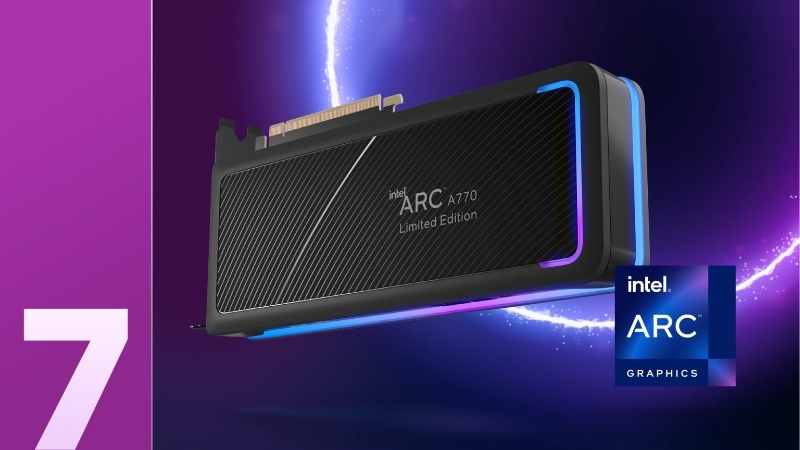
What the Intel Arc A770 Is
The Intel Arc A770 is the flagship of Intel’s first-generation Alchemist graphics lineup, built around a wide memory interface and a large frame buffer. It was designed to compete in the mainstream market with generous memory, capable ray tracing, and modern media features. Understanding its core specifications, its standout memory and encoding capabilities, and who it is really for today lays the groundwork for judging its value in a market where it now sells at a discount.
As an Amazon Associate we earn from qualifying purchases at no extra cost to you.


The 16GB Alchemist Flagship
The A770’s defining feature is its 16GB of GDDR6 memory on a wide 256-bit bus, a combination that gives it far more capacity and bandwidth than most cards near its current price. That large buffer is genuinely useful for 1440p gaming, texture-heavy titles, and memory-hungry creative work.
As the Alchemist flagship, it carries the most compute resources of the first Arc generation, and years of driver refinement have unlocked performance that its early reviews never showed.
For a value-focused buyer, that pairing of 16GB and a low current price is the single most compelling reason to look at the A770 in 2026.
The practical value of that 16GB buffer only grows as software demands climb. Modern games at higher settings, along with creative applications and even local AI experiments, increasingly bump against the 8GB limit that many budget cards still impose. The A770 sidesteps that ceiling entirely, letting you crank textures and tackle memory-heavy tasks without the sudden stutter or outright failures that a smaller buffer produces. At a discounted price, that much headroom is genuinely rare.
Key Specs, XeSS, and AV1 Encoding
Beyond its memory, the A770 supports Intel’s XeSS upscaler, which runs at its highest quality on Arc’s dedicated hardware, and it handles ray tracing better than many cards at its price point.
A standout practical feature is its hardware AV1 encoder, which arrived on Arc earlier and more broadly than on many rivals and is a genuine asset for streamers and video creators who want efficient, high-quality encoding.
Together, the generous memory, capable ray tracing, XeSS, and AV1 encoding make the A770 a surprisingly well-rounded package for gaming and light content creation alike.
That versatility is unusual at the A770’s discounted price, where budget cards typically force a choice between gaming ability and creator features. By covering both competently, the A770 appeals to the growing number of users who game, stream, and edit on the same machine, making it a smart single-card solution for a mixed-use build rather than a narrowly focused gaming-only option.
Who the A770 Is For
The A770 suits value hunters who want maximum memory and features per dollar, 1440p gamers who benefit from its large buffer, and content creators who will make use of its AV1 encoder.
It is a particularly strong pick for buyers shopping the discounted or used market, where its aggressive current pricing makes the 16GB flagship an unusually generous amount of hardware for the money.
As with all Arc cards, it depends on Resizable BAR being enabled to reach full performance, so it is best paired with a reasonably modern platform to realize its potential.
Real-World Performance and User Impressions
Specifications matter less than how the card performs today, so a fair review blends its current, driver-improved performance with what owners report. Combining the enthusiastic 4-5 star feedback with the more critical 2-3 star reviews gives a balanced picture of where the A770 delivers and where it still shows its first-generation roots. Here is the consistent pattern from both the data and the community.
1080p, 1440p, and Driver Gains
At 1080p the A770 runs modern games comfortably, and its 16GB buffer and wide bus let it handle 1440p more gracefully than many cards at its current price, holding up in demanding, texture-heavy scenes.
The most striking aspect is how much its performance has improved through driver updates since launch, with substantial frame-rate gains in many games that make it a far stronger card today than its original reviews suggested.
The analytical takeaway is that anyone evaluating the A770 should seek out recent benchmarks rather than launch-day numbers, because the card’s real-world standing has shifted significantly in its favor over time.
This driver story is central to understanding the A770 today. At launch, inconsistent performance and rough game compatibility defined its reputation, but Intel’s sustained optimization work steadily unlocked the hardware’s potential, closing gaps and smoothing out problem titles. A buyer judging the card by its early reviews would badly underrate what it delivers now, which is exactly why checking current, up-to-date testing is essential before dismissing or choosing it.
What 4-5 Star Users Praise
Positive owners consistently praise the value, describing the 16GB flagship at its current price as an exceptional amount of hardware for the money, especially for 1440p and creative work.
They also highlight the AV1 encoder as a standout for streaming and video, and appreciate the dramatic performance gains delivered through Intel’s ongoing driver work, which made their purchase feel better over time.
Many describe a sense of getting flagship-tier memory and features for a mid-range or budget price, which is the core of the A770’s appeal to bargain-focused buyers.
Owners upgrading from older or weaker cards are often the most enthusiastic, describing the A770 as an affordable leap that lets them raise settings, enable ray tracing, and stream with AV1 all at once. For a buyer moving up from an aging budget GPU, the combination of a large memory jump and a modern feature set can feel transformative, and that outsized value for the money is a recurring thread in the card’s most positive reviews.
Common Complaints from 2-3 Star Reviews
The most common criticism is power draw, since the A770 pulls around 225W, more than some competitors, requiring adequate PSU headroom and cooling that budget builders should plan for.
The Resizable BAR requirement also frustrates users on older platforms, where the card can underperform badly until ReBAR is enabled or if the system does not support it well.
A minority cite the familiar first-generation driver caution and occasional trouble in older or niche games, though the situation has improved enormously and continues to get better with updates.
It is worth weighing these complaints in proportion to the price. The power draw and Resizable BAR requirement are real considerations for a budget build, but they are setup details rather than fundamental flaws, and the driver concerns have shrunk dramatically from Arc’s early days. For a buyer on a modern platform who plays mostly current titles, the practical downsides are modest next to the sheer amount of hardware the discounted A770 provides.
Value, Comparison, and Buying Advice
An older flagship must be judged against newer alternatives and the current market, so this section compares the A770 with Intel’s own newer cards, lays out the pros and cons, and frames the decision within 2026’s GPU pricing, where the gap between discounted older cards and pricier new ones is central to the value question.
A770 vs Newer Cards
Against Intel’s newer Battlemage B580, the A770 offers more memory at 16GB but trails in efficiency and modern architecture, so the comparison hinges on price and priorities.
If the A770 is available at a steep discount, its 16GB buffer and AV1 encoder make it compelling, particularly for creators; if prices are close, the newer, more efficient B580 is usually the smarter fresh purchase.
The practical verdict is that the A770 shines specifically as a discounted or used bargain, where its generous hardware outweighs its older architecture, rather than as a full-price buy against current-generation cards.
The creator angle sharpens that verdict further. For someone who streams or edits video, the A770’s 16GB buffer and AV1 encoder combine to make it unusually capable for the money, handling memory-heavy timelines and efficient encoding that pricier gaming-focused cards may not match at the same cost. For a pure gamer, the newer B580 may make more sense at similar money, but for a creator hunting value, the discounted A770 is a particularly strong fit.
Pros and Cons of the Arc A770
Here is the balanced summary drawn from the evidence and owner feedback.
Pros: 16GB of VRAM, a wide memory bus, capable ray tracing, excellent AV1 encoding, and outstanding value at its discounted price. Cons: high power draw, requires Resizable BAR, older architecture than newer cards, and first-generation drivers that, while much improved, remain younger than rivals’.
Because the A770’s appeal is so tied to its current price, if it fits your needs, checking live pricing through the link on this page is the logical next step before a good deal disappears.
Is the A770 Worth Buying in 2026?
The A770’s value case is shaped by 2026’s market. After the steep climb at the end of 2025, new graphics-card pricing has settled into a calmer stretch, but calm here means flat rather than falling, so current-generation cards remain relatively expensive.
With fresh memory supply from sources like CXMT and Micron’s two new Idaho plants not arriving until 2027–2028, meaningful price relief on new cards is years away, which keeps discounted older cards like the A770 attractive by comparison.
For a value buyer, a well-priced A770 is a reasonable move now rather than a gamble on future drops. If one fits your budget, check its current price through the link on this page and secure it while the deal lasts.
See More:
Conclusion
The verdict on the intel arc a770 is that Intel’s first-generation flagship has aged into a genuine value champion, thanks to years of driver gains and steep price cuts that pair its 16GB buffer, capable ray tracing, and excellent AV1 encoding with a low cost. Its caveats are higher power draw, the Resizable BAR requirement, and an older architecture, but for discount-focused buyers and creators, the amount of hardware on offer is hard to beat. As a bargain rather than a full-price purchase, it remains well worth considering — and with new-card prices only holding steady rather than dropping, there is little reason to wait. Use the link above to compare live pricing on the Arc A770 and secure yours today.
Top-Rated Picks


| Product | Brand | Rating | Reviews | Price |
|---|---|---|---|---|
| ARCTIC MX-4 (4 g) – Premium Performance Thermal Paste… | ARCTIC | ★ 4.8 | 104k | $4.99 |
| ARCTIC MX-4 (incl. Spatula, 4 g) – Premium Performanc… | ARCTIC | ★ 4.8 | 71.9k | $5.49 |
| Crucial 8GB DDR4 RAM 3200MHz (PC4-25600), Downclockab… | Crucial | ★ 4.8 | 62.8k | $74.99 |
| AMD Ryzen 5 5600X 6-core, 12-thread unlocked desktop … | — | ★ 4.8 | 30.2k | $177.60 |
| NVIDIA Shield Remote; Voice Search, Motion-Activated,… | — | ★ 4.7 | 10.6k | $25.99 |
Frequently Asked Questions
Does the Arc A770 need Resizable BAR to perform well?
Yes, and this is not optional advice. Intel built Alchemist around Resizable BAR, and running without it can cost 20 to 40 percent of your frame rate in many titles. Enable Above 4G Decoding and Re-Size BAR Support in BIOS. Most Intel 10th gen and Ryzen 3000 or newer boards support it after a firmware update.
What power supply and connectors does the A770 need?
Intel rates the 16GB Limited Edition at 225W total board power and recommends a 600W unit. The card takes one 8-pin and one 6-pin PCIe connector, so run two separate cables instead of a single daisy-chained one. Partner cards from ASRock and Sparkle draw a little more under factory overclocks, so budget 650W for older supplies.
Is 16GB of VRAM overkill on a card in this class?
Not in 2026. The 16GB buffer sits on a 256-bit bus with roughly 560GB/s of bandwidth, so the A770 can hold ultra texture packs at 1440p where 8GB rivals start swapping and stuttering. The capacity also pays off in Stable Diffusion and local LLM work, where buffer size matters more than raw shader throughput.
What resolution is the Arc A770 actually built for?
1080p and 1440p at high settings. In modern DirectX 12 and Vulkan titles it trades blows with the RTX 3060 Ti, and its ray tracing hardware is genuinely stronger than equivalent RDNA 2 cards. With XeSS quality mode enabled, a steady 1440p60 is realistic in most current releases without dropping to medium presets.
Are older DirectX 9 and DirectX 11 games still a problem?
Far less than at launch. Intel now routes DirectX 9 through the D3D9On12 translation layer and has rewritten large parts of the DirectX 11 driver, which delivered multi-fold gains in older engines like Source and early Unreal builds. You may still hit oddities in obscure indie titles, but the mainstream back catalog runs properly today.





Write Your Review
No reviews yet. Be the first to share your experience!