
Choosing the right indiana jones great circle gpu is trickier than it looks, because this is one of the first major games to make ray tracing mandatory rather than optional. Older cards without dedicated RT hardware will not even launch it. Drawing on the patterns in hundreds of owner reviews, performance reports and our own analysis of the engine, this review explains exactly what graphics card you need for a smooth run at 1080p, 1440p and 4K, where the demanding Full Ray Tracing mode draws the line, and which card delivers the best experience for the money in 2026.
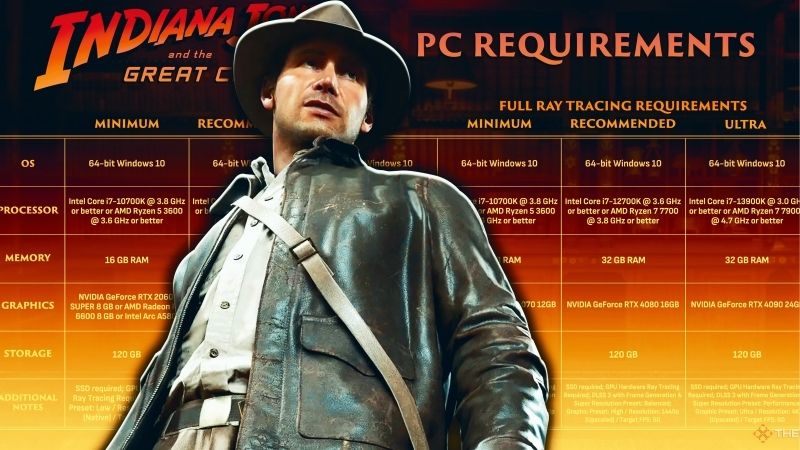
Indiana Jones Great Circle GPU Requirements Explained
Built on the id Tech 7 engine, the game uses always-on ray-traced global illumination, which is why a ray-tracing-capable GPU is the hard floor rather than a nice-to-have. The result is gorgeous lighting, but it also means your card’s RT performance and VRAM matter more than usual. The three tiers below map the load from entry level up to the punishing path-traced mode, so you can see where your card lands before you spend anything.
The Mandatory Ray Tracing Minimum
The entry floor is an RT-capable card such as an RTX 2060 Super or RX 6600. Without ray tracing hardware the game simply will not run, which catches out owners of older GTX cards.
At this level you are looking at 1080p with moderate settings. It is playable and looks excellent, but you will be managing the texture pool carefully to avoid running short on memory.
This hard requirement is the single most important fact in this review. If your card predates ray tracing support, no settings tweak will help, and an upgrade is the only path in.
The 1440p Recommended Sweet Spot
For a smooth 1440p experience with higher settings, a card in the RTX 4070 or RTX 5070 class with 12GB of VRAM is the practical target. This is where the game stops feeling carefully tuned and starts feeling effortless.
Owners at this tier consistently report stable frame rates with DLSS enabled. It is the configuration most players will be happiest with for the money.
The 12GB buffer is the key reason this tier works so well, giving the engine enough memory to hold high-resolution textures without the stutter that frustrates owners of smaller cards.
4K and Full Ray Tracing (Path Tracing)
The optional Full Ray Tracing mode is essentially path tracing, and it is brutal. To run it at 4K you want a flagship such as an RTX 5080 or RTX 5090 with 16GB of VRAM or more.
Even on that hardware, DLSS and frame generation do the heavy lifting to keep the experience fluid. This mode is a showcase, not a baseline expectation.
Treat path tracing as the reward for owning top-tier hardware rather than something to chase on a mid-range card. The standard ray tracing already looks superb at a fraction of the cost.
Real-World Performance and Owner Feedback
Specs only tell half the story, so this section synthesizes what actual owners report across resolutions. The pattern is clear: people running a recommended-tier Nvidia card with DLSS describe one of the best-looking games they own, while complaints cluster almost entirely around memory limits and the mandatory ray tracing requirement rather than the engine itself.
What 4 and 5-Star Owners Praise
Positive reviews repeatedly highlight how clean and stable the game runs on a 12GB RTX card with DLSS turned on. Players describe locked frame rates at 1440p and striking lighting that justifies the ray tracing approach.
The recurring theme is that the engine is well optimized for its visual ambition. Owners who match the recommended tier rarely report the stutter that plagues some other modern releases.
Many also single out how well DLSS 4 holds image quality, saying the upscaled image is hard to tell apart from native while delivering a large jump in frame rate.
What 2 and 3-Star Reviews Complain About
The most common frustration is VRAM. Owners of 8GB cards report texture pop-in and stutter at 4K unless they lower the texture pool setting, which is the single biggest tuning lever in the game.
The other complaint is the mandatory ray tracing floor, which locks out older GPUs entirely. A handful of reviews also note that maxing the path-traced mode tanks frame rates on anything short of a flagship.
Importantly, very few of these complaints are about bugs or poor optimization. They are about buying too little GPU for the resolution, which is exactly what this review aims to help you avoid.
The Card Most Owners Recommend
Across the feedback, the card that comes up most often as the value pick is the RTX 5070, with the RTX 4070 Super as a close alternative. Both pair 12GB of VRAM with strong ray tracing and full DLSS 4 support.
That combination directly answers the two biggest complaints: enough memory to avoid texture stutter, and the upscaling muscle to keep the demanding lighting smooth.
It is also the tier where satisfaction is highest in the reviews, with owners describing a near-flawless 1440p experience that needed little tinkering to enjoy.
Pros and Cons of the Recommended GPU
No single card is right for everyone, so here is an honest accounting of the RTX 5070 as the recommended choice for this game. The strengths line up neatly with the engine’s demands, while the trade-offs are mostly about price and the extreme 4K path-traced ceiling rather than everyday play.
The Strengths That Stand Out
Pros: A 12GB buffer that clears the game’s texture demands at 1440p, excellent ray tracing performance for the price, and DLSS 4 with frame generation that turns the heavy lighting into a smooth experience.
It also runs efficiently and quietly, and Nvidia’s ongoing driver optimization means performance tends to improve over the card’s life rather than stagnate.
For a game built around ray tracing, that blend of RT muscle and AI upscaling is exactly the skill set you want, which is why owner satisfaction at this tier runs so high.
The Trade-Offs to Know
Cons: It is not a true native-4K-maxed card for the Full Ray Tracing mode, where only the most expensive flagships keep up. Buyers chasing that specific showcase will need to spend significantly more.
The 12GB buffer is comfortable today but not enormous, so 4K enthusiasts who want maximum future headroom may prefer a 16GB card.
These are limits of ambition, not flaws. For the resolution most people actually play at, none of them affect the day-to-day experience.
Who Should Buy It
The RTX 5070 is the right call for the large majority of players who want a smooth, beautiful 1440p run with ray tracing and DLSS doing their jobs. That covers most of the audience for this game.
If you are targeting native 4K with path tracing, step up to an RTX 5080 or 5090. If you only play at 1080p, a cheaper RT-capable card will clear the bar at lower cost.
In short, match the card to your monitor. The RTX 5070 is the safe default, with a step up or down only if your resolution truly demands it.
Indiana Jones Great Circle GPU FAQs
These quick answers cover the questions that come up most often from buyers researching what to run this game on. They round out the review so you can match a card to your resolution and budget with confidence rather than guesswork.
Can I run the game without a ray tracing GPU?
No. Ray-traced global illumination is always on, so a card without dedicated RT hardware will not launch the game. An RTX 2060 Super or RX 6600 is the realistic minimum.
If your current card predates ray tracing, an upgrade is the only way in, and it is the first thing to budget for.
The good news is that even the entry RT cards deliver the game’s signature lighting intact, so the visual payoff arrives the moment you clear that hardware floor rather than only at the high end.
How much VRAM do I need at 4K?
Plan for at least 12GB, and 16GB is the comfortable target for 4K with high textures. Owners of 8GB cards report needing to lower the texture pool setting to avoid stutter.
At 1080p and 1440p the memory pressure is much gentler, which is why the recommended 12GB cards do so well there.
One practical tip from owners: the texture pool slider is the lever that matters most, so dropping it a single notch on an 8GB card often removes stutter at 4K with almost no visible loss in detail.
See More:
Does DLSS improve performance much?
Significantly. DLSS 4, and frame generation where available, is what lets recommended-tier cards run the demanding lighting smoothly. It is the most reliable way to lift frame rates without sacrificing image quality.
Owner reviews consistently describe it as the feature that turns a borderline frame rate into a comfortable one, so leave it enabled.
Because the game leans so heavily on ray-traced lighting, the upscaling and frame generation in DLSS 4 effectively reclaim the performance that ray tracing costs, which is why Nvidia cards punch above their raw specs in this particular title.
For the best indiana jones great circle gpu experience without overspending, the RTX 5070 is the standout choice, delivering the VRAM, ray tracing and DLSS support the engine demands at 1440p, with the RTX 5080 or 5090 reserved for native 4K path tracing. Match the card to your resolution, lean on DLSS, and you will see why this is one of the best-looking games of its generation. Check current pricing and availability on the recommended cards through the links above before you buy. As an Amazon Associate we may earn from qualifying purchases.
Top-Rated Picks


Editor's Pick
GIGABYTE GeForce RTX 3060 Gaming OC 12G (REV2.0) Graphics Card, 3X WINDFORCE Fans, 12GB 192-bit GDDR6, GV-N3060 Video Card


| Product | Brand | Rating | Reviews | Price |
|---|---|---|---|---|
| MSI GeForce RTX 3060 Ventus 2X 12G OC, Gaming Graphic… | — | ★ 4.7 | 4.5k | $635.00 |
| GIGABYTE GeForce RTX 3060 Gaming OC 12G (REV2.0) Grap… | — | ★ 4.7 | 3.2k | $479.00 |
| EVGA GeForce GTX 1060 3GB GAMING, ACX 2.0 (Single Fan… | EVGA | ★ 4.6 | 3.4k | $247.79 |
| MSI Gaming GeForce GTX 1660 Super 192-bit HDMI/DP 6GB… | — | ★ 4.7 | 2.2k | $232.60 |
| MSI GeForce RTX 4060 Ti Ventus 3X 8G OC (8GB GDDR6/PC… | — | ★ 4.7 | 1.3k | $998.00 |
Frequently Asked Questions
Does Indiana Jones and the Great Circle require a ray tracing GPU?
Yes. The game uses always-on ray traced global illumination, so it requires an RTX 20-series or newer GeForce, an RX 6000-series or newer Radeon, or an Intel Arc card. Older GTX 10-series and RX 5000-series cards cannot run it at all, which is unusual and catches many players out.
What GPU do I need for 1080p and 1440p?
For 1080p60 at high settings an RTX 5060 Ti or RX 7700 XT class card is a reasonable floor. At 1440p high aim for an RTX 5070 or RX 9070. The optional full ray tracing and path tracing modes raise requirements substantially, realistically needing an RTX 5080 or better.
Why does the game use so much VRAM?
The id Tech engine uses an explicit texture pool setting that scales directly with your available memory, and high texture pool values combined with ray traced lighting push consumption well past 8GB at 1440p. Setting the texture pool to match your card actual capacity is the single most important optimisation step.
Is 8GB of VRAM enough for this game?
Only at 1080p with a low or medium texture pool and ray tracing kept to the baseline global illumination. Pushing texture pool size beyond your buffer causes hard crashes or severe stutter rather than graceful degradation. Twelve gigabytes or more is strongly recommended for 1440p play.
How well does the game run once configured correctly?
Very well. The id Tech engine is efficient and, with an appropriate texture pool setting, delivers high frame rates and excellent frame pacing compared with many contemporary releases. Most performance complaints trace back to VRAM misconfiguration rather than a genuine lack of graphics horsepower.







Write Your Review
No reviews yet. Be the first to share your experience!