
- Top Pick: ASUS ROG STRIX GeForce GTX 1080 TI 11GB VR Ready 5K HD Gaming Graphics Card (ROG-STRIX-GTX1080TI-11G-GAMING) (Renewed)
- Best Value: MSI GAMING GeFroce GTX 1080 Ti 11GB GDRR5X DirectX 12 352-bit VR Ready Graphics Card (GTX 1080 TI GAMING X 11G) (Renewed)
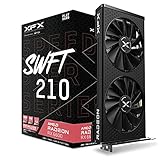
- Premium Choice: ASRock AMD Radeon RX 6600 Challenger D 8GB GDDR6 DisplayPort 14Gbps HDMI 0dB Silent Cooling 128-bit 7680 x 4320 Dual Fan Graphics Card PCI Express 4.0 x8 8-pin
The GTX 1080 Ti is the faster card, roughly 10-25% ahead of the RX 6600 in rasterized games, with the gap growing at 1440p. It also has 11 GB of VRAM against the RX 6600’s 8 GB. The RX 6600 is still the more sensible choice for many buyers: it draws about half the power, supports ray tracing and DirectX 12 Ultimate, runs games that require RT hardware, and keeps getting full driver support. Pick the 1080 Ti for maximum frames per dollar in older and current non-RT games. Pick the RX 6600 for a quiet, efficient, future-compatible 1080p build.
The GTX 1080 Ti launched in March 2017 as Nvidia’s Pascal flagship at $699. The RX 6600 launched in October 2021 at $329 as AMD’s mainstream 1080p RDNA 2 card. In 2026 neither is current. RTX 50, Radeon RX 9000 and Intel Arc B570/B580 are the current lineups, and RTX 40 and RX 7000 are the previous generation. Both cards are common on the used market at overlapping prices, which makes this an old-flagship versus newer-midrange question.
As an Amazon Associate we earn from qualifying purchases at no extra cost to you.



Side-by-Side Specifications
| Specification | GeForce GTX 1080 Ti | Radeon RX 6600 |
|---|---|---|
| Architecture / process | Pascal, 16 nm | RDNA 2.0, 7 nm |
| Release date | 10 March 2017 | 13 October 2021 |
| Launch MSRP | $699 | $329 |
| Shader units | 3584 CUDA cores | 1792 stream processors |
| Boost clock | 1582 MHz | 2491 MHz |
| VRAM | 11 GB GDDR5X | 8 GB GDDR6 |
| Bus / bandwidth | 352-bit / 484.4 GB/s | 128-bit / 224.0 GB/s |
| Cache | 2.75 MB L2 | 2 MB L2 + 32 MB Infinity Cache |
| Interface | PCIe 3.0 x16 | PCIe 4.0 x8 |
| Board power | 250 W | 132 W |
| Power connectors | 1x 6-pin + 1x 8-pin | 1x 8-pin |
| Length / width | 267 mm, 2-slot | 190 mm, 2-slot |
| Outputs | 1x HDMI 2.0, 3x DP 1.4a | 1x HDMI, 3x DisplayPort |
On paper the 1080 Ti is a much bigger GPU: twice the shaders and more than twice the memory bandwidth. The RX 6600’s high clocks and 32 MB Infinity Cache close much of the gap at 1080p. The cache becomes less effective at higher resolutions, which is why the 1080 Ti pulls further ahead at 1440p.
Gaming Performance Breakdown
TechPowerUp’s RX 6600 launch review found the RX 6600 matched the RTX 2070 at 1080p across its 25-game suite, and noted the card falls behind competitors at 1440p and 4K because of its small cache. TechSpot reached a similar conclusion, calling it RTX 2070-class at 1080p. In most review data the GTX 1080 Ti sits somewhat above the RTX 2070. Aggregated benchmark comparisons put the 1080 Ti about 20-25% ahead overall, with PassMark at roughly 19% and other aggregate scores near 24%.
- 1080p: GTX 1080 Ti roughly 10-20% faster. Some newer DX12 titles such as Forza Horizon 5 and Cyberpunk 2077 can favor the RX 6600.
- 1440p: GTX 1080 Ti roughly 20-30% faster, as the RX 6600’s 128-bit bus and small cache become the limit.
- 1% lows: the 1080 Ti’s higher bandwidth often gives steadier minimum frame rates in heavy scenes.
In demanding 2024-2026 games at 1080p medium-high, both cards typically land somewhere around 45-75 FPS, with the 1080 Ti toward the higher end in most non-RT titles. Results vary with settings, CPU and game patch.
Features That Pascal Lacks
Raw speed favors the 1080 Ti, but the feature list favors the RX 6600:
- Ray tracing: the RX 6600 has RDNA 2 ray accelerators. The 1080 Ti has none, so RT-mandatory titles like Indiana Jones and the Great Circle and Doom: The Dark Ages will not run on it.
- DirectX 12 Ultimate: the RX 6600 supports mesh shaders, variable rate shading and sampler feedback. Pascal does not, and some newer engines run poorly without mesh shaders.
- Frame generation: the RX 6600 supports FSR 3.1 frame generation and AMD Fluid Motion Frames 2 at the driver level. The 1080 Ti can use FSR 3 frame generation only in games that integrate it.
- Driver lifespan: Nvidia has said its 580 driver branch is the last with Game Ready support for Pascal. AMD continues to support RDNA 2.
Neither card supports DLSS (Pascal lacks Tensor cores), and neither officially supports FSR 4, which is built for RDNA 4. Both can use FSR 2/3 and Intel XeSS where games offer them. The RX 6600’s ray tracing is weak and mainly useful for meeting minimum requirements at 1080p with upscaling. It is not a showcase feature.
VRAM and the PCIe x8 Caveat
The 1080 Ti’s 11 GB gives it more breathing room than the RX 6600’s 8 GB. For 2026 releases at 1080p high textures, 8 GB is usually workable, but a growing list of games needs textures lowered. At 1440p, 10-12 GB is the comfortable target. The RX 6600 also uses a PCIe 4.0 x8 link. In an older PCIe 3.0 motherboard the bus bandwidth is halved, so running out of VRAM causes worse stutter than on a full x16 card. If your platform is PCIe 3.0 and you play texture-heavy games, that point favors the 1080 Ti.
Power Supply and Running Cost
The efficiency gap is large: 250 W against 132 W on paper. Using GPU board power + CPU + about 150 W headroom:
- GTX 1080 Ti + 125 W CPU: 250 + 125 + 150 = 525 W, so a quality 600-650 W unit is the safe choice, with 6-pin + 8-pin connectors
- RX 6600 + 125 W CPU: 132 + 125 + 150 = 407 W, so a quality 450-500 W unit is enough, with a single 8-pin
The difference is about 118 W under load. At 20 hours of gaming a week, that is around 120 kWh a year. Depending on local electricity rates, the extra cost can offset a meaningful part of any price saving on a 1080 Ti over a few years. Heat and noise follow the same pattern. The RX 6600 runs cool and quiet even with small coolers, while a 1080 Ti, especially the blower-style Founders Edition, is much louder under load.
For size, the RX 6600 reference figure is 190 mm against 267 mm for the 1080 Ti, and many RX 6600 models are compact dual-fan cards that suit mini-ITX cases. Large partner 1080 Ti cards can exceed 300 mm.
Used Pricing and Value
The GTX 1080 Ti usually sells used for around $120-$180, and the RX 6600 for around $120-$170. With the 1080 Ti about 20% faster at a similar price, its frames per dollar are better. The math changes once you count power, missing features and the end of Pascal driver development. Buy a 1080 Ti only in good condition, ideally with fresh thermal paste and working fans. Many units are seven or more years old and some saw heavy mining use.
Decision Table
| Your priority | Better pick |
|---|---|
| Highest FPS in non-RT games at 1080p/1440p | GTX 1080 Ti |
| Games that require ray tracing hardware | RX 6600 |
| 450-500 W PSU or small form factor case | RX 6600 |
| PCIe 3.0 motherboard with texture-heavy games | GTX 1080 Ti |
| Quiet, cool system | RX 6600 |
| Ongoing driver optimizations for new games | RX 6600 |
This is a real trade-off. The GTX 1080 Ti still wins on raw performance and VRAM. The RX 6600 wins on efficiency, size, feature support and longevity. For a new budget build in 2026, the safer pick is the RX 6600, or a current entry card like the Intel Arc B570. A 1080 Ti makes sense as a cheap upgrade in an existing PC with a capable power supply, mainly for non-RT games.
Frequently Asked Questions
Is the GTX 1080 Ti faster than the RX 6600?
Yes, in most rasterized games. Published reviews and aggregate benchmark data put the 1080 Ti roughly 10-20% ahead at 1080p and around 20-30% ahead at 1440p. A few newer DirectX 12 titles favor the RX 6600.
Does the RX 6600 support ray tracing?
Yes, the RX 6600 has RDNA 2 ray accelerators and supports DirectX 12 Ultimate. Its RT performance is modest, so upscaling and lower settings are usually needed. The GTX 1080 Ti has no RT hardware and cannot run games that make ray tracing mandatory.
How much power does the GTX 1080 Ti use compared with the RX 6600?
The GTX 1080 Ti is rated at 250 W and the RX 6600 at 132 W, a difference of over 100 W under load. The 1080 Ti needs a 600-650 W PSU with 6-pin and 8-pin connectors. The RX 6600 runs comfortably on a quality 450-500 W unit with one 8-pin.
Is 8 GB on the RX 6600 enough for 1080p?
For most games at 1080p, 8 GB works with high textures. Some 2025-2026 releases need textures lowered to avoid stutter, especially on PCIe 3.0 motherboards because of the card’s x8 link. The GTX 1080 Ti’s 11 GB is more forgiving.
Is the GTX 1080 Ti still worth buying in 2026?
Only at a low price and for older or non-RT games. Its raw performance is still respectable, but it lacks ray tracing, DLSS and DirectX 12 Ultimate, and Nvidia has ended Game Ready driver development for Pascal. A newer card is the better long-term purchase.
Ready to decide? Our #1 pick for 2026 is the Architecture / process.
Live price & availability on Amazon.










Write Your Review
No reviews yet. Be the first to share your experience!