
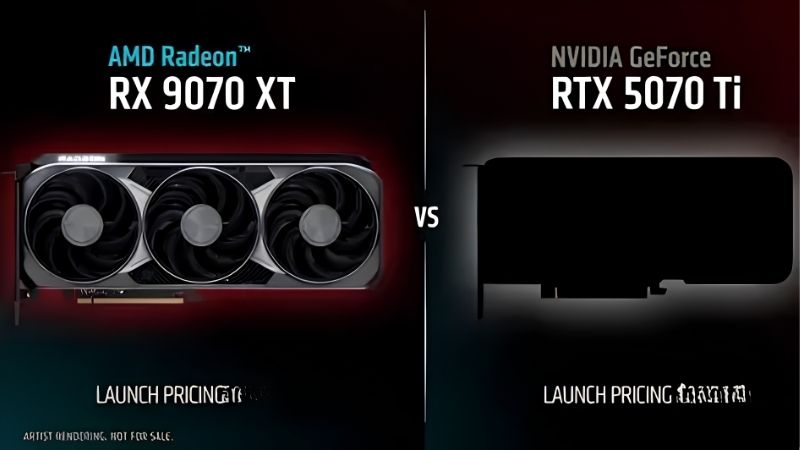
9070 vs 5070 ti is the exact matchup a lot of 1440p buyers get stuck on before they check out, and for good reason: these two cards sit close enough that the wrong choice costs you either 200 dollars or a real chunk of frames. The AMD Radeon RX 9070 and the Nvidia GeForce RTX 5070 Ti both carry 16GB of VRAM and both target high-refresh 1440p, yet they get there with different silicon, power budgets, and software stacks. This face-off skips the marketing and gives you the numbers, the trade-offs, the pricing reality, and a clear buy-this-if verdict so you can decide in minutes instead of tabbing through a dozen reviews.

Best Seller
XFX Swift AMD Radeon RX 9070 OC Triple Fan Gaming Edition with 16GB GDDR6 HDMI 3xDP, AMD RDNA 4 RX-97SWFB3B9

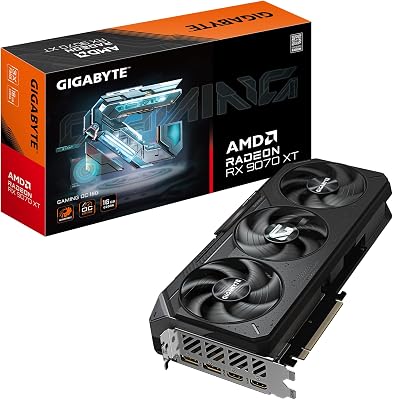
Limited Time
GIGABYTE Radeon RX 9070 XT Gaming OC 16G Graphics Card, PCIe 5.0, 16GB GDDR6, GV-R9070XTGAMING OC-16GD Video Card
Quick answer: Our top pick in 2026 is the Architecture — our #1 rated choice. See the full ranked comparison, alternatives and buying advice below.
The Quick Verdict on the RX 9070 vs RTX 5070 Ti
If you only read one section, read this. The RTX 5070 Ti is the faster card, especially in ray tracing and AI upscaling, and it is the pick when you want the highest frame rate at 1440p or plan to step into 4K. The RX 9070 is the value card: it lands roughly 200 dollars cheaper at launch pricing while still handling 1440p at high settings with room to spare. Your decision comes down to how much you value ray tracing and Nvidia’s DLSS ecosystem versus keeping cash in your pocket for the rest of the build.
Who should buy the RX 9070
The RX 9070 makes sense for the buyer who games at 1440p, rarely maxes ray tracing, and wants the most raw rasterization per dollar. At around 549 dollars MSRP, it undercuts the 5070 Ti hard while matching its 16GB frame buffer, which is the spec that protects you against rising VRAM demands in new games.
It is also a strong fit for anyone pairing a GPU with a mid-range CPU or a 650W power supply. The lower 220W board power means less heat dumped into your case, quieter fans under load, and a smaller upgrade tax on the rest of your system.
In practical terms, this is the card for the value-focused player who measures a purchase by frames per dollar and total build cost, not by topping a benchmark chart.
Who should buy the RTX 5070 Ti
The RTX 5070 Ti is the choice when you want ray tracing to stay playable in demanding titles, or when you plan to game at 4K on a 120Hz or 144Hz panel. Its GDDR7 memory and wider effective bandwidth give it headroom the 9070 simply does not have in the heaviest scenes.
It also unlocks DLSS 4 with Multi Frame Generation, a Blackwell-exclusive feature that can multiply on-screen frames in supported games. If you chase the highest possible number on a fast monitor, the 5070 Ti is built for that scenario.
Think of it as the enthusiast pick: you pay more up front, but you buy performance headroom and a software stack that keeps improving with each driver release.
Specs and price at a glance: 9070 vs 5070 Ti
Numbers cut through marketing faster than paragraphs, so here is the core data side by side. Treat the frame figures as representative ranges at 1440p high settings; exact results shift by game, driver, and settings.
| Spec | RX 9070 | RTX 5070 Ti |
|---|---|---|
| Architecture | RDNA 4 | Blackwell |
| VRAM | 16GB GDDR6 | 16GB GDDR7 |
| Memory bus | 256-bit | 256-bit |
| Board power (TDP) | ~220W | ~300W |
| Upscaling | FSR 4 (AI) | DLSS 4 + Multi Frame Gen |
| Launch MSRP | ~549 dollars | ~749 dollars |
| Best fit | 1440p value | 1440p max / entry 4K |
The pattern is clear: you pay roughly 200 dollars more for the 5070 Ti and, in exchange, get faster memory, a stronger ray-tracing pipeline, and Nvidia’s frame-generation stack. Whether that premium is worth it depends entirely on the criteria in the deep dive below, not on the spec sheet alone.
Deep Dive Face-Off: 9070 vs 5070 Ti Performance
A spec sheet only hints at real behavior. This section breaks the two cards down by the criteria that actually decide your experience: rasterization, ray tracing plus upscaling, and the practical realities of power and physical fit that benchmark clips tend to skip over.
Raw rasterization and 1440p gaming
In pure rasterized games, the RTX 5070 Ti leads, but the gap is smaller than the price gap suggests. Expect the 5070 Ti to sit roughly 15 to 25 percent ahead at 1440p in raster-heavy titles, which often means a comfortable buffer above 100 FPS on both cards at high settings.
For a 1440p 144Hz monitor, the RX 9070 already delivers the frames most players want in the vast majority of games. The 5070 Ti’s extra headroom matters most in the heaviest new releases and for players who refuse to drop below their monitor’s refresh ceiling.
The honest read: both cards are excellent 1440p rasterizers. The 5070 Ti wins the chart, but the 9070 rarely leaves you wishing for more in day-to-day play.
To put it in concrete terms, if your panel is a 1440p 144Hz display, the RX 9070 will keep most titles near or above that refresh with high settings, and the 5070 Ti simply gives you a larger cushion so you rarely dip under it in the toughest scenes. That cushion is exactly what you are paying extra for, and whether it is worth 200 dollars depends on how sensitive you are to occasional frame-rate dips versus a consistently pinned counter.
Ray tracing and upscaling: DLSS 4 vs FSR 4
This is where the 5070 Ti pulls away. Nvidia’s ray-tracing hardware is more mature, so with path tracing or heavy RT effects enabled, the 5070 Ti holds playable frame rates in scenarios where the 9070 leans harder on upscaling to keep up.
On the software side, DLSS 4 with Multi Frame Generation can generate additional frames to fill a fast panel, a genuine experimental edge for chasing high numbers. AMD’s FSR 4 has closed the image-quality gap dramatically and looks excellent, but Nvidia’s install base and frame-gen tooling remain broader today.
Practical takeaway: if ray tracing is a nice-to-have you toggle occasionally, the 9070 is fine. If RT is a must-have you leave on in every game, the 5070 Ti earns its premium and then some.
It is also worth thinking about how you actually play. If your library leans toward competitive and esports titles, ray tracing barely matters and the 9070’s raster value wins outright. If you gravitate toward story-driven, graphically showcase games where lighting sells the atmosphere, the 5070 Ti’s ray-tracing lead turns from a benchmark bragging point into a visible, moment-to-moment upgrade you will notice on screen.
Power draw, cooling, and system compatibility
The RX 9070’s ~220W board power is a real-world advantage. It runs cooler, is quieter under load on comparable coolers, and pairs happily with a quality 650W PSU. The RTX 5070 Ti’s ~300W draw pushes you toward a 750W supply and better case airflow.
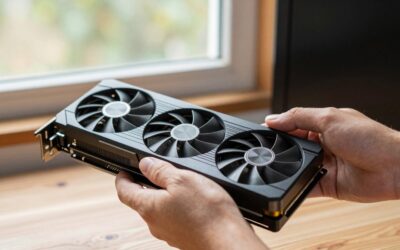
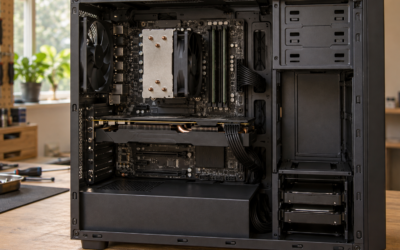
Physically, most partner 5070 Ti cards are chunkier triple-fan units, so measure your case clearance before buying. If you build in a compact mid-tower or a small-form-factor case, the 9070’s lower thermals and power make it the friendlier component.
These are exactly the details a benchmark video glosses over but that decide whether a card actually fits and runs cool in your rig. Factor the PSU and case cost into the 5070 Ti’s total price when you compare.
Value, Pricing Trends, and the Smart Buy in 2026
Performance tiers rarely change; prices change constantly. To make a smart call on the 9070 vs 5070 Ti today, you have to weigh the pros and cons against where GPU and memory pricing is actually heading, because timing can matter as much as the silicon itself.
Pros and cons of each card
The RX 9070’s strengths are price, efficiency, a full 16GB of VRAM, and low system requirements. Its weaknesses are a smaller ray-tracing lead and a still-maturing, though rapidly improving, upscaling ecosystem.
The RTX 5070 Ti’s strengths are top-tier ray tracing, GDDR7 bandwidth, DLSS 4 Multi Frame Generation, and 4K headroom. Its weaknesses are the higher price, the 300W power draw, and a larger physical footprint on most models.
Neither card is wrong. They target different budgets and priorities, which is exactly why the price gap should drive your decision as much as the frame gap does.
One quiet advantage both share is the 16GB frame buffer, and it deserves weight in the pros column for either card. As new games push texture budgets higher, that capacity is what keeps a card feeling smooth years from now, so neither the 9070 nor the 5070 Ti is likely to feel starved for memory the way an 8GB card already does today. That shared strength narrows the real decision down to ray tracing and price.
What rising GPU and memory prices mean for buyers
Here is the market context that changes the math. Laptop and PC component prices have been trending upward, driven heavily by memory costs, and GDDR-class supply is tight. That pressure filters straight into graphics card street prices, so the launch MSRPs above are often the floor, not the ceiling you will actually pay.
There is cautiously good news, but it is weak and far off. Pricing has stopped climbing as steeply as it did in late 2025, and some hardware makers have reported a stretch of relative stability, while still warning that volatility is not over. New memory supply is opening up too: OEMs can source DDR5 from Chinese suppliers such as CXMT, and Micron is building two plants in Idaho. The catch is timing, because those fabs will not run until 2027 to 2028, so prices have merely plateaued rather than fallen, and real relief is still years away.
For a buyer, the read is simple: waiting for a big price crash on either card is a bad bet in the near term. If you find the 9070 or 5070 Ti at or near MSRP, that is a good buy today, not a reason to hold out for a drop that is not coming soon.
The alternative if both are too pricey
If the 5070 Ti stretches your budget but the 9070’s ray tracing leaves you wanting, the RTX 5070 (12GB) is the obvious middle option, though its smaller frame buffer makes it a weaker long-term 1440p pick. Going the other direction, the RX 9070 XT sits just above the 9070 and often costs only a bit more for a meaningful raster bump.
For strict value hunters, dropping to a 16GB card in the 5060 Ti or 9060 XT class saves real money if you mainly play at 1080p or esports titles. Match the card to your monitor first, because overbuying GPU for a 60Hz 1080p panel wastes budget you could put toward memory or storage.
That third-option flexibility is worth keeping in mind: the best purchase is the one that fits your resolution, your case, and your wallet, not simply the fastest card in the comparison.
See More:
Final Verdict: 9070 vs 5070 Ti
The 9070 vs 5070 Ti decision is really a question of priorities. Buy the RTX 5070 Ti if ray tracing, DLSS 4 Multi Frame Generation, and 4K headroom matter to you and the roughly 200 dollar premium fits your budget. Buy the RX 9070 if you want excellent 1440p performance, lower power and heat, and the most frames per dollar. Both are strong 16GB cards that will hold up for years, and with component prices flat-to-rising rather than falling, grabbing whichever one hits a fair price is the smart move. When you have picked your side, check current listings and availability through the link below before stock and pricing shift again.
Frequently Asked Questions
How much faster is the RTX 5070 Ti than the RX 9070?
The 5070 Ti is meaningfully quicker, typically around 12 to 18 percent ahead in 1440p rasterised games and further ahead once ray tracing is enabled. The non-XT RX 9070 sits between the 9060 XT and 9070 XT, so it competes more directly with the standard RTX 5070 than with the Ti variant.
Which one gives better value for the money?
The RX 9070 usually launches at a lower price than the 5070 Ti, so cost per frame often favours AMD if you find it near list price. However, the 5070 Ti’s extra headroom, superior path tracing and multi frame generation make it the better buy if you intend to keep the card for four or more years.
What are the power and PSU differences?
The RX 9070 is the efficiency winner at roughly 220W using two 8-pin connectors, comfortable on a good 650W supply. The RTX 5070 Ti sits near 300W through a single 12V-2×6 connector and wants 750W. If you are reusing an older mid-range PSU, the AMD card is the safer and cooler-running fit.
Do both cards have 16GB of VRAM?
Yes, both ship with 16GB, which is a key reason this comparison is interesting. The 9070 uses 16GB of GDDR6 on a 256-bit bus while the 5070 Ti uses faster GDDR7 on the same bus width. Neither will run short of capacity at 1440p or 4K for the foreseeable future.
How do ray tracing and upscaling compare between them?
RDNA 4 made AMD respectable in ray tracing, and the 9070 is fine in standard RT titles, but the 5070 Ti pulls clearly ahead in path traced games. On upscaling, FSR 4 looks close to DLSS in quality, though Nvidia supports many more titles and adds multi frame generation for high refresh displays.
Ready to decide? Our #1 pick for 2026 is the Architecture.
Live price & availability on Amazon.



Write Your Review
No reviews yet. Be the first to share your experience!