
The best performance thermal paste buys you a few degrees at most, and on a well-mounted cooler the gap between a premium compound and a decent mid-range one is often smaller than the difference a clean dust filter makes. That context matters before spending on the top tier. Mounting quality matters more than the brand on the tube.
As an Amazon Associate we earn from qualifying purchases at no extra cost to you. Product prices and availability are accurate as of the date shown and are subject to change.




As an Amazon Associate we earn from qualifying purchases at no extra cost to you. Product prices and availability are accurate as of the date shown and are subject to change.
By Ryan Cole
How to Choose the Best Performance Thermal Paste
High-end compounds compete on numbers that are measured inconsistently across brands. These four factors explain what actually separates them once the cooler is mounted and the system has been running for a year. That is the honest frame for the best performance thermal paste.
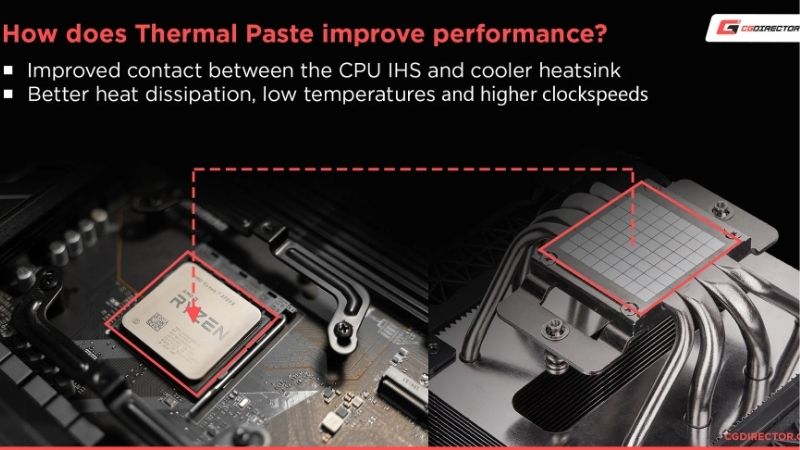
Conductivity claims and their limits
Premium compounds quote figures between roughly 12 and 15 watts per metre-kelvin, but there is no shared test standard, so numbers from different manufacturers are not directly comparable. Treat them as a tier indicator rather than a ranking. Compare within a brand rather than across them.
The practical gap is small. Between two quality compounds the difference on a mainstream processor is usually a degree or two, which is why mounting pressure and cooler choice deserve more attention than the number on the packaging. Cooler choice outweighs compound choice.
Where a premium compound actually helps
Heat density is what makes the difference visible. A chip pushing 250W through a small die concentrates heat in a way that rewards a better interface, whereas a 65W processor sees very little benefit from an expensive tube. Heat density is the variable that decides it.
The same applies to delidded processors, laptops with tight cooling, and graphics card repastes. Those are the situations where enthusiasts genuinely measure a change, rather than reporting one from a single before-and-after reading. Those are the cases where the gain is measurable.
Pump-out resistance over time
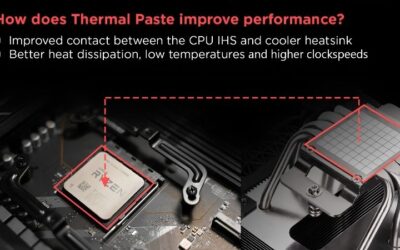
Pump-out is the gradual migration of compound away from the centre of the die as the system heats and cools. It is why temperatures creep up after a year or two, and some high-performance formulations are worse at resisting it than cheaper ones. It is why idle temperatures creep up over time.
Phase-change pads sidestep the problem by melting into place once and staying there. If you would rather not reseat a cooler every couple of years, that stability is worth more than a marginally higher conductivity claim. Stability beats a marginal conductivity claim.
Application on a hot chip
Thicker compounds need firm, even mounting pressure to spread properly, and a poor mount costs far more than any difference between brands. Tighten cooler screws gradually in a diagonal pattern rather than fully seating one corner first. A poor mount undoes any compound advantage.
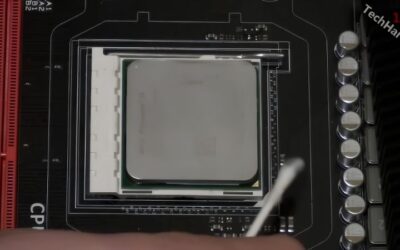
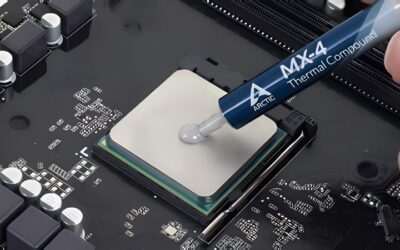
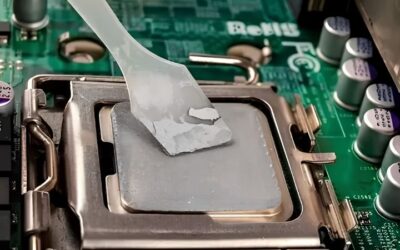
Quantity matters less than coverage. A pea-sized dot in the centre works for standard heat spreaders, while a thin line along the long axis suits rectangular dies, and excess simply squeezes out without helping contact at all. Coverage matters more than quantity.
Top Picks: Best Performance Thermal Paste in 2026
These five cover the high-conductivity tier plus one phase-change alternative. All are electrically non-conductive, so a small overspread will not damage anything. Stock was checked in August 2026 against current listings. Which is the best performance thermal paste depends on how hot your die runs.
| Compound | Type | Manufacturer claim | Best for |
|---|---|---|---|
| Thermal Grizzly Kryonaut Extreme | High-performance paste | 14.2 W/mK | Extreme cooling and benchmarking |
| Thermalright TF8 | High-performance paste | 13.8 W/mK | Value at the top tier |
| Thermal Grizzly Kryonaut | High-performance paste | 12.5 W/mK | High-power desktop chips |
| Arctic MX-6 | Ceramic paste | Non-conductive, long service life | Everyday high-power use |
| Honeywell PTM7950 | Phase-change pad | Melts into place on first heat cycles | Long-term stability |
Thermal Grizzly Kryonaut Extreme
Kryonaut Extreme sits at the top of the conventional paste range with a claimed 14.2 W/mK, and it was formulated for extreme cooling scenarios including sub-ambient benchmarking where ordinary compounds behave unpredictably. It was built for benchmarking rather than daily use.
It is expensive per gram and, like the standard formulation, it can dry out faster on very hot components. Unless you are running a delidded chip or chasing benchmark results, the money is better spent elsewhere in the build. Most builds will never see the difference.
Thermalright TF8
TF8 claims 13.8 W/mK at a fraction of the price of the Thermal Grizzly options, and it ships in quantities that make repasting several machines realistic. For most people this is the sensible way into the high-performance tier. It is the sensible entry to the top tier.
It is thick enough that application needs care on a small die, and warming the tube slightly helps it spread. Independent long-term data is thinner than for the established brands, which matters if you plan to leave it untouched for years. Warming the tube helps it spread evenly.
Thermal Grizzly Kryonaut
The standard Kryonaut remains a benchmark for high-power desktop processors, claiming 12.5 W/mK and performing strongly the moment the cooler is mounted with no curing period required before it reaches full effect. It reaches full performance immediately.
Its known weakness is longevity on hot components, where the compound can dry out sooner than steadier formulations. That makes it a better fit for systems you reseat periodically than for a machine you build and forget about. Plan on reseating every couple of years.
Arctic MX-6
MX-6 is the pragmatic choice, giving up a small amount of peak performance in exchange for stability, easy application and a much lower price per gram. On a well-mounted cooler the gap to premium compounds is often barely measurable. Stability is what you are buying here.
Arctic no longer publishes a conductivity figure, which makes direct specification comparisons awkward. The compound is also slightly thicker than the older MX-4, so it needs a firm squeeze and a properly seated cooler to spread evenly. Seat the cooler firmly and tighten diagonally.
Honeywell PTM7950
This phase-change pad is cut to size and melts into place over the first heat cycles, after which it largely stops migrating. For laptops and for desktops you would rather not open again, that stability is the real advantage. It is the option to fit once and forget.
Performance is not immediate, so temperatures settle over several sessions rather than instantly. Counterfeit sheets are widespread, so buy from a seller with a clear supply chain and inspect the packaging carefully on arrival. Buy from a seller with a clear supply chain.
What the 2026 Market Means for Repasting
Compound is a small purchase, but it sits inside a wider maintenance argument this year. Two factors are worth weighing before deciding where the money goes. Both matter when the best performance thermal paste is competing with other upgrades.
Maintenance beats waiting for new hardware
Graphics card pricing has risen sharply since late 2025 and no new processor or graphics generation arrives before CES in January 2027. Against that backdrop, a tube of compound is a rounding error with a measurable result. A tube costs less than a single game.
On a system that has run for two or three years, fresh paste and clean dust filters together often recover several degrees. That is a real improvement rather than the marginal gain the top tier offers over a mid-range compound. That is measurable rather than theoretical.
Pricing and stock this year
Thermal compound and coolers have seen roughly 6% to 8% price movement since promotional pricing policies ended at the start of February 2026, which is mild compared with what happened to memory and storage. Compound sits outside the memory problem entirely.
Prices quoted here reflect August 2026 and should be checked against the live listing. Buying a slightly larger tube usually costs little more and covers several applications, which is worthwhile if you maintain more than one machine. A larger tube covers several applications.
Late November still works for this category
Genuine Black Friday reductions are unlikely on memory, storage or prebuilt systems this year, because that stock reflects high contract pricing. Coolers, fans and thermal compound sit outside that constraint entirely. Cooling parts are still discounting properly.
If your temperatures are stable, waiting until 27 November is reasonable. If the system is already throttling under load, repaste now, because the saving is smaller than the performance you are giving up in the meantime. Throttling costs more than the saving.
Frequently Asked Questions
The questions readers ask most about the best performance thermal paste, covering liquid metal, expected gains, replacement intervals and application. They assume a desktop chip rather than a laptop.
How much cooler will a premium paste run?
Usually one to three degrees against a decent mid-range compound on a well-mounted cooler. The gain is larger on high heat density chips and on systems where the previous application was old, uneven or applied too thinly. Old, uneven applications show the biggest gain.
Is liquid metal better?
It performs better on paper, but it is electrically conductive, corrodes aluminium and can ruin a board if it escapes. For almost every build, a high-performance non-conductive compound is the sensible trade-off. The risk outweighs the benefit for most builds.
How often should high-performance paste be replaced?
Every two to three years for a daily-use system, and sooner for compounds known to dry out on hot components. Rising idle temperatures over weeks are the practical signal that the interface has degraded. Rising idle temperatures are the practical signal.
Does a thicker layer help?
No. Compound fills microscopic gaps rather than acting as a heat conductor in bulk, so excess simply squeezes out under mounting pressure. Even coverage from a thin layer beats a thick application every time. Thin and even is what you are aiming for.
See More:
- best CPU cooler for Ryzen 5 5600X
- best small form factor CPU cooler
- best SFF CPU cooler
- best CPU cooler for i9-14900K
- What is the best AIO CPU cooler
Final Thoughts
The best performance thermal paste is worth buying when your chip runs hot and dense, and largely irrelevant when it does not. Get the mount right first, choose a compound that resists pump-out, and treat the last degree as a bonus. Technique still beats brand every time.




Write Your Review
No reviews yet. Be the first to share your experience!