
Nvidia Grace Hopper represents one of the biggest architectural bets in modern computing: fusing a CPU and a GPU so tightly that they share one coherent pool of memory. For engineers evaluating infrastructure for AI and high-performance computing, the real question is not whether the design is clever, but whether its unified approach solves a bottleneck your workloads actually hit. This review explains what the Grace Hopper architecture is, where it genuinely outperforms a conventional GPU server, and whether adopting it makes sense for your team in 2026.
As an Amazon Associate we earn from qualifying purchases at no extra cost to you.








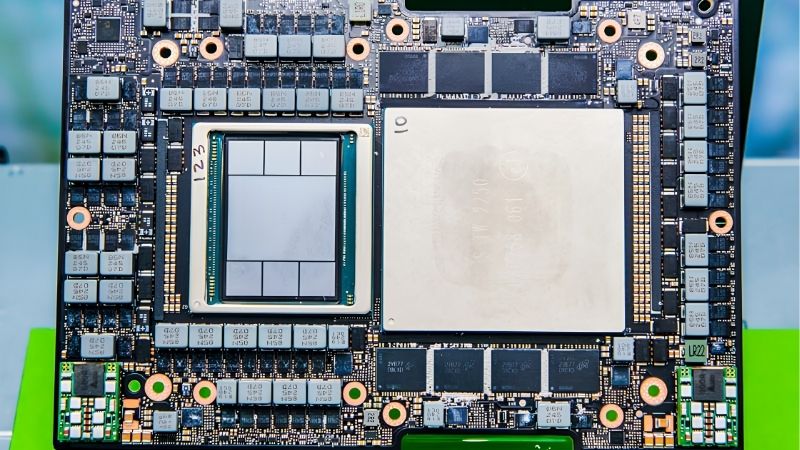
What the Nvidia Grace Hopper Architecture Is
The Grace Hopper design abandons the traditional split between a host CPU and a discrete accelerator connected over a slow bus. Instead it binds an Arm-based Grace CPU and a Hopper GPU into a single coherent system, and understanding that shift is the foundation for judging whether the architecture fits your problem or is simply an elegant solution to a bottleneck you do not have.
Grace CPU and Hopper GPU United
At the heart of the architecture is the pairing of Nvidia’s Grace CPU, built on energy-efficient Arm Neoverse cores, with a Hopper-class GPU on the same module. The commercial embodiment is the GH200 Grace Hopper Superchip, but the idea is broader than any single product number.
The point of uniting them is data locality. In a conventional server, moving data between CPU and GPU memory costs time and energy; Grace Hopper removes much of that penalty by letting both processors work against a shared, coherent memory space instead of two separate islands.
For engineers, that changes what is feasible on a single node. Workloads that constantly shuttle data between host and accelerator, or that outgrow GPU memory, are exactly the ones the architecture is built to accelerate, which is the first signal that it may fit your needs.
Equally, it clarifies when the architecture is wasted. If your accelerator rarely waits on the CPU and your models sit comfortably inside GPU memory, the coherence that defines Grace Hopper adds cost without solving a problem you actually face.
NVLink-C2C and Coherent Memory
The connective tissue is NVLink-C2C, a chip-to-chip link running at 900 GB/s, roughly seven times the bandwidth of a PCIe Gen5 slot. That speed is what makes coherence practical rather than theoretical, letting the GPU reach into the CPU’s large memory pool without a crippling transfer cost.
The practical result is a single node presenting a very large, unified memory space, combining fast GPU memory with the CPU’s capacious LPDDR5X. For memory-hungry workloads, that pooled capacity is the architecture’s defining advantage over a discrete card.
The experimental angle is that software is still catching up to what coherent memory enables. As frameworks mature around unified addressing, existing Grace Hopper systems should keep gaining efficiency, making the architecture a forward-looking rather than static investment.
For a buyer, that trajectory affects depreciation. Hardware whose real-world performance keeps improving through software updates holds its usefulness longer, which strengthens the case for a platform you expect to keep in service for several years.
How Grace Hopper Differs From a Discrete GPU Server
A traditional server pairs an x86 CPU with one or more PCIe GPUs, each with its own memory and a relatively narrow link to the host. That design is proven and flexible, but it forces explicit data movement and caps how much memory a single GPU can address.
Grace Hopper flips this by making the CPU and GPU peers on a fast coherent fabric. The trade-off is that you commit to an integrated, Arm-based platform rather than mixing and matching components, which suits some teams and constrains others.
The honest way to frame the choice is by bottleneck. If your workloads are compute-bound and fit comfortably in GPU memory, a discrete server may be simpler and cheaper; if they are memory-bound or data-movement-bound, Grace Hopper directly targets your pain.
It is worth being blunt about the commitment. Choosing Grace Hopper means standardizing on an integrated Arm-based platform, so the decision is as much about your software portability and operational preferences as it is about raw performance.
Nvidia Grace Hopper Performance and Use Cases
Architecture matters only insofar as it moves real numbers on real work. Across the workloads Grace Hopper targets, the pattern is consistent: it shines when memory capacity and data movement dominate, and offers less advantage where they do not.
Large Language Models and Recommender Systems
For serving large language models, the unified memory lets a single node hold models and their caches that would otherwise be split across multiple discrete GPUs, cutting communication overhead and simplifying deployment. That capacity often matters more than peak compute for inference.
Recommender systems are an even cleaner fit. Their enormous embedding tables, often reaching into the terabytes, benefit directly from the GPU’s ability to stream from the CPU’s large memory pool without the copy penalty a discrete card would incur.
In both cases, the architecture turns a memory wall into headroom. Teams whose models or data structures keep overflowing discrete GPU memory are the clearest candidates to see a real, measurable benefit from Grace Hopper.
The practical filter is simple: count how often your current serving is limited by memory rather than compute. The more often the answer is memory, the more directly Grace Hopper converts that limit into throughput you can actually use.
Recommender workloads deserve special mention here, since their terabyte-scale tables are almost a textbook case for coherent memory, and teams running them often see the clearest gains of any Grace Hopper adopter.
If that description matches your stack, Grace Hopper stops being an exotic option and becomes the obvious one, and the value case largely writes itself from your own profiling numbers.
HPC and Data Analytics
In high-performance computing, many scientific codes are limited less by raw FLOPS than by moving data between CPU and GPU. Grace Hopper’s coherent design lets these applications keep the accelerator fed, improving sustained performance on real workloads rather than just benchmarks.
Large-scale data analytics and graph processing tell a similar story. When datasets exceed GPU memory, the ability to reach into the coherent CPU pool at high bandwidth keeps processing on the accelerator instead of stalling, which is where the architecture earns its cost.
The analytical takeaway is to profile before committing. If your HPC or analytics jobs spend meaningful time on host-to-device transfers or memory limits, Grace Hopper addresses that directly; if they do not, the coherent link is capability you will pay for but underuse.
Deployment, Power, and Software
Practically, Grace Hopper systems run hot and dense, with modules that can approach a kilowatt, so most serious deployments assume liquid cooling and a facility provisioned for that power. This is data-center infrastructure, not a card you self-install.
The software stack is the mature CUDA ecosystem plus Nvidia’s AI and HPC frameworks, increasingly tuned for coherent memory. The one caveat is the Arm-based host: teams with hard x86 dependencies should validate their stack on Grace before assuming a clean port.
Because procurement runs through OEM system builders rather than retail cards, plan for lead times and confirm your facility’s cooling and power up front. Treating Grace Hopper as a systems project rather than a component purchase is how successful deployments avoid delays.
Budgeting for the surrounding infrastructure is part of the honest cost. Power distribution, liquid-cooling plumbing, and OEM lead times all add to the project, and teams that plan for them up front consistently report smoother deployments than those who treat the module as a drop-in part.
Adopting Grace Hopper in 2026: Market, Value, and Pros and Cons
Architecture decisions are made against a live market, and two developments in 2026 shape both the availability and the case for adopting Grace Hopper. Both suggest planning deliberately rather than waiting indefinitely for easier conditions.
The H200-to-China Change and Hopper Supply
The United States has moved to permit Nvidia to sell the H200, one of its most powerful AI chips, into China. Because Grace Hopper systems draw on the same Hopper-generation silicon and HBM supply, that policy adds a large new source of demand to the pool your platform depends on.
For an infrastructure planner, the lesson is practical rather than alarmist: when scarce Hopper-class parts gain a huge new market, assuming supply will loosen and prices will drop is a risky basis for a roadmap. If your plan already calls for this capacity, securing allocation early protects your schedule.
The analytical read is that competing global demand rewards decisiveness. Grace Hopper is not a commodity you can source on short notice, so aligning procurement with your actual timeline matters more than chasing a hypothetical future discount.
Memory Prices and Timing
The broader memory market is the second force. Component and memory prices climbed steeply through late 2025 before merely leveling off, which is relief but not a reduction, and a platform built around large high-bandwidth memory is fully exposed to those costs.
New supply is coming, with OEMs able to source DDR5 from vendors such as CXMT and Micron building two plants in Idaho, but those fabs will not reach volume production until 2027 to 2028. The measured conclusion is that memory-heavy platforms are unlikely to get dramatically cheaper soon.
For a Grace Hopper adopter, that means waiting for a price collapse is optimistic. If the architecture solves a real bottleneck in your pipeline, the value it unlocks now generally outweighs speculative savings that remain years away.
Nvidia Grace Hopper Pros and Cons
The adoption picture distilled for a fast decision.
Pros: coherent CPU-GPU memory that removes the PCIe bottleneck; very large unified memory for LLMs, recommenders, and HPC; 900 GB/s NVLink-C2C; mature CUDA software with ongoing coherent-memory optimization.
Cons: high power that usually mandates liquid cooling; integrated Arm platform rather than mix-and-match components; procurement through OEM systems with lead times; strong global demand and a firm memory market keep it premium.
See More:
Final Verdict: Is Nvidia Grace Hopper Worth It?
For teams whose real bottleneck is memory capacity or CPU-GPU data movement, the Nvidia Grace Hopper architecture is a genuinely differentiated tool, turning walls that limit discrete servers into headroom for large models, recommenders, and data-heavy HPC. If your workloads are compute-bound and fit comfortably in GPU memory, a conventional discrete-GPU server will likely serve you at lower cost and complexity.
If Grace Hopper matches your workloads, current supply pressure and a firm memory market both favor planning your adoption sooner rather than later. Check the latest Nvidia Grace Hopper systems, configurations, and availability through the link below and align your procurement with your roadmap before demand tightens further.
Top-Rated Picks

Best Seller
AMD Ryzen 5 5600X 6-core, 12-thread unlocked desktop processor with Wraith Stealth cooler


Top Rated
intel Core i7-4770 Quad-Core Desktop Processor 3.4 GHZ LGA 1150 8 MB Cache BX80646I74770 (Renewed)
| Product | Brand | Rating | Reviews | Price |
|---|---|---|---|---|
| AMD Ryzen 5 5600X 6-core, 12-thread unlocked desktop … | — | ★ 4.8 | 30.2k | under $200 |
| Intel® Core™ i5-11400 Desktop Processor 6 Cores up to… | — | ★ 4.8 | 1.4k | — |
| intel Core i7-4790 Processor – BX80646I74790 (Renewed) | Amazon Renewed | ★ 4.6 | 289 | under $60 |
| intel Core i7-4770 Quad-Core Desktop Processor 3.4 GH… | Amazon Renewed | ★ 4.4 | 279 | under $60 |
Frequently Asked Questions
What is Grace Hopper and how is it built?
Grace Hopper, sold as the GH200 superchip, combines the Arm-based Grace CPU with a Hopper GPU on one module, linked by NVLink-C2C at around 900GB/s. The CPU uses LPDDR5X memory and the GPU uses HBM, with the interconnect allowing coherent access across both memory pools.
Why does the CPU-GPU coherent link matter?
It removes the PCIe bottleneck between processor and accelerator. Workloads that constantly move data, such as large recommendation models, graph analytics, and inference on models exceeding GPU memory, can spill into CPU memory at far higher bandwidth than a conventional PCIe-attached GPU allows.
Does the Arm CPU cause software compatibility problems?
Mainstream AI frameworks, CUDA libraries and container images are available for Arm64, so common workloads run fine. Problems appear with legacy x86-only binaries, proprietary tools without Arm builds, and niche dependencies. Audit your software stack for Arm support before committing to the platform.
Who should consider Grace Hopper over a standard GPU server?
Teams running memory-capacity-bound workloads benefit most, especially large model inference, recommender systems, and scientific codes with heavy host-device traffic. If your work fits comfortably within GPU HBM and is compute bound, a conventional x86 server with PCIe or SXM GPUs is usually simpler and cheaper.
What are the power and deployment requirements?
A GH200 module draws several hundred watts on its own, and multi-node deployments require high-density rack power and substantial cooling, often liquid on denser configurations. It is sold through server OEMs as part of complete systems rather than as a component for self-assembly.
Ready to decide? Our #1 pick for 2026 is the AMD Ryzen 5 5600X 6-core, 12-thread unlocked desktop ….
Live price & availability on Amazon.


Write Your Review
No reviews yet. Be the first to share your experience!