
Thermal Paste Best Brand debates usually turn into a contest over one number on a tube, which is exactly the wrong way to choose. What separates the serious makers is consistency between batches, how the compound behaves after two years, and whether the tube is honest about what it contains.
As an Amazon Associate we earn from qualifying purchases at no extra cost to you. Product prices and availability are accurate as of the date shown and are subject to change.


As an Amazon Associate we earn from qualifying purchases at no extra cost to you. Product prices and availability are accurate as of the date shown and are subject to change.
By Ryan Cole, hardware writer at NVIDIAReview.
How to Judge Which Thermal Paste Best Brand Deserves Your Money
Between the top compounds, the gap on a normal desktop processor is usually one to three degrees. That is why the thermal paste best brand question is settled by handling, longevity and honest specifications rather than by the headline figure. Four checks do most of the work.
Published Conductivity Figures Are Not Comparable Across Brands
Thermal conductivity in watts per metre-kelvin is measured under different test standards by different companies, using different bond line thicknesses and pressures. A compound quoted at 12.5 does not automatically beat one quoted at 8.5 in a real mount.
Noctua is the clearest example. The company deliberately declines to publish a W/mK figure at all, arguing the number misleads buyers, and its compounds still finish near the top of independent comparisons.
Treat the number as a rough class indicator only. Within a brand it tells you which product sits higher in the range; across brands it tells you very little about the temperature you will actually see.
Electrical Conductivity and Capacitance Matter for Safety
Most modern ceramic and carbon-based compounds are electrically non-conductive, so a small spill onto surrounding components is recoverable. Metal-loaded pastes can be capacitive even when marketed as non-conductive, which is worth knowing before you overfill.
Liquid metal is a separate category entirely. It conducts electricity freely, attacks aluminium, and needs careful masking around the socket, which puts it outside sensible territory for a general-purpose build.
For anything you rely on daily, treat electrical safety as a filter rather than a preference. A compound that cannot damage the board no matter how clumsy the application removes the only failure mode that actually costs money.
Pump-Out, Curing and Re-Paste Intervals
Pump-out is the slow migration of compound away from the centre of the die as the system heats and cools. Thinner, high-conductivity pastes are more prone to it, which is why some compounds test brilliantly on day one and drift several degrees over a year.
Manufacturer durability claims give you a rough guide. Eight-year figures on stable ceramic compounds and five-year usage recommendations on premium pastes are common, while phase-change materials are designed to reflow rather than migrate.
For most desktops, reapplying whenever the cooler comes off is enough. If temperatures creep upward over a year with no other change, pump-out is the usual explanation.
Tube Size, Application Aids and Real Cost per Gram
A single processor application uses a few tenths of a gram, so a one gram tube covers several mounts. For workshop use the thermal paste best brand is often simply whoever sells the largest tube, since four or eight gram syringes cut the cost per application dramatically.
Accessories matter more than they sound. Spatulas, cleaning wipes and isopropyl pads included in the box save a separate purchase, and a stiff plunger on a cheap syringe makes a neat application harder than it needs to be.
Shelf life closes the argument for buying larger. A capped tube stays usable for years, so a four gram syringe bought once will still be serviceable through several builds while costing less per mount than repeated small purchases.
Top Picks: Thermal Paste Best Brand Options Worth Buying
These six cover the ceramic mainstream, the high-conductivity tier and one phase-change material. Figures are manufacturer-rated, and retail pricing at the time of writing in August 2026 moves weekly, so treat tiers as your guide.
| Product | Brand | Rated conductivity | Type | Notes |
|---|---|---|---|---|
| Kryonaut | Thermal Grizzly | 12.5 W/mK | Ceramic-loaded | 1 g to 5.55 g tubes |
| MX-6 | Arctic | Not directly comparable | Carbon-based | Sizes up to 135 g |
| NT-H2 | Noctua | Not published | Hybrid compound | Cleaning wipes included |
| MasterGel Maker | Cooler Master | 11 W/mK | Nano-diamond | Flat-tip syringe |
| TF7 | Thermalright | 12.8 W/mK | Ceramic-loaded | Low cost per gram |
| PTM7950 | Honeywell | Around 8.5 W/mK | Phase change pad | Resists pump-out |
Thermal Grizzly Kryonaut
Kryonaut is the compound most people picture when they think of premium paste. Rated at 12.5 W/mK, it spreads easily, applies cleanly at room temperature and performs at the top of the ceramic group on a fresh mount.
Its weakness is longevity under heat. The compound is known to dry out faster than thicker rivals on hot, hard-worked processors, and the cost per gram is among the highest here, so it suits enthusiasts who re-paste regularly.
Arctic MX-6
Arctic sells the sensible default. MX-6 is a carbon-based, electrically non-conductive compound with a soft consistency that spreads under mounting pressure, and it comes in sizes from two grams up to a 135 gram tub for workshop use.
Peak performance sits a degree or so behind the highest-rated compounds on a bench. In exchange you get very low cost per application and a paste that stays stable for years, which is the better trade for most builds.
Noctua NT-H2
Noctua’s approach is to publish no conductivity figure and let independent testing speak. NT-H2 is thick, non-conductive and non-corroding, ships with cleaning wipes, and carries a recommended in-use lifespan measured in years rather than months.
The thickness is the trade-off: it needs firm mounting pressure to spread properly and is harder to apply on a bare die. Price per gram is high compared with the value tier, though a tube still covers many mounts.
Cooler Master MasterGel Maker
Rated at 11 W/mK with a nano-diamond filler, MasterGel Maker sits in the high-conductivity tier and ships with a flat-tip syringe that makes a controlled line or dot pattern straightforward for a first-time application.
Tube sizes are small, so cost per application is steep if you re-paste often. The compound is also fairly thin, which puts it in the group more likely to migrate on processors that cycle hot and cold repeatedly.
Thermalright TF7
Thermalright applies the same strategy to paste that it applied to coolers. TF7 is rated at 12.8 W/mK, is electrically non-conductive, and typically costs a fraction of the premium tubes for a comparable amount of compound.
Packaging and documentation are minimal, and independent results place it a degree or two behind the best rather than level with them. As the paste you buy in bulk to keep in the drawer, it is difficult to beat.
Honeywell PTM7950
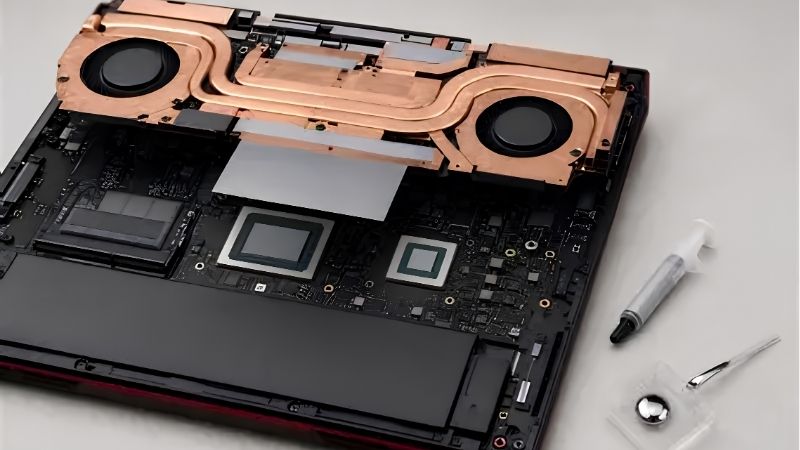
PTM7950 is not a paste but a phase-change pad that softens at operating temperature and reflows instead of migrating outward. That makes it the strongest option against pump-out, which is why laptop owners adopted it first.
Application is different: you place a cut sheet, run the system warm to let it settle, and accept slightly worse numbers for the first heat cycle. Counterfeits are common, so buy from a seller you can verify.
What 2026 Pricing Means for Paste Buyers
Paste is a small purchase, but the wider market changes how much value the thermal paste best brand debate really carries this year. Three points are worth knowing before you order.
Cheap Upgrades Are Doing the Heavy Lifting This Year
With graphics card pricing elevated and no new processor generation arriving before CES in January 2027, the upgrades that still deliver measurable gains are the small ones. Fresh paste on a three-year-old mount is the cheapest of them all.
The result is usually a few degrees, which translates into higher sustained boost clocks and slower fan ramping. It costs less than a game and takes twenty minutes with the cooler already off.
Component Pricing Has Drifted Upward
Manufacturers have concentrated on mid and upper tiers as budget demand fell, and cooler and power supply pricing has moved up in the region of six to eight percent. Promotional programmes that cushioned entry-level products ended in early 2026.
Paste has been less affected than hardware, but the larger tubes now represent even better value against small premium syringes. Buying four or eight grams once tends to beat buying one gram three times.
Cooling Is Still a Real Black Friday Category
Memory, drives and prebuilt systems are unlikely to see genuine November reductions this year because stock was manufactured against high contract pricing. Paste, coolers, fans and cases remain a category with honest markdowns.
If you are re-pasting as maintenance rather than fixing a throttling machine, waiting for that window is reasonable. If your processor is already hitting its limit, buy now and take the few degrees today.
Frequently Asked Questions
These come up most often once someone has decided which thermal paste best brand to buy and moves on to applying it.
Does the application pattern really matter?
Less than most guides suggest. A pea-sized dot in the centre works on almost every modern processor because mounting pressure spreads the compound. Rectangular AMD packages benefit slightly from a line or small X, but the difference is small.
How much paste should I use?
Enough to cover the die under pressure, roughly the volume of a pea or a small line. Too much insulates rather than conducts and can spill onto the substrate, while too little leaves dry patches that show up as unstable temperatures.
Is the paste that comes with a cooler good enough?
Usually yes. Bundled compounds from the established cooler brands are adequate for normal use, and the difference against a premium paste is typically one to two degrees on a well-mounted cooler.
How often should thermal paste be replaced?
Every three to five years is a sensible guideline for a desktop, or whenever the cooler is removed for any reason. Hot laptops and heavily loaded workstations benefit from a shorter interval or a phase-change material.
See More:
- What Is the Best Thermal Paste
- Best PC Case Fans 120mm
- Best Thermal Paste Brands
- Best CPU Cooler Reddit
Final Thoughts
Choosing a thermal paste best brand comes down to how often you re-paste rather than which number is printed on the tube. Buy Arctic or Thermalright in a larger tube if you want value, Noctua or Thermal Grizzly if you want a premium mount, and a phase-change pad if pump-out is your real problem.





Write Your Review
No reviews yet. Be the first to share your experience!