
arc b580 vs 4060 is the comparison where the spec sheet and the safe choice point in opposite directions, and that tension is exactly why you are reading rather than watching. Intel offers more VRAM for less money. Nvidia offers a decade of driver maturity and an ecosystem that never gives you a reason to file a support ticket. This piece gives you the verdict up front, the full table, an honest section on the driver situation that Intel buyers actually report, and the one hardware requirement that disqualifies the B580 entirely for some readers. Read that part before you buy anything.
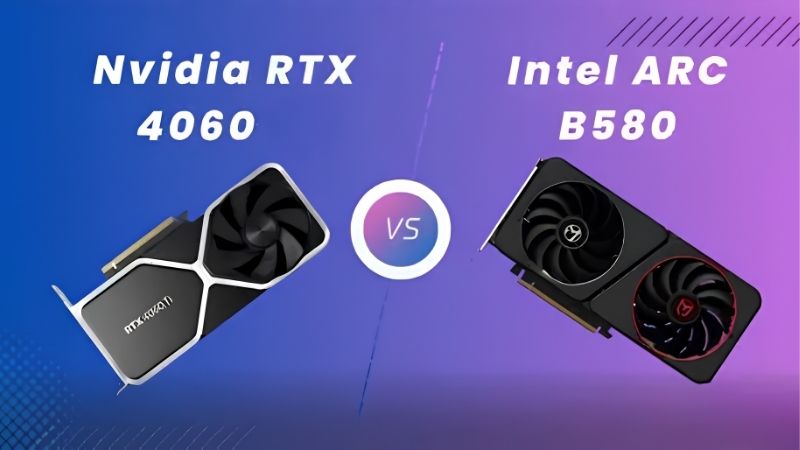
Quick Verdict: Arc B580 vs RTX 4060 for 1080p Gaming
The Arc B580 is the better card on paper and the better value in most cases – 12GB against 8GB, a lower price, and roughly 10-15% more performance at 1080p. The RTX 4060 is the safer card, and safety has genuine value here. If your system supports Resizable BAR and you are comfortable with an occasionally rough experience in older titles, buy the B580. If you need reliability across a wide library including older games, or if your platform lacks ReBAR, buy the 4060 and do not look back.
Why the B580 Wins on Paper
The headline is VRAM and it deserves the attention. The B580 carries 12GB on a 192-bit bus; the RTX 4060 carries 8GB on a 128-bit bus. In 2026 that is not a spec-sheet flourish – it is the difference between adjusting textures and living with stutter.
The failure mode is what makes this decisive. A card short on shader power runs slower, which is predictable and tunable. A card short on VRAM hitches, streams textures in late, and watches its 1% lows collapse while the average frame rate stays deceptively healthy. At 1080p with high textures, several current titles already brush against 8GB, and enabling ray tracing pushes past it.
Performance follows the same direction, if less dramatically. At 1080p high the B580 typically leads by roughly 10-15% in modern titles – call it 75-95 fps against 65-85. The lead widens at 1440p, where the wider bus and larger buffer both work in Intel’s favour. And it does this at a lower launch price, which makes the fps-per-dollar gap larger than the fps gap.
The Resizable BAR Requirement That Disqualifies Some Buyers
Stop here before anything else, because this single requirement invalidates the entire comparison for a portion of readers.
Arc GPUs depend on Resizable BAR to a degree Nvidia and AMD cards do not. Without ReBAR enabled, B580 performance does not degrade gracefully – it falls apart, losing anywhere from 20% to 40% in some titles. This is not a tuning preference. It is a functional requirement.
ReBAR needs a reasonably modern platform and a BIOS that exposes the setting. Broadly: Intel 10th gen and newer, AMD Ryzen 3000 and newer, with a UEFI boot install and the option enabled in BIOS. If you are upgrading an older prebuilt, an office machine, or anything running legacy BIOS mode, check this before you spend a cent.
The RTX 4060 benefits from ReBAR but does not need it. That asymmetry is the quiet reason many buyers who should choose Intel on paper end up correctly choosing Nvidia in practice.
Full Spec and Performance Table
The whole comparison in one scan.
| Specification | Intel Arc B580 | Nvidia RTX 4060 |
|---|---|---|
| Launch MSRP | $249 | $299 |
| VRAM | 12GB GDDR6 | 8GB GDDR6 |
| Memory bus | 192-bit | 128-bit |
| Board power | ~190W | ~115W |
| Recommended PSU | 600W | 450W |
| Power connector | 1x 8-pin | 1x 8-pin |
| Resizable BAR | Required | Optional |
| AAA 1080p high (avg) | ~75-95 fps | ~65-85 fps |
| Older / DX11 titles | Inconsistent | Consistent |
| Upscaling | XeSS | DLSS 3 + Frame Gen |
| Encoder | Intel AV1 (excellent) | NVENC AV1 (excellent) |
| Best for | Modern titles, VRAM value | Wide library, low power, reliability |
Three rows carry the decision and they are not the fps rows. Power draw: 190W against 115W is a 65% difference that decides whether your existing PSU survives. Resizable BAR: required against optional. Older titles: inconsistent against consistent. Those three, not the frame rate, are where this comparison is actually won and lost.
Deep Dive: The Driver Question Everyone Is Really Asking
Nobody searching this comparison is genuinely uncertain about the benchmarks – they are published everywhere. What people actually want to know is whether Intel drivers will ruin their week. That deserves a direct answer rather than reassurance.
Where Intel Drivers Are Now, Honestly
The short version: dramatically better than the Alchemist launch, and still not Nvidia.
Intel has put sustained engineering into driver work, and the results are real. Modern DX12 titles run well and are usually optimised at or near launch. The AV1 encoder is genuinely excellent – competitive with NVENC and better than what AMD offered at this generation. Day-one support for major releases has become routine rather than exceptional.
The gap is in the back catalogue. DX11 and DX9 titles run through a translation layer, and performance there ranges from fine to erratic. If your library includes older games, emulators, mods, or niche titles, you are in the part of the map Intel has spent the least time on – and that is precisely where owner complaints cluster. The recurring theme in critical feedback is not “the card is slow in Cyberpunk.” It is “the card is fine in everything new and does something strange in the ten-year-old game I actually play most.”
The forward-looking case is genuinely interesting though. Intel’s driver trajectory has been steeply upward, and XeSS has improved substantially with each revision. Buying an Arc card is a bet that the curve keeps rising – which, unlike most hardware bets, has actually been paying off. Whether you want your $249 riding on a trajectory is a personal question.
Power Draw: The Practical Detail That Decides Builds
This is where the 4060 quietly wins, and where spec sheets get skimmed past.
The B580 draws roughly 190W. The RTX 4060 draws roughly 115W. That is a 65% difference, and it cascades. The 4060 runs comfortably on a 450W PSU – which means it drops into budget prebuilts, OEM machines, and older builds without a power supply upgrade. The B580 wants 600W.
Run the maths honestly. If the B580 saves you $50 on the card but forces a $70 PSU upgrade, the value argument inverts completely. For anyone upgrading an existing system rather than building fresh, this single row can be the entire decision.
Heat follows power. 190W in a small case with poor airflow is a card that throttles, and a throttling B580 gives back the performance lead it was purchased for. If your case has one intake fan, the 4060 is the more realistic choice regardless of what the benchmark chart says.
Pros and Cons: Arc B580 vs RTX 4060
| Intel Arc B580 | Nvidia RTX 4060 | |
|---|---|---|
| Pros | 12GB VRAM at a price nothing else matches; 10-15% faster at 1080p; $50 cheaper; 192-bit bus scales better to 1440p; excellent AV1 encoder; driver trajectory improving fast | 115W runs on a 450W PSU and drops into prebuilts; no ReBAR requirement; mature drivers across old and new titles; DLSS 3 with Frame Generation; strong resale; CUDA for creator apps |
| Cons | Requires Resizable BAR or performance collapses; 190W needs 600W PSU and real airflow; DX11 and DX9 performance inconsistent; weaker in emulation, mods and older titles; no CUDA | 8GB is below the 2026 comfort floor and fails as stutter; 128-bit bus limits it; $50 more for less performance; poor fps per dollar; effectively 1080p-only |
Notice the shape. Intel’s cons are all conditions – if you have ReBAR, if you have the PSU, if you play modern titles, they evaporate. Nvidia’s main con is structural: 8GB does not become 12GB with a driver update. That is why the B580 wins for most people and loses badly for some.
Why the RTX 4060 Is Not Getting Cheaper
The value case above assumes today’s prices. That assumption is worth examining, because the reason the 4060 holds its price has nothing to do with the 4060.
Prices Flattened – the Discount Is Not Coming
The memory-driven surge through late 2025 lifted component and laptop pricing broadly. The genuinely positive news is narrow but real: the steep climb seen at the end of 2025 has stopped, and manufacturers including Framework have reported a stretch of relative stability – while still warning that further volatility is possible.
Flat is not falling. Neither of these cards is likely to be meaningfully cheaper in three months, which means the $50 gap between them is a real, durable $50 rather than something that closes on its own.
This tilts the VRAM argument decisively. The old strategy of buying 8GB now and upgrading in two years assumed upgrades get cheaper. They are not. In a flat market, the 12GB card is worth more than its benchmark position implies, because your escape route from a VRAM problem just got expensive.
The Nvidia H200 Decision and Why Nvidia Does Not Need to Compete Here
The US has cleared Nvidia to sell the H200 – among its most capable AI accelerators – to China. That reads like data centre news, but it explains something directly relevant to why a $299 card with 8GB still exists at that price.
Nvidia has finite advanced packaging and memory allocation, and every unit of it gets assigned somewhere. AI silicon carries margins that entry-level gaming cards cannot approach. Opening a large additional market for H200 increases the pull on the same upstream supply, and it reduces any commercial pressure on Nvidia to fight for the $250-300 gaming bracket with aggressive specs or pricing.
That is the structural reason Intel has an opening here at all. Nvidia’s attention and its wafer allocation are pointed elsewhere, and the entry tier is not where its business is decided anymore. If you have been wondering why a 2026 card at this price still ships with 8GB while a smaller competitor offers 12GB for less – that is your answer, and it is not going to change this year.
The Alternative If Neither Fits
If the B580 is disqualified by ReBAR or your PSU, and the 4060’s 8GB bothers you, two options are worth pricing. The RTX 4060 Ti 16GB solves the VRAM problem within the Nvidia ecosystem but costs meaningfully more and is poor value at MSRP – look for it used. The RX 7600 XT 16GB offers the same VRAM headroom as the B580 without the ReBAR dependency, at the cost of AMD’s weaker RT and thinner FSR coverage in older titles.
And if you already own an 8GB card that is running hot, check temperatures before you spend anything – a throttling card in a case with one intake fan is losing frames you already paid for.
See More:
- A fan curve msi afterburner
- amd radeon rx 9070 vs rtx 5070
- 5060 ti vs 5070 benchmark
- rx 6600 vs rtx 3050
- 2060 vs 3060
Final Verdict and Recommendation
On arc b580 vs 4060, the spec sheet says Intel and the risk profile says Nvidia, and the correct answer depends on three conditions rather than on frames.
Buy the Arc B580 at $249 if your platform supports Resizable BAR, your PSU is 600W or better, your case has real airflow, and your library leans modern. You get 12GB, 10-15% more performance, and $50 back. In a market where VRAM is not getting cheaper, that buffer is the most future-proof thing available at this price.
Buy the RTX 4060 at $299 if any of those conditions fail. No ReBAR, a 450W PSU, a cramped prebuilt, or a library full of older games, emulators, and mods – any one of them makes the 4060 the correct purchase despite losing on paper. Reliability is a feature, and at this price tier it is one you feel more often than 10% more frames.
And decide on today’s prices rather than a hoped-for correction. With component pricing flat and Nvidia’s attention firmly on AI silicon rather than the entry tier, neither the 4060’s price nor its 8GB buffer is going to improve on its own this year.
Frequently Asked Questions
Are Intel Arc drivers still risky in 2026?
Far less than at launch. Intel has shipped years of driver work and modern DirectX 12 and Vulkan titles run well. The remaining friction is with older DirectX 9 and 11 games, emulators and niche applications, where performance can be inconsistent and day-one profiles for smaller releases sometimes lag behind Nvidia.
Does the extra VRAM on the B580 matter?
Yes at 1440p. The B580 carries 12GB on a 192-bit bus against 8GB on 128-bit for the RTX 4060, and that gap shows up as smoother frame times when texture settings are high or ray tracing is on. The 4060 hits its memory ceiling first in several recent releases.
Do I need Resizable BAR for the Arc B580?
Effectively yes. Intel Arc architecture depends heavily on Resizable BAR, and performance can drop substantially without it. Confirm your motherboard supports it, that the BIOS is current, and that both Resizable BAR and Above 4G Decoding are enabled before judging the card. Older pre-2019 platforms may not offer it at all.
What power supply does each card need?
The B580 is rated near 190W and the RTX 4060 near 115W, which is one of the largest efficiency gaps in this class. A 550W unit covers the Arc card and a good 450W to 500W unit covers the 4060. Both use a single 8-pin connector on most models.
Which is better for streaming and encoding?
Both include AV1 hardware encode. Intel Quick Sync on Arc is genuinely excellent and often preferred for AV1 and H.265 transcoding, including Plex work. Nvidia NVENC has broader application support and more mature integration in streaming software, so the 4060 remains the safer choice if your tools are Nvidia-centric.
As an Amazon Associate we earn from qualifying purchases at no extra cost to you.



Write Your Review
No reviews yet. Be the first to share your experience!