
- Top Pick: GIGABYTE GeForce RTX 5060 WINDFORCE OC 8G Graphics Card, Cooling System, 8GB 128-bit GDDR7, PCIe 5.0, Manufactured by NVIDIA, DisplayPort & HDMI – Video Output Interface, GV-N5060WF2OC-8GD Video Card
- Best Value: GIGABYTE GeForce RTX 5060 Ti WINDFORCE OC 8G Graphics Card, 8GB 128-bit GDDR7, PCIe 5.0, WINDFORCE Cooling System, GV-N506TWF2OC-8GD Video Card
- Premium Choice: GIGABYTE GeForce RTX 5060 OC Low Profile 8G Graphics Card, by NVIDIA, 8GB 128-bit GDDR7, PCIe 5.0, Supports up to 4 displays, DisplayPort & HDMI – Video Output Interface, GV-N5060OC-8GL Video Card
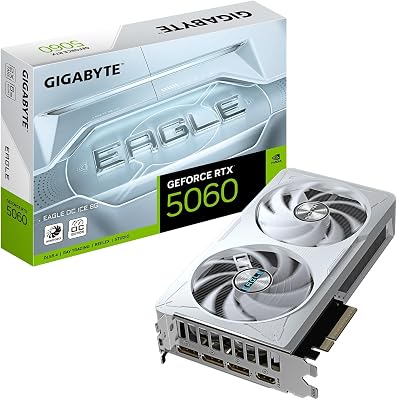


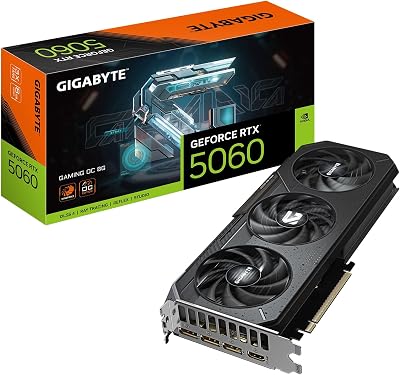
Gigabyte GeForce RTX 5060 OC searches usually mean you have picked the chip and are now lost inside Gigabyte’s catalogue. Eagle OC. Windforce OC. Gaming OC. OC Low Profile. Four names, one GPU, a $20 spread, and no obvious explanation of what separates them. This review answers that, explains what the OC badge is worth on a 145W card, and covers the reason this is the most pleasant GPU article to write in 2026: the RTX 5060 is the tier you can actually buy.
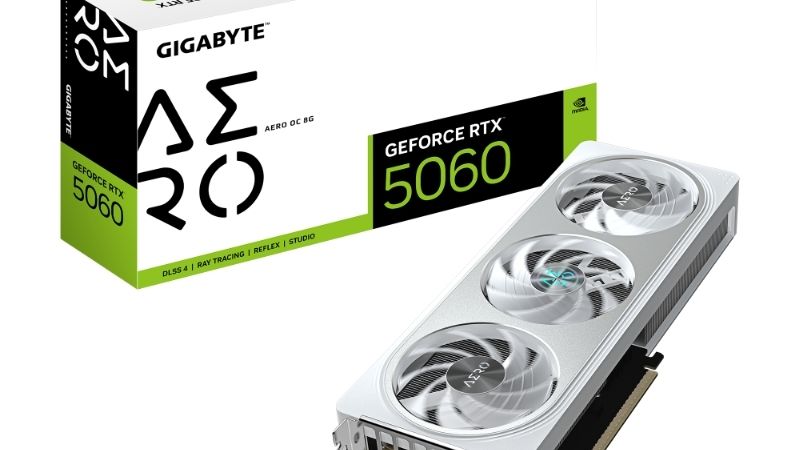
Gigabyte’s RTX 5060 Range Decoded
Gigabyte runs a tiered naming system across its whole GeForce line. Once you know the order, the catalogue stops being confusing — every card here carries identical silicon and the choice is cooler, size, and price.
As an Amazon Associate we earn from qualifying purchases at no extra cost to you.


The Ladder
Windforce sits at the value end — Gigabyte’s volume cooler, plain and effective. Eagle adds a slightly more considered design. Gaming sits above with a larger cooler and more RGB. AORUS tops the range, though Gigabyte does not always field one at this tier. Separately there is a Low Profile model, which is a different proposition entirely.
As of July 2026, Gigabyte’s RTX 5060 models have run roughly like this at major retailers:
| Model | Typical street price | Position |
|---|---|---|
| Windforce OC | ~$349–$370 | Value line |
| Eagle OC | ~$339–$359 | Volume line |
| Gaming OC | ~$359 | Larger cooler, RGB |
| OC Low Profile | ~$359 | SFF and prebuilt upgrades |
What Actually Differs
Nothing that makes frames. Every one of these is the same die at 3,840 CUDA cores, with 8GB of GDDR7 on a 128-bit bus at 448 GB/s and a 145W total board power.
Factory clocks differ by a few tens of MHz. On a card this size the difference lands in low single digits — frequently inside your own run-to-run variance, which on most systems is 2–4% between identical runs.
Note the pricing does not follow the ladder. Eagle has listed below Windforce at several retailers, which is the opposite of what the naming implies. Check both rather than assuming the “lower” line is cheaper.
Why 145W Makes the Cooler Question Easy
Here is the thing that settles this comparison. This is a 145W card.
Cooler quality matters enormously on a 360W RTX 5080, where a weak heatsink means throttling and a good one holds boost. At 145W there is simply not enough heat for a premium cooler to distinguish itself. Any competent design handles it.
So the $20 spread across Gigabyte’s range buys cooling headroom the card cannot use, plus aesthetics. That is a real product difference and a poor value proposition — take whichever is cheapest on the day and fits your case.
The Low Profile Model Is the Interesting One
Three of Gigabyte’s four models are variations on the same idea. The fourth solves a problem nothing else in the lineup does, and it is why this tier exists.
Who Actually Needs It
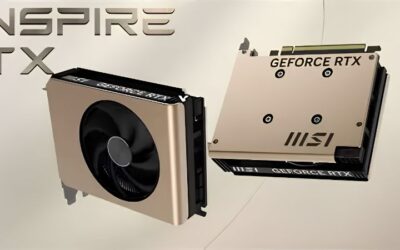
RTX 5060 buyers are disproportionately upgrading prebuilts and small-form-factor machines — office Dells, HP towers, compact ITX builds. Those cases frequently cannot take a standard dual-fan card at all, let alone a triple-fan one.
A low-profile card fits a slim chassis where nothing else will. That is not a nice-to-have; it is the difference between an upgrade being possible and not.
The 145W TBP is what makes it feasible. You cannot build a low-profile RTX 5080 — 360W has nowhere to go in that form factor. At 145W it works.
The Trade-Offs, Honestly
Low-profile coolers are smaller and run warmer and louder than full-height ones. On a 145W card that is manageable rather than problematic, but it is not free.
Check two things before ordering: whether your case needs the low-profile bracket fitted (usually included), and whether your PSU has the connector. Slim prebuilts frequently ship 300W supplies with no PCIe power at all, and the RTX 5060 needs around 550W of quality supply plus a proper 8-pin.
That PSU question is the one that stops these upgrades on the bench. In a slim OEM chassis, replacing the supply may not be possible at all, since many use proprietary form factors.
The PCIe Link Worth Checking
One more trap specific to prebuilt upgrades. Cards at this tier run a PCIe 5.0 x8 link rather than x16. On a modern board that is fine. On a PCIe 3.0 motherboard — which describes a great many of the machines this card is bought to upgrade — the narrower link costs measurable performance.
Check your motherboard’s PCIe generation before ordering. It is the most common unpleasant surprise at this tier and it is entirely avoidable.
Pros and Cons of the RTX 5060 Itself
Variant choice is secondary to whether this chip suits you. The honest assessment is that it is a good card in a bad market, which makes it look better than it is.
What It Does Well
1080p is its home ground and it is genuinely strong there. At that pixel load the 128-bit bus keeps up, and 3,840 Blackwell cores handle high and ultra settings with ray tracing enabled.
The full DLSS 4.5 stack including Multi Frame Generation is the real argument. Nvidia’s own figure is that DLSS 4.5 now draws 23 of every 24 pixels on screen. On a card this size that is not a bonus feature — it is what makes recent titles playable. And DLSS 5 arrives this autumn with real-time neural rendering, expected to require RTX 50 silicon.
145W is friendly. A quality 550W supply runs it, and it fits builds that could not take anything larger.
Where It Falls Short
8GB is the specification aging worst, and the criticism is fair. At 1080p high it is workable; enable ray tracing and Ultra texture packs and it starts filling, and the symptom is stutter in 1% lows rather than a lower average.
The generational uplift over the RTX 4060 is modest without frame generation — the headline multipliers depend on MFG, which is real but is not the same thing as raw performance.
And at street prices AMD’s RX 9060 class competes hard on rasterization, though it does not match DLSS.
What the OC Badge Is Worth
Little, and it is worth being specific. Gigabyte cannot change the silicon — an OC model is a stock card with a higher boost target written into its firmware and a cooler validated to sustain it.
A few tens of MHz on a card that is frequently memory-limited rather than core-limited yields low single digits. Measure your own variance first: run a fixed benchmark twice and compare. If your variance is 3% and the OC is worth 2%, the OC is undetectable on your machine.
MSI Afterburner is free, works on any card regardless of brand, and does more. Version 4.6.6 added official RTX 50 support and extended memory tuning considerably — and undervolting typically drops 10–20°C, which raises sustained clocks rather than peak ones. That is the thing a factory OC cannot give you.
Why This Is the Tier Worth Buying Right Now
Every other card review this year comes with a caveat about availability. This one does not, and the reason is worth understanding.
The 5060 Is What Nvidia Is Still Making
Component pricing has continued trending upward, memory foremost. The positive news is real but weak: the steep late-2025 climb has flattened, and Framework has reported a stretch of relative stability while still warning that volatility remains. New supply is opening — OEMs can source DDR5 from Chinese suppliers such as CXMT, and Micron is building two Idaho fabs — but neither produces until 2027–2028.
The consequence has been concentrated rather than uniform. At CES 2026, board partners reported the RTX 5070 Ti and RTX 5060 Ti 16GB as end of life while Nvidia disputed the claim; Nvidia’s allocation has visibly shifted toward 8GB parts.
The RTX 5060 is an 8GB part. It has stayed in normal supply and has held nearest to list of anything in the lineup — $299 MSRP trading around $339 as of July 2026. That is roughly 13% over list in a generation where the tier above has run 30–40% over and periodically vanished.
What That Means for You
The 8GB that reviewers criticise is the reason you can buy this card. A 16GB version would consume twice the GDDR7 modules, and that is precisely the product Nvidia’s allocation has been dropping.
So the weakness and the availability are the same fact viewed from two directions. That is an uncomfortable thing to write in a review and it is the truth.
Practically: you do not need to rush, and you do not need to wait either. This tier is not going anywhere and it is not getting cheaper — prices flattened rather than fell, and the supply that would push them down is three years out.
Who Should Buy It
Buy it if you game at 1080p, are upgrading a prebuilt or small case, and have or can fit a 550W supply. Take whichever Gigabyte variant is cheapest that fits — on a 145W card the cooler premium buys nothing.
Take the Low Profile only if you need it. It costs the same as the Gaming OC and runs warmer; it exists to solve a clearance problem rather than to be better.
Skip it if you game at 1440p and expect Ultra, or if you run local AI where 8GB restricts you — and check your motherboard’s PCIe generation and your PSU connector before ordering, because those are the two things that turn an easy upgrade into a return. It is worth comparing current listings across Gigabyte’s Eagle, Windforce, and Gaming variants, since the pricing does not follow the naming and the cheapest one is usually the right one.
See More:
- Nvidia beta
- Nvidia CUDA 11.8
- Check CUDA version
- Nvidia GPU for gaming
- PNY GeForce RTX 5080 16GB OC review
Final Verdict on the Gigabyte GeForce RTX 5060 OC
The Gigabyte GeForce RTX 5060 OC verdict is refreshingly simple. Every variant carries identical silicon, and at 145W there is not enough heat for a premium cooler to earn its premium — so take whichever of Eagle, Windforce, or Gaming is cheapest on the day, and note that the pricing does not follow the ladder. The Low Profile is the one genuinely different product, and it exists for slim cases where nothing else fits.
The OC badge is worth low single digits, frequently inside your own measurement noise. Afterburner is free and does more, particularly through undervolting, which raises sustained clocks rather than peak ones. And the wider point: this is the tier that stayed in stock and nearest to list while Nvidia’s 16GB cards were reported end of life — because 8GB uses half the memory modules. The specification reviewers criticise is the reason you can buy it, and in this market that counts for more than it should.
Frequently Asked Questions
What is the real difference between Eagle, Windforce, and the low profile model?
All three carry the same GB206 GPU and 8GB of GDDR7, so the silicon is identical. Eagle typically pairs a slightly higher factory boost clock with a more substantial cooler and shroud, Windforce is the value oriented dual-fan design, and the low profile version is a half height card for slim office cases with a much smaller heatsink and correspondingly higher noise and temperatures.
How much performance does the OC badge actually buy?
Factory overclocked 5060 cards usually run a boost clock a few dozen megahertz above reference, which translates to roughly one to three percent in games. That is inside run to run variance in many titles. Buy the model with the better cooler and the price you like, not the one with the highest number printed on the box.
What power supply and connector do these need?
Board power sits around 145W, and Nvidia recommends a 550W system supply. Full height Gigabyte 5060 cards use a single 8-pin PCIe connector. Low profile variants often run at reduced power limits and may use a smaller connector or none at all, so confirm the exact SKU before assuming your prebuilt supply is sufficient.
Will the low profile card fit a slim prebuilt?
It is designed for exactly that, but you must check three things: the bracket type included in the box, whether the card is dual slot even at half height, and whether your case has clearance behind the expansion slots. Many slim OEM chassis also restrict airflow badly, so expect the card to sit near its thermal limit and throttle slightly under sustained load.
Is 8GB enough, or should I wait for the Ti with 16GB?
For 1080p gaming with high rather than ultra textures, 8GB holds up in most current titles. If you play at 1440p, use heavy texture mods, or want the card to last several more years, the 16GB 5060 Ti is the more future proof purchase and its wider effective memory headroom is the single biggest practical difference between the two tiers.
Ready to decide? Our #1 pick for 2026 is the Windforce OC.
Live price & availability on Amazon.


Write Your Review
No reviews yet. Be the first to share your experience!