
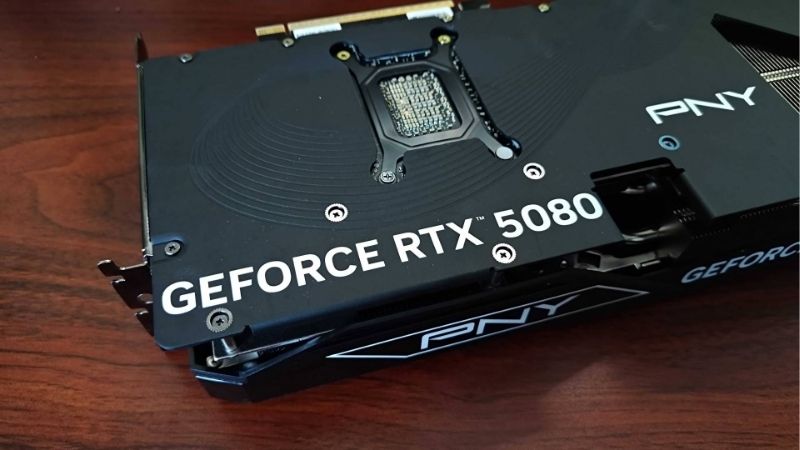
PNY GeForce RTX 5080 16GB OC review searches almost always start from the same place: you found this card listed noticeably below the ASUS and MSI equivalents, and you want to know what the catch is. It is a fair instinct. PNY does not get the review coverage the bigger board partners do, which leaves buyers guessing about a card that costs several hundred dollars. This review covers what the hardware actually is, how the OC bin compares to reference, what owners consistently praise and complain about, and whether the discount reflects a compromise or just a smaller marketing budget.
Quick answer: Our top pick in 2026 is the Part number — our #1 rated choice. See the full ranked comparison, alternatives and buying advice below.
What the PNY RTX 5080 16GB OC Actually Is
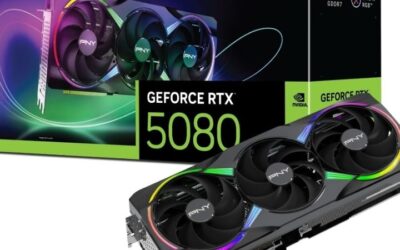
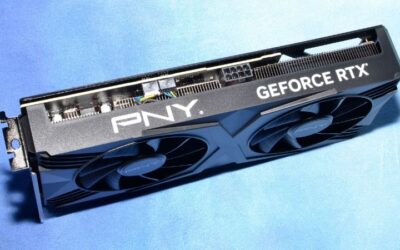
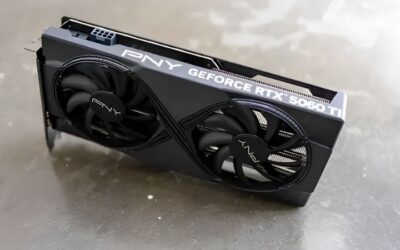
The card in question is PNY’s Overclocked Triple Fan model, part number VCG508016TFXPB1-O. PNY sells several RTX 5080 variants — a Slim dual-fan, an ARGB EPIC-X, and this Triple Fan OC — and they are not the same product despite similar names. Getting the part number right matters, because the boost clocks differ between them.
The Silicon: Identical to Every Other RTX 5080
Underneath, this is the same GB203-400 die every RTX 5080 uses. Blackwell architecture on a 4nm process, 378 mm² of die area, roughly 45.6 billion transistors. The configuration is 10,752 CUDA cores, 84 fourth-generation RT cores, 336 fifth-generation Tensor cores, 336 texture units, and 112 ROPs.
Memory is 16GB of GDDR7 on a 256-bit bus delivering 960 GB/s. Display outputs are three DisplayPort 2.1b and one HDMI 2.1. The interface is PCIe 5.0 x16.
This is worth stating plainly because it is the answer to the question most buyers are actually asking: no, PNY is not selling you weaker silicon. Board partners do not get different chips. What they differ on is the cooler, the power delivery, the factory clock, and the warranty.
Where the OC Bin Lands
The Triple Fan OC ships at a 2730 MHz boost clock. For context, PNY’s own ARGB EPIC-X model runs 2617 MHz — which is reference speed. That makes this the faster of PNY’s cards on paper, by roughly 113 MHz.
Be realistic about what that buys you. A 113 MHz boost delta on a card that boosts past 2.6 GHz is roughly a 4% clock increase, and clock increases do not translate one-to-one into frame rates because the card is frequently limited by memory bandwidth or power rather than core clock. Expect low single digits in practice.
| Spec | PNY RTX 5080 OC Triple Fan |
|---|---|
| Part number | VCG508016TFXPB1-O |
| GPU | GB203-400, Blackwell, 4nm |
| CUDA cores | 10,752 |
| RT / Tensor cores | 84 / 336 |
| Boost clock | 2730 MHz |
| Memory | 16GB GDDR7, 256-bit, 960 GB/s |
| Slot width | 2.99 slots |
| Power connector | 1x 16-pin (3x 8-pin adapter) |
| PSU requirement | 850W minimum |
| Outputs | 3x DP 2.1b, 1x HDMI 2.1 |
| Reference MSRP | $999 |
Physical Fit: The Spec That Actually Bites
This is where the review gets practical, and where the most useful owner feedback lives. The card is 2.99 slots wide — PNY’s own documentation asks for a motherboard with a 3.0-width x16 slot clearance. That is three expansion slots gone.
Owner reports on this card are consistent and blunt about its size. One buyer described having to remove their CPU cooler and reroute several cables just to create a path to get the card into the case. That is not a defect — it is a large triple-fan cooler doing its job — but it is the single thing most likely to ruin your afternoon.
Measure before you buy. Check your case’s maximum GPU length, confirm you have three slots of clearance below the x16, and look at where your front radiator or drive cage sits. This applies to every triple-fan RTX 5080, not just PNY’s, but it applies here in full.
Performance and Power in Practice
Because the silicon is identical across board partners, performance conversations about a specific AIB card are really conversations about sustained clocks and thermals. A cooler that holds boost under load performs better than one that throttles, and that is the whole of the difference.
Where the RTX 5080 Lands
The RTX 5080 sits between the RTX 5070 Ti and the RTX 5090, closer to the former than the naming implies. It carries 20% more CUDA cores than the 5070 Ti and roughly 7% more bandwidth, which typically translates to a 10–14% frame rate advantage at 1440p and 4K.
At 4K with DLSS 4 Quality, this is a comfortable maximum-settings card in current titles with ray tracing enabled. At 1440p it is beyond what most panels can display without Multi Frame Generation. Native 4K path tracing is where it starts to strain — that remains RTX 5090 territory.
The 16GB of VRAM is adequate today and is the card’s most debated long-term limitation, particularly given the rumoured SUPER refresh would move this tier to 24GB. That refresh has slipped toward late 2026 or CES 2027 on GDDR7 supply constraints, so it is not a near-term alternative.
The forward-looking argument is stronger than the specs suggest. DLSS 4.5 already draws 23 of every 24 pixels by Nvidia’s own figure, and DLSS 5 arrives this autumn with real-time neural rendering — a different proposition from upscaling, adding photoreal lighting and materials rather than more frames. Nvidia has not confirmed hardware requirements, but the GTC demos ran on RTX 5090s and RTX 50 silicon is the expectation. If that holds, this card is on the right side of a line that RTX 40 owners are not.
Power Delivery and PSU Requirements
PNY specifies an 850W system power supply minimum and three 8-pin supplementary connectors. The card itself uses the 16-pin 12V-2×6 connector; the three 8-pin figure refers to the included adapter.
The RTX 5080 runs a 360W TDP, and transient power spikes on Blackwell cards can substantially exceed the rated figure for brief periods. An 850W unit is not conservative padding — it is the floor. If your PSU is a 750W unit that has been running an RTX 3080, plan on replacing it rather than hoping.
If your supply predates ATX 3.x, use the included adapter and seat it fully. Partially seated 16-pin connectors remain the most common cause of melted connector reports across the entire RTX 40 and 50 generation, and it is a user-installation issue rather than a card defect.
Thermals, Noise, and the Triple-Fan Cooler
The triple-fan design with its large heatsink is why the card is 2.99 slots thick, and it is the trade-off PNY made: bulk in exchange for cooling capacity. Owner feedback on thermal performance is broadly positive — the card holds its boost under sustained load in cases with reasonable airflow.
Noise is the more variable report. A 360W card moving that much heat is not silent under load, and users transitioning from a lower-tier card frequently comment on the change. In a well-ventilated case it sits within normal expectations for the tier; in a cramped or poorly ventilated build the fans work harder and it becomes noticeable.
Pros and Cons from Real Owner Reports
This is the section that matters most for a card with thin professional review coverage. Reading across 4–5 star and 2–3 star owner reports produces a consistent picture, and it is more favourable than the price gap would lead you to expect.
What Positive Reviews Consistently Praise
Raw performance is the dominant theme, particularly from buyers upgrading across multiple generations. Users coming from an RTX 3080 Ti or similar describe the jump to 4K maximum settings as substantial — which it is, since it spans two architectures plus the DLSS 4 feature set.
The second recurring positive is that the card simply works. No coil whine complaints dominating the reviews, no widespread driver quirks specific to PNY, no dead-on-arrival cluster. For a board partner buyers are nervous about, “unremarkable” is high praise.
Third is value. PNY consistently prices below ASUS TUF, MSI Gaming Trio, and Gigabyte AORUS on equivalent silicon. In a market where the RTX 5080’s $999 MSRP has translated to street prices from roughly $1,249 upward as of July 2026, a card that sits at the bottom of that band is not a compromise — it is the closest thing to buying at list.
What the Complaints Reveal
Size dominates. The 2.99-slot thickness and overall length generate more negative feedback than any other attribute, and the complaints are about installation difficulty rather than product failure. This is entirely predictable from the spec sheet and entirely avoidable by measuring first.
The second theme is PSU surprises — buyers who did not read the 850W requirement, or who assumed their existing unit would cope. This produces instability that gets attributed to the card.
The third is aesthetics and software. PNY’s cooler design is plain compared to the RGB-heavy competition, and PNY does not ship a tuning utility with the polish of MSI Afterburner or ASUS GPU Tweak. Neither affects frame rates; both affect satisfaction if you expected otherwise.
PNY vs ASUS and MSI: Is the Discount a Trap?
The honest answer is no, with one qualification. You get identical silicon, a competent triple-fan cooler, and a factory OC that is modest but real. What you give up is cosmetic polish, software ecosystem, and the brand’s resale premium.
The qualification is warranty and support. PNY’s RMA process has a thinner reputation than the larger partners’, which matters more on a card at this price than on a $300 one. Register the card, keep the receipt, and factor this into the discount rather than treating it as free money.
| Factor | PNY OC Triple Fan | ASUS TUF / MSI Gaming Trio |
|---|---|---|
| Silicon | GB203-400, identical | GB203-400, identical |
| Boost clock | 2730 MHz | Similar, varies by model |
| Cooling | Adequate, holds boost | Marginally better, larger |
| Price position | Bottom of the street band | $100–$200 higher typically |
| Aesthetics / RGB | Plain | Extensive |
| Software suite | Basic | Mature tuning utilities |
| RMA reputation | Adequate, thinner | Stronger |
Market Timing: Should You Buy This Card Now?
The specs settle whether the card is good. The market settles whether now is the moment, and that question has a clearer answer in 2026 than it did a year ago.
Why the PNY Discount Matters More Than It Used To
Component pricing has continued trending upward, with memory as the dominant pressure. The positive signals are real but modest: the steep late-2025 climb has flattened, and Framework has reported a period of relative stability while still flagging that volatility remains. New supply is coming — OEMs can source DDR5 from Chinese suppliers such as CXMT, and Micron is building two Idaho fabs — but those plants do not produce until 2027–2028.
For this card specifically, that changes the calculus. When every RTX 5080 sold above MSRP, the board partner charging least stops being the budget option and becomes the only one selling near list. PNY’s traditional weakness — less marketing, less brand premium — is precisely why its price sits where it does. In a normal market that is a reason to hesitate. In this one it is the point.
What the H200 China Decision Signals
The United States has approved Nvidia selling the H200 into China. The relevance to a GeForce buyer is allocation: consumer cards and datacentre accelerators draw on the same constrained advanced packaging capacity and high-bandwidth memory supply. Handing Nvidia’s highest-margin product line a large new market does not empty shelves by itself, but it removes the downward pressure that would normally correct GPU pricing.
Nor is a better option arriving soon. The RTX 5080 SUPER, rumoured to move this tier to 24GB, has slipped toward late 2026 or CES 2027 with GDDR7 supply named as the constraint. Waiting for it means waiting on an unannounced product with a bill of materials the market cannot currently supply.
Who Should Buy It
Buy this card if you want RTX 5080 performance at the lowest street price available, you have measured your case for a 2.99-slot card, and you have an 850W or better supply. You are getting the same chip as everyone else for less money.
Skip it if your case is compact, if your PSU is 750W or below and you have not budgeted a replacement, or if RGB and a polished tuning suite are part of what you are paying for. And if you are gaming at 1440p rather than 4K, look one tier down first — the RTX 5070 Ti delivers 85–90% of this card’s performance and the price gap is real money.
If you have measured and the card fits, checking current listings is worth doing sooner rather than later — the PNY variants move at the bottom of the price band, which is exactly why they go out of stock first.
See More:
Final Verdict on the PNY GeForce RTX 5080 16GB OC
The PNY GeForce RTX 5080 16GB OC review verdict is straightforward once you strip away brand anxiety: this is the same GB203-400 silicon, the same 10,752 CUDA cores, the same 16GB of GDDR7 at 960 GB/s as any other RTX 5080, wrapped in a competent triple-fan cooler with a modest 2730 MHz factory OC. The discount does not come from cutting corners on the parts that make frames. It comes from PNY spending less on marketing and RGB.
The two things that will actually cause you problems are physical: 2.99 slots of clearance and an 850W power supply. Measure and check both before ordering, and the card becomes exactly what it looks like — the cheapest legitimate route to this performance tier in a market where MSRP stopped being a real price. If your case and PSU can take it, the brand premium you are declining to pay is the best deal on the shelf.

Write Your Review
No reviews yet. Be the first to share your experience!