
- Top Pick: ASRock Radeon RX 9070 Challenger 16GB OC Graphics Card, RDNA 4, 2520MHz Boost, 16GB GDDR6 256-bit, PCIe 5.0, Triple Fans, 0dB Silent, LED Indicator
- Best Value: GIGABYTE Radeon™ RX 9070 XT Gaming OC ICE 16G Graphics Card (16GB GDDR6, 256-bit, PCIe 5.0, HDMI/DP 2.1, 2.7 Slot, Hawk Fan, Server-Grade Thermal Gel, Reinforced Structure)
- Premium Choice: GIGABYTE GeForce RTX 5080 Gaming OC 16G Graphics Card, WINDFORCE Cooling System, 16GB 256-bit GDDR7, GV-N5080GAMING OC-16GD Video Card

Best Seller
XFX Swift AMD Radeon RX 9070XT Triple Fan Gaming Edition with 16GB GDDR6 HDMI 3xDP, AMD RDNA 4 RX-97TSWF3BA


RX 9070 vs RTX 5080 is the comparison people run after they have already watched the reviews. You know the 5080 is faster. What you are trying to work out — with three tabs open and a spreadsheet somewhere — is whether roughly $450 more is proportionate, or whether it is the same diminishing-returns trap that every tier above mid-range sets. This page gives you the thing the videos cannot: dollars per frame calculated explicitly, the hidden costs that never appear on a spec sheet, and an honest account of where each card stops making sense.
The Quick Verdict: RX 9070 vs RTX 5080 in One Minute
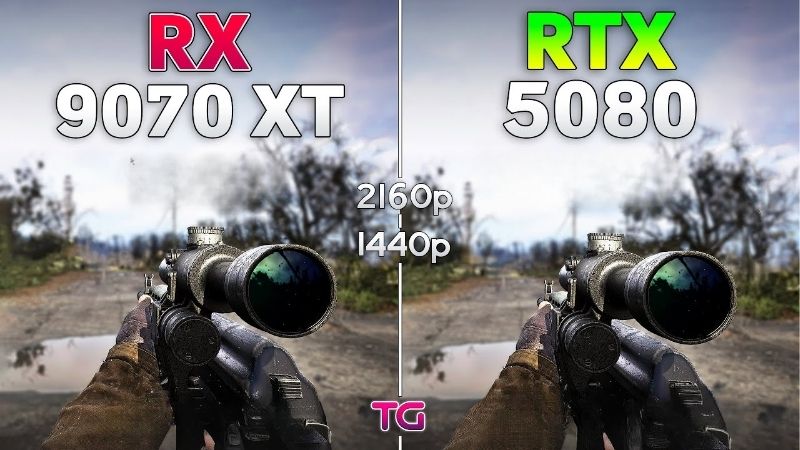
The RTX 5080 is roughly 45-55% faster and costs roughly 80% more. That ratio tells you most of what you need. The RX 9070 wins price per frame decisively and is the right card for 1440p high refresh or 4K 60 with FSR 4 enabled. The RTX 5080 is the right card if you have a 4K high refresh panel, if ray tracing matters to you, or if you want to stop thinking about settings entirely. Both carry 16GB, so neither has a VRAM advantage — this is purely a speed-versus-money question, which makes it cleaner than most comparisons. If your monitor is 1440p, the 9070 is the answer and the 5080 is money spent on headroom you cannot display.
As an Amazon Associate we earn from qualifying purchases at no extra cost to you.


Who Should Buy the RX 9070
Buy the 9070 if your monitor is 1440p at any refresh rate. It clears 100+ FPS at 1440p in nearly everything with FSR 4 Quality, which saturates a 144Hz panel. Spending $450 more to generate frames a 1440p display cannot show is not a value judgement, it is arithmetic.
Buy it if your PSU is 650-750W. At roughly 220W the 9070 is remarkably efficient — genuinely one of the standout numbers in this generation — and it runs on supplies the 5080’s 360W would strain. If a PSU upgrade is on the table, add $150 to the 5080’s real price.
And buy it if you upgrade on a three-year cycle. Two $550 cards across six years buys you a full architecture generation in the middle, which beats one $1,000 card sitting still.
Who Should Buy the RTX 5080
Buy the 5080 if your monitor is 4K, particularly 4K at 120Hz or above. This is the card’s actual purpose and it does the job without compromise — high settings across essentially everything, with DLSS 4.5 multi-frame generation available for the high refresh case.
Buy it if ray tracing is something you actually enable rather than something you read about. The gap in RT workloads is far larger than the raster gap, and in heavier titles it is the difference between a slideshow and a game.
And buy it for compute. Blender, DaVinci Resolve, Stable Diffusion, local model inference — CUDA’s ecosystem advantage over ROCm remains substantial, and for anyone whose GPU occasionally has to earn money, that is not a tiebreaker, it is the whole decision.
What Both Cards Share, and Why That Simplifies This
Worth stating because it removes the usual complication: both have 16GB. Neither will hit a VRAM wall before the other. Neither has a memory-capacity argument to make.
That is unusual and it is helpful. Most GPU comparisons are secretly VRAM arguments wearing a performance costume — the RTX 2070 versus RTX 3060 matchup is a pure example, where the slower card wins because the faster one runs out of memory. Here that layer is absent. What you are comparing is speed against price, cleanly, with no hidden asterisk.
The 16GB figure is comfortable at 4K today and will be adequate rather than generous by 2028. That applies equally to both, so it does not move the decision either way.
Specs and Real Frame Rates Side by Side
The specification gap is large but the memory rows are identical, which is unusual for cards $450 apart. Read the bandwidth and shader rows together — they explain the entire performance difference.
Core Specifications Compared
| Specification | RX 9070 | RTX 5080 |
|---|---|---|
| Architecture | RDNA 4 (Navi 48) | Blackwell (GB203) |
| Shader units | 3,584 | 10,752 |
| VRAM | 16GB GDDR6 | 16GB GDDR7 |
| Memory bus | 256-bit | 256-bit |
| Bandwidth | ~645 GB/s | ~960 GB/s |
| Upscaler | FSR 4 | DLSS 4.5 |
| Frame generation | FSR 4 FG | DLSS 4.5 MFG (up to 6X) |
| Board power | ~220W | ~360W |
| Power connector | 2x 8-pin | 1x 12V-2×6 |
| PSU recommended | 650W | 850W |
| Launch price | ~$549 | ~$999 |
The power row deserves more attention than it usually gets. 220W against 360W is a 64% difference, and it is the 9070’s most underrated specification. It means less heat in the room, a quieter build, lower running costs, and — critically — no PSU upgrade for most people.
Same bus width, different memory generation: GDDR7 gives the 5080 960 GB/s against 645 GB/s. That 49% bandwidth advantage is doing a large share of the work at 4K, where the working set stops fitting in cache.
1440p and 4K Frame Rates, and the Dollars Per Frame
Native, high presets, no upscaling. Both resolutions shown because the answer genuinely differs between them.
| Game | RX 9070 (1440p) | RTX 5080 (1440p) | RX 9070 (4K) | RTX 5080 (4K) |
|---|---|---|---|---|
| Cyberpunk 2077 | ~88 FPS | ~132 FPS | ~45 FPS | ~72 FPS |
| Alan Wake 2 | ~72 FPS | ~108 FPS | ~38 FPS | ~60 FPS |
| Black Myth: Wukong | ~68 FPS | ~100 FPS | ~35 FPS | ~56 FPS |
| Horizon Forbidden West | ~112 FPS | ~162 FPS | ~58 FPS | ~90 FPS |
| Call of Duty (recent) | ~145 FPS | ~205 FPS | ~82 FPS | ~126 FPS |
| Counter-Strike 2 | ~265 FPS | ~360 FPS | ~180 FPS | ~248 FPS |
Now the number this whole page exists to produce. At 4K, averaging this set: the 9070 delivers roughly 73 FPS at $549, or under $10 per frame. The 5080 delivers roughly 109 FPS at $999, or under $10 per frame — about 22% more expensive per frame.
That 22% is the honest answer, and it is far better than most tier jumps. Compare it to the RTX 5090, which runs roughly double the 9070’s cost per frame. The 5080 is not a bad-value card; it is a card whose value depends entirely on whether you have a display that can show what it produces.
The Hidden Costs Nobody Puts in the Comparison
The $450 gap is not the real gap, and this is where a page beats a video.
If your PSU is 650-750W, the 5080 needs an 850W replacement — add $150. If it is an older unit without a native 12V-2×6 cable, you are using the bundled three-way 8-pin adapter, which needs bend clearance above the card. And at 360W against 220W, running eight hours a day at typical electricity rates, the 5080 costs roughly $30-60 more per year depending on your region — call it $100-180 over three years.
Stack those and the real-world gap for a buyer on a 750W supply is closer to $700 than $450. That does not kill the 5080’s case, but it does change the arithmetic, and no benchmark chart will do this sum for you.
Deep Dive Face-Off: Where the Extra Money Actually Goes
The averages conceal an uneven picture. In some workloads the gap is 35%; in others it is over 70%. Which bucket your games fall into decides whether the $450 is well spent or wasted.
Rasterization and the Resolution Question
In pure raster the 5080 leads by roughly 45-55%. Proportionate to a card with three times the shaders, tempered by RDNA 4’s efficiency and clock behaviour.
But look at the 1440p column again. The 9070 hits 88-145 FPS in demanding titles and 265 in CS2. On a 1440p 144Hz panel, both cards saturate the display in most of what you play. The 5080’s extra frames are real and entirely invisible. At 4K the picture inverts: the 9070’s 35-45 FPS in heavy titles needs FSR 4 to become comfortable, while the 5080’s 56-72 does not.
This is why the monitor question comes before the GPU question. The same $450 is either well spent or completely wasted depending on what you plug into.
Ray Tracing, FSR 4 and DLSS 4.5
RDNA 4 closed a large part of AMD’s historic RT deficit, and the 9070 is genuinely competitive in light RT titles. In heavy path-traced workloads the 5080 still pulls far ahead — Blackwell’s dedicated RT cores and shader execution reordering do work AMD has no direct equivalent for.
On upscaling, the gap is narrower than AMD’s reputation suggests. FSR 4 on RDNA 4 is a real generational leap and at 1440p Quality the difference from DLSS is now something you look for rather than something you notice. This is the 9070’s quiet advantage over its own RDNA 3 predecessors, and it is why the 9070 is a fundamentally different value proposition from a 7700 XT.
Where the 5080 separates is multi-frame generation. DLSS 4.5 runs fixed 5X and 6X modes plus a Dynamic mode that shifts the multiplier in real time to match your display’s refresh rate. One restriction worth knowing before you buy on this basis: Dynamic mode is not compatible with frame rate limiters or V-Sync, which catches people who cap frames by habit.
Pros and Cons of Each Card
| RX 9070 | RTX 5080 | |
|---|---|---|
| Pros | 22% cheaper per frame; 220W is the standout efficiency figure this generation; runs on a 650W PSU with 2x 8-pin; FSR 4 closed most of the upscaling gap; saturates any 1440p panel; leaves $450 for a monitor | 45-55% faster raster, far more in RT; 960 GB/s on the same bus; DLSS 4.5 with 5X/6X MFG; the sensible 4K card; CUDA for compute; stronger resale |
| Cons | Needs FSR 4 to be comfortable at 4K; heavy ray tracing is out of reach; ROCm still trails CUDA badly for compute | Costs 80% more for 45-55% more frames; 360W plus a likely PSU upgrade adds ~$150; 12V-2×6 adapter is bulky; pointless below 4K; ~$100-180 more in power over three years |
Read the two cons columns and the decision is really one question: do you own a 4K display? If yes, the 5080’s cons are manageable costs. If no, they are pure waste.
Market Reality Behind Both Prices
Everything above assumes these prices hold. They have been anything but stable, and at this spending level the market direction deserves as much attention as the frame rates.
Why Neither Card Is Drifting Toward a Discount
Component and laptop prices have kept trending upward rather than settling, and 16GB cards sit squarely in the path of that pressure. The 5080’s GDDR7 is newer, made by fewer suppliers, and priced accordingly — which is precisely why the 5080 has held near its launch price rather than following the usual second-year drift downward.
The 9070 is somewhat insulated. GDDR6 supply is more mature and AMD is not diverting Navi 48 wafers to AI customers the way Nvidia allocates its largest dies. That is a genuine structural point in the 9070’s favour, and it is not visible in any benchmark.
The practical read: the $450 gap is more likely to hold or widen than to close. Waiting for the 5080 to meet you halfway is a plan without evidence behind it.
Prices Have Flattened, Not Fallen
The positive news is real and deserves precision rather than optimism. The sharp climb of late 2025 has eased. Framework, which publishes unusually candid component pricing updates, has reported a stretch of relative stability while still warning that volatility persists. That is stabilisation, not a decline.
Genuine new supply is coming. OEMs can now source DDR5 from Chinese manufacturers such as CXMT, and Micron is constructing two fabs in Idaho. Both add real capacity to a constrained market. Neither begins production before 2027-2028, which places them well outside the horizon of a decision you are making this month.
So: flat, not falling, with relief two to three years out. For a $549 card that argument is mild. For a $999 card with a possible $150 PSU attached, it is the difference between buying now and losing a year of use to save nothing.
The Alternative: The Card Between Them
If the 9070 feels light for 4K but the 5080 is a stretch, two options sit in the gap. The RX 9070 XT adds roughly 15% over the 9070 for around $50 more and is arguably the better buy of the two AMD cards. The RTX 5070 Ti lands between on price with 16GB and full DLSS 4.5 support including multi-frame generation.
The 5070 Ti in particular is the card many people searching this comparison actually want: Nvidia’s feature set, 4K capability with upscaling, without the 360W and the PSU replacement. Compare current pricing and stock across the 9070, 9070 XT, 5070 Ti and 5080 before you commit — the ordering between them moves month to month, and the card that made sense last quarter may not be the one that makes sense now.
See More:
- GTX 1650 vs RTX 3050
- Nvidia DIGITS
- Nvidia cuDNN
- Radeon RX 9070 XT vs RTX 5090
- PNY GeForce RTX 5080 review
Final Verdict: RX 9070 vs RTX 5080
The rx 9070 vs rtx 5080 decision comes down to one question you can answer without reading another benchmark: what resolution is your monitor? At 1440p, buy the RX 9070. It saturates any 144Hz panel, costs 22% less per frame, draws 220W on a power supply you already own, and FSR 4 has closed enough of the upscaling gap that the old AMD compromise argument no longer applies. The $450 you keep buys a better monitor or a CPU upgrade — both of which will improve your experience more than the 5080 would at that resolution.
At 4K, or if you actually enable ray tracing, or if your GPU sometimes has to earn money in Blender or a model, buy the RTX 5080. It is the sensible 4K card and its 22% price-per-frame premium is genuinely reasonable for what it delivers. Just budget honestly: with a PSU upgrade and three years of power, the real gap is closer to $700 than $450. With pricing flat rather than falling, check current stock on both and buy whichever fits the display you actually own.
Frequently Asked Questions
Does the RTX 5080 justify roughly 450 dollars more?
For 4K high refresh gaming and heavy ray tracing, yes, since the 5080 is comfortably faster and adds DLSS 4 multi frame generation. For 1440p gaming the RX 9070 delivers most of the experience for far less money, and the saving buys a better monitor, CPU or power supply that you will notice more.
How do the specifications compare?
The RX 9070 is an RDNA 4 card with 16GB of GDDR6 on a 256-bit bus and around 220W board power. The RTX 5080 is Blackwell with 16GB of GDDR7 on a 256-bit bus, roughly 960GB/s of bandwidth and 360W. Capacity is equal, but the 5080 has far more bandwidth and shader throughput.
What is the ray tracing gap?
RDNA 4 closed much of AMD historic deficit, so in light and moderate ray tracing the 9070 is respectable. In path traced titles such as Cyberpunk 2077 overdrive mode or Alan Wake 2, the 5080 remains substantially ahead, and DLSS ray reconstruction widens the image quality gap further at the same frame rate.
What power supply does each need?
The RX 9070 at around 220W is happy on a good 650W to 750W unit with two 8-pin connectors. The RTX 5080 at 360W wants 850W and a native 12V-2×6 cable from an ATX 3.0 or 3.1 supply. Factor the cost of a PSU upgrade into the 5080 total price if yours is older.
Which upscaling technology is better now?
DLSS 4 with the transformer model still holds an edge in fine detail and motion stability, and multi frame generation has no AMD equivalent for raw frame multiplication. FSR 4 on RDNA 4 narrowed the gap considerably and is genuinely good, but its game support list is shorter than DLSS.
Ready to decide? Our #1 pick for 2026 is the Architecture.
Live price & availability on Amazon.

Write Your Review
No reviews yet. Be the first to share your experience!