


9070 vs 5080 is the matchup on every upgrader’s mind right now, pitting AMD’s value-focused Radeon RX 9070 against Nvidia’s high-end GeForce RTX 5080. They do not sit at the same price, and that is exactly what makes the comparison useful: one chases the best frames per dollar, the other chases outright performance and the deepest feature set. This breakdown gives you the quick verdict, a clean spec table, a feature-by-feature face-off, a cheaper alternative, and a clear recommendation on which card actually fits your build and budget in 2026.
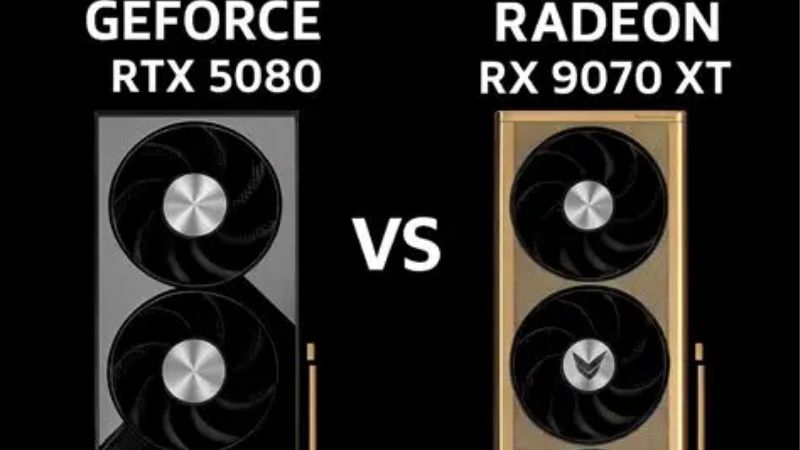
Quick answer: Our top pick in 2026 is the Architecture — our #1 rated choice. See the full ranked comparison, alternatives and buying advice below.
The Quick Verdict: RX 9070 vs RTX 5080
For readers who want the answer without scrolling: the RTX 5080 is the faster card in almost every scenario, especially at 4K and in ray tracing, while the RX 9070 delivers far more performance per dollar and is the smarter buy for mainstream 1440p gaming. You are not really choosing the “better” GPU; you are choosing which trade-off matches your wallet and your monitor.
If You Want Raw Power
The RTX 5080 wins the horsepower contest. Its Blackwell architecture, faster GDDR7 memory, and stronger ray tracing hardware make it the clear pick for 4K high-refresh gaming and heavy creative work.
If your goal is maxing settings at 4K, driving a 240 Hz panel, or running demanding ray-traced titles without compromise, the 5080 is built for exactly that and the 9070 is not trying to compete there.
Creative professionals should weigh this heavily too. Faster memory and stronger compute make the 5080 the better tool for 4K video editing, 3D rendering, and AI-assisted workflows, where the extra bandwidth shortens export and render times in a way you feel every day.
If You Want the Best Value
The RX 9070 flips the script on cost. It typically lands at a substantially lower price while still delivering excellent 1440p and solid 4K rasterized performance.
For the majority of gamers on a 1440p 144 Hz setup, the 9070 provides the frames that matter at a price that leaves room in the budget for a better monitor, faster storage, or simply money saved.
The savings are not just theoretical. The money you keep by choosing the 9070 can fund a higher-refresh monitor or a faster SSD, upgrades that often improve the felt experience more than a raw GPU performance bump at the same resolution.
The Short Answer for Most Gamers
Most people should buy based on resolution. Gaming at 1440p on a sensible budget? The RX 9070 is the value champion. Committed to 4K, ray tracing, and the fullest feature set, with the budget to match? The RTX 5080 earns its premium.
Everything below explains why, so you can be confident the card you click “buy” on is the one you will still be happy with two years from now.
There is also a longevity angle. The 5080’s extra performance headroom means it will stay comfortable at high settings for more years, while the 9070 is the card you buy to get excellent frames now without paying for headroom you may not use.
RX 9070 vs RTX 5080 Spec Comparison
Specs do not tell the whole story, but they frame the entire debate. The table below lines up the core numbers so you can see at a glance where each card invests its silicon and its power budget. Treat these as representative figures for planning; exact models and clocks vary by board partner.
| Specification | AMD Radeon RX 9070 | Nvidia GeForce RTX 5080 |
|---|---|---|
| Architecture | RDNA 4 | Blackwell |
| VRAM | 16 GB GDDR6 | 16 GB GDDR7 |
| Memory bus | 256-bit | 256-bit |
| Typical board power | ~220 W | ~360 W |
| Ray tracing | Improved RDNA 4 RT | 4th-gen RT cores |
| Upscaling | FSR | DLSS 4 (multi-frame gen) |
| Recommended PSU | ~650 W | ~850 W |
| Best target resolution | 1440p, entry 4K | 4K high-refresh |
| Positioning | Value / mainstream | High-end / premium |
Reading the Spec Table
The headline is that both cards carry 16 GB of memory on a 256-bit bus, so neither will run short on VRAM for gaming any time soon. The difference is the memory type: the 5080’s GDDR7 offers meaningfully higher bandwidth than the 9070’s GDDR6, which helps at 4K and in bandwidth-hungry workloads.
The power gap is the other big signal. The 5080 pulls roughly 60 percent more board power, which translates directly into performance but also into a bigger PSU, more heat, and a larger cooler.
Notice too that neither card is memory-starved for gaming. The 16 GB pool on both is enough for current titles at their target resolutions, so the memory debate here is really about bandwidth and speed rather than raw capacity.
Memory and Bandwidth
Equal capacity does not mean equal capability. GDDR7 on the 5080 moves data faster, and that bandwidth advantage widens as resolution climbs, which is a core reason the 5080 pulls ahead most decisively at 4K.
For 1440p, though, the 9070’s GDDR6 is plenty. At that resolution the memory system is rarely the limiting factor, so the value card gives up little where most gamers actually play.
For creators, that bandwidth gap matters more than for gamers, since large project files and high-resolution timelines lean on memory throughput, which is another reason the 5080 pulls ahead in professional use.
Power and Cooling Requirements
This is where practicality bites. The RX 9070’s roughly 220 W draw fits comfortably in a mainstream build with a 650 W supply and a mid-size case. It runs cooler and quieter with less airflow, which matters in compact systems.
The RTX 5080’s roughly 360 W appetite demands an 850 W-class PSU, strong case airflow, and physical room for a chunky triple-fan cooler. Before you choose the 5080, confirm your case length, PSU wattage, and connector type, because an upgrade that will not fit or power on is no upgrade at all.
Efficiency also affects your running costs and comfort. The 9070’s lower draw means less heat dumped into your room and a quieter system under load, which is easy to overlook on a spec sheet but very noticeable during long gaming sessions.
Deep Dive Face-Off: Performance, Features, and Price
Numbers on a page only matter once you translate them into the experience you will actually have while gaming. Here we pit the two cards against each other on the criteria that decide satisfaction: rasterized performance, ray tracing and upscaling, and the honest pros and cons of living with each one.
Rasterized Gaming Performance
In traditional rasterized games, the RTX 5080 is the stronger performer, comfortably ahead at 4K where its bandwidth and shader power stretch their legs. Expect it to hold high frame rates in demanding titles that would push the 9070 to dial settings back.
At 1440p, the gap narrows in practical terms. Both cards produce high, smooth frame rates, and many players would struggle to tell them apart in fast-paced games. The 9070 delivers the vast majority of the playable experience at a fraction of the cost, which is the heart of its value argument.
Frame pacing is worth a mention alongside raw averages. Both cards deliver smooth, consistent frame times in well-optimized games, so the difference you notice is less about stutter and more about how high you can push settings before the frame rate dips.
Ray Tracing and Upscaling: DLSS 4 vs FSR
Ray tracing is Nvidia’s stronghold. The 5080’s fourth-generation RT cores handle heavy path-traced and ray-traced titles with more headroom, and this is the clearest win in the 5080’s column. RDNA 4 improves AMD’s ray tracing significantly, but the 5080 still leads.
Upscaling widens that lead further. Nvidia’s DLSS 4 with multi-frame generation is a genuine experimental edge, using AI to insert frames and lift smoothness in supported games. AMD’s FSR is capable and constantly improving, and it works across more hardware, but Nvidia’s AI-driven approach and future optimization roadmap remain the more advanced ecosystem today.
The practical question is how much you value these features. If you play mostly competitive or esports titles, ray tracing rarely enters the picture and the 9070’s value shines. If you love single-player showcase games with full ray tracing, the 5080’s lead becomes something you see on screen every session.
Pros and Cons of Each Card
The RX 9070’s strengths are clear: outstanding value, lower power and heat, easy fit in mainstream builds, and excellent 1440p performance. Its trade-offs are weaker ray tracing than the 5080 and an upscaling stack that trails Nvidia’s AI features, though for many buyers those matter less than the price saved.
The RTX 5080’s pros are raw speed, class-leading ray tracing, DLSS 4, faster GDDR7, and a strong creative-work profile. The cons are the higher price, the roughly 360 W power draw, and the need for a beefier PSU and case. In short, the 9070 wins on efficiency and cost, the 5080 wins on performance and features, and your priorities decide the tie-break.
Pricing in 2026 and the Value Question
A GPU decision this size is really a budget decision, and the 2026 market has a specific shape you should factor in before you commit. The pricing backdrop affects not just what you pay, but whether waiting makes any sense at all.
Where GPU Prices Stand Now
The steep price climb that defined late 2025 has cooled, and the market has entered a relatively stable phase, a welcome pause after a long stretch of increases. That stability makes buying now less risky than it felt a few months ago.
But stable is not cheap. Prices have plateaued rather than fallen, and memory-heavy high-end cards like the 5080 still carry premium pricing. New supply is on the way, including additional DDR5 sourcing and Micron’s new Idaho fabs, yet those facilities are not expected to run until roughly 2027 to 2028. Real relief is years out, so holding your purchase in hope of a near-term crash is a weak strategy.
This backdrop reframes the value math. When high-end cards stay expensive, the price gap between the 9070 and the 5080 looms larger, which strengthens the 9070’s case for anyone who does not strictly need 4K and ray tracing today.
The Alternative If Both Are Too Expensive
If the RTX 5080 stretches your budget and you still want strong ray tracing, the RTX 5070 Ti is the natural middle ground, offering much of Nvidia’s feature set for noticeably less. If value is everything and even the 9070 feels rich, the RX 9070’s own step-down siblings or a previous-generation card deliver great 1080p and 1440p frames for less.
For most buyers, the sensible move is to match the card to the monitor you actually own. You can compare current prices on the RX 9070, the RTX 5080, and the RTX 5070 Ti alternative through the links in this guide to see which one lands in your budget today.
Whichever tier you land on, buy the card that matches how you play rather than the most powerful option you can stretch to. A GPU that comfortably drives your actual monitor at your actual settings is a better purchase than an overpowered card bottlenecked by the rest of your system.
See More:
Final Verdict: Which Card Wins the 9070 vs 5080 Battle?
The 9070 vs 5080 decision comes down to one honest question: are you optimizing for value or for performance? Buy the RX 9070 if you game mostly at 1440p, want lower power and heat, and would rather keep money in your pocket than chase the last few frames. Buy the RTX 5080 if you are targeting 4K high-refresh gaming, care deeply about ray tracing and DLSS 4, and have the budget and the case and PSU to feed it.
With prices merely stable rather than dropping and genuine supply relief still years away, this is a reasonable window to upgrade rather than wait. Check the latest deals on both the RX 9070 and the RTX 5080, along with the RTX 5070 Ti alternative, through the links in this comparison and lock in the card that matches your resolution and your wallet.
Frequently Asked Questions
How much slower is the RX 9070 than the RTX 5080?
Considerably, since these are different tiers. The RX 9070 has 56 compute units and a 220W board power, while the 5080 carries around 10752 CUDA cores at 360W. Expect the NVIDIA card to lead by roughly 50 percent or more at 4K, with a bigger margin in ray traced games.
Do both have enough VRAM for 4K?
Both carry 16GB, which is adequate for 4K in current titles. The 5080 pairs it with GDDR7 for much higher bandwidth, and that bandwidth rather than capacity is what makes the difference at high resolution with ray tracing and high quality textures enabled.
What are the power supply requirements?
The RX 9070 is efficient at around 220W and runs on a quality 650W to 750W unit with standard 8-pin connectors. The RTX 5080 needs 850W or more with a native 12V-2×6 cable from an ATX 3.1 supply to handle its higher sustained draw and transient spikes.
Which is better for 1440p high refresh gaming?
The RX 9070 is the sensible choice, since it comfortably drives 1440p at high frame rates with FSR 4 and costs far less. The 5080 will be CPU limited in many 1440p titles, meaning you pay a large premium for performance your monitor and processor cannot fully use.
Is the RTX 5080 worth the extra money?
Only if you run 4K at high refresh, want path traced games playable, or use CUDA-accelerated rendering and larger local AI models. For everyone else the RX 9070 delivers far better frames per dollar and lower power draw, leaving budget for a better monitor or CPU.
Ready to decide? Our #1 pick for 2026 is the Architecture.
Live price & availability on Amazon.




Write Your Review
No reviews yet. Be the first to share your experience!